Dynaudio is taking an unapologetically high-end approach to the integrated TV speaker with the Symphony Opus One, a 73-inch soundbar that combines 24 drivers, 1,500 watts of stated digital amplification and onboard spatial-audio processing in a single aluminium-clad enclosure. Expected to be unveiled at CES 2025 in Las Vegas, the Danish company’s flagship is an evolution of the version shown at CEDIA Expo 2024 and is projected to start at $20,000.
That price immediately places the Symphony Opus One outside the conventional soundbar market. This is not a compact add-on intended merely to make a slim television sound less thin; it is a large, furniture-scale active loudspeaker system designed for screens from 83 inches upwards, and aesthetically conceived to sit beneath televisions of 100 inches or more. Its proposition is to deliver stereo music, wide-screen TV audio and virtualised immersive playback without an equipment rack full of separate amplifiers and processors.
The important change from the CEDIA Expo concept is that amplification and processing now reside inside the soundbar. That makes the product materially easier to install than an equivalent multi-channel system built from separate electronics, as it removes the need for external amplification and associated speaker cabling. It does, however, mean that the Symphony Opus One is a self-contained solution: prospective owners will need to confirm the final input provision, television-control options and any installation requirements when Dynaudio announces full production specifications.
A soundbar built on loudspeaker-system scale
At 73 inches wide, the Symphony Opus One is considerably larger than the soundbars commonly paired with 55- to 65-inch TVs. Width matters here for more than visual balance. In stereo reproduction, physical separation between left and right radiating sections provides a more convincing foundation for image width than a small enclosure can manage. A soundbar remains a single cabinet, so it cannot replicate the outright placement freedom of two separate loudspeakers, but this broad format gives Dynaudio more room to create distinct left, centre and right radiation zones.
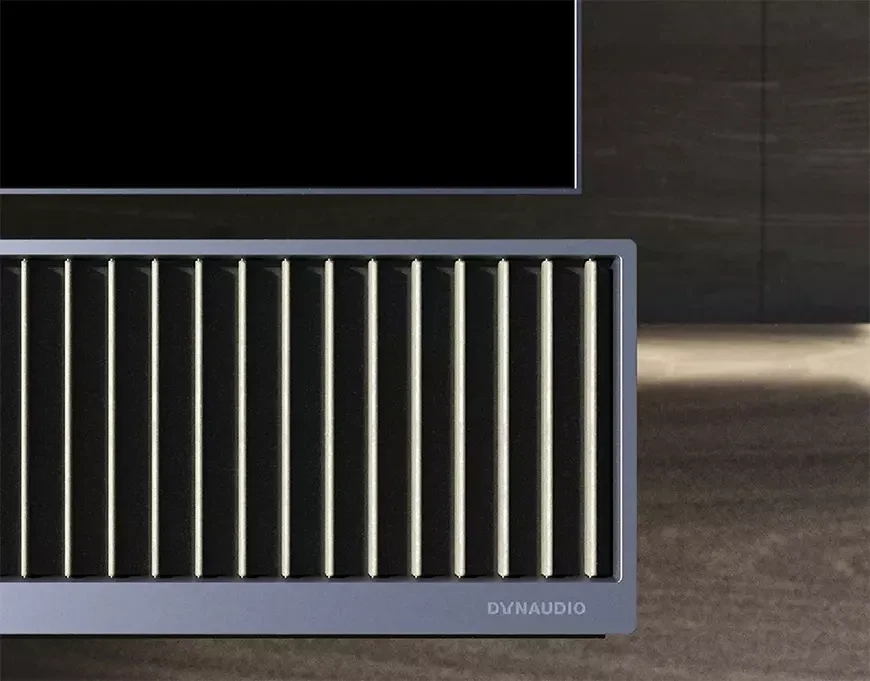
The cabinet is made from aluminium alloy and covered in acoustically transparent fabric with a Scandinavian-inspired finish. Aluminium is a useful enclosure material because it can be formed into a rigid, relatively slim structure; cabinet rigidity is significant in any loudspeaker because unwanted panel vibration can store and release energy after a drive unit has stopped. Dynaudio has not detailed the internal bracing, chamber arrangement or crossover implementation, so it would be premature to draw conclusions about the cabinet’s acoustic behaviour. Nevertheless, a substantial metal enclosure is consistent with the product’s premium, architectural role.
The scale also allows Dynaudio to fit an exceptionally dense driver complement. The company specifies six soft-dome tweeters, 14 midrange/woofer drivers and four dual-cone subwoofer drivers, for a total of 24. It says these are the same quality of components used in its high-end home loudspeakers, automotive systems and studio reference monitors.
That statement should not be read as meaning the Symphony Opus One is simply a collection of standalone hi-fi speakers in one box. The driver placement, DSP, amplification and intended beam control will be integral to how it operates. But the use of multiple dedicated units is meaningful. Rather than asking a small number of drivers to cover a very broad frequency range and play loudly at the same time, Dynaudio can allocate work between treble, mid/bass and low-frequency sections. In principle, that permits greater output capability and more deliberate control of the sound radiated into the room.
24 drivers and 1,500W: what the architecture is intended to achieve
The six soft-dome tweeters handle the upper frequencies, while the 14 midrange/woofer drivers are responsible for much of the vocal, effects and musical body of the presentation. Soft-dome tweeters have long been associated with Dynaudio’s loudspeaker designs. Their relevance in a soundbar is not simply tonal: high-frequency drivers are directional, and an array of them can be used with processing to influence where treble energy is directed.
At the low end, four dual-cone subwoofer drivers provide bass support within the main enclosure. Dynaudio has not supplied extension figures, maximum output data or details of the enclosure loading, so there is no basis for predicting how deep the onboard bass will reach in a particular room. Large-scale film soundtracks often benefit from a separate subwoofer because the deepest effects demand substantial air displacement and room placement flexibility. Dynaudio appears to recognise this, as it plans a wireless subwoofer for the Symphony Opus One system.
Its stated 1,500W of digital amplification is correspondingly substantial for an integrated soundbar. Power ratings alone do not reveal available peak current, distortion at high output, the bandwidth over which the figure applies, or how power is apportioned among channels. Those details are particularly relevant with 24 drivers. Yet the central practical advantage of active amplification remains clear: each driver group can be paired with amplification and DSP selected for its job, while electronic crossover filters can divide frequencies before the power-amplifier stage.
Compared with a passive loudspeaker connected to a conventional integrated amplifier, this active approach gives the manufacturer much tighter control over driver protection, equalisation and phase alignment. It also avoids the losses and component tolerances associated with a traditional high-level passive crossover. None of this guarantees a particular sonic outcome, but it is a sensible architecture for a product attempting to combine high output, multiple driver arrays and spatial processing in one enclosure.
Dynaudio says the amplification works with proprietary spatial-audio algorithms to produce a large soundstage and an immersive surround presentation. Spatial processing in a soundbar generally works by manipulating level, timing and frequency response between its driver groups, directing sound towards walls or using psychoacoustic cues that persuade the listener of sound arriving from positions beyond the cabinet. The result is inherently dependent on room geometry, furnishing and the listener’s location. A symmetrical room with reasonably clear side walls will usually offer more predictable opportunities for reflected-sound effects than a highly open-plan or asymmetrical space.
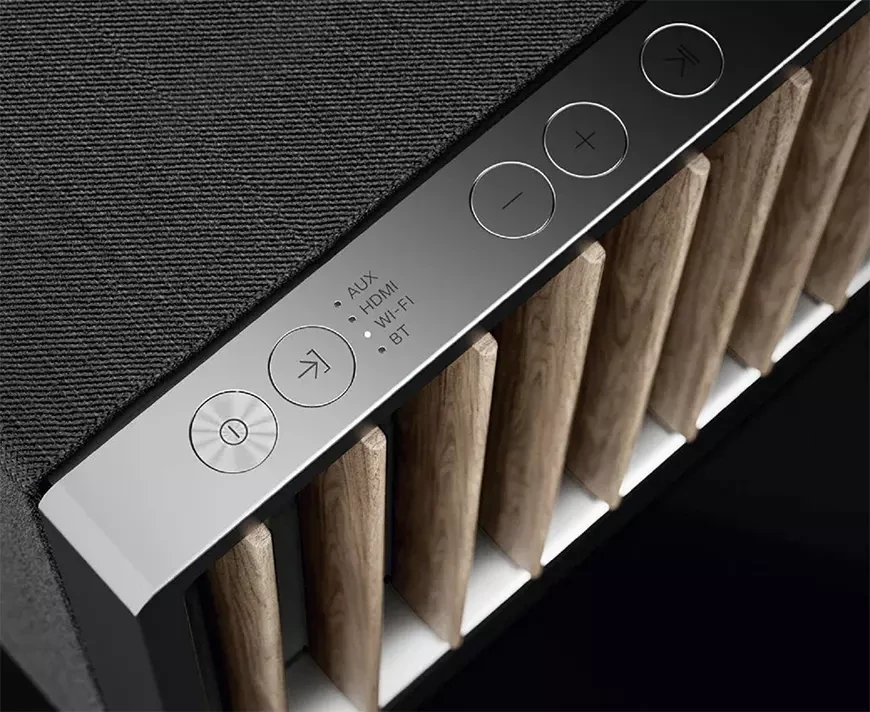
Motorised oak fins are part of the acoustic design
One of the Symphony Opus One’s most distinctive features is its set of 72 motorised white-oak fins. These are not presented purely as decorative grilles. Dynaudio says their position changes with the selected listening mode, altering the sound-beam pattern produced by the soundbar.
Physical beam-shaping is a notably different proposition from relying solely on DSP. At higher frequencies, where wavelengths become short enough for the dimensions of a grille or fin structure to matter, the profile in front of the drive units can affect dispersion and reflections. In principle, adjustable fins give Dynaudio an additional mechanical means of tailoring how sound leaves the cabinet. Combined with the multi-driver array and processing, that could allow the system to favour direct stereo presentation in one mode and broader or more deliberately directed radiation in another.
The fins therefore serve two roles: they make the Opus One look less like conventional AV hardware, while also supporting its mode-dependent acoustic strategy. Their moving action will be a major part of the ownership experience, and it introduces more mechanical complexity than a fixed fabric grille. Long-term reliability, service arrangements and whether their movement is audible in use are matters for a final production assessment rather than assumptions to make from the announcement.
Four modes for music, wide stereo and virtual immersion
Dynaudio specifies four listening modes, each reflecting a different compromise between directness, spaciousness and room-wide coverage.
Authentic mode
Authentic mode is intended to provide genuine stereo playback for hi-fi music listening. This is likely to be the most relevant setting for listeners who want recordings presented with minimal spatial enhancement. For a soundbar, “genuine stereo” should be understood in the context of its one-piece cabinet: the left and right sections are still much closer together than separate speakers positioned either side of a display. The 73-inch width should nevertheless offer a more credible stereo foundation than narrower all-in-one designs.
Soundstage mode
Soundstage mode is intended to broaden the stereo experience. Such processing can make TV programmes and music feel less tied to the physical location of the soundbar, though its success will depend on the content and room. It may suit casual music listening or programmes where a bigger sense of scale is desirable, while listeners focused on the most stable placement of voices and instruments may prefer the more direct Authentic setting.
Immersive mode
Immersive mode is designed for native Dolby Atmos, using sound-beaming technology to create a surround effect. Dolby Atmos content contains object-based positional information, but a single front-mounted soundbar must recreate much of the surround and height experience through processing and reflected sound rather than physically placing loudspeakers around and above the listener. It can be an elegant alternative where rear speakers and ceiling installation are impractical, but it should not be confused with a conventional speaker layout with dedicated surround and height channels.
DeepDive mode
DeepDive mode creates a virtual sound environment intended to maintain immersion from any seating position. This addresses one of the natural limitations of beamforming and virtual surround systems: the spatial effect can change as a listener moves away from a central seat. Dynaudio has not explained the processing behind DeepDive, but its stated goal suggests a mode prioritising broader listening-area coverage over a tightly focused sweet spot.
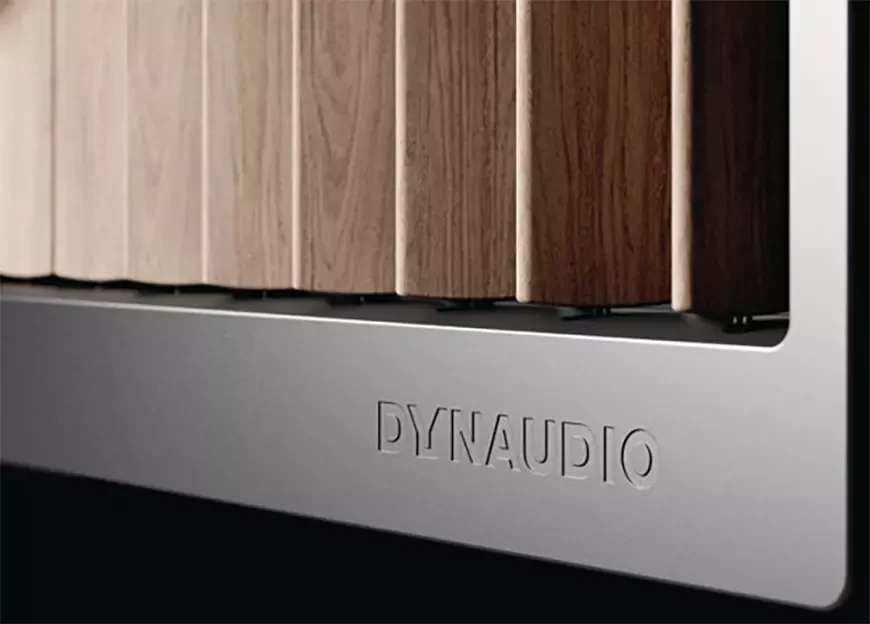
A luxury integrated system, with expansion planned
Dynaudio plans to offer wireless surround speakers and a wireless subwoofer to extend the Symphony Opus One. That is significant because it gives the soundbar a possible route beyond virtualisation. A separate subwoofer can be placed where the room gives the smoothest bass response rather than where the television dictates, while actual surround loudspeakers can provide more convincing rearward effects than front-only processing in rooms where they are feasible.
No further details have been given on the wireless connection, channel configuration, latency management, supported audio formats or whether these optional speakers will be required for particular playback modes. Those are important practical questions for prospective buyers. Likewise, the announcement does not state which digital and analogue inputs will be fitted, whether HDMI eARC is included, how source switching will work, or what streaming and control facilities will be available. For a $20,000 starting-price soundbar, those integration details will matter as much as the striking driver count.
Development is expected to continue through 2025, with final pricing varying according to selected high-end material finishes. The Symphony Opus One is therefore best viewed as a flagship statement of intent rather than a conventional off-the-shelf soundbar specification. Its appeal will be to owners building a large-screen, design-conscious system who want serious engineering contained in one visual object—and who may later choose to add the planned wireless bass and surround modules.
The core idea is compelling: a genuinely large active loudspeaker array, rather than a miniature speaker bar, with physical beam control as well as DSP. Whether that ambitious approach fulfils its promise will ultimately depend on the final connections, room calibration and expansion options, plus how consistently it delivers across music and film in real rooms. Those are the details to watch for as Dynaudio completes development.