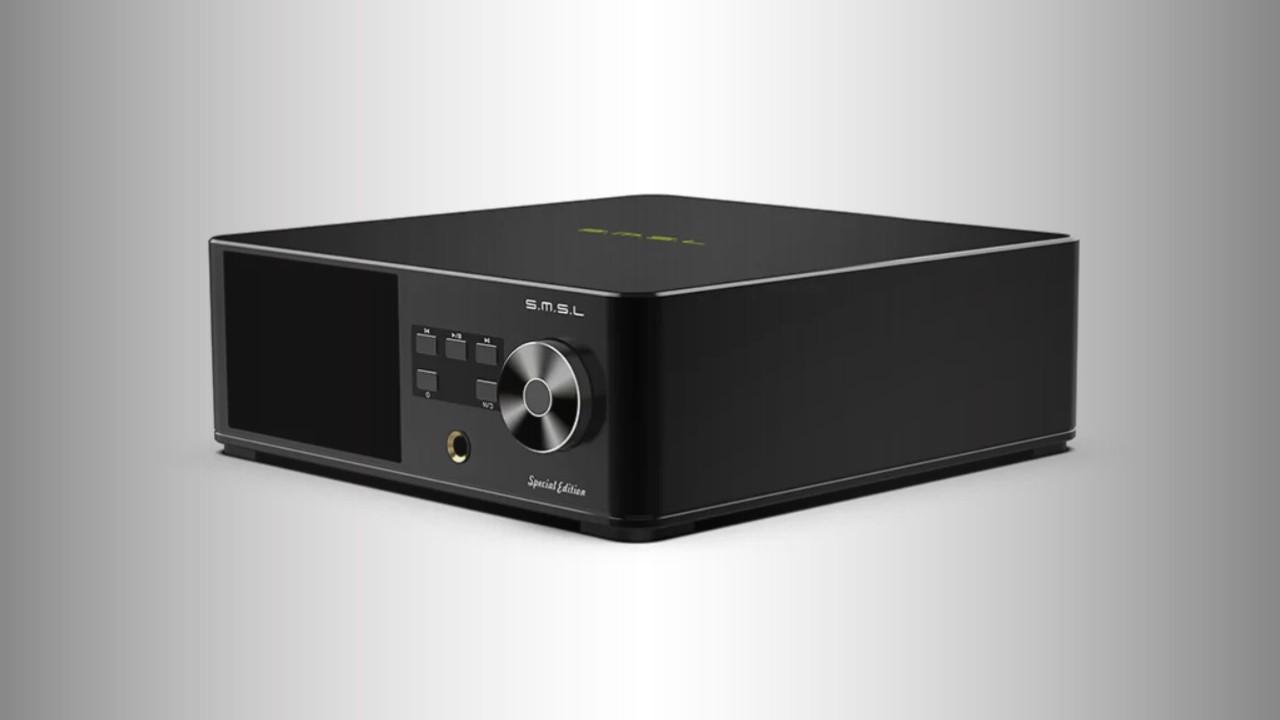
SMSL has announced the DP5SE, a compact network player intended to cover several of the jobs normally divided between separate digital components. The $379 unit combines a network music player, digital-to-analogue converter, preamplifier and headphone amplifier in a 228 x 210 x 71mm chassis, with both balanced XLR and unbalanced RCA analogue outputs for connection to an external amplifier or active speakers.
That combination makes the DP5SE potentially interesting as the digital control centre of a compact system. Rather than adding a streamer to an existing DAC and then placing a separate preamp between the source and power amplifier, the SMSL is designed to handle network and local-file playback, convert the signal to analogue and provide a variable-output route to amplification. Its digital outputs also mean it can be used as a network transport with a separate DAC.

A network player with local storage options
The DP5SE can play music from streaming services, network drives, external USB drives and memory cards. This is a broader brief than a streamer limited to an online service or a computer-connected USB DAC: it gives owners several ways to keep a local music library available without necessarily leaving a computer running.
Network-drive playback is particularly useful for listeners with a NAS (network-attached storage) holding ripped CDs or downloaded hi-res files. In that arrangement, the player accesses music over the home network, while the library remains centrally stored and can be available to other compatible devices. USB storage and memory-card support offer a more self-contained alternative, potentially suited to a small library or temporary playback without a network library.
SMSL says the DP5SE includes both wireless and physical interfaces for network integration, although the supplied information does not identify the specific network standards, streaming platforms, control app or wireless protocol. Those details matter in practice. A streamer’s long-term appeal is influenced not only by its format support but also by the quality of its browsing interface, its reliability on a home network and whether it supports a listener’s preferred service or ecosystem. Prospective buyers using Roon, UPnP, AirPlay, Spotify Connect, Tidal Connect or a particular control app should therefore confirm compatibility before ordering.
ES9039Q2M DAC and high-resolution file support
Digital-to-analogue conversion in the DP5SE is based on ESS Sabre ES9039Q2M DAC chips. The ES9039Q2M is a modern DAC device intended for compact audio electronics, and SMSL highlights its signal-to-noise-ratio capability. In a finished product, however, the DAC chip is only one part of the result: power-supply design, clock implementation, output-stage circuitry and the care taken with layout all contribute to noise, distortion and overall performance. The information supplied does not specify those surrounding design choices, so the chip designation should be viewed as a useful indication of the DP5SE’s digital platform rather than a complete description of its performance.
The player supports PCM material up to 32-bit/384kHz and DSD up to DSD256. PCM is the format used by CD and by the great majority of downloaded and streamed music, while DSD is used by a smaller catalogue of specialist releases and SACD-derived files. A 384kHz PCM ceiling accommodates common high-resolution PCM files, and DSD256 support gives the DP5SE headroom for listeners who have built a library in that format.
MQA is also fully supported according to SMSL. MQA is an encoded format associated with selected releases and services, and full decoding support can be relevant to owners of compatible files or streams. Its importance will depend on the services and catalogue a listener actually uses, rather than on the specification alone.

Analogue outputs for an integrated system, digital outputs for future upgrades
At the analogue end, the DP5SE provides both RCA and XLR outputs for connection to power amplifiers. RCA is the standard unbalanced connection found on most integrated amplifiers, preamplifiers and active loudspeakers. XLR provides a balanced connection option where the partnering equipment supports it. Balanced connections can be useful in installations with long cable runs or electrically noisy environments because they are designed to reject noise picked up equally by both conductors, but they are not automatically superior in every short domestic installation. The most sensible choice is generally the connection type that matches the amplifier’s best-supported input.
Because SMSL describes the DP5SE as a preamplifier as well as a DAC, it is positioned to feed a power amplifier directly. This can simplify a digital-only system, but owners should establish how volume is controlled in their intended setup and ensure that the amplifier and loudspeakers are compatible with a direct preamp connection. Listeners who also use a turntable, analogue tuner or other analogue source will still need an appropriate phono stage and/or a conventional preamp or integrated amplifier, since no analogue input provision is listed in the supplied specifications.
The digital output complement is unusually flexible on paper. Coaxial and optical S/PDIF outputs are joined by AES/EBU and I2S connections, allowing the DP5SE to pass a digital signal to an external DAC. This gives the unit a second role: it can serve as a streaming and file-playback transport if an owner later wishes to use a different converter.
Each connection has a different practical place. Optical can provide useful galvanic isolation between components, as it uses light rather than an electrical conductor, though supported sample rates can vary by implementation. Coaxial S/PDIF is widely used and robust over sensible cable lengths. AES/EBU is a balanced digital interface more commonly found on higher-end and professional-derived equipment. I2S can carry clock and audio data separately, but connector wiring is not universal between manufacturers; compatibility should be checked carefully before treating it as an upgrade route.
Headphone output: check the match, not just the headline figure
The DP5SE also includes a headphone amplifier rated at a maximum of 89mW into 32 ohms. This establishes that it can act as a personal listening station without another box on the desk or rack, but the figure needs to be considered alongside the headphones being used.
Headphone sensitivity and impedance determine how much voltage and current are needed for a given listening level. Some efficient in-ear monitors and portable-style headphones require very little power, while certain full-size headphones can be substantially more demanding. A single power figure into 32 ohms does not reveal performance into higher-impedance headphones, nor does it by itself indicate noise performance with highly sensitive earphones. Buyers planning to use challenging full-size models should check SMSL’s fuller headphone-output specifications and, ideally, compare them with the manufacturer’s requirements for their headphones.

What the DP5SE is for
At $379, the DP5SE’s appeal is its consolidation of a network player, local-library player, DAC and preamp into one relatively small component. It could make particular sense in a digital-first desktop or living-room system built around a power amplifier and passive speakers, or active speakers with appropriate analogue inputs. The dual analogue outputs offer integration flexibility, while the range of digital outputs leaves open the option of using an external DAC later.
The trade-off with a multi-function component is that its suitability depends on details beyond the headline specification. The supplied announcement does not state the streaming platform, supported services, app, input list, volume-control implementation, headphone socket type or the precise wired and wireless network connections. Those are all worth confirming for a system where ease of use and source compatibility are as important as hi-res format support.
The SMSL DP5SE Network Player is available to order online for $379.