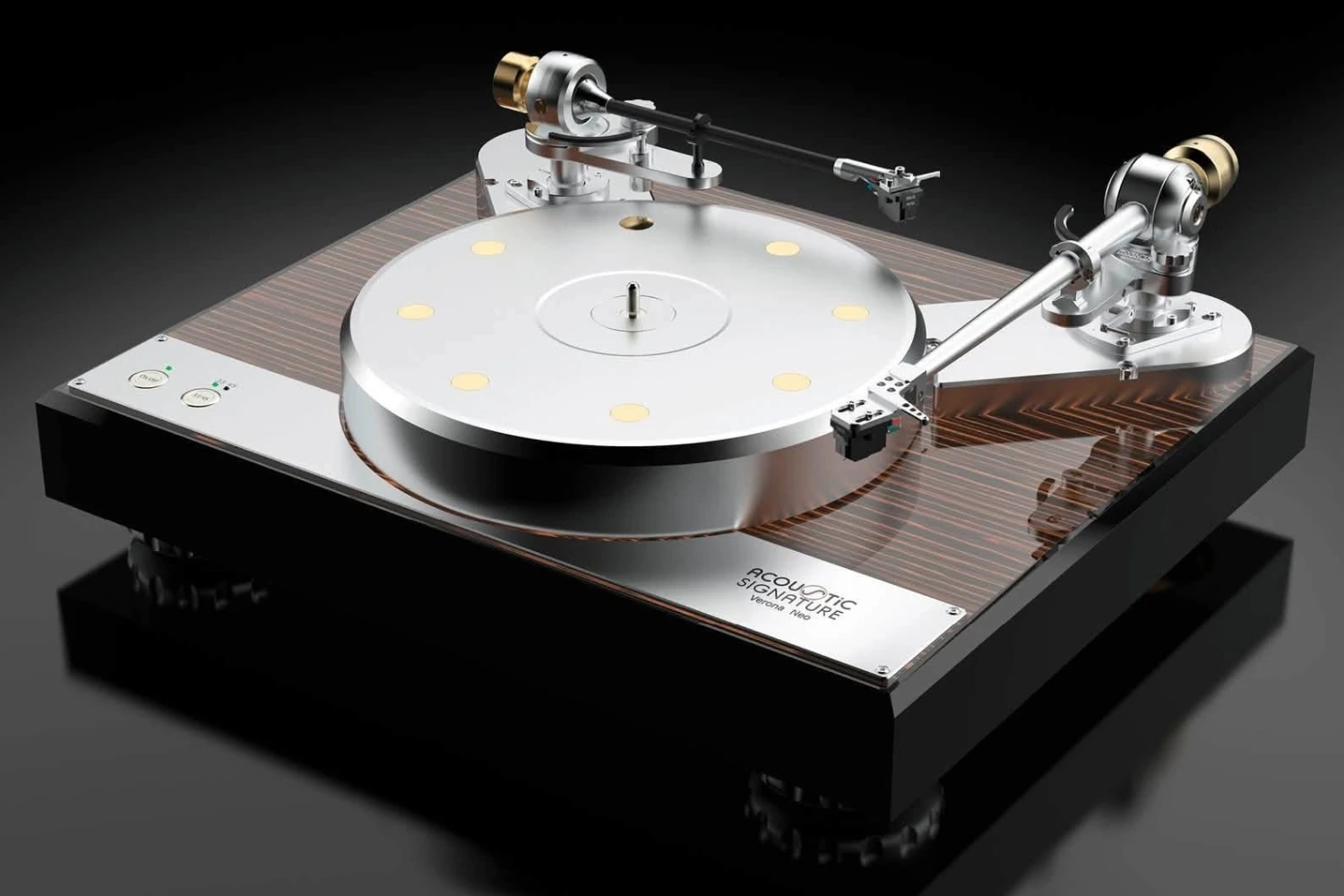
Acoustic Signature has announced the Verona Neo, a high-end turntable that applies the German manufacturer’s current Neo-series engineering to a more traditionally styled chassis. Its central proposition is not simply vintage-inspired appearance: the Verona Neo is designed as a configurable analogue platform, with provision for as many as two tonearms between 9 and 12 inches.
That capability gives the deck a distinctly different role from a conventional single-arm turntable. Rather than requiring an owner to remove, realign and recalibrate a cartridge whenever they want to change presentation or play different record types, a two-arm arrangement can keep separate pickup systems ready for use. One arm might be set up with a moving-magnet cartridge and another with a moving-coil design, for example, though the exact arm boards, arm combinations and cartridge arrangements available for the Verona Neo will depend on the chosen version and dealer configuration.
The Verona Neo also combines a two-motor drive system, Acoustic Signature’s patented DTD bearing, an external DMC-20 motor controller with AVC Level 3 technology, CLD construction and a 50mm platter containing eight integrated dampers. These are all mechanical areas that matter in a record player: accurate speed is only part of the task; the deck must also manage vibration, resonance and the extremely small signal being read by the cartridge.
A classic-looking deck with a system-building purpose
Traditional turntable styling can sometimes suggest a simple, self-contained record player. The Verona Neo instead appears intended for the enthusiast building an analogue front end around carefully selected components. Its support for two tonearms is the clearest indication. Cartridge choice has a substantial effect on an LP playback system, but changing a cartridge is not a casual operation. It involves mounting hardware, setting alignment geometry, tracking force, anti-skate and arm height where available; changing between cartridge types can also call for different phono-stage gain and loading.
A second installed arm makes it possible to preserve two optimised setups rather than repeatedly disturb one. In practical terms, this may appeal to collectors who play both stereo and mono records, listeners who own cartridges with different stylus profiles, or those who want the option of contrasting moving-magnet and moving-coil cartridges. It could equally suit an owner who wants to keep a more robust cartridge available for less-than-perfect records. Those are general benefits of a multi-arm deck, not confirmed supplied configurations for the Verona Neo, but they explain why the format remains valuable at the specialist end of analogue playback.
The stated 9- to 12-inch tonearm compatibility is similarly important. Tonearm length is not merely an aesthetic choice. A longer arm can reduce tracking-angle error across the record surface because the cartridge follows a shallower arc, although it also demands more physical space and careful installation. The ideal choice depends on the arm itself, its mounting geometry and the cartridge’s compliance characteristics. The Verona Neo’s range gives a prospective buyer scope to choose from common 9-inch designs as well as longer 10- or 12-inch arms, subject to the arm-board and mounting options offered.

Two motors, external control and the importance of speed stability
Acoustic Signature specifies a two-motor drive system for the Verona Neo. The company has not supplied details here on the belt arrangement, motor type or speed-change method, so it would be premature to infer the exact implementation. What can be said is that drive-system engineering is fundamental to a belt-driven turntable’s behaviour. The motor must rotate the platter at a consistent average speed while avoiding the transmission of vibration into the record-playing structure.
Using two motors is one approach to distributing the task of driving the platter and managing belt tension. Whether it delivers a practical advantage in a particular installation depends on the complete execution: motor control, belt path, platter inertia, bearing behaviour and chassis damping all interact. It is therefore more useful to view the Verona Neo’s dual-motor arrangement as part of a wider mechanical system than as an isolated feature.
Motor operation is handled by Acoustic Signature’s external DMC-20 motor controller, which incorporates the brand’s AVC Level 3 technology. Separating the controller from the main deck is a familiar high-end turntable strategy. It can keep the electronics responsible for motor operation physically outside the plinth, potentially reducing the opportunity for electrical or mechanical interference to reach the cartridge area. The supplied information does not define precisely what AVC Level 3 does, so no more specific claim should be made for this Verona Neo implementation.
For the owner, an external controller also makes the drive electronics a distinct part of the installation. It will need shelf or equipment-rack space, and its cable routing deserves the same attention as a phono cable. Keeping low-level phono leads sensibly separated from power supplies and motor-control cabling is good analogue-system practice, particularly with low-output moving-coil cartridges, where the phono signal is exceptionally small before amplification.
DTD bearing, CLD chassis and a heavily damped platter
At the centre of the Verona Neo is Acoustic Signature’s patented DTD bearing, a technology used elsewhere in the company’s current family. The main bearing is among the most consequential parts of any turntable because it supports the platter while allowing it to rotate smoothly and consistently. Its behaviour influences platter stability, friction and the pathway through which vibration can enter or leave the rotating assembly. Long-term precision and quiet operation are also part of the engineering challenge.
Acoustic Signature has not provided bearing dimensions, materials, lubrication details or measured performance figures in the announcement. Still, the inclusion of the DTD bearing signals that the Verona Neo is drawing on an established element of the brand’s Neo platform rather than using a purely cosmetic retro design. Buyers comparing turntables at this level should still ask their retailer about bearing servicing requirements and the manufacturer’s recommended care routine, as these are useful ownership considerations for any substantial analogue deck.
The chassis uses the company’s CLD construction. In hi-fi engineering, constrained-layer damping generally refers to combining layers of materials so that vibrational energy is dissipated rather than allowed to persist as ringing. A turntable plinth has to address energy from several directions: airborne sound from the loudspeakers, structure-borne vibration through the support furniture and floor, and internally generated energy from the drive and bearing. The aim is not simply to make a deck heavy, but to control where mechanical energy goes and how quickly it decays.
That strategy continues in the Verona Neo’s 50mm-thick platter, which contains eight integrated dampers. A large, damped platter can contribute rotational inertia and help suppress resonant behaviour, although its performance is inseparable from the bearing and drive system beneath it. The eight dampers are intended to reduce unwanted resonance and support smooth, controlled rotation. The announcement does not provide the platter’s mass or identify the damper material, so those figures should not be assumed.

What the dual-arm layout means for setup
A multi-arm turntable rewards deliberate setup. Each arm and cartridge combination must be aligned independently, and both must be mounted with sufficient clearance to operate without fouling the other arm, its cueing mechanism or cabling. The turntable itself must also be placed on a rigid, level support. This is especially relevant with a substantial platter: levelling is necessary for correct bearing loading and for reliable arm operation, while a stable support helps prevent footfall and speaker-induced vibration from becoming audible through the cartridge.
The phono stage is another key part of the equation. Two cartridges may require different gain, loading and capacitance settings, particularly if they are of different generator types. An owner planning to exploit the Verona Neo’s two-arm capacity should consider how switching will be handled. That could mean a phono preamplifier with multiple configurable inputs, separate phono stages, or a carefully chosen external switcher designed for very low-level signals. The Verona Neo announcement does not specify a built-in phono stage or switching arrangement, so purchasers should expect to provide the appropriate downstream electronics.
There is also a trade-off. A turntable capable of taking two arms is more flexible, but it is not a plug-and-play route to vinyl. It invites the owner to make informed choices about arms, cartridges, phono amplification and support furniture. For listeners who want one cartridge and uncomplicated operation, a simpler single-arm deck may be the more proportionate solution. For someone who regards cartridge selection as an important part of listening, however, the ability to leave two systems installed and properly adjusted can be highly worthwhile.
Versions, availability and who the Verona Neo is for
Acoustic Signature says the Verona Neo will be offered in several versions, allowing buyers a degree of choice in appearance and configuration. The information currently supplied does not set out the individual versions, regional availability, detailed finish list or pricing, and no US dollar price has been announced. Those details will be important because arm boards, tonearms, cartridges and phono amplification can significantly affect the total cost of a two-arm analogue system.
On the available information, the Verona Neo is positioned less as a minimalist record player than as a long-term platform for serious vinyl use. Its classic design language should appeal to listeners who prefer the visual permanence of a traditional turntable, while its two-motor drive, external DMC-20 control, DTD bearing, CLD construction and damped 50mm platter place the focus firmly on mechanical execution.
The most compelling aspect is the combination of that engineering with support for two 9- to 12-inch tonearms. It gives the Verona Neo a clear purpose: accommodating the listener who wants an analogue source capable of evolving with changing cartridge preferences, rather than locking the system into a single arm-and-cartridge choice. Final judgement will depend on the available configurations, pricing and the quality of installation, but the design makes a credible case for flexibility as a central high-end turntable feature.