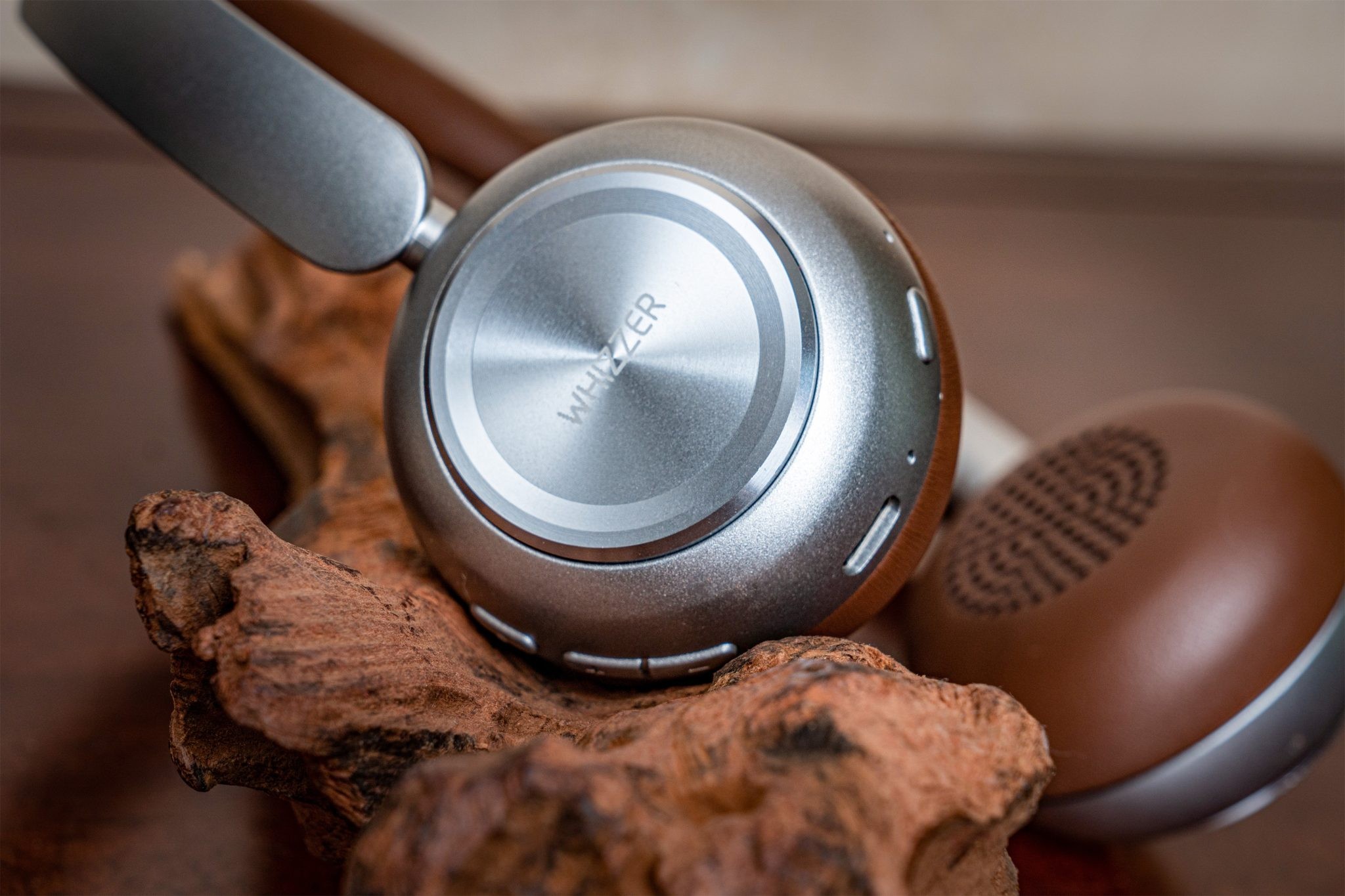
The Whizzer 1969S take an increasingly unusual route in wireless headphones: rather than pursuing maximum features, active noise cancellation or a large over-ear form factor, they prioritise low weight, battery endurance and acoustic containment. These are wireless on-ear headphones, not studio monitors or travel-focused ANC cans, and their headline figures are striking for that category: a 135g weight, more than 75 hours of claimed playback and a five-minute charge said to provide up to three hours of listening.
That combination gives the 1969S a clear everyday role. They are aimed at listeners who want headphones that can be worn for long stretches at work, around the home or on a commute without needing to make charging a daily ritual. Whizzer also specifies Bluetooth 6.0, a 40mm dynamic driver with a 0.8mm long-stroke diaphragm, and a construction intended to reduce the amount of music escaping into the surrounding space.
There is no price, codec support, wired connection option, microphone specification, app support or active noise-cancellation specification in the information supplied. Those details will matter to buyers comparing the 1969S with more fully featured wireless alternatives. But the published design brief makes sense: minimise physical and charging fatigue first, then address two common compromises of light on-ear headphones—bass control and sound leakage.
A lightweight on-ear alternative to bulky wireless headphones
At 135g, the Whizzer 1969S are substantially lighter in principle than many full-size wireless headphones. Weight is not the only determinant of comfort—headband geometry, pad material, clamping force and the wearer’s head shape are all consequential—but reducing mass can make a meaningful difference over a full working day. Less mass also means less tendency for the headphones to shift when walking or looking down, provided the headband tension is appropriately judged.
The trade-off is inherent to the on-ear format. Rather than surrounding the ear, the pads rest against it. This can keep the headphones compact and avoid the warm, enclosed feeling some listeners experience with over-ear models, but it also makes pad pressure especially important. Whizzer says the 1969S use soft, low-rigidity composite earpads and have been designed to maintain low clamping pressure. In practical terms, that is intended to reduce pressure points where the pads meet the outer ear—often the limiting factor in long on-ear sessions.
Comfort remains highly personal, particularly with on-ear designs. The 135g figure is promising, but it does not establish how the model will fit every listener. Prospective owners should regard the claimed low-pressure approach as a useful design indication rather than a substitute for trying the fit where possible.

Battery life designed to make charging less of a routine
Whizzer quotes battery life of more than 75 hours from a charge. That is the defining convenience specification here. Even allowing for the fact that real battery endurance varies with volume level, connection conditions, content and battery age, a claim at this level potentially moves charging from a daily or weekly concern to something far less frequent. It is particularly useful for listeners who move between laptop, phone and tablet use and do not want another device competing for a USB charging cable.
The company also claims that five minutes of fast charging can provide up to three hours of playback. Fast-charge figures are most valuable not as a replacement for normal charging but as an escape route from a flat battery just before leaving home. Three hours should cover many commutes, a film or a sizeable work session, although—as with the overall battery claim—the result will depend on listening level and operating conditions.
Long battery life has a secondary practical benefit: it permits owners to be more selective about charging. Lithium-based rechargeable batteries are consumable components, so avoiding a need to repeatedly run a device empty and immediately recharge it may be welcome over the longer term. Whizzer has not supplied battery capacity, charge-port information or replacement-battery details, however, so those aspects of ownership cannot yet be assessed.
40mm dynamic driver and the challenge of on-ear bass
The 1969S use a 40mm dynamic driver. Dynamic drivers are the conventional moving-coil arrangement used in most headphones: a voice coil moves a diaphragm to generate sound. The diameter alone does not determine sound quality, but 40mm is a familiar size for portable headphones because it offers useful radiating area without requiring an oversized earcup.
Whizzer specifies a 0.8mm long-stroke diaphragm with a thin metalised membrane. A longer available excursion can be relevant to low-frequency reproduction, where a driver needs to move sufficient air to reproduce bass at audible levels. In a small, light on-ear enclosure, that is only one part of the equation. Pad seal, cup volume, venting and DSP or amplifier tuning can have just as much influence on the perceived weight and consistency of bass. Still, the long-stroke design shows that Whizzer has considered the mechanical demands placed on a compact driver rather than treating the transducer as a generic component.
The metalised diaphragm description points to a membrane with a very thin metallic layer. In general loudspeaker and headphone engineering, diaphragm material is chosen to balance low mass, stiffness and damping. A lighter diaphragm can respond rapidly to changes in the signal, while stiffness helps prevent unwanted flexing within the audible band. The actual acoustic outcome depends on the complete driver assembly and tuning, so the specification cannot predict a particular tonal balance or level of detail. No independent measurements or listening impressions have been provided, and it would be premature to claim a sound signature.
Leakage control matters in an on-ear headphone
Whizzer’s more distinctive acoustic claim is its dipole-based leakage-control system. The company quotes less than 2% pressure leakage and refers to a 91-hole matrix in the soft composite earpads. Sound leakage is a genuine concern with portable headphones: at higher levels, a conventional on-ear design can be audible to nearby colleagues or fellow passengers, while poor sealing can also diminish bass at the listener’s ear.
Headphone cups and pads must manage pressure on both sides of the driver. Vents are often used to tune the driver’s low-frequency behaviour and prevent uncomfortable pressure build-up, but uncontrolled openings can also allow more sound to radiate outward. Whizzer’s language suggests it is using the cup and pad structure to manage that outward radiation rather than merely attempting to create the tightest possible seal. The published sub-2% pressure-leakage figure is a manufacturer specification, and no test method or frequency range accompanies it, so it should not be treated as directly comparable with another brand’s leakage measurement.
What can be said is that the priority is sensible. Passive isolation and leakage control serve different but related purposes: isolation reduces the intrusion of external sound, while leakage control limits what others hear from the headphones. The 1969S make no claim of active noise cancellation, so prospective buyers who frequently travel by air or use loud trains should not assume they will provide the same reduction of low-frequency engine noise as an ANC design. Their stated approach is better understood as considerate, low-spill everyday listening.

Bluetooth 6.0 and Whizzer’s latency claim
Wireless operation is based on Bluetooth 6.0. Bluetooth generation alone does not reveal which audio codecs are available, how the headphones handle multipoint pairing, or whether they support low-latency modes; Whizzer has not published those details in the supplied specification. Codec support remains important for anyone choosing headphones primarily for a particular phone, computer or streaming service, because the source device and headphone need a codec in common.
Whizzer also names MultiAcceler 2.7 processing, which it says operates in parallel to reduce latency to from 1/20 of a second—approximately 50 milliseconds. Latency is the delay between a device sending audio and the listener hearing it. It is most noticeable with video dialogue, mobile games and musical instrument apps; with music playback alone, it is usually irrelevant. Around 50ms is a useful target for casual video and gaming use, but it should be read as a stated starting figure rather than a guarantee for every phone, application and connection environment.
Connection stability and power efficiency are also cited as benefits of Bluetooth 6.0. Both are worthwhile priorities in a portable headphone, especially one positioned around long duration, but actual performance will also depend on the transmitting device, local radio congestion and how the implementation behaves in busy urban environments. There is no indication in the supplied material of a wired analogue fallback. Users who need a guaranteed zero-latency connection for gaming, production or in-flight entertainment should confirm that point before buying.
Who the Whizzer 1969S are for
The Whizzer 1969S look most compelling for listeners who place comfort and charging freedom above a long feature list. The low 135g weight, 75+ hour battery claim and rapid top-up capability address everyday frustrations more directly than many specifications-led launches. Their on-ear form, low-rigidity pads and stated leakage-control work also suggest an effort to make them suitable for shared spaces such as offices, libraries and homes.
The apparent compromise is equally clear. The supplied information does not indicate active noise cancellation, a companion app, codec choices, physical controls, call quality, multipoint operation or wired use. None should be assumed. Listeners who want deep isolation for flights, detailed EQ adjustment, a desktop-ready USB audio mode or comprehensive call features should wait for fuller specifications and compare accordingly.
For the intended brief, though, Whizzer has selected relevant engineering priorities. A long-stroke 40mm driver is intended to support a compact on-ear acoustic system; the pad and enclosure design attempts to address seal and sound spill; and the unusually ambitious battery claim should make the headphones simple to live with. The 1969S are not presented as a universal wireless solution. They are a light, endurance-led option for listeners who want to put on a pair of headphones in the morning and spend much less time thinking about them.

Whizzer 1969S specifications
- Design: Wireless on-ear
- Driver: 40mm dynamic driver; 0.8mm long-stroke, metalised diaphragm
- Acoustics: Dipole leakage control; <2% pressure leakage
- Passive isolation: Soft composite earpads; 91-hole matrix
- Bluetooth: Version 6.0
- Latency: From 1/20 second (MultiAcceler 2.7)
- Battery life: 75+ hours
- Fast charge: Five minutes for up to three hours of playback
- Weight: 135g