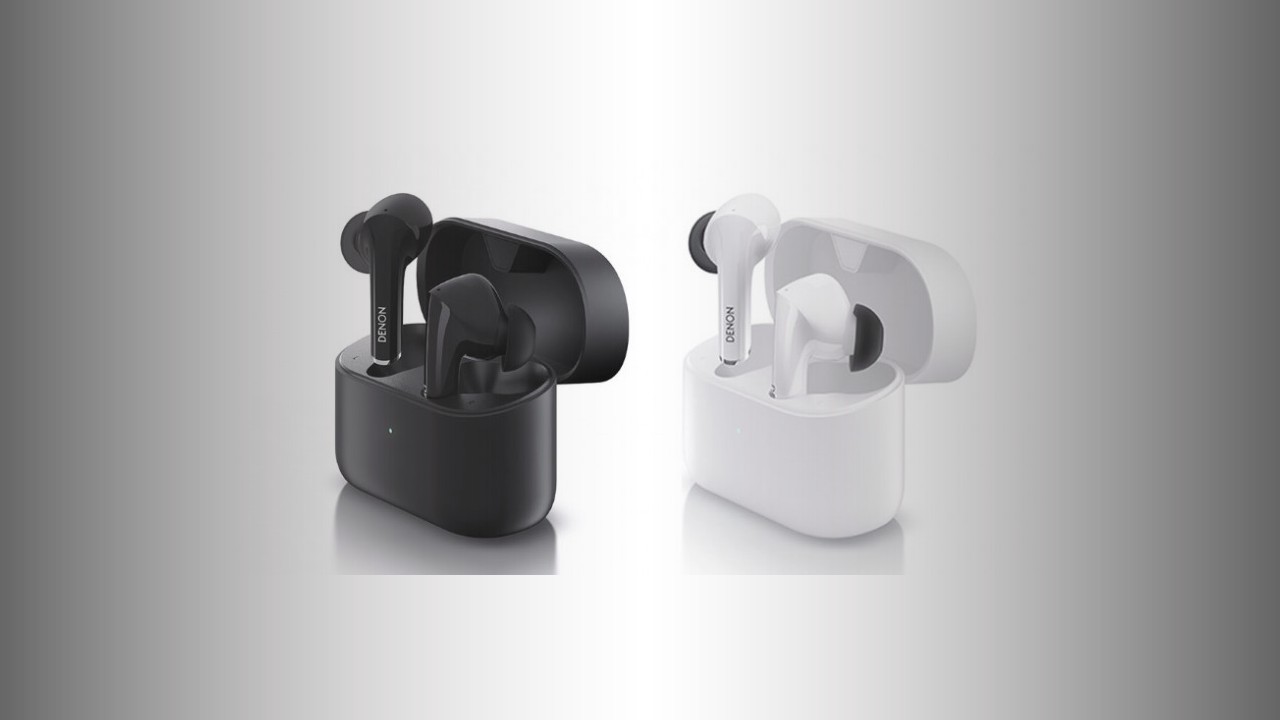
Denon’s AH-C830NCW are true wireless earbuds aimed squarely at the everyday situations in which compact headphones are most useful: travel, work, exercise and relaxed listening at home. Their headline features are active noise cancellation (ANC), a touch-accessible transparency mode, a multi-microphone system intended to improve voice calls, Google Fast Pair and a quoted battery life of up to six hours from the earbuds themselves, rising to up to 24 hours when the charging case is included.
That is a sensible feature combination for listeners who want one pair of pocketable earbuds to cover music and entertainment, but who also spend time taking calls in noisy places. The AH-C830NCW do not simply present ANC as an isolated specification: Denon has built its noise-control and call systems around multiple microphones, with separate roles for listening to the surrounding environment and transmitting speech. As ever, the quality of the final experience will depend on fit, the surrounding noise and the processing implementation, but the design gives a clearer indication of the intended use than a simple “noise cancelling” label.

Compact true wireless earbuds with active noise control
The AH-C830NCW are a pair of true wireless earbuds, meaning each earpiece operates without a cable to the other and communicates wirelessly with a phone, tablet or other Bluetooth source. This format has obvious practical benefits over wired in-ear headphones for commuting and training: there is no cable to catch on clothing, and the case serves as both storage and a portable battery reserve.
Denon specifies its next-generation ANC system with two microphones in each earbud. In broad terms, ANC works by using microphones to monitor unwanted external sound and applying digital signal processing to create an opposing signal at the ear. It is usually most effective against the sustained low-frequency sounds associated with aircraft cabins, rail travel, road traffic and air-conditioning. Sudden high-frequency noises and voices are harder to remove completely, while the physical seal between an ear tip and the ear canal remains an important part of passive isolation.
The use of two microphones per side gives the system more information with which to distinguish the external acoustic environment from the sound reaching the listener. Denon says the system is designed to reduce or eliminate ambient noise. “Eliminate” should naturally be read as an aspiration rather than a promise that every sound will disappear; ANC performance is strongly influenced by the earbud seal and by the type of noise encountered. Nevertheless, the approach is relevant to the AH-C830NCW’s role as a travel and work earbud, where suppressing a steady background can make low-volume listening more viable and reduce fatigue on longer journeys.
Transparency mode is as important as ANC
Noise cancellation is only half of a useful modern in-ear design. The AH-C830NCW also offer a transparency mode, activated by pressing an earpiece, which uses the onboard microphones to pass external sound through to the listener. This is the mode that matters when waiting for a station announcement, speaking to a colleague, hearing a doorbell or maintaining awareness around traffic without removing an earbud.
For real-world ownership, having that control on the earbud is significant. It avoids the interruption of reaching for a phone, unlocking it and navigating an app merely to hear what is happening nearby. It also means the same microphones that provide noise reduction can be used to make a sealed in-ear design less socially isolating when the situation changes.
Listeners should still treat transparency as an aid rather than a replacement for natural hearing, particularly outdoors. Microphone pass-through involves electronic processing, and environmental awareness is never identical to having nothing in the ears. But the option makes the AH-C830NCW more flexible than an ANC-only design.

A three-microphone approach to calls
Denon has also focused on voice capture. The AH-C830NCW use beamforming with two microphones working alongside digital headphone signal processing to pick up and transmit speech more clearly. Beamforming is a technique that combines the output of multiple microphones to favour sound arriving from a desired direction — in this case, the wearer’s voice — while attempting to reduce sounds arriving from elsewhere.
A third microphone is said to use the ear canal’s natural shielding from wind or loud surroundings to help transmit speech clearly. Wind noise is one of the more persistent challenges for true wireless earbuds because moving air across an exposed microphone creates substantial low-frequency turbulence. The ear itself can provide a degree of physical shelter depending on microphone placement, while digital processing can further attempt to identify and suppress the unwanted component.
This does not guarantee perfect calls in every exposed location: gusty conditions, traffic and multiple nearby talkers are demanding for any small earbud microphone system. What it does show is that the AH-C830NCW have been conceived as communications devices as well as music headphones. That distinction matters for anyone moving frequently between calls and listening during a workday, rather than buying earbuds solely for private music playback.
Denon tuning and the information still to confirm
Denon says the AH-C830NCW use its “Denon Sound Master” tuning, intended to provide powerful, detailed sound for music, entertainment and calls. Tuning is particularly important in a true wireless earbud because the drivers, enclosure, ear tips, DSP and seal at the ear all work as a system. A good acoustic seal generally has a major effect on perceived bass weight and overall tonal balance; a poor seal can make even a carefully tuned earbud sound thin.
The supplied information does not identify the driver type or diameter, Bluetooth codec support, water-resistance rating, supported sample formats, equalisation controls or the exact Bluetooth version. Those are all worthwhile details to establish before purchase, especially for listeners with a particular phone ecosystem or those who intend to use the earbuds for regular training. Codec support can affect the connection options available from a source device, while an IP rating indicates a manufacturer-tested level of resistance to dust or water. Neither should be assumed from the AH-C830NCW’s compact design alone.
Similarly, no claim should be made yet about a particular sonic signature. “Powerful and detailed” is Denon’s stated tuning objective, not a substitute for an independent listening assessment. For buyers, the more useful takeaway is that these are not presented as basic call-first earbuds: Denon is explicitly positioning music reproduction as part of the brief.
Google Fast Pair and day-to-day connection
The AH-C830NCW support Google Fast Pair. This uses Bluetooth Low Energy to detect compatible nearby Bluetooth devices and streamline the initial pairing process. Denon also states that it enables quick switching between devices associated with the same account. For Android users who move between a phone and tablet, that can remove some of the friction traditionally associated with Bluetooth earbuds.
Fast Pair is a convenience feature, not a different wireless audio standard, and its usefulness depends on the compatibility of the source devices and the account ecosystem in use. Owners of other platforms should check the relevant connection behaviour for their own devices rather than assuming the same account-based conveniences. Conventional Bluetooth pairing remains the fundamental link between a true wireless earbud and its source.
As with any Bluetooth headphone, stable use also depends on the radio environment. Busy stations, offices and city centres contain numerous wireless devices, and the practical reliability of a connection is affected by both the earbuds and the transmitting phone or player. The principal benefit of the compact form, however, remains straightforward: the AH-C830NCW are designed to be ready whenever the case is in a pocket or bag.

Six hours per charge, 24 hours with the case
Denon quotes up to six hours of wireless music playback from a full charge of the earbuds, with up to 24 hours in total when the charging case is used. This indicates that the case provides a further 18 hours of stated listening time beyond the initial earbud charge.
The word “up to” is important. Battery figures are generally achieved under defined conditions, and actual runtime can vary with volume, noise-cancellation use, call time, wireless conditions and the type of material being played. ANC consumes power because the microphones and processing must remain active, while calls can be particularly demanding because the microphones are transmitting as well as receiving. Even so, the quoted total is designed to cover several sessions before the case itself needs recharging.
For many buyers, the split between single-charge and case-assisted stamina is more useful than one large total figure. Six hours is the relevant number for a long uninterrupted journey or work session; 24 hours is the figure that describes how long the complete package may last across a few days of shorter use. The charging case is therefore central to ownership, not merely an accessory.
Who the Denon AH-C830NCW suit
The Denon AH-C830NCW make the most sense for listeners seeking a compact, all-purpose true wireless solution with a clear focus on noise management and calls. Their ANC and transparency functions address opposite sides of the same problem: reducing intrusive background when concentration is needed, then restoring awareness without taking the earbuds out. The three-microphone voice arrangement adds a practical reason to consider them for work and travel, while Fast Pair will be particularly appealing within a compatible Google device setup.
Potential buyers should consider their priorities carefully. Those who need verified sport durability, a specific high-resolution Bluetooth codec, extensive app-based sound adjustment or detailed information about drivers and charging hardware will need to seek confirmation of those details. They are not included in the available specifications. Likewise, users considering true wireless earbuds primarily for home hi-fi listening may place greater weight on acoustic tuning, fit options and codec compatibility than on voice processing.
On the information available, though, Denon’s proposition is coherent: the AH-C830NCW combine compact wireless listening with active cancellation, a quick-access awareness mode and a microphone system designed to make calls more intelligible in less-than-ideal surroundings. For the commuter or hybrid worker who wants one unobtrusive pair for both music and communication, those are the features likely to matter most.