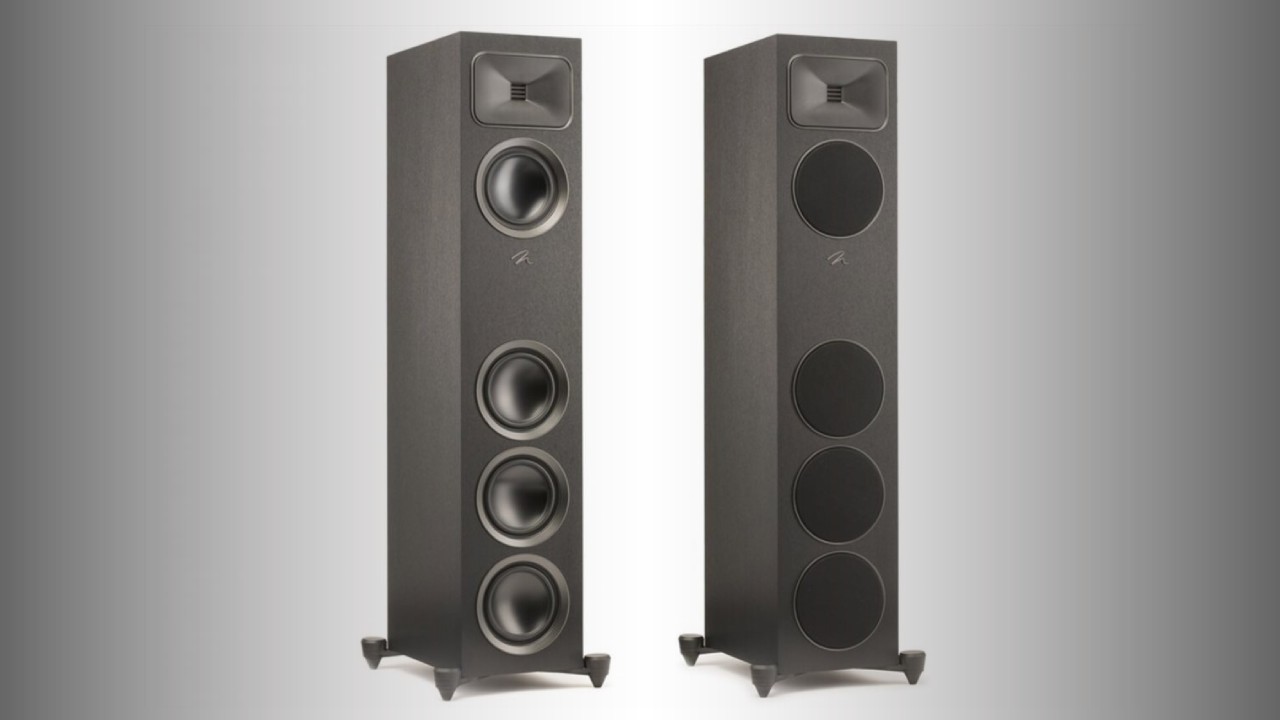
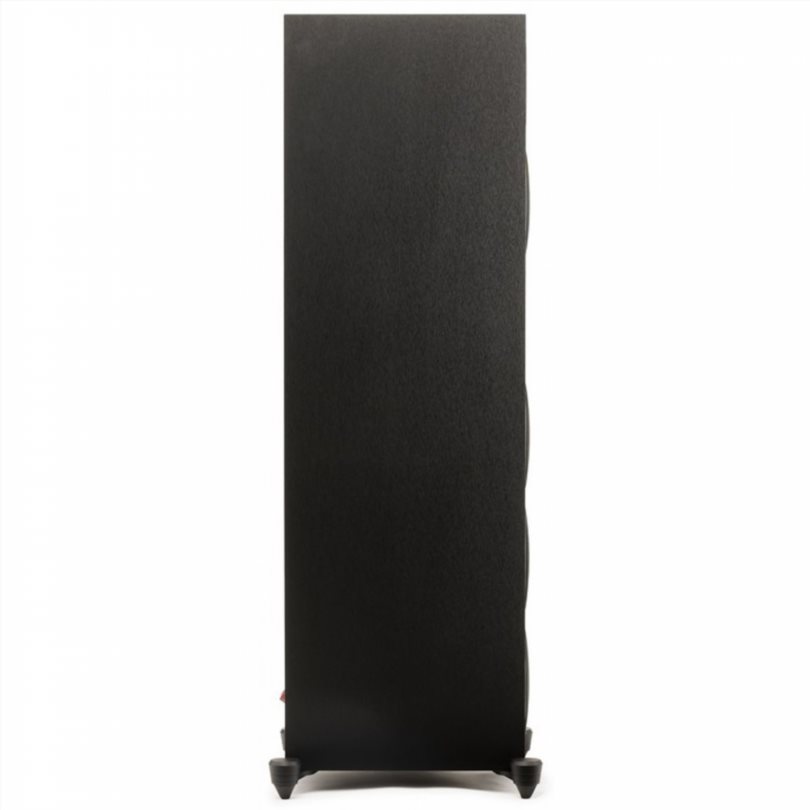
The MartinLogan Motion Foundation F1 is the smaller floorstanding model in the company’s Motion Foundation range, intended for listeners who want the scale and driver area of a tower speaker without moving to a particularly wide cabinet. At 21cm wide, 36.65cm deep and 105.2cm tall, it is a substantial loudspeaker rather than a desktop-friendly compact, but it occupies less visual and floor space than many larger multi-driver floorstanders.
Its key technical proposition is unusually ambitious for a space-conscious tower: a three-way layout employing MartinLogan’s Gen2 Obsidian Folded Motion tweeter alongside four 14cm (5.5-inch) aluminium-cone drivers. The published specification identifies one driver for mid-frequency duties and three for low-frequency duties, with crossover points at 240Hz and 3.7kHz. That division of labour is important. Rather than asking a single conventional mid/bass driver to cover a very broad portion of the spectrum, the F1 gives its dedicated midrange driver a more focused operating band while three other drivers share bass output.
A compact floorstander, not a compromised standmount alternative
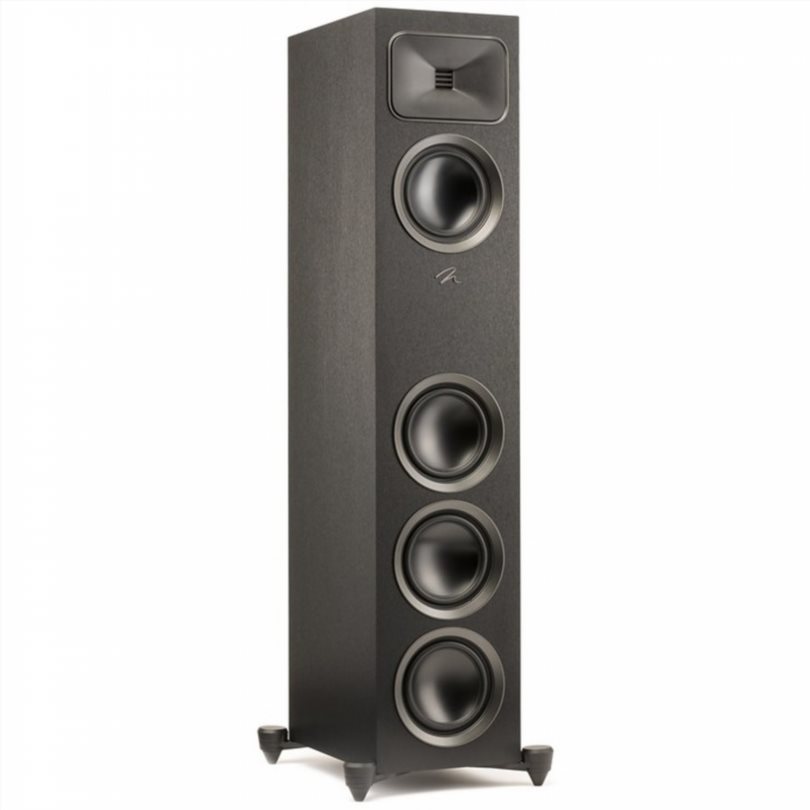
Floorstanding speakers are often chosen not simply because they are taller, but because their cabinets can accommodate more driver area and internal volume than a standmount. Those factors can be useful when a system needs greater low-frequency output and dynamic headroom without a separate subwoofer. The Motion Foundation F1’s quoted frequency response extends from 41Hz to 23kHz, so it is specified to reach meaningfully into bass territory, although the figure alone does not indicate the level at which that range is measured.
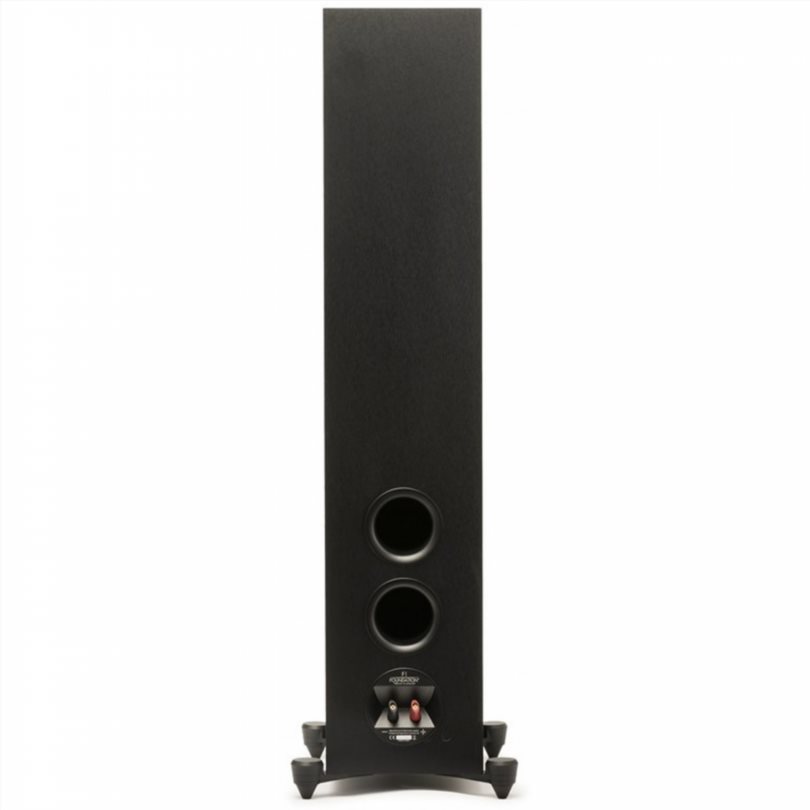
The F1 uses two rear-facing bass-reflex ports. A ported enclosure uses the air mass in each port to support the bass drivers over part of the low-frequency range, improving extension and output compared with a similarly sized sealed cabinet. The trade-off is that the ports interact with the wall behind the speaker. In a small room, placing the F1 very close to that wall may make the lower registers seem overemphasised or less even, while pulling the cabinets forward can reduce that boundary reinforcement. There is no universal distance that works in every room, so owners should use the manufacturer’s installation guidance and adjust placement while listening to familiar bass-rich recordings.
At 21.09kg per speaker, the F1 is also heavy enough that careful installation matters. A stable, level floor and secure footing are basic requirements for any tower speaker; they help prevent unwanted movement and make repeatable positioning easier. The 36.65cm cabinet depth should be included in room-planning calculations, particularly because a rear-ported speaker generally needs breathing space behind it rather than being treated as a flush-against-the-wall design.
Folded Motion tweeter and controlled dispersion
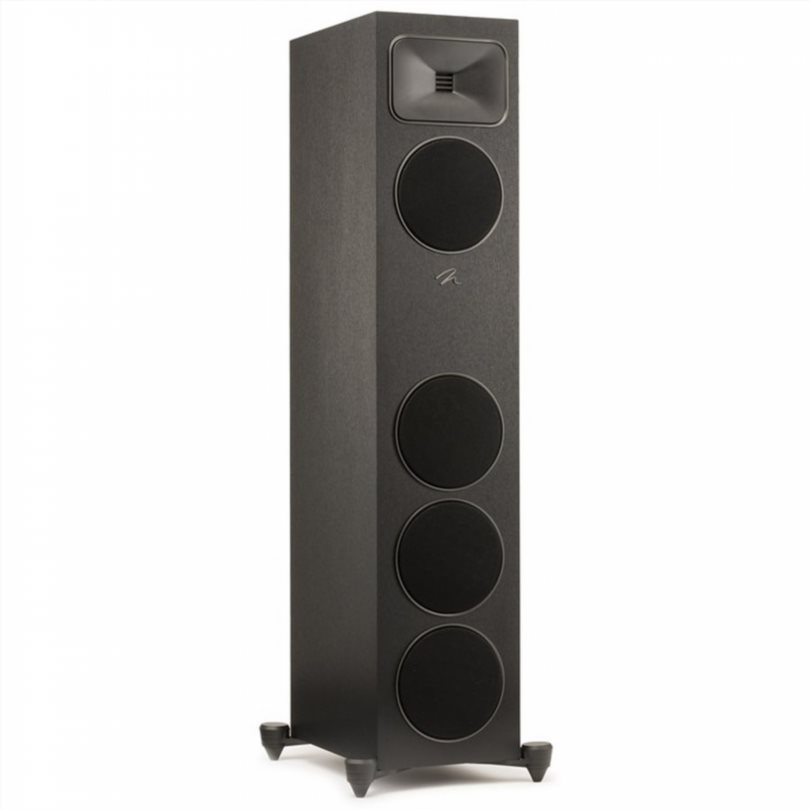
The visual and technical focal point of the Foundation F1 is MartinLogan’s S Gen2 Obsidian Folded Motion tweeter, specified here at 2.54 x 2.39cm. A Folded Motion design is not a conventional dome tweeter. It uses an ultra-thin diaphragm arranged in folds, so the folds move together to squeeze air in and out. This allows a relatively compact driver assembly to present a larger effective radiating area than its frontal dimensions might suggest.
The engineering rationale is that a large radiating area can move the required air with very small diaphragm excursions. Low moving mass and short travel are useful traits at high frequencies, where the driver must start and stop extremely quickly. MartinLogan’s stated aim is high-resolution treble reproduction with low distortion and strong transient response. That should not be read as a substitute for an audition—the final balance will depend on the room, amplifier and recordings—but it explains why this tweeter architecture is central to the F1’s identity.
The tweeter is partnered with a Folded Motion waveguide, specified to provide 90-degree vertical by 90-degree horizontal dispersion. A waveguide is the shaped structure surrounding a tweeter that influences how its output spreads into the room. Dispersion control is not just an on-paper feature: the direct sound arriving from the loudspeakers mixes with reflections from side walls, ceiling, floor and furnishings. A well-controlled radiation pattern can make the speaker’s in-room behaviour more predictable and can help preserve tonal consistency across the listening area.
MartinLogan describes the waveguide as helping to control reflections while covering the listening area with detail. The useful practical interpretation is that toe-in and listening height deserve attention. The 90-degree figures do not tell us precisely how the F1 will behave in an individual room, but they do indicate that the speaker has been designed with directivity in mind rather than relying on a bare tweeter to radiate as widely as possible. Start with the speakers symmetrically positioned and aimed broadly towards the listening seat, then experiment with small changes in toe-in. This can alter the balance between direct treble energy and room reflections, as well as centre-image focus.
Why the three-way aluminium-driver array matters
Beneath the Folded Motion unit, the F1 employs four 14cm aluminium-cone drivers in die-cast aluminium frames. MartinLogan specifies one as the mid-frequency driver and three as low-frequency drivers. Aluminium is a stiff diaphragm material, a property that can help a cone retain its intended shape over its working range. The important caveat is that diaphragm material alone does not define performance: driver motor design, surround, cabinet behaviour and crossover implementation all contribute. Still, the use of a dedicated midrange and multiple bass drivers gives the F1 a clear engineering route to combining a narrow cabinet with useful driver surface area.
The crossover points are 240Hz and 3,700Hz. Below 240Hz, the three low-frequency drivers operate; from 240Hz to 3.7kHz, the dedicated midrange driver covers the central band; above 3.7kHz, the Folded Motion tweeter takes over. This is a conventional three-way allocation in principle, but it is especially relevant in a slim floorstander. Vocal fundamentals, much of the body of acoustic instruments and a large share of musical presence information fall within the midrange driver’s assigned region, while bass-heavy demands are distributed across three separate cones.
Multiple small bass drivers are a different solution from one or two larger woofers. They allow a designer to retain a narrower front baffle while adding cone area. A narrow baffle can be advantageous aesthetically and may help a floorstander fit more easily into a room, whereas the multi-driver arrangement increases crossover complexity and places a premium on matching between drivers. The F1’s die-cast aluminium driver frames are also a construction detail of note: a rigid frame provides a stable mounting platform for the cone and motor assembly.
Amplifier matching: sensitivity is only part of the picture
MartinLogan rates the Motion Foundation F1 at 92dB sensitivity, 4 ohms nominal impedance, and 15–200W power handling. A 92dB sensitivity figure suggests that the F1 should not require an unusually high-powered amplifier to achieve useful listening levels in a normal domestic room. However, sensitivity and impedance must be considered together. A 4-ohm loudspeaker can demand more current from an amplifier than an 8-ohm design at a similar volume, particularly when musical peaks occur.
For that reason, prospective owners should look beyond a single headline wattage number. An amplifier specified as stable into 4-ohm loads, with an adequately robust power supply, is the sensible starting point. This does not mean the F1 automatically requires a 200W amplifier; the published 15–200W range indicates broad compatibility. It does mean that a receiver or integrated amplifier should be selected on the basis of its real load-driving capability as well as its quoted output into one impedance.
The F1 can form the basis of either a stereo or surround system, according to MartinLogan. For two-channel use, it will suit a conventional integrated amplifier and a choice of analogue or digital source components. In an AV system, matching front, centre and surround speakers by voicing and dispersion characteristics can be beneficial for a coherent soundfield, though the supplied information does not identify the specific companion models or connection hardware. Before buying, confirm terminal arrangement, grille options, finishes, supplied feet and any recommended placement distances with the retailer or manufacturer, as these details are not included in the published specification provided here.
Who should consider the Motion Foundation F1?
The Motion Foundation F1 is aimed at the listener who wants a serious-looking, three-way floorstanding speaker but needs a cabinet that remains relatively narrow. Its strongest design differentiators are the Folded Motion tweeter and waveguide, the one-midrange/three-bass-driver array, and the claimed 41Hz lower frequency reach from a rear-ported enclosure. It is also a potentially flexible choice for systems that may begin as stereo and later become part of home cinema.
The practical limitations are equally clear. This is still a 105.2cm-tall, rear-ported loudspeaker, so it needs considered placement rather than being regarded as a solution for any available corner. Its nominal 4-ohm impedance also makes amplifier matching more important than the favourable 92dB sensitivity figure might initially imply. Listeners with very limited placement freedom, or an amplifier not rated to drive 4-ohm speakers, should establish compatibility before committing.
For buyers whose priority is the footprint of a standmount but who do not want to forgo the physical scale and bass-driver area of a tower, the Foundation F1 represents a coherent approach. The detailed final choice should come down to room dimensions, available distance from the rear wall, amplifier capability and an audition with familiar music wherever possible.
MartinLogan Motion Foundation F1 specifications
- Type: Floorstanding loudspeaker
- System: Three-way
- Frequency response: 41Hz–23kHz
- Tweeter dispersion: 90° vertical x 90° horizontal
- Sensitivity: 92dB
- Impedance: 4 ohms
- Crossover frequencies: 240Hz / 3,700Hz
- Tweeter dimensions: 2.54 x 2.39cm
- Driver complement: One 14cm mid-frequency driver; three 14cm low-frequency drivers
- Midwoofer construction: Aluminium cone with die-cast aluminium frame
- Enclosure: Bass reflex with two rear ports
- Recommended power: 15–200W
- Dimensions (W x D x H): 21 x 36.65 x 105.2cm
- Weight: 21.09kg per speaker