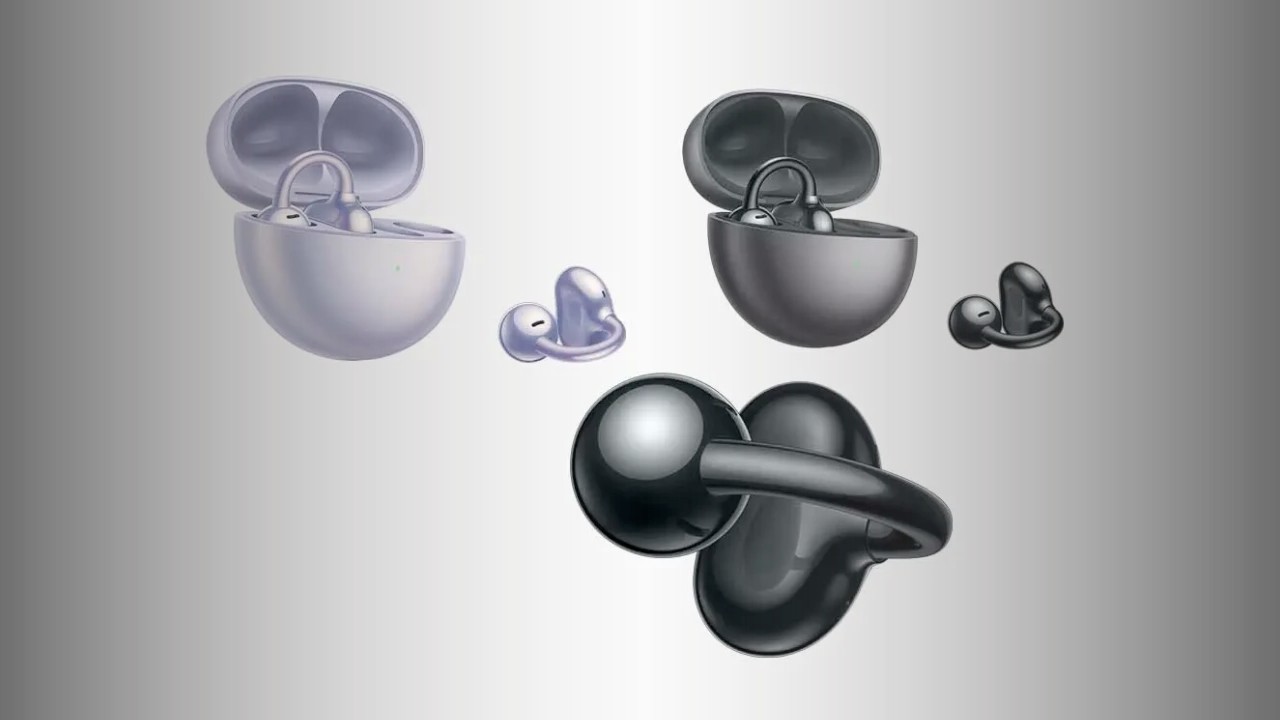
Huawei has announced European sales of the FreeClip, an open-ear true wireless headphone that takes a notably different route from the familiar in-ear bud. Rather than sitting in the ear canal and relying on silicone tips to hold itself in place, each FreeClip uses a wraparound clip arrangement called C-bridge. The intention is straightforward: keep the ear canal unobstructed while providing a more secure, potentially lower-pressure fit than a conventional earbud resting in the concha.
That makes the FreeClip a product aimed at a specific listening scenario rather than a direct substitute for noise-isolating wireless earbuds. At €199, it enters a premium-priced part of the true wireless market, but its proposition is not maximum isolation for trains and flights. It is for listeners who want music, podcasts or calls while retaining awareness of traffic, colleagues, doorbells and other sounds around them.

An open-ear design changes the listening experience
Most true wireless headphones are in-ear designs. Their tips create a seal at the entrance to the ear canal, providing passive isolation before any electronic noise cancelling is introduced. That seal has two important consequences: it reduces external noise, and it gives the small driver a more controlled acoustic load. In practical terms, a well-fitting in-ear headphone can deliver stronger perceived bass at lower volumes and make fine musical detail easier to hear in noisy surroundings.
The FreeClip deliberately does not work this way. Its open acoustic construction leaves the ear canal open, so environmental sound remains audible. For a commuter crossing busy roads, someone working in an office, or a listener who finds sealed buds uncomfortable over long periods, this can be a more natural and safer arrangement than repeatedly removing an earbud. It also avoids the occlusion effect that some people experience with sealed earpieces, where one’s own footsteps, breathing or voice can sound unusually amplified.
The trade-off is fundamental rather than a simple matter of product quality. Without a seal, there is less passive attenuation of the outside world, and low-frequency reproduction is inherently more difficult to preserve at the ear. The listener may need to raise the volume in a loud environment, which can diminish both battery life and the advantage of open-ear awareness. Sound escaping from an open design can also be more noticeable to people nearby than it would be from a properly sealed in-ear model, particularly at higher listening levels.
None of this means an open-ear headphone is automatically poor sounding; it means it must be judged against the use case it is designed for. An open construction can feel less intrusive and can make spoken-word listening especially convenient. But anyone buying headphones principally for aircraft cabins, underground trains or other noisy environments will generally benefit more from an in-ear design with effective passive isolation and, where available, active noise cancellation.
The C-bridge clip is the defining physical feature
Huawei’s distinctive feature is its C-bridge mounting system, which clips around the outer ear rather than pressing a housing into the ear canal. This type of architecture seeks to solve one of the persistent problems in true wireless ownership: fit is both personal and consequential. A bud that feels stable in one listener’s ear may work loose in another’s, while an in-ear tip that seals exceptionally well can become tiring after several hours.
With the FreeClip, Huawei says an adaptive sensor helps reduce the pressure exerted by the clip on the auricle, the visible outer portion of the ear. This is a meaningful ergonomic goal. A clip must apply enough force to remain in position during normal movement, but too much clamping force risks soreness where the device contacts the ear. Conversely, too little force can compromise stability. The company has not detailed how that adaptive sensor functions or published pressure figures, so it is not possible to draw firm conclusions about its effectiveness from the announcement alone. The principle, however, is clear: comfort depends on balancing retention and pressure rather than on creating an airtight seal.
For prospective owners, the key consideration is that a clip-on headphone still needs a personal fit check. Ear thickness, the shape of the helix and concha, and whether the listener wears glasses can all affect how a wraparound design sits. This is especially important for a product positioned around all-day wear. Where possible, trying this type of design before purchase remains more informative than assuming a clip will suit every ear more comfortably than a conventional bud.
Awareness without transparency mode
Many sealed true wireless headphones now offer a transparency or ambient mode, using microphones to feed outside sound into the earphones. The FreeClip’s open construction approaches the same everyday requirement acoustically rather than electronically: the outside world is not blocked in the first place.
That has an obvious appeal for listeners who dislike the processed character that can accompany microphone-based ambient modes. It also means there is no need to switch modes merely to hear a brief conversation. On the other hand, an open headphone cannot provide the abrupt quiet that a sealing in-ear model can offer when the listener needs to focus. The two approaches serve overlapping but not identical priorities.
Battery life: eight hours per charge, 36 hours with the case
Huawei quotes battery life of up to eight hours from a single charge and up to 36 hours when the charging case is included. In true wireless terms, the first figure is the most useful indication of how long the earpieces may last away from their case, while the combined figure describes the total portable reserve available before the case itself needs recharging.
As with any wireless headphone battery claim, “up to” matters. Actual endurance varies with playback volume, the nature of the audio material, call use, wireless conditions and the operating features enabled. Open-ear products can invite higher volume levels when used outdoors because external sound remains audible; that can reduce real-world runtime compared with a controlled manufacturer test. The stated figures nevertheless suggest that the FreeClip is intended to cover a working day or extended casual use without demanding a mid-session recharge.
The case is therefore more than a storage accessory. For true wireless headphones it is the central part of the ownership model: it protects the earpieces between uses, keeps their batteries topped up and makes multi-day use practical. Huawei has not provided charging-time, charging-connector or wireless-charging details in the supplied announcement, so these are points buyers should confirm before treating the FreeClip as a replacement for another set of earbuds with a preferred charging arrangement.
IP54 protection and what it means for everyday use
The FreeClip is rated IP54 for dust and moisture protection. An IP rating is useful because it separates two different types of resistance. The first numeral, 5, indicates a dust-protected construction: dust ingress is not expected to reach a level that prevents satisfactory operation. The second numeral, 4, denotes resistance to water splashing from any direction.
In ordinary ownership, that makes the rating relevant to sweat, light rain and the incidental moisture associated with outdoor activity. It should not be treated as permission to submerge the headphones, shower with them or expose them to sustained water jets. IP54 is not an immersion rating. The announcement also does not state whether the charging case carries an equivalent rating, so it would be prudent to keep the case dry even if the earpieces themselves are suitable for use in changeable weather.
The combination of an open ear and splash protection gives the FreeClip an understandable role for walking, running errands and less isolated office or home listening. For vigorous sport, however, a buyer should assess both retention and personal comfort, not simply the IP figure. A secure fit is essential with any small wireless earpiece, and clip-style designs can behave very differently from person to person during repeated motion.
Where Huawei FreeClip fits in a headphone system
The FreeClip is best understood as a convenience and situational-listening headphone. It can occupy a useful place alongside a more traditional hi-fi headphone rather than replacing it. A dedicated wired open-back headphone, for example, is normally used in a quiet room with a suitable headphone amplifier and offers the physical scale and controlled listening environment needed for serious music sessions. A sealed in-ear true wireless model is generally better equipped for travel and noisy spaces. Huawei’s design occupies the middle ground: immediate, cable-free access to audio while maintaining contact with one’s surroundings.
That positioning is also worth keeping in mind when considering value. The €199 retail price buys an unusual physical format, wireless portability, quoted eight-hour earpiece battery life and IP54 protection. The supplied information does not specify the Bluetooth version, supported audio codecs, driver arrangement, microphone system, control method, companion app, multipoint operation, voice-assistant support or any form of active noise cancellation. Those details can materially affect day-to-day ownership, particularly for Android and iPhone users with different codec and ecosystem priorities, and should be checked in the final regional specification.
Similarly, there are no published sensitivity, frequency-response or distortion figures in the announcement. It would therefore be premature to make claims about tonal balance, bass extension, call quality or sound leakage. The open construction does provide a reliable guide to the broad experience: environmental awareness and comfort are central priorities, while isolation is not.
Colours, availability and price
Huawei says the FreeClip will be offered in two colours and will arrive on the European market at the end of December 2023. The retail price is €199.
For listeners who have found conventional in-ear buds fatiguing, or who need to remain alert to the world around them, the C-bridge concept is the substantive point of difference here. It is an alternative to the increasingly familiar recipe of sealed earbuds plus electronic noise control. The compromise is equally clear: open-ear listening is unlikely to be the best answer where silence, privacy and maximum low-level musical detail in noisy places are the priorities. But for long, low-friction daily listening, Huawei’s FreeClip is designed around a genuinely different set of needs.