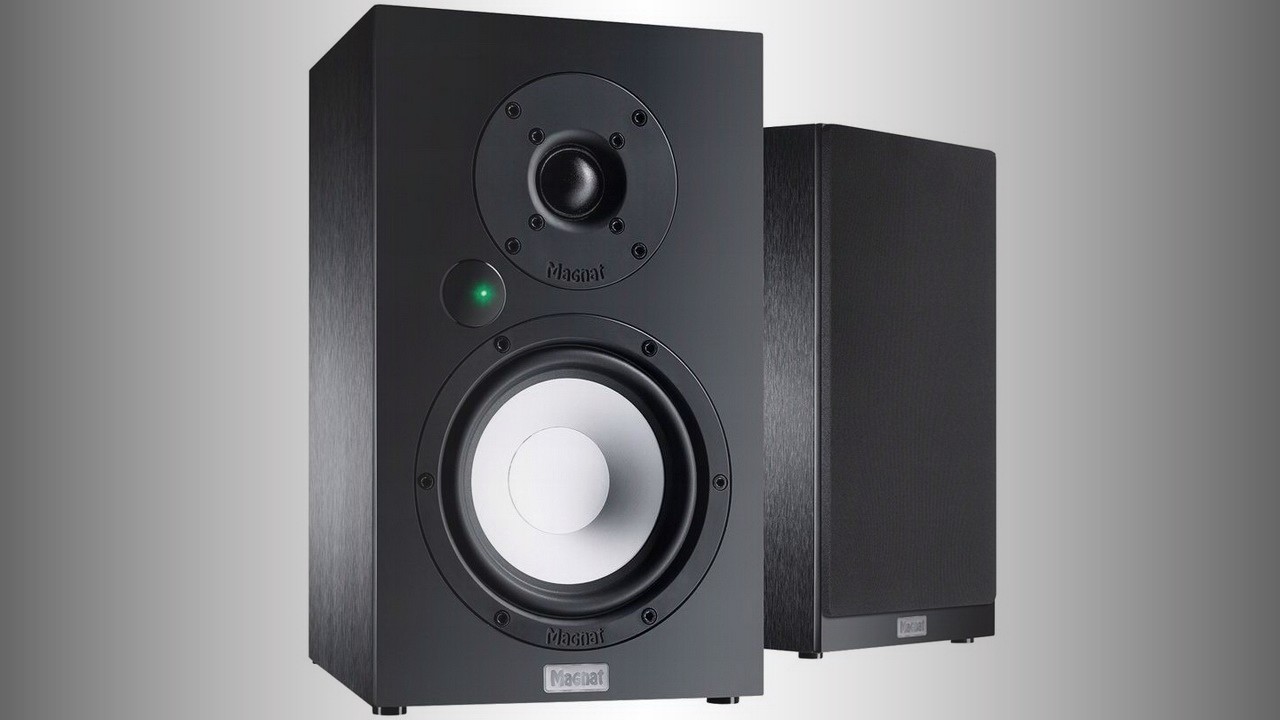
The Magnat Multimonitor 220 is a compact active bookshelf speaker system intended to do considerably more than a conventional pair of passive standmounts. One cabinet contains the amplification, DAC and input section, while the second is a passive partner connected by speaker cable. Add optical and coaxial digital inputs, analogue line and phono provision, a 3.5mm socket, aptX Bluetooth and a subwoofer output, and this is a genuine all-in-one hub for a desk, TV setup, modest living-room system or vinyl-led second rig.
It is not a new model, but its specification remains relevant because it addresses a practical problem: bringing several sources together without requiring a separate integrated amplifier, DAC, phono preamp and switching box. The Multimonitor 220’s appeal is therefore less about visual drama than system simplification. Its limitations are equally clear from the design: one speaker must accommodate the electronics and mains connection, the two cabinets remain linked by a cable, and the compact enclosure places sensible limits on how loudly and deeply it can play in a large room.
A conventional-looking active speaker, with one important difference
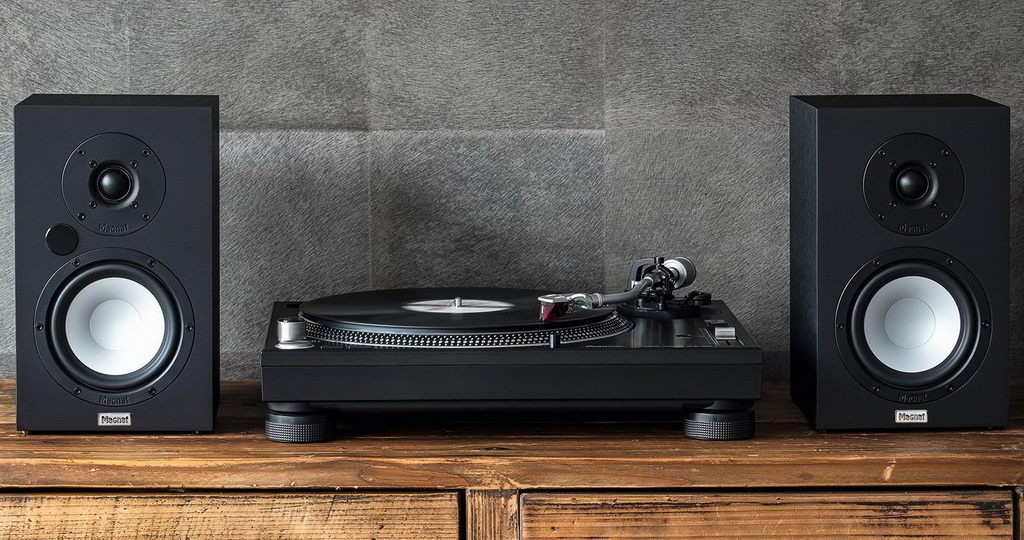
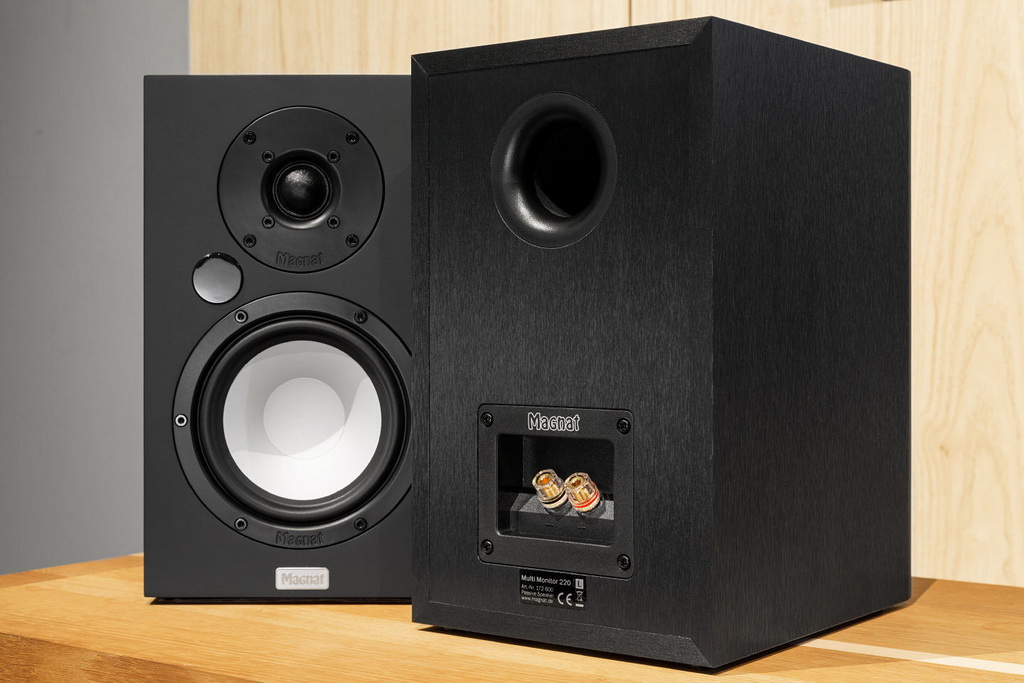
In appearance, the Multimonitor 220 is deliberately restrained. It is a matte-black, two-way bass-reflex design in a familiar compact bookshelf form, using MDF cabinets. MDF remains a common cabinet material because it is relatively dense, easy to machine accurately and can help control panel resonances when used well. Magnat does not provide cabinet-wall thickness or internal bracing details in the supplied specification, so no conclusion should be drawn about those aspects of construction.
Remove the magnetic grilles and the speaker complement is exposed: a 1-inch Magnat Fmax dome tweeter and a 125mm (5-inch) mid/bass driver with an aluminium-ceramic composite sandwich diaphragm. The published crossover frequency is 3,200Hz. In a two-way speaker, the crossover determines where the larger driver hands over to the tweeter; its implementation and dispersion behaviour are at least as important as the frequency itself, but Magnat has not detailed the filter slopes or crossover topology here.
The claimed frequency range is 35Hz to 40kHz, quoted within ±3dB. The upper figure reflects the Fmax tweeter’s intended extension, while the 35Hz lower limit is ambitious territory for a small, ported cabinet. Such a specification does not mean the speaker will deliver the weight and room-filling authority of a large floorstander at 35Hz. It does indicate that Magnat has voiced the system to reach lower than many compact desktop speakers, aided by its bass-reflex loading. Room boundaries and placement will strongly affect how much bass is heard in practice.
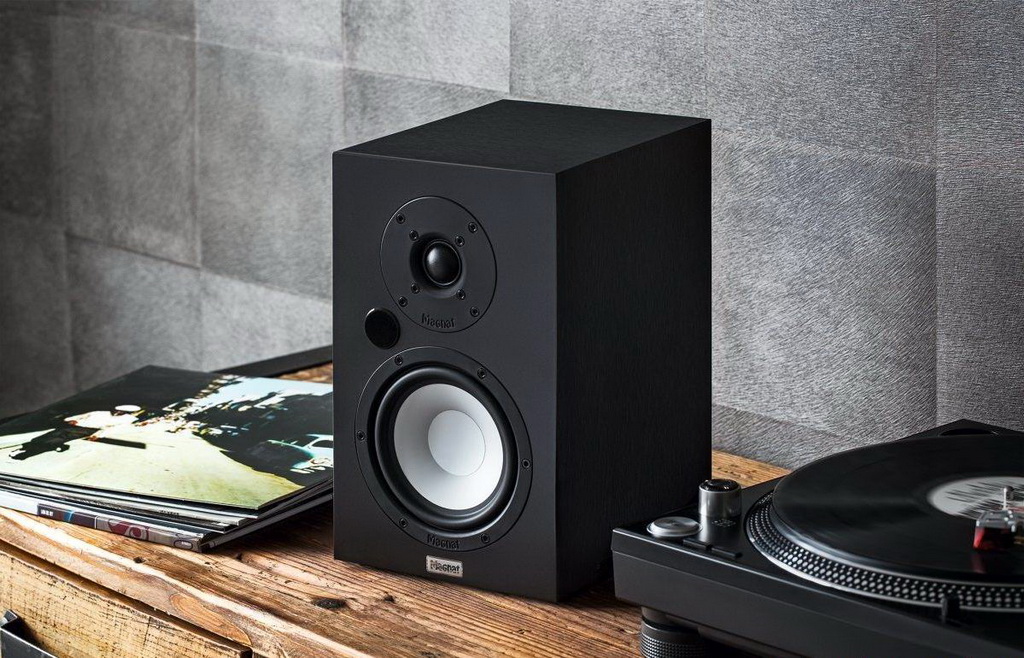
The leading left speaker is identified by a small, convex-glass-covered status indicator on its front baffle. Different LED colours communicate the active input. This keeps the fascia uncluttered, but it is less immediately legible than a small text display: users will need the manual to learn the colour scheme, aside from the more intuitive blue Bluetooth indication. For a product explicitly designed to switch between numerous sources, that is an ergonomic compromise worth noting.
Active/passive architecture and the electronics inside
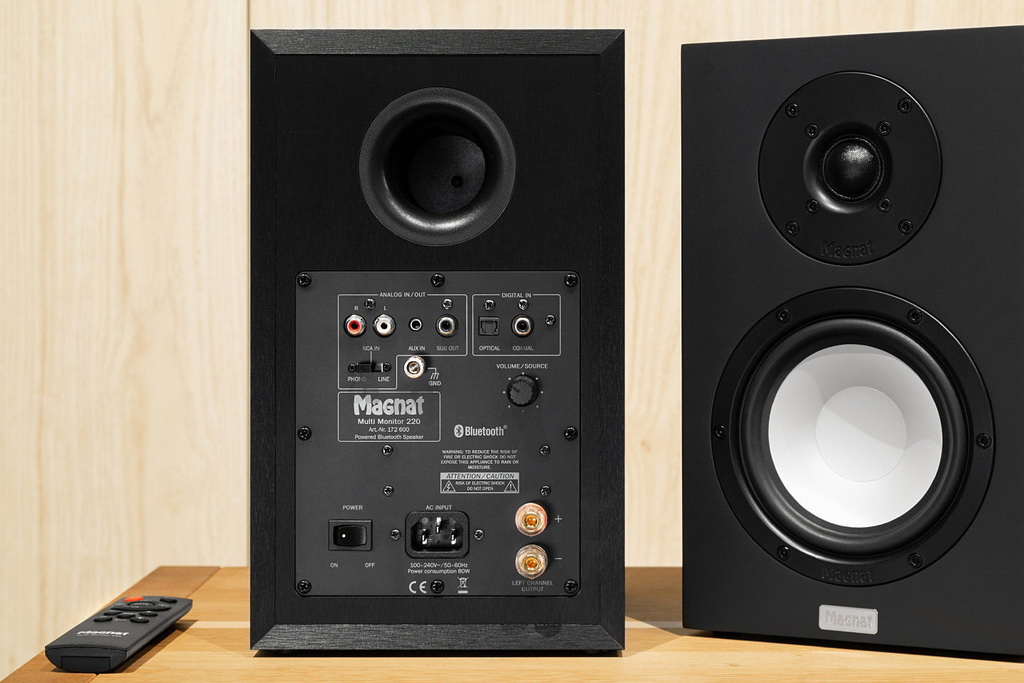
Magnat uses a classic master-and-slave arrangement. The left speaker is the active, or leading, cabinet: it contains the 40-watt-per-channel Class D amplifier, DAC, input switching and controls. The right speaker is passive, receiving its amplified signal from the left cabinet through the supplied three-metre speaker cable.
Class D amplification is well suited to this kind of active speaker because it is compact and efficient, allowing the amplifier module to live inside a modest enclosure without the size and heat associated with many conventional linear amplifier designs. The stated 40W per channel should be viewed in the context of the product’s compact drivers and intended near- to mid-field role. It is enough on paper for normal listening in a small or medium-sized space, but neither driver sensitivity nor maximum sound-pressure capability is provided, so it would be inappropriate to make firm claims about ultimate output.
The main cabinet’s rear panel also carries a notably large bass-reflex port. Ports use the air mass inside the opening to reinforce output around a chosen tuning frequency, helping a small driver and cabinet produce more low-frequency energy. The trade-off is that ported speakers tend to be more placement-sensitive than sealed designs. Bringing the rear port close to a wall can add bass, but may also make the upper-bass and lower-midrange region sound thicker. Starting with some breathing room behind the cabinet, then moving the speakers in small increments, is the sensible approach.
The passive right cabinet is much simpler: alongside its bass port are a pair of speaker terminals in an angled rear recess. The supplied cable length is practical for a conventional stereo triangle on a desk, TV unit or compact stands, but it is not ideal for exceptionally wide room-spanning placement. As always with a linked active/passive pair, plan the room around the location of the powered speaker, power outlet and source cables before committing to a final layout.
Inputs for television, vinyl, computer and Bluetooth use
The Multimonitor 220’s connection set is its defining advantage. Its optical and coaxial digital inputs feed an internal DAC specified to accept signals up to 24-bit/192kHz. Optical is especially useful for a television, games console or streamer with a Toslink output, while coaxial S/PDIF is common on CD transports and some dedicated digital sources. A digital input lets the speaker’s internal DAC handle conversion rather than relying on the source device’s analogue stage.
There is no stated support for USB audio, so a computer cannot be connected directly as a USB DAC source. That does not rule out computer use: Bluetooth is available, as is a 3.5mm analogue input. However, listeners wanting a wired, bit-perfect USB connection will need either a separate USB DAC feeding the analogue input, or a digital interface that outputs optical or coaxial S/PDIF. That is a meaningful distinction when comparing the Magnat with desktop-focused active monitors that include USB.
The RCA input is more flexible than usual at this level because it can operate as either a standard line input or an MM phono input. In phono mode, the built-in stage is intended for moving-magnet cartridges, and a grounding terminal is provided. A turntable fitted with an MM cartridge can therefore connect directly, assuming it does not already have a fixed-level line output selected. Moving-coil cartridges are not mentioned, and should not be assumed to be supported without an external phono stage.
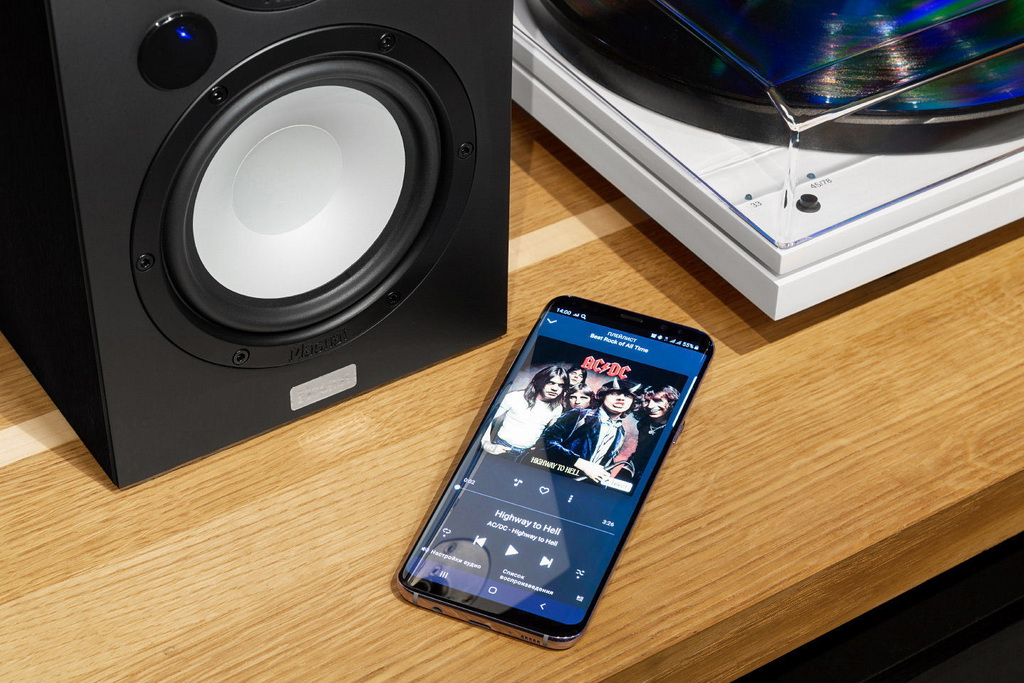
Bluetooth includes aptX support. AptX is a Bluetooth codec intended to improve on basic SBC transmission where both the sending device and speaker support it; it is a convenience connection rather than a substitute for a wired digital link, but it is useful for quick playback from a laptop or compatible phone. The supplied listening account reports stable Bluetooth connection and quick source changes.
A subwoofer output rounds out the system. This is potentially valuable not simply for more bass, but for more controlled bass in a larger room. A properly integrated subwoofer can take responsibility for the lowest octave and reduce the temptation to push compact main speakers towards their limits. The supplied information does not state whether the main speakers apply a high-pass filter when a subwoofer is connected, so buyers should not assume they are relieved of low-frequency duties.
Control scheme and everyday operation
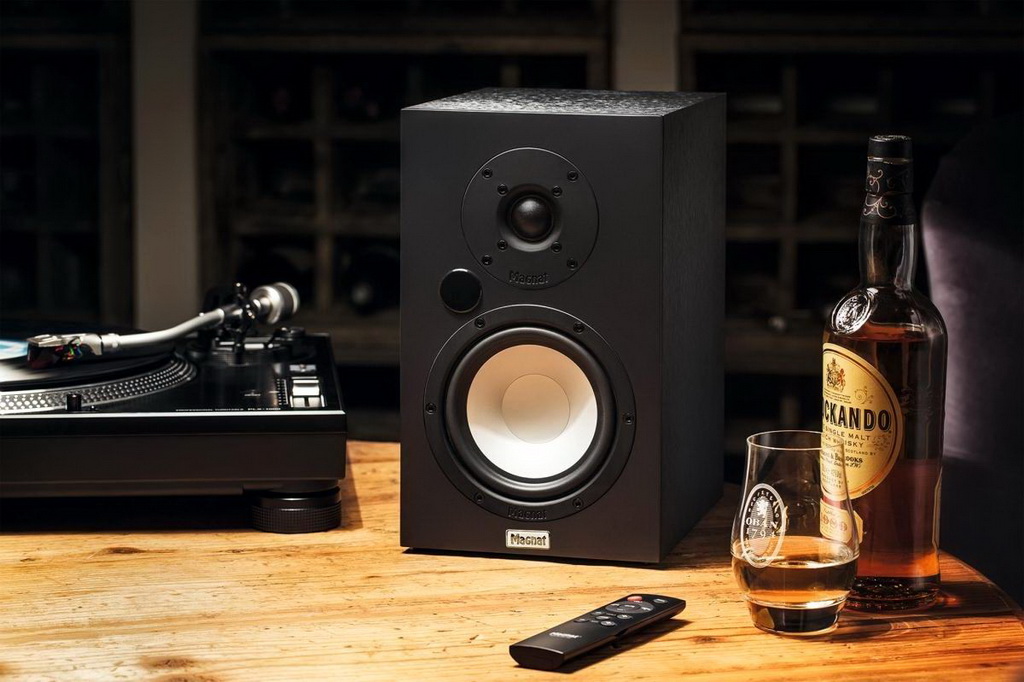
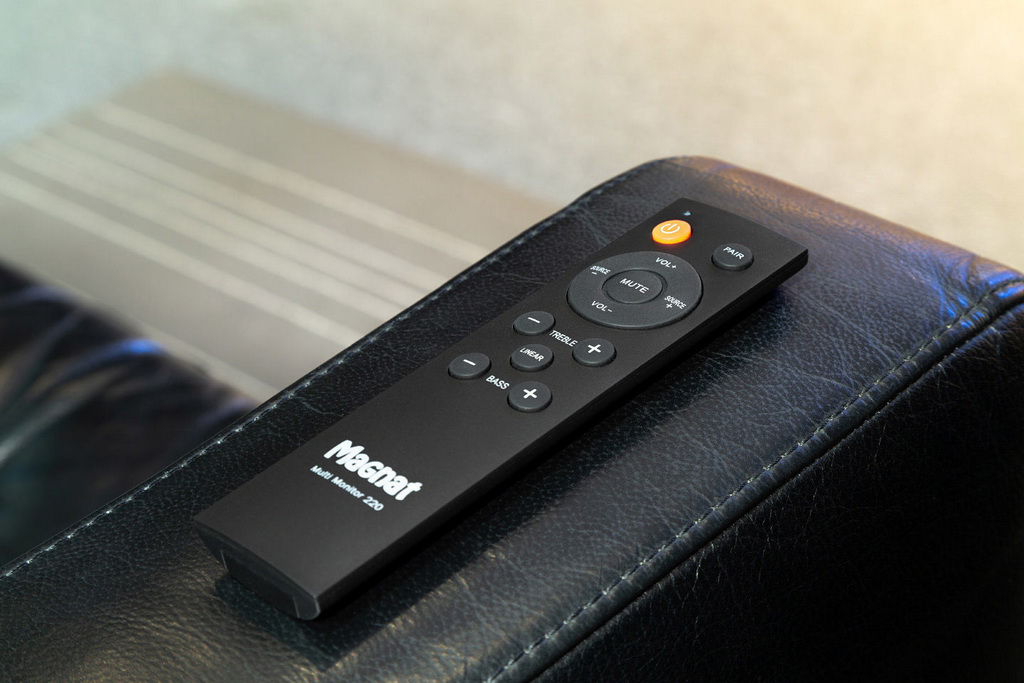
Volume and source controls are fitted to the active speaker, while the supplied remote handles volume, input selection and bass and treble adjustment. Separate buttons are provided for Bluetooth pairing and the line input, suggesting Magnat expects these to be regular day-to-day choices.
Tone controls can be genuinely useful in a compact all-in-one system. A speaker used near a rear wall, on a desk or beneath a television may need a small bass reduction to avoid excess warmth, while a softly furnished room may benefit from a modest treble lift. They should be treated as fine adjustment rather than a cure for poor placement. The original audition also found the remote’s infrared reception narrow: it reportedly needed to be pointed accurately at the leading speaker. That is not a major issue from a fixed listening position, but it is less forgiving than a wide-angle receiver or app-based control.
Placement is central to stereo performance
The review listening notes make a useful point about setup. When the speakers were positioned 2.5 to 3 metres apart, the stereo image reportedly lost coherence, with the left and right channels seeming too separate. Moving farther away improved integration, but the findings suggest that the Multimonitor 220 is best treated as a near- or mid-field system rather than a speaker to spread widely across a large room.
That is consistent with the physical format. A pair this compact generally benefits from a sensible equilateral or near-equilateral triangle: begin with the speakers roughly as far apart as the listener is seated from each one, then adjust in small stages. Keep the tweeters near ear height where possible, avoid putting the cabinets right at the edge of a wide sideboard, and experiment with modest toe-in. Those steps can improve centre-image focus before any tonal adjustment is needed.
For TV use, optical connection is the obvious route where available, but users should check their television’s digital output settings. Many active speakers expect two-channel PCM over optical; multichannel bitstreams may need to be converted to PCM in the TV menu. That is a general setup consideration, not a published Magnat-specific compatibility claim.
Reported sound: weighty lower mids and prominent small details
The supplied audition describes a character that is somewhat dark, full through the lower midrange and bass, and not especially airy or holographic. At the same time, high-frequency detail was said to come through convincingly, with small effects, guitar-string transients and bright instrumental textures catching attention. This is an interesting combination: a generally weighty tonal foundation, paired with a tendency to spotlight fine treble events rather than presenting a uniformly forward top end.
With anime material, the account found that small sound effects—rustles, drops, creaks and mechanical clicks—could move forward in the mix. Action sequences were described as large-scale, with clear impact. That may appeal to listeners using the Multimonitor 220 as a TV or gaming speaker, where incidental effects and positional cues can add involvement, although it may be less suitable for those seeking the most neutral, dialogue-prioritised balance.
Acoustic guitar was a reported strength, particularly on Rodrigo y Gabriela, where the darker resonant body of the speaker’s presentation was said to contrast agreeably with the attack and colour of plucked strings. The same ability to track busy, effect-rich game soundtracks was also noted. In horror games, the speakers reportedly delivered useful atmosphere, while Wolfenstein: Youngblood was said to benefit from clear approximate enemy location cues.
Dynamics were judged capable with electronic music and fast guitar playing, without losing the broad shape of a track or the lower-frequency line. Dense early Nine Inch Nails recordings could become congested, according to the source listening notes, but not featurelessly so: individual textures still remained apparent. These are subjective impressions from the original audition, not independent measurements, and they should be read as guidance on the speaker’s likely voicing rather than a universal outcome in every room.
Who should consider the Multimonitor 220?
The Multimonitor 220 makes the strongest case for itself as a compact, multi-source system. It can serve a television through optical, a turntable through its MM phono stage, a CD transport or streamer through coaxial/optical, and a laptop or phone through analogue input or aptX Bluetooth. Few separate boxes are needed, and the subwoofer output gives the system a credible upgrade path if a room or listening habits demand more low-frequency scale.
Its practical trade-offs are straightforward. There is no USB input, no network streaming platform is listed, no HDMI connection is specified, and the LED-only input display is less clear than a text screen. The linked-speaker architecture is simpler and usually more affordable than two fully active wireless speakers, but it still requires a cable between the cabinets. The reported tonal balance also means careful placement and use of the bass/treble controls will be worthwhile, especially in smaller rooms or close to walls.
For a listener wanting a conventional amplifier-and-passive-speaker route, Magnat’s approach will feel less modular. For someone who wants to connect a record player, TV and everyday wireless source without assembling a rack of components, it is much more persuasive. The Multimonitor 220 is not presented here as a studio monitor or a last-word high-end standmount; it is a pragmatic active stereo system with unusually broad connectivity and a reported sound that favours solidity, detail effects and unfatiguing listening over outright neutrality.
Magnat Multimonitor 220 specifications
- Type: Two-way, bass-reflex active/passive bookshelf speaker system
- Frequency response: 35Hz–40kHz (±3dB)
- Drivers: 1-inch Fmax dome tweeter; 5-inch mid/bass driver with sandwich diaphragm
- Crossover frequency: 3,200Hz
- Amplification: Class D, 40W per channel
- Digital capability: DAC accepts up to 24-bit/192kHz signals
- Inputs: Optical, coaxial, RCA line/phono (MM), 3.5mm analogue, Bluetooth with aptX
- Outputs: Subwoofer output
- Dimensions: 298 x 235 x 178mm
- Weight: 5kg, leading speaker; 4.4kg, driven speaker