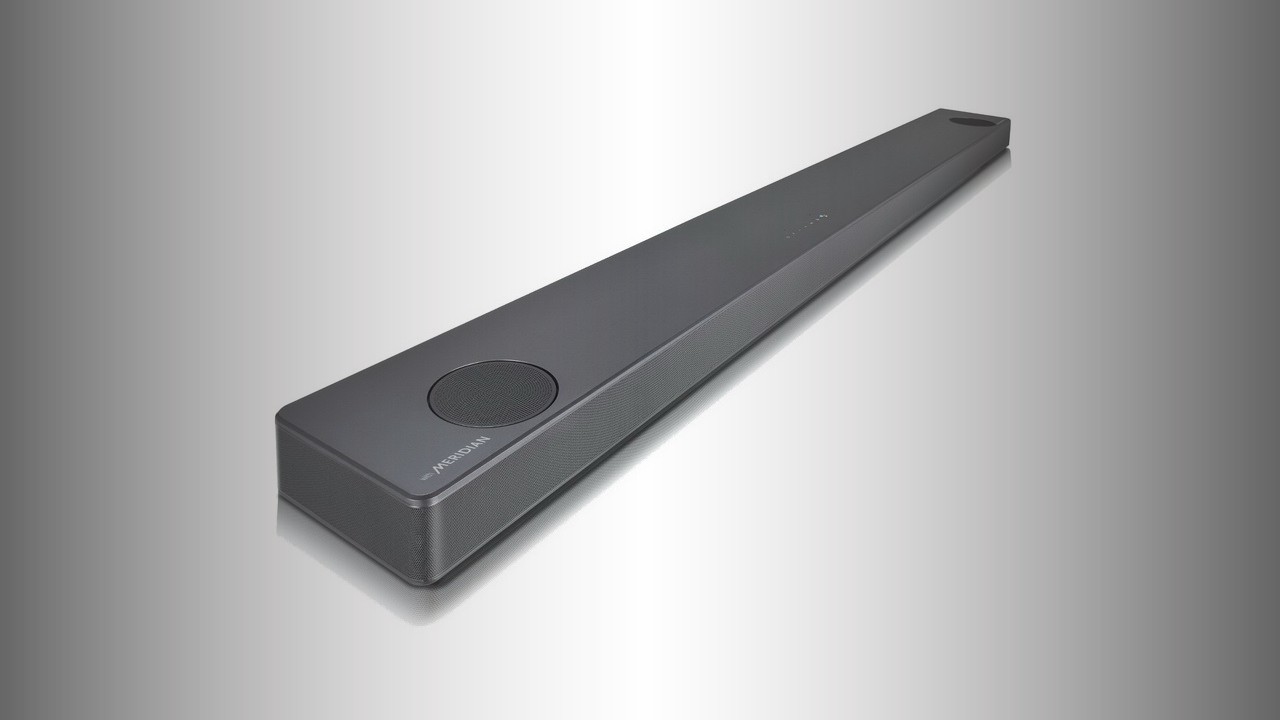
The LG SL10Y is a premium, wide-format soundbar designed to address two increasingly connected parts of the modern TV system: more convincing film sound and simpler control of connected entertainment and smart-home devices. Its headline combination is Dolby Atmos and DTS:X object-based surround decoding alongside built-in Google Assistant, with Chromecast, Wi-Fi, Bluetooth and HDMI connectivity completing what is intended to be a more flexible hub than a conventional TV speaker replacement.
LG describes the SL10Y as the world’s first soundbar to support both Google Assistant and Dolby Atmos. Whatever the historical distinction, the important practical point is that it combines voice control and immersive audio in one chassis rather than requiring a separate smart speaker beside the television. Say “Hey Google” and the soundbar can be used for information searches and compatible smart-home commands, while its audio hardware is intended to create a larger, more enveloping presentation for films, games and music.
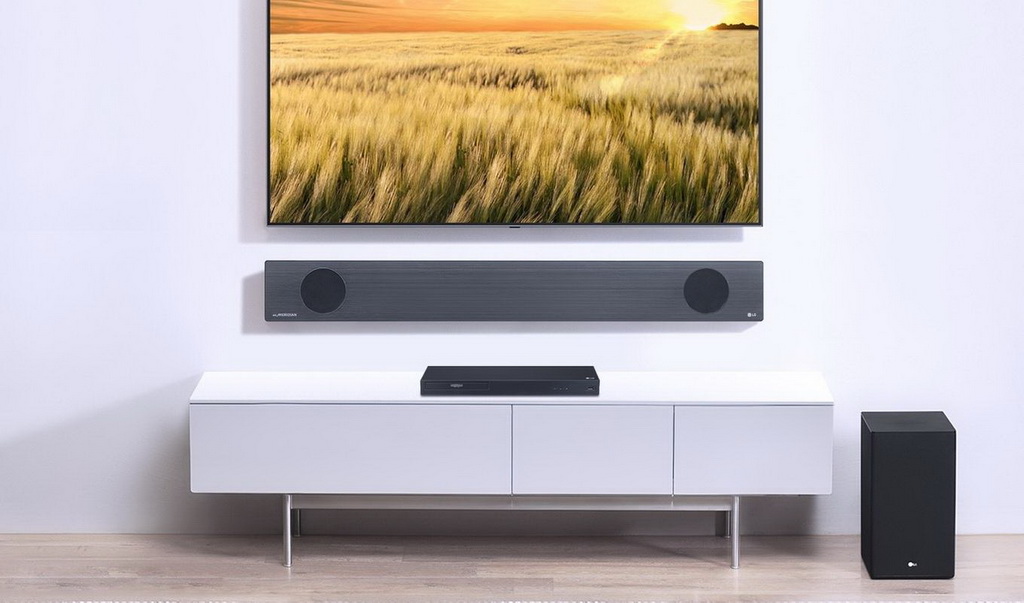
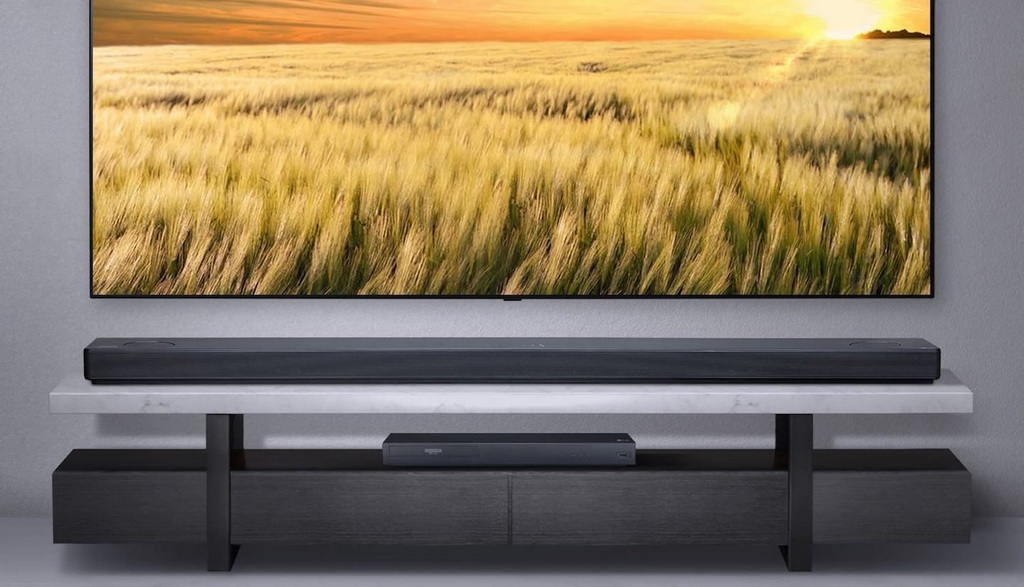
It is also a physically substantial model. At 1,443mm wide, the main bar has been designed to sit naturally with LG’s 55- and 65-inch OLED B- and C-series televisions. That makes sense aesthetically, but it is also a useful reminder to check the available furniture width and the height of the screen’s lower edge before buying: a soundbar that is only 63mm high is relatively low-profile, yet it can still obstruct an infrared receiver or a small portion of the picture if placed directly in front of certain TV stands.
A 5.1.2-channel platform with height channels
The SL10Y is specified as a 5.1.2-channel system. In surround terminology, the first number refers to the main and surround channels, the “.1” denotes the dedicated subwoofer channel, and the final “.2” identifies two height channels. Here, those height channels are handled by two integrated upward-firing speakers.
Upward-firing Atmos speakers work by directing sound towards the ceiling so that reflections arrive at the listening position from above. When the room is suitable, this can add a sense of vertical space to compatible Dolby Atmos soundtracks: effects such as rain, aircraft, ambience and musical score can seem less tied to the plane of the television. DTS:X pursues a similarly three-dimensional, object-based approach, although the mix and the playback system determine how objects are placed in the available speaker layout.
This method is a practical alternative to installing ceiling loudspeakers, but it is inherently dependent on the room. A relatively flat, reflective ceiling at a conventional height gives reflected sound the best chance of reaching the seating position predictably. Very high, vaulted, heavily treated or acoustically absorbent ceilings are less favourable. Likewise, the bar needs a clear path above it; placing it inside a deep cabinet will work against the upward-firing drivers.
LG states that two additional wireless speakers operating as rear satellites can provide full surround sound. Rear channels matter because they supply the lateral and behind-the-listener information that a front soundbar, even a sophisticated one, cannot physically place at the back of the room. The supplied information does not clarify whether these wireless rear speakers are included with every SL10Y package or offered separately, so prospective buyers should confirm the bundle in their region. It is also worth noting that “wireless” rear speakers generally refers to the audio link: each rear unit may still require mains power.
Meridian processing and what high-resolution support means
The SL10Y incorporates technology from Meridian Audio, the British company known for its work in digital audio and high-resolution playback. LG says the implementation combines advanced signal processing with hardware design to create a sound field with greater height, width and depth. That is a design objective rather than a guarantee of a particular listening result, but it identifies an important aspect of soundbar engineering: processing is used not only for decoding a soundtrack but also to manage the relationship between closely spaced drive units and to broaden the apparent soundstage.
In a soundbar, the left, centre and right channels are physically much closer together than they would be in a conventional separate-speaker system. Digital processing can help steer sound, maintain dialogue focus and make the front stage seem wider than the cabinet. The benefit is convenience and a clean installation; the trade-off is that the result remains influenced by room boundaries, seating position and the limited physical separation of the front channels.
LG specifies high-resolution audio capability up to 24-bit/192kHz. Bit depth and sample rate describe the resolution of a digital audio file or signal: 24-bit material can theoretically accommodate a greater dynamic range than 16-bit CD audio, while a 192kHz sample rate extends the bandwidth of the encoded signal. In daily use, this support is most relevant to listeners with compatible high-resolution files on USB storage or available through a supported playback route. It should not be confused with a promise that every streaming service, Bluetooth connection or TV input will deliver 24-bit/192kHz audio; the actual format reaching the soundbar depends on the source, application and connection in use.
The published frequency range is 24Hz–192kHz. As quoted, the upper figure is far beyond the conventional audible range and may reflect the system’s stated high-resolution signal capability rather than a straightforward acoustic response figure. LG does not provide response tolerances or measurement conditions in the supplied specifications, so it should not be treated as a directly comparable in-room bass or treble measurement. The more tangible low-frequency component of the system is its separate subwoofer, which is intended to handle the impact and scale that a slim soundbar enclosure cannot readily reproduce on its own.
HDMI, ARC and 4K video pass-through
Connectivity is one of the SL10Y’s more useful strengths. It provides two HDMI inputs and one HDMI output, specified as HDMI 2.0, plus an optical digital input and a USB 2.0 Type-A port. The HDMI output supports Audio Return Channel (ARC), allowing sound from a compatible television to travel back down the HDMI cable to the soundbar.
ARC simplifies a typical installation. Connect the SL10Y’s HDMI output to the TV’s ARC-labelled HDMI input, select the appropriate output mode in the television’s menus, and the TV can send its own audio—including sound from internal apps—to the bar. HDMI-CEC control, where supported by the TV, can also allow the television remote to control core soundbar functions such as volume and power. This reduces the number of remotes needed for everyday viewing.
There is a distinction to keep in mind for buyers comparing newer soundbars: the supplied specification identifies ARC, not enhanced ARC (eARC). ARC is widely useful, but its bandwidth is more limited than eARC. The precise audio formats available from a particular TV app or external source will therefore depend on the television, the source device and their settings. For the most reliable configuration, users should consult both the TV and soundbar manuals, particularly when trying to pass immersive audio from an external player.
The SL10Y supports 4K Pass Through with HDCP 2.2 and is specified to pass 4K HDR and Dolby Vision video without performance loss. This lets compatible 4K source components connect to the soundbar’s HDMI inputs, with video then forwarded to the television and audio decoded by the bar. HDCP 2.2 is the copy-protection standard commonly associated with protected 4K content. Dolby Vision is a high dynamic range format, so the ability to pass it through is especially relevant to owners of compatible OLED displays and source devices.
In practical system terms, the two HDMI inputs are useful if, for example, a streaming player and games console need direct connection. However, the specification lists HDMI 2.0 rather than later HDMI capabilities, so buyers with the newest gaming hardware should verify their required video features before deciding whether to route a console through the soundbar or connect it directly to the TV and return audio through ARC.
Streaming, voice control and everyday operation
Built-in Google Assistant turns the SL10Y into more than an audio endpoint. It can respond to voice requests for information and control compatible smart-home devices, which can be useful in an open-plan living room where the television system is often central to lighting, routines and connected devices. Voice interaction is convenient, although it also means the soundbar is a network-connected product rather than a purely conventional AV component.
Chromecast support adds another route into the system. Chromecast allows compatible apps and devices to hand off playback to the soundbar over the network, rather than relying solely on a local Bluetooth link. Wi-Fi is specified, as is Bluetooth, providing different options for casual listening. Bluetooth is often the quickest way for visitors to play audio from a phone, while network playback can be more integrated within a home setup. The exact services, file formats and control behaviour available should be confirmed through LG’s current app and regional support information, as these details can change over a product’s life.
USB playback is available through the front or rear Type-A USB 2.0 connection specified by LG, offering a direct option for music held on compatible storage. An optical input remains useful for older televisions and source devices that lack HDMI ARC, though optical connections have different format limits from HDMI and are best viewed as a straightforward digital-audio fallback rather than the first choice for a feature-rich Atmos system.
LG lists Google Multi Zone, Adaptive Sound Control, Meridian, Music, Bass Blast/Bass Blast +, Cinema (Dolby Surround), Dolby Atmos and DTS:X among the SL10Y’s listening modes. These should be chosen according to material rather than treated as universal upgrades. A Cinema or native immersive mode is the natural starting point for compatible film and television content; music modes may be preferred for stereo playback; and bass-enhancement modes can add weight at lower volumes but may be less suitable in rooms where bass already builds up. Adaptive processing can be helpful for varied broadcast material, although enthusiasts may wish to compare it with a more direct mode and use the setting that gives dialogue and tonal balance they prefer.
Installation considerations and who it suits
The SL10Y’s main unit measures 1,443 x 63 x 146mm (W x H x D) and weighs 7.5kg. The wireless subwoofer measures 221 x 390 x 313mm and weighs 7.8kg. Those dimensions make the subwoofer compact enough to place beside TV furniture, but it should not automatically be hidden in the tightest available corner. Corners can reinforce bass, which may increase impact but can also make low frequencies uneven or overbearing. Starting with some space from the wall and experimenting in small increments is usually more productive than assuming one position will suit every room.
The bar itself should be centred beneath the television and aimed unobstructed towards the listening area. For its height effects, leave the top of the chassis open to the ceiling. If adding the wireless rear speakers, place them to the sides or slightly behind the principal seating position, approximately around ear height where practical, then use the system’s setup controls to balance their level. Correct placement and level matching are often more important to surround coherence than simply turning the rear channels up.
With total output power quoted at 570W, the SL10Y is positioned as a powerful all-in-one TV audio system rather than a small secondary-room bar. Total power alone does not indicate how loud it will sound in every room or how that output is divided among channels, but it does indicate that LG has allocated substantial amplification across the soundbar and subwoofer system. The supplied specifications do not detail amplifier topology, individual channel ratings, driver sizes or distortion measurements, so meaningful comparisons on those points require further manufacturer information or independent testing.
For LG OLED owners wanting visual integration, HDMI control and a route to Dolby Atmos without installing an AV receiver and separate speaker package, the SL10Y’s feature set is coherent. Its breadth suits larger televisions, its 5.1.2 arrangement addresses the demand for height effects, and its HDMI pass-through, Chromecast and Google Assistant make it more adaptable than a basic optical-only soundbar. The principal buying checks are equally clear: confirm whether rear speakers are included, ensure the room and ceiling can support upward-firing effects, and verify that the TV and source devices provide the desired HDMI audio and video functionality.
LG SL10Y specifications
- Channel configuration: 5.1.2
- Total output power: 570W
- Quoted frequency range: 24Hz–192kHz
- High-resolution audio support: up to 24-bit/192kHz
- Supported immersive formats: Dolby Atmos and DTS:X
- Dolby Digital / Dolby Digital Plus: Yes
- Wireless: Wi-Fi and Bluetooth
- HDMI: 2 inputs, 1 output; HDMI 2.0; ARC
- Video pass-through: 4K Pass Through with HDCP 2.2; 4K HDR and Dolby Vision pass-through
- Other inputs: 1 optical digital input; 1 x USB 2.0 Type-A
- Main unit dimensions (W x H x D): 1,443 x 63 x 146mm
- Main unit weight: 7.5kg
- Subwoofer dimensions (W x H x D): 221 x 390 x 313mm
- Subwoofer weight: 7.8kg