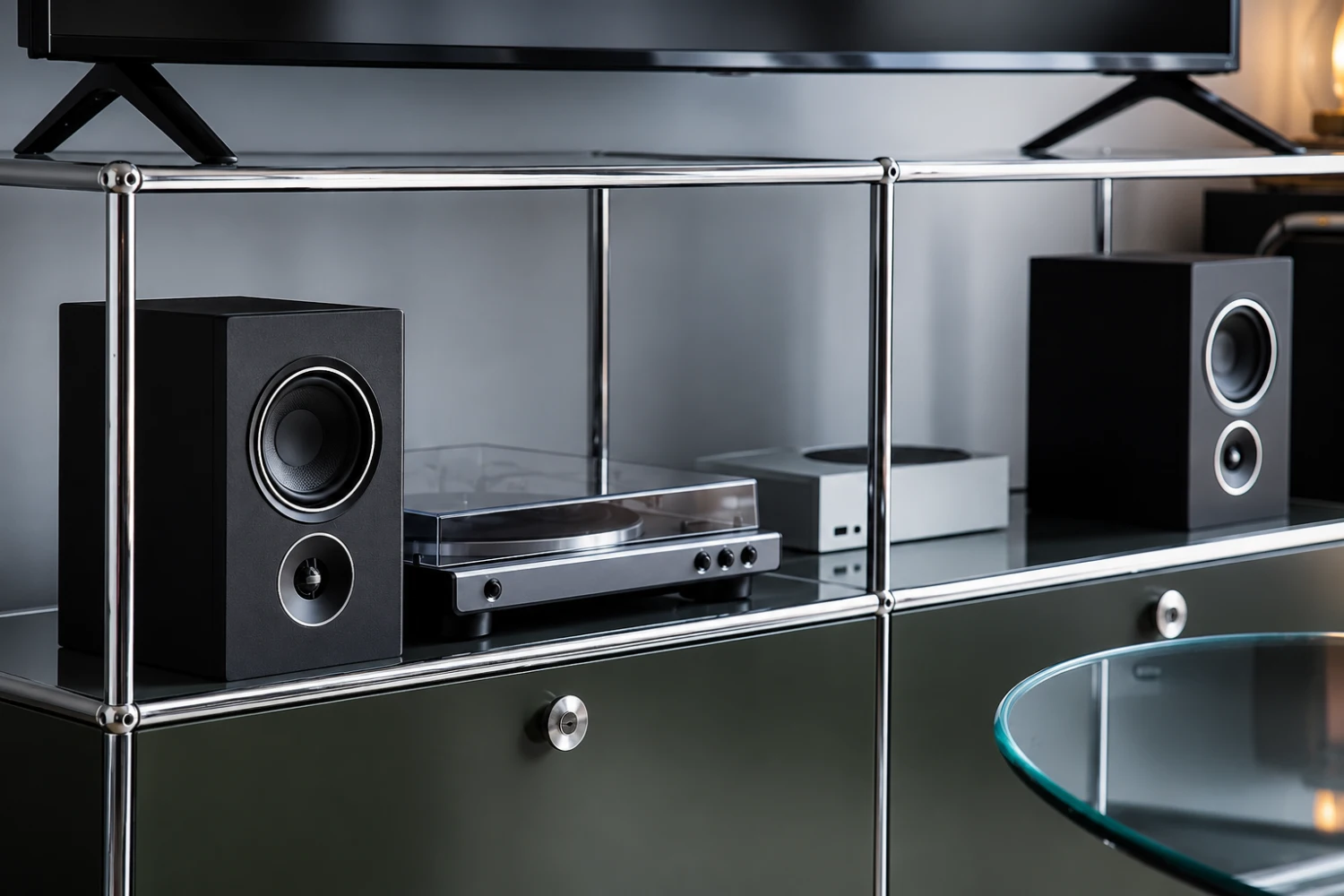
PSB Speakers has introduced the iQ series, a pair of compact active stereo systems intended to condense much of a conventional separates setup into two loudspeakers. The new range consists of the iQ1 and the more premium iQ2, each combining amplification, BluOS network streaming, TV connectivity via HDMI eARC, an MM phono input and provision for a subwoofer.
That is a notably broader brief than that of a typical pair of powered desktop speakers. In principle, either iQ model can serve as a music system, TV sound upgrade and turntable partner without requiring a separate amplifier, network streamer or phono preamplifier. For listeners short on space—or for those assembling a second system in a study, bedroom or smaller living room—the appeal is obvious: a proper left/right stereo arrangement with fewer boxes and fewer interconnects.
The platform follows PSB’s earlier Alpha iQ, which established the Canadian company in the compact streaming-speaker category. The iQ1 and iQ2 retain the core acoustic concept while adding updated amplification, connectivity, finish options and system flexibility. Importantly, these remain two-speaker systems rather than single-box wireless speakers. That matters because physical separation between the left and right cabinets is fundamental to stereo imaging: it gives recordings room to establish width, placement and scale in a way that one enclosure cannot reproduce.

A compact stereo system rather than just a wireless speaker
PSB positions the iQ series as an active two-way solution. “Active” in this context means amplification is built into the system, so the owner does not need to match a separate integrated amplifier to the speakers. It is a sensible approach for an all-in-one setup, since the manufacturer can specify the amplification and digital signal processing around the installed drive units rather than leaving performance dependent on the choice of external electronics.
Both the iQ1 and iQ2 use a 4-inch polypropylene mid-bass driver in a steel housing, with a rubber surround, alongside a 0.75-inch aluminium-dome tweeter. The tweeter uses a neodymium magnet and ferrofluid damping. These are meaningful details rather than mere component-list decoration. Polypropylene is a widely used cone material whose behaviour can be engineered to be well controlled, while a rubber surround is intended to allow the cone to move repeatedly over long periods without relying on a foam suspension that can deteriorate with age. The steel driver housing provides a rigid mounting structure for the mid-bass unit.
At the top end, an aluminium dome is a light, rigid diaphragm approach often chosen for extended high-frequency output. Neodymium permits a powerful magnetic motor in a compact assembly. Ferrofluid, a magnetic fluid used in the voice-coil gap, can assist damping and heat transfer. None of those construction choices alone predicts how the iQ speakers will sound in a room; crossover implementation, cabinet design, DSP and positioning are all consequential. They do, however, indicate that PSB has retained a conventional, purpose-built two-way driver complement rather than treating streaming features as a substitute for loudspeaker engineering.
The total amplification figure is 270 watts per pair. PSB allocates 90 watts to each woofer and 45 watts per channel to the tweeters. In an active system, assigning amplifier channels directly to individual drivers enables the designer to manage the crossover and protection functions in the electronic domain. It also means the quoted total should not be compared simplistically with the single power rating of a traditional passive-speaker amplifier: the system has separate power allocation for the bass/midrange and treble sections.

BluOS brings serious streaming and multi-room scope
Network streaming is handled by BluOS, the platform used across Bluesound, NAD and other BluOS-compatible products. The iQ series supports streaming up to 24-bit/192kHz and offers access to more than 20 streaming services, internet radio, personal music libraries and multi-room playback. It also supports Apple AirPlay 2, Spotify Connect, TIDAL Connect, Qobuz Connect and Bluetooth with aptX Adaptive.
For prospective owners, the distinction between these access methods is useful. BluOS provides the broader ecosystem for browsing compatible services, integrating a music library and grouping products around the home. Spotify Connect, TIDAL Connect and Qobuz Connect can hand playback from their respective native apps to the speaker system, which many listeners prefer because they can continue using the service interface they know. AirPlay 2 adds convenient playback from Apple devices and can be particularly practical in mixed-use households. Bluetooth remains the quick, universal option for guests and casual listening; aptX Adaptive is designed to adjust its operation according to conditions and content where compatible source devices are used.
For an owner already using a Bluesound or NAD streaming component in another room, BluOS compatibility is potentially more significant than a long list of individual services. A compact iQ system can become part of the same multi-room arrangement rather than operating as an isolated wireless speaker. Conversely, buyers should consider whether BluOS suits their preferred control habits before committing; an integrated speaker is most satisfying when its app and streaming ecosystem fit naturally into everyday use.
HDMI eARC, phono and computer audio make the iQ pair unusually adaptable
The iQ series’ physical inputs are central to its appeal. HDMI eARC allows either system to connect to a compatible television and receive TV audio through the HDMI connection. This avoids the separate optical cable often associated with compact active speakers, while making the iQ pair a plausible alternative for viewers who value stereo music reproduction and want better TV sound without installing a soundbar.
A stereo pair will not duplicate the surround-processing feature set of every AV product, but it has a different advantage: when placed with sensible spacing either side of a screen, it can create a convincing, stable front soundstage for films, television and concert material. HDMI eARC also promises a cleaner day-to-day experience than switching inputs manually for every programme, assuming the television’s HDMI control settings are correctly configured.
There is also an integrated moving-magnet phono preamplifier. This is specifically relevant to turntables fitted with MM cartridges. A turntable’s cartridge produces a very low-level signal and requires RIAA equalisation before it can be used by a normal line-level input. Building that stage into the speaker system removes the need for a separate phono box for an MM-equipped deck. Owners of a turntable with its own switchable phono stage should take care to use one phono stage only, while those using moving-coil cartridges would need to confirm cartridge and gain compatibility rather than assume the MM input is suitable.
Further wired connections include RCA analogue input, optical digital input, USB-C audio and USB-A. The RCA socket gives older line-level sources—such as a CD player with analogue outputs or an external DAC—a straightforward route into the system. Optical can be useful for a television or legacy digital source where HDMI is unavailable. USB-C audio makes the iQ system especially relevant to laptop and mobile-device users, providing a direct digital connection rather than relying solely on Bluetooth. PSB also lists USB-A connectivity, though prospective purchasers should confirm the intended function and compatibility for their particular source device.

Subwoofer integration is more than a bass add-on
Both iQ models include a subwoofer output with DSP-controlled high-pass and low-pass filters. This is an unusually welcome feature in a compact active speaker system, because adding a subwoofer is not simply about generating more low bass. When a system applies a high-pass filter to the main speakers, their small mid-bass drivers no longer have to reproduce the deepest bass at high level. In the right setup, that can reduce excursion demands on the 4-inch drivers and allow the subwoofer to handle the frequency range for which it is physically better suited.
The matching low-pass filter limits the subwoofer to bass duties, helping to create a more coherent handover. Correct placement and level matching still matter enormously: a poorly positioned or overly loud subwoofer can make bass seem detached, slow or boomy. But the availability of managed high- and low-pass filtering gives the iQ series a more credible upgrade path than systems with only a basic, full-range sub output.
This option is likely to be particularly valuable in larger rooms, for film use and for listeners who want more low-frequency weight than a compact two-way speaker can deliver alone. It may also give buyers the confidence to start with the iQ pair and add a subwoofer later, rather than committing to a larger loudspeaker system from day one.

PSB iQ1: the wired-link option
The iQ1 is the entry point to the range and is offered in black or white vinyl finishes. Its left and right speakers are connected by cable. That is a practical design decision rather than an inherent shortcoming. A wired inter-speaker link provides a direct and predictable means of keeping channels synchronised, and it avoids allocating more of the product budget to wireless transmission hardware.
For many installations, the cable will not be a serious inconvenience. A TV setup, desktop installation or shelving arrangement often already requires a mains lead and source cabling, and a cable between the speakers can be routed discreetly. The trade-off is simply that the placement of the two cabinets is constrained by the available cable run. Buyers who prioritise a clean, cable-minimised visual installation may prefer the iQ2, but the iQ1’s approach should appeal to those who value the same core platform and connectivity at the more accessible end of the range.
As with any compact stereo pair, placement should be treated as part of the system rather than an afterthought. A sensible starting point is to place the speakers at approximately equal distance from each other and the main listening position, with the tweeters near ear height where practical. Avoiding tight corners and allowing some space around the cabinets can help reduce the tendency for nearby boundaries to reinforce bass unevenly. Exact positioning will depend on the room, furniture and whether a subwoofer is added.
PSB iQ2: wireless stereo and a much broader finish choice
The iQ2 retains the same loudspeaker drivers, 270-watt amplification, BluOS ecosystem and connection complement, but introduces a low-latency wireless link between the left and right speakers. The practical benefit is obvious in rooms where running a cable across furniture, a fireplace or an open-plan space would compromise the installation. Low latency is especially important where the system is connected to a television, since an excessive delay between picture and sound is immediately distracting.
Wireless speaker links should not be confused with the complete absence of cables: each speaker will still require power. Nevertheless, removing the physical connection between channels can make a genuine difference to where a stereo pair can be placed, and therefore to the quality of stereo separation an owner can achieve in a real room.
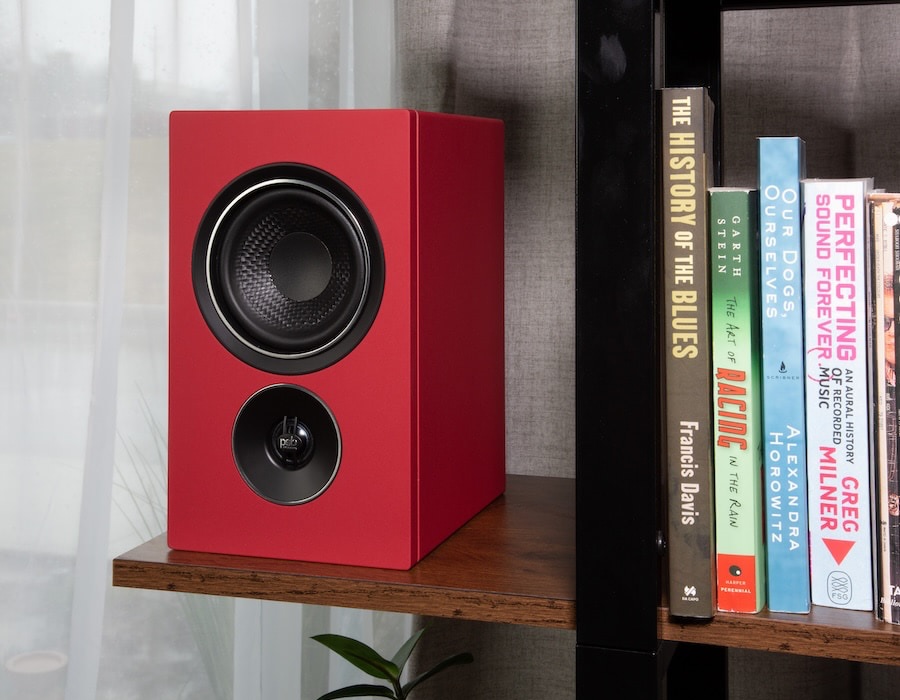
The iQ2 is also the stylistic flagship. It is available in black, white, ember red, boreal green, granite grey, sandstone beige and premium walnut veneer. The walnut version adds copper-finish accents, while PSB says the iQ2 cabinets use a fingerprint-resistant coating. This may sound like a minor domestic detail, but it is relevant to active systems designed to live visibly in shared spaces: they are handled more often than passive speakers, particularly when connected to a TV, turntable and computer.
Who are the PSB iQ speakers for?
The iQ1 and iQ2 make the strongest case for listeners who want a real stereo system but do not want a rack of separate electronics. Their combination of streaming, HDMI eARC, MM phono support, USB-C audio, analogue and optical inputs means they can accommodate a surprisingly broad mix of modern and legacy sources. The subwoofer management expands their prospects beyond nearfield or very small-room listening.
The choice between the two is principally an installation and finish decision. The iQ1 suits buyers content with a cable linking the speakers and choosing between black and white vinyl. The iQ2 is aimed at those for whom low-latency wireless inter-speaker operation, more decorative colour choices and the walnut veneer option justify stepping up.
PSB has not supplied pricing, dimensions, detailed frequency-response figures or further technical information in the announcement provided, so those are points worth checking before purchase—particularly for buyers assessing placement on a shelf, desk or TV unit. On the published specification, though, the iQ range’s proposition is clear: it seeks to put the convenience expected of a modern connected speaker into a compact, properly separated two-channel system with enough inputs to remain useful as the rest of the household’s audio changes around it.