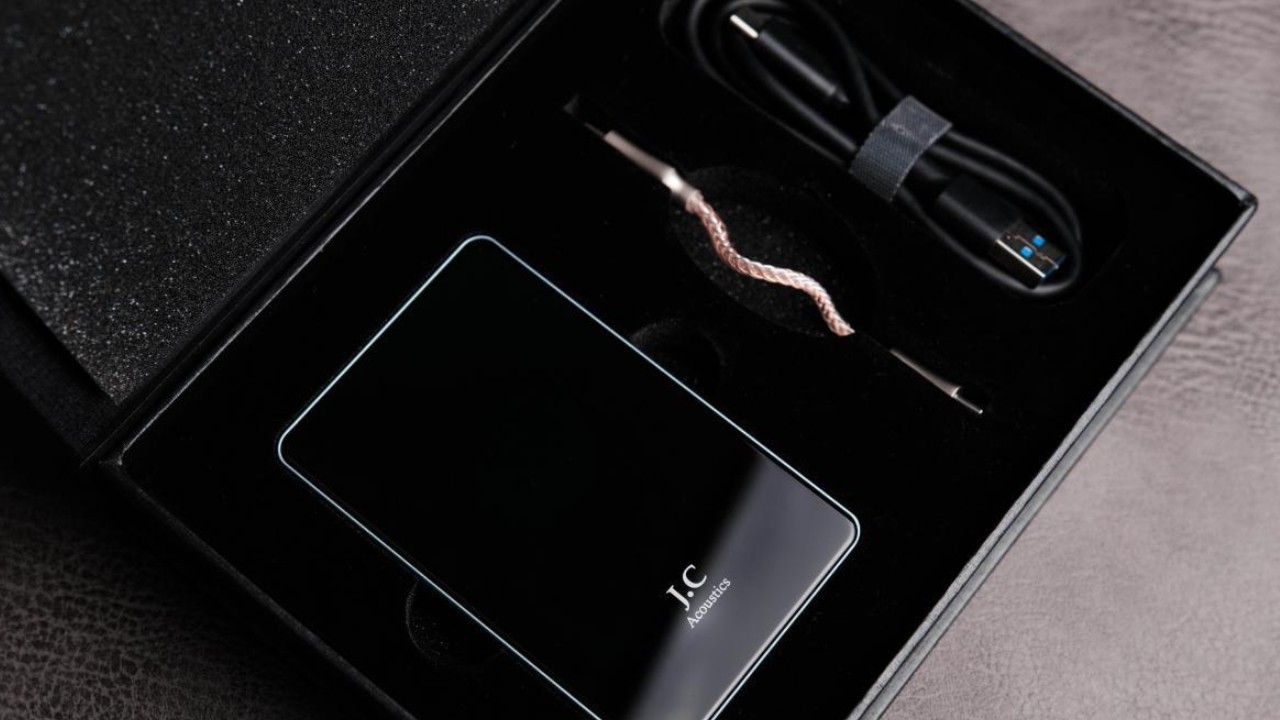
The JC Acoustics UDP-M3 is a compact Bluetooth USB DAC and headphone amplifier aimed at listeners who want considerably more drive than a phone, laptop or small dongle DAC can usually provide. Priced at $412, it combines a dual-DAC, fully balanced audio architecture with USB and Bluetooth connectivity, a 4.4mm balanced headphone connection rated at 1,500mW per channel into 32 ohms, and a built-in 4,200mAh battery.
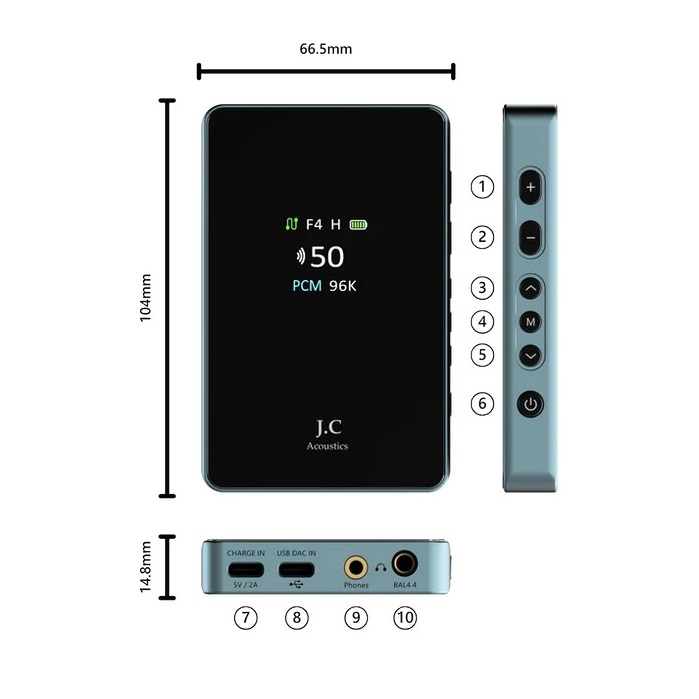
That makes it an interesting proposition at the boundary between portable and desktop listening. It is small enough to travel with at 104 x 66.5 x 14.8mm and 165g, but its output specification is substantial for a battery-powered component. The important caveat is that the UDP-M3 is described as a USB DAC/headphone amplifier with Bluetooth rather than a self-contained digital audio player: the supplied information does not state that it has onboard music storage, streaming apps or a microSD slot. In practice, it appears intended to receive music from a phone, tablet or computer and provide the conversion and headphone amplification stages externally.
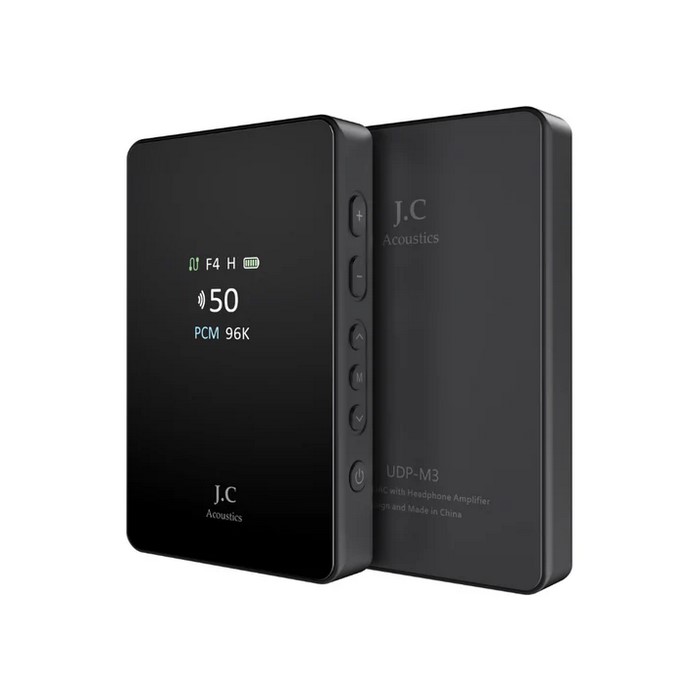
A portable DAC/amp built around a balanced signal path
JC Acoustics says the UDP-M3 took two years to develop and has adopted a fully balanced circuit. In a balanced headphone design, the left and right channels each use separate positive and negative signal legs through the relevant stages, rather than sharing a common return connection as conventional single-ended headphone outputs do. Properly implemented, this approach can help preserve channel separation and allows the amplifier to develop greater voltage swing at the balanced output.
It is worth separating that internal topology from the connector itself. The 4.4mm Pentaconn socket is the balanced headphone output, while the 3.5mm socket is single-ended. A headphone must be terminated and wired specifically for balanced use before it can be connected to the 4.4mm output; a simple mechanical adaptor from a normal 3.5mm headphone plug is not automatically suitable. Owners should use the cable supplied for their headphones or a correctly wired replacement cable, and should not attempt to connect the balanced output to equipment that expects a shared-ground connection.
The UDP-M3’s quoted channel separation is -118dB at 1kHz, while the stated dynamic range is 123dB and SNR is 118dB. These are laboratory performance figures rather than guarantees of audible behaviour in every system, but they indicate that JC Acoustics is targeting low noise and strong left/right isolation. This matters particularly with complex headphone mixes, where a portable device’s shared grounds, limited power supply and compact internal layout can otherwise make it harder to maintain clean separation at higher listening levels.
Dual AKM conversion, XMOS USB and FPGA reclocking
Digital conversion is handled by two AKM AK4493SEQ DAC chips, one per channel within the UDP-M3’s balanced architecture. A dual-mono-style allocation of DAC resources is a common route to maintaining independent left and right signal paths, though the ultimate result depends on the analogue output stage, power supply and circuit layout as much as the DAC chips themselves.
For wired digital playback, JC Acoustics specifies an XMOS XU316 USB controller. XMOS hardware is widely used in asynchronous USB audio designs, where the DAC’s clocking system controls how data is requested from the host device instead of simply following a computer’s potentially noisier timing. The manufacturer also specifies FPGA-based digital shaping, synchronous RECLOCK processing and global clock synchronisation, alongside Japanese NDK femtosecond clocks.
Clock accuracy and low timing uncertainty are important because digital audio must be converted at precisely spaced intervals. Jitter is the term commonly used for timing errors in that process. No digital system is literally free of jitter, but careful clocking, data buffering and reclocking can reduce timing-related errors before conversion. The UDP-M3’s stated approach suggests that JC Acoustics has paid attention to the digital interface and clock domain, not simply fitted a pair of DAC chips.
Over USB, the UDP-M3 supports PCM up to 384kHz and DSD512. These headline format limits are useful for listeners with high-resolution PCM or DSD libraries, although a file’s native format alone says little about its mastering quality. For most music, reliable driver support, sensible volume control and a clean conversion stage will have more practical impact than chasing the largest possible sample-rate figure. Prospective owners should also confirm compatibility with their specific phone, tablet or computer, including any required USB adapter, playback software settings and power-management behaviour.
Bluetooth convenience, with the limits of wireless audio understood
The UDP-M3 uses Qualcomm’s QCC5125 Bluetooth chip and supports Bluetooth 5.1, LDAC, aptX HD and aptX Low Latency. JC Acoustics lists support for these codecs at up to 24-bit/96kHz. This gives the unit a useful second role: it can be used wirelessly from a compatible source while retaining its own DAC and headphone amplification section.
LDAC and aptX HD are designed to carry more audio data than basic Bluetooth codecs, while aptX Low Latency is principally relevant where reduced delay matters, such as video viewing or gaming. However, codec selection is always negotiated with the transmitting device. A phone or computer that does not support one of these formats will fall back to another mutually compatible codec, and Bluetooth remains a compressed wireless connection rather than a bit-perfect equivalent to USB playback.
That does not make Bluetooth a token feature. It can be the practical choice for travel, office listening and occasions when a cable to the source is inconvenient. USB remains the more straightforward route when the aim is to play high-resolution files in the formats stated by JC Acoustics or to avoid Bluetooth codec negotiation altogether. The flexibility to choose between the two is arguably more useful than treating either connection as universally superior.
Power output and headphone matching
The standout specification is the 4.4mm balanced output, rated at up to 1,500mW per channel into 32 ohms. The conventional 3.5mm output is rated at up to 380mW into the same load. These are not directly interchangeable ratings: the balanced output has significantly more claimed power, and a compatible balanced cable is needed to access it.
Power figures into 32 ohms are a useful reference point, especially for many modern planar-magnetic and low-impedance dynamic headphones, but they do not tell the whole matching story. Headphone sensitivity determines how loudly a headphone plays for a given voltage or power, while impedance affects the current and voltage demands an amplifier sees. A high-impedance headphone can require substantial voltage swing even if its power requirement looks modest on paper; a low-impedance, low-sensitivity design may be more demanding of current delivery.
Consequently, the UDP-M3’s headline output suggests useful reserve for difficult full-size headphones, but it does not by itself establish compatibility with every headphone on the market. The manufacturer has not provided output ratings into other impedance loads, output impedance, gain settings or a recommended headphone impedance range. Those are details worth confirming for owners of unusually sensitive in-ear monitors or particularly demanding headphones.
For sensitive earphones, the practical concern is not maximum power but usable volume range and background noise. The UDP-M3’s quoted 118dB SNR and low stated THD+N of less than 0.0008% at 1kHz and 1Vrms, A-weighted, through the 4.4mm balanced output point towards a low-noise design, but they should not be read as a guarantee that every sensitive IEM will be silent. Volume control implementation and gain behaviour remain important in day-to-day use.
The amplifier section uses OPA1656 and OPA1642 operational amplifiers, plus a pair of TPA6120A2RGYT devices. These components form part of the signal conditioning and headphone-driving circuitry, but their presence should not be mistaken for a complete account of the circuit. Component choice matters, yet power-supply design, implementation and thermal management are equally central to the performance of a compact, high-output headphone amplifier.
Battery, heat and desktop use
A 4,200mAh battery is built in, with a quoted playback time of eight hours. Actual endurance will naturally vary with the output being used, headphone load, volume, Bluetooth versus USB operation and screen use. Driving low-impedance headphones loudly from the balanced socket asks much more of the battery than modest-level listening with efficient earphones.
JC Acoustics says the unit can fast-charge in 1.5 hours using a Texas Instruments control chip, can be charged while operating, and includes a USB power mode for desktop use. The latter could make the UDP-M3 a more practical companion for a laptop or fixed work setup, where preserving battery cycles and avoiding a depleted portable device are meaningful conveniences. The supplied information does not specify the exact behaviour of this mode, the charger requirement or whether battery charging can be bypassed completely, so those details should be checked before purchase.
The company also acknowledges that the UDP-M3 generates heat because it combines high output power with a compact enclosure. That is not surprising: amplifier output stages and power regulation dissipate energy as heat, particularly when asked to supply significant current. Some warmth is normal for a powerful portable amplifier, but users should avoid enclosing it in a tight case, covering it during charging, or leaving it in hot environments. Heat may be an ownership trade-off for the output capability offered in this small chassis, even though JC Acoustics says it does not affect operational stability.
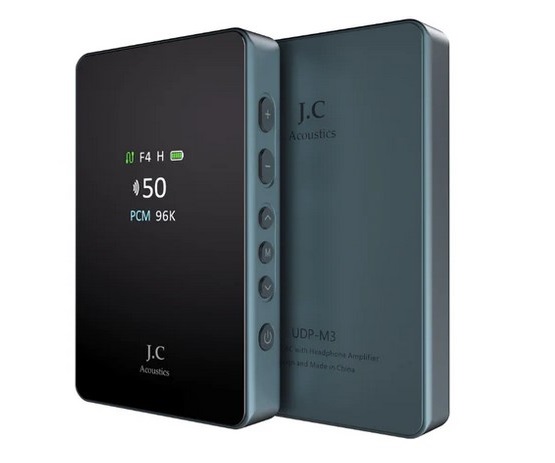
Controls, parts selection and everyday appeal
The UDP-M3 has a 1.28-inch colour touchscreen for settings adjustment. A screen is valuable on a component with multiple input and playback options because it can provide direct confirmation of the active source, format or setting rather than relying solely on status LEDs. The draft does not detail the interface layout, volume-control method, filters or menus, so its usability cannot be assessed from the available information.
JC Acoustics also cites Japanese Panasonic film capacitors, 0.1% tolerance precision resistors and silver Jensen wiring. Film capacitors are often selected in audio circuits for their stable electrical properties, while closely tolerated resistors can assist channel matching and circuit consistency. These are meaningful construction details, although enthusiasts should resist reducing a device’s likely performance to a list of premium parts. Their placement, circuit role and overall engineering execution determine their relevance.
JC Acoustics UDP-M3: key specifications
- DAC: AKM AK4493SEQ x 2, fully balanced circuit
- Bluetooth: Qualcomm QCC5125, Bluetooth 5.1; LDAC, aptX HD and aptX Low Latency support, up to 24-bit/96kHz
- USB controller: XMOS XU316
- Signal processing: FPGA with digital shaping, synchronous RECLOCK and global clock synchronisation
- Format support: DSD512 and PCM 384kHz
- Headphone outputs: 4.4mm balanced, 1,500mW at 32 ohms per channel; 3.5mm single-ended, 380mW at 32 ohms
- THD+N: less than 0.0008% at 1kHz, 1Vrms, A-weighted, 4.4mm balanced
- SNR: 118dB
- Dynamic range: 123dB
- Channel separation: -118dB at 1kHz
- Battery: 4,200mAh, up to eight hours of playback
- Charging: 1.5-hour fast charging; charging during operation supported
- Display: 1.28-inch colour touchscreen
- Dimensions: 104 x 66.5 x 14.8mm
- Weight: 165g
- Price: $412
Who should consider it?
On specification, the JC Acoustics UDP-M3 is most compelling for headphone listeners who need a transportable USB DAC/amp with a serious balanced output, rather than a minimal dongle for efficient earphones. Dual AKM conversion, the XMOS XU316 interface, FPGA reclocking and broad USB format support give it the ingredients of a capable wired digital front end, while Bluetooth adds a more casual route from a compatible phone or computer.
The trade-offs are equally clear. Its power-focused design produces heat, battery life is quoted at eight hours rather than an all-day figure, and the available information leaves several integration details unconfirmed, including line-level output facilities, gain options and app or streaming functionality. For listeners who want a dedicated player with local storage and independent playback, this may not be the appropriate category of device. For those with a phone or laptop as their music source and headphones that can benefit from more amplifier headroom, the UDP-M3’s combination of compact dimensions and 1,500mW balanced output makes it a portable DAC/amp worth closer examination.