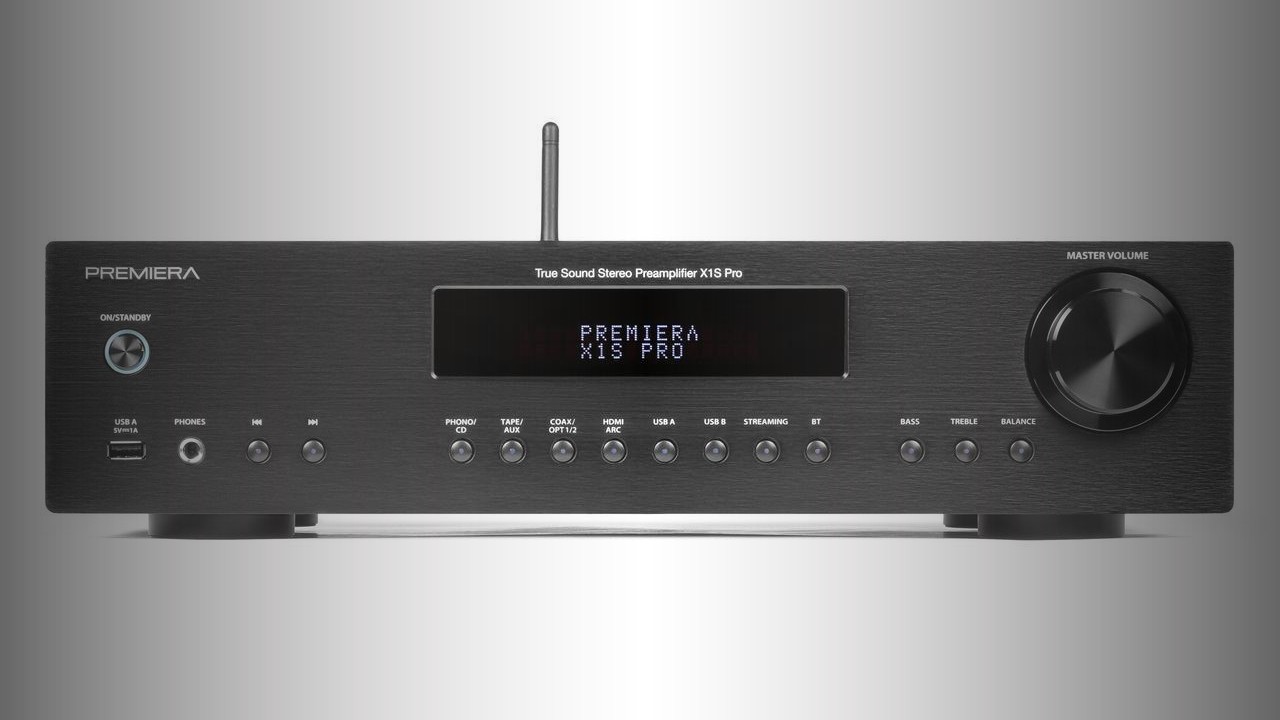
The Premiera X1S PRO is a full-function stereo preamplifier intended to sit at the centre of a modern separates system. Rather than asking the owner to assemble a streamer, DAC, phono stage and TV interface around a conventional analogue preamp, it brings those functions together in one component, then supplies variable-level balanced XLR and unbalanced RCA outputs to a power amplifier.
At its stated price of $900, the appeal is not simply that the X1S PRO has a long feature list. It is that the feature list addresses several genuinely different source types: a turntable fitted with either a moving-magnet or moving-coil cartridge, conventional line-level sources, Bluetooth devices, a network music library or streaming source, and a television via HDMI ARC. The result is a potentially tidy answer for listeners who want the flexibility and speaker-driving headroom of a separate power amplifier without filling a rack with front-end boxes.
A preamplifier rather than an all-in-one amplifier
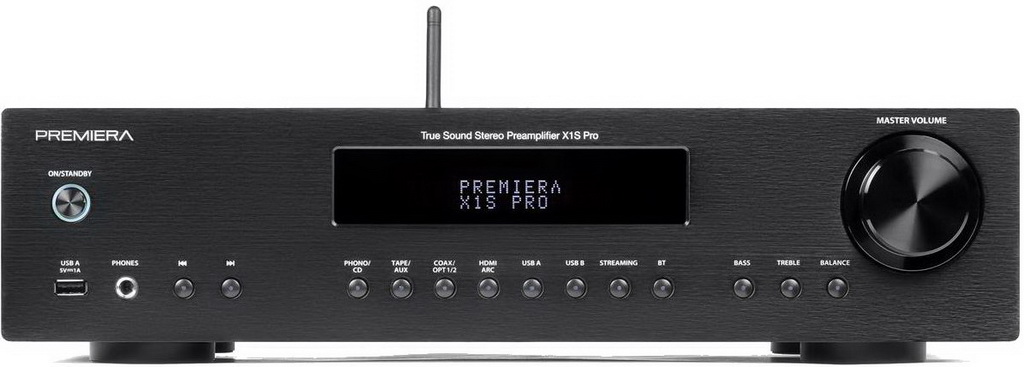
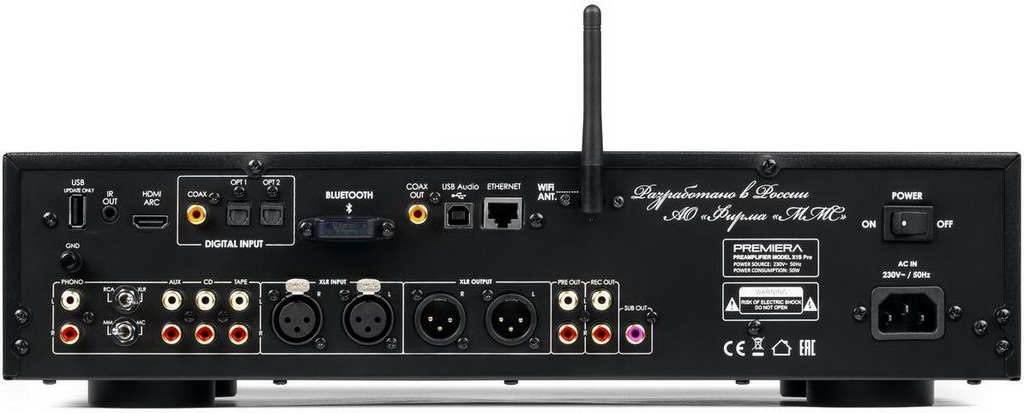
It is important to establish what the X1S PRO is and is not. This is a preamplifier: it controls source selection and volume, but it does not contain the speaker power-amplifier stage needed to drive passive loudspeakers. Owners will need a separate power amplifier, or active loudspeakers that accept a suitable line-level connection. Premiera provides both adjustable RCA and balanced XLR pre-outs, which gives the unit a useful degree of flexibility when matching it to the amplification already in a system.
Balanced XLR connections can be particularly useful where the preamp and power amplifier are separated by longer cable runs, or where an installation is susceptible to electrical interference. The balanced connection uses a differential signal arrangement that can reject noise picked up equally by both signal conductors. It is not automatically superior in every short domestic cable run, but its inclusion makes the X1S PRO more adaptable than a preamp restricted to RCA outputs.
The published maximum output figures are 5.25V via RCA and 6.74V via XLR, with THD below 0.8% in stereo mode. Those are generous voltage capabilities for a preamplifier and should provide ample level for many conventional power amplifiers. As always, the relevant practical consideration is gain structure: a particularly high-gain power amplifier and sensitive loudspeakers may require a more restrained volume setting, while a lower-sensitivity amplifier benefits from a preamp that can deliver a healthy output voltage.
There is also a fixed recording output and a dedicated mono output for an active subwoofer. The record output is useful for a recorder or an external device that requires a non-volume-controlled feed. The subwoofer connection is a welcome system-building provision, particularly in a two-channel setup where a powered subwoofer is being used to extend bass response. The draft does not specify whether the subwoofer output is filtered or how bass management is implemented, so prospective buyers should confirm that point if crossover integration is central to their plans.
Inputs, TV integration and day-to-day control
Premiera says the X1S PRO offers 12 potential input sources. The supplied specification explicitly lists one RCA MM phono input and three RCA analogue stereo line inputs, labelled CD, Aux and Tape; the Aux connection may be RCA or XLR. There is also a balanced XLR input, with a nominal sensitivity of 1.23V (+4dBu), compared with 630mV (-4dBV) for the RCA line inputs. That reflects the different operating levels commonly encountered in balanced and unbalanced equipment.
The line stage is specified to accept up to 3.17V at its RCA inputs and 6.18V at its balanced XLR input. In practical terms, these headroom figures matter because they indicate the unit should accommodate the higher output levels of many modern DACs and source components without overload. Premiera quotes channel separation above 90dB for the line input, a signal-to-noise ratio above 107dB, and THD+N below 0.008% from 10Hz to 25kHz at -10dBV through RCA in stereo. These figures do not substitute for auditioning or independent measurement, but they describe a low-noise, low-distortion line-stage target.
HDMI ARC is one of the X1S PRO’s more practical inclusions. ARC, or Audio Return Channel, allows a compatible television to send audio back down an HDMI cable to the preamplifier. This can simplify TV, film and console sound in a stereo system, avoiding the need for a separate optical connection in many installations and allowing volume to be managed in a more integrated way, depending on the TV’s HDMI control settings. Compatibility can vary between television brands and configurations, so it remains sensible to check the TV’s ARC/eARC and HDMI-CEC settings during installation.
The front panel provides the controls most likely to be needed without reaching for a phone: volume adjustment, source selection, tone controls and playback management. A display presents system information, while menu navigation is handled using Premiera’s rotary control, described as a regulator puck, or the supplied remote control. The menu includes loudness compensation, tone-control adjustment, display and button brightness settings, device information, software updating and a factory reset.
Loudness compensation is worth distinguishing from a conventional bass boost. At lower playback levels, human hearing becomes relatively less sensitive to bass and treble than it is to the midrange. A loudness function is intended to counteract that tendency for low-level listening. Its usefulness depends on programme material, speakers and listening level, so the ability to turn it on or off is more valuable than treating it as a permanent sound mode. The X1S PRO’s tone section provides adjustment of ±10dB at 100Hz and ±10dB at 10kHz, offering broad low- and high-frequency tailoring for recordings, rooms or speaker placement that need a modest correction.
Streaming, Bluetooth and the onboard DAC
Network functionality is handled through Wi-Fi, supporting both 2.4GHz and 5GHz bands, with configuration and playback control available through the Audio System app for iOS and Android. Dual-band Wi-Fi matters in a practical sense: 2.4GHz generally has better range through walls, while 5GHz can offer a less congested connection at shorter distances. A stable network remains essential for reliable streaming, and an owner with weak wireless coverage near the hi-fi rack should consider network placement carefully.
The stated streaming protocols are AirPlay 2 and DLNA. AirPlay 2 makes the X1S PRO relevant to listeners using Apple devices and permits AirPlay 2 multiroom operation. DLNA is useful for browsing and playing compatible music stored on a network-attached storage device or computer, although the experience and library navigation will depend on the control app and server being used. Linkplay multiroom is also listed. Premiera notes that support for third-party software and services is subject to availability; no specific subscription services or Roon compatibility are confirmed in the supplied information, so these should not be assumed.
Bluetooth 5.0 is included with aptX, aptX HD and AAC codec support. Bluetooth remains the quickest way to hand playback over to a guest’s phone or to play an app that is not integrated with a network-streaming platform. Codec support can influence sound quality and stability when the transmitting device supports the same codec, but Bluetooth is still a wireless, source-dependent link rather than a guarantee of a particular audio quality. For critical listening from a stored library or a supported streaming service, network playback may be the more appropriate route.
Digital conversion is based on an ESS ES9018K2M Sabre DAC with 32-bit HyperStream architecture. The X1S PRO is specified to support PCM up to 32-bit/384kHz and DSD up to 11.2MHz, while the listed XMOS firmware is guaranteed to support DSD at 5.6MHz. The distinction is worth noting: the source material gives a headline DSD ceiling of 11.2MHz for the DAC section but separately confirms 5.6MHz support for the XMOS firmware. The exact capability available through each input and playback route should therefore be confirmed before making a purchasing decision based on DSD256 files.
Premiera also lists both synchronous and asynchronous sample-rate-conversion (ASRC) modes. In broad terms, sample-rate conversion can be used to translate one digital sampling frequency to another before conversion to analogue; asynchronous approaches use an independent clocking process. The presence of modes does not itself establish a sonic outcome, but it gives the manufacturer an additional way to manage digital signals. A coaxial digital output is fitted, allowing the X1S PRO to feed an external DAC should an owner later wish to explore a separate converter.
MM and MC vinyl playback: useful flexibility, fixed loading
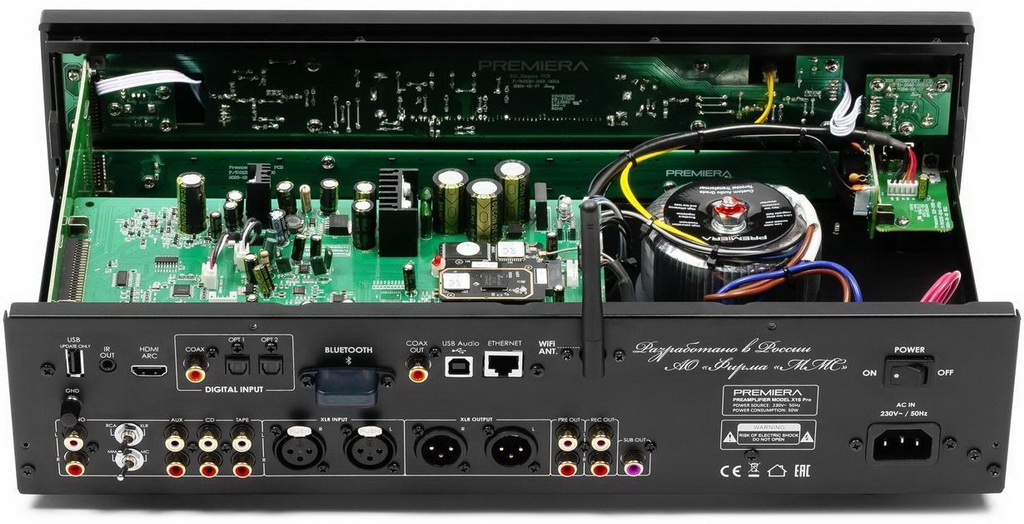
The integrated phono stage accepts both moving-magnet and moving-coil cartridges, eliminating an additional box for vinyl listeners. For MM cartridges, Premiera specifies sensitivity of at least 2.5mV, with 47kΩ impedance and 47pF capacitance preset. The 47kΩ load is the conventional MM standard and will suit a broad range of moving-magnet designs. Input capacitance can influence the ultrasonic and upper-treble resonance of an MM cartridge, however, and the tonearm cable contributes additional capacitance. Because the X1S PRO’s 47pF setting is stated as preset rather than adjustable, owners of cartridges with unusually prescriptive loading recommendations should check the total capacitance in their arm and cable arrangement.
For MC, the published specification is at least 0.25mV sensitivity, 300Ω loading and 470pF capacitance, again preset. A 0.25mV figure indicates the stage is intended for many low-output moving-coil cartridges, but not necessarily every exceptionally low-output design. The fixed 300Ω load is a practical compromise, rather than the adjustable resistance offered by some dedicated phono stages. It may work well with numerous cartridges, but committed vinyl enthusiasts who want to optimise loading precisely for a particular MC could regard a separate adjustable phono stage as a future upgrade path.
Who should consider the X1S PRO?
The X1S PRO makes the strongest case for someone building a compact but capable separates system around a power amplifier. It can consolidate a TV connection, a turntable, line-level sources, casual Bluetooth playback and network music in a single control component, while preserving the option of balanced connection to the amplifier and a subwoofer in the system. Its maximum 30W power consumption should also make it a relatively undemanding component to leave ready for network use, though the supplied information does not state standby consumption.
The trade-off of this all-in-one front end is that certain specialist details are not specified in the available material. There is no full enumeration of the digital inputs within the supplied draft, no stated Ethernet connection, and no confirmation of particular streaming services. The phono stage is notably flexible in supporting both MM and MC cartridges, but its loading is preset. These are not necessarily shortcomings, but they are the questions a buyer should resolve against their existing sources and listening habits.
For a listener who values an uncluttered rack, uses a television as part of a two-channel system and wants to retain a proper separate power amplifier, the Premiera X1S PRO’s combination of HDMI ARC, network playback, phono capability and comprehensive preamp outputs is its central proposition. At $900, it is positioned as a feature-rich hub rather than a minimalist analogue preamplifier—and the right choice will depend on whether that integration suits the rest of the system.
Premiera X1S PRO key specifications
- DAC: ES9018K2M Sabre with 32-bit HyperStream architecture; PCM to 32-bit/384kHz and DSD to 11.2MHz stated
- XMOS firmware: DSD support guaranteed to 5.6MHz
- Frequency response: 10Hz–70kHz, ±1.0dB
- Line-input channel separation: >90dB
- THD+N: <0.008%, 10Hz–25kHz in stereo at -10dBV/RCA
- Line-input signal-to-noise ratio: >107dB
- Wireless: 2.4GHz/5GHz Wi-Fi; Bluetooth 5.0 with aptX, aptX HD and AAC
- Network protocols: AirPlay 2 and DLNA; AirPlay 2 and Linkplay multiroom
- Outputs: record out, variable RCA and XLR pre-outs, mono active-subwoofer output, coaxial digital output and IR Trigger Output
- Maximum output level: 5.25V RCA; 6.74V XLR (THD <0.8% in stereo mode)
- Phono stage: MM and MC; MM 47kΩ/47pF preset, MC 300Ω/470pF preset
- Tone controls: ±10dB at 100Hz and 10kHz
- Power requirement: 220–240V, 50Hz; consumption up to 30W
- Price: $900