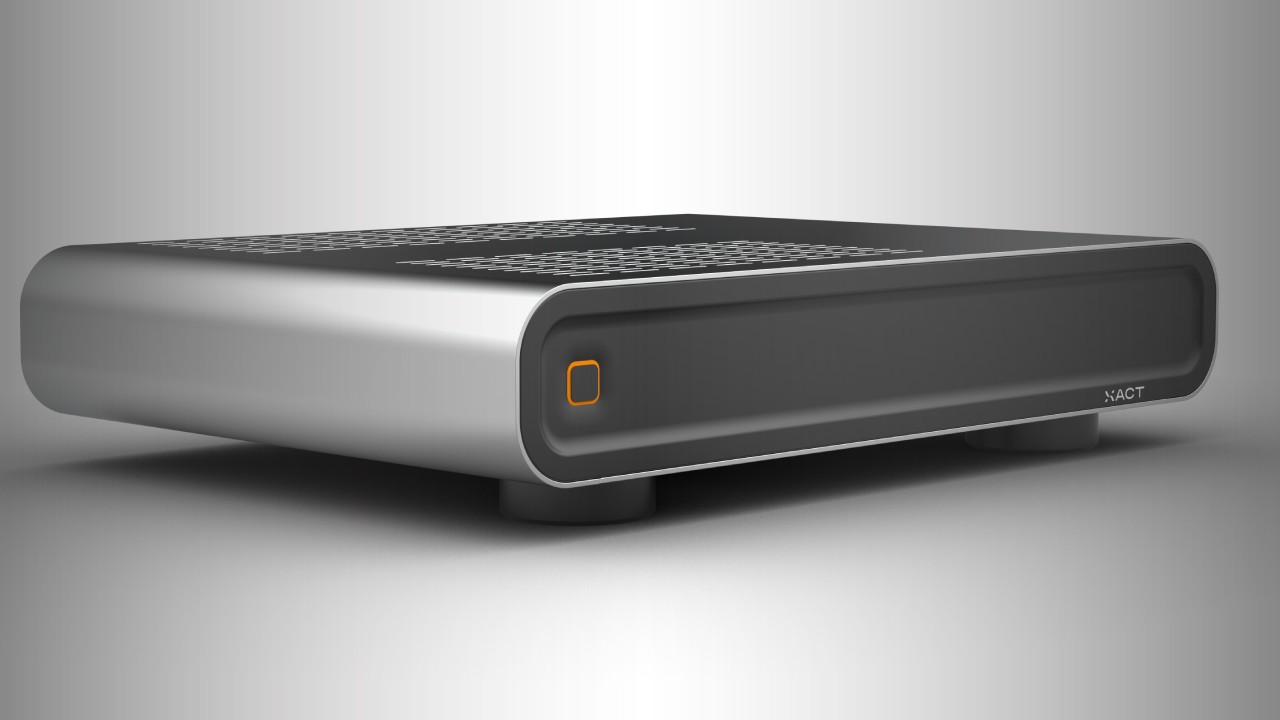
Polish manufacturer XACT has introduced the XACT S1 EVO, a high-end audio server priced at €16,000. Its launch is built around two areas that are often treated as secondary details in computer-based music playback but can be important in a carefully resolved digital system: timing precision and mechanical control.
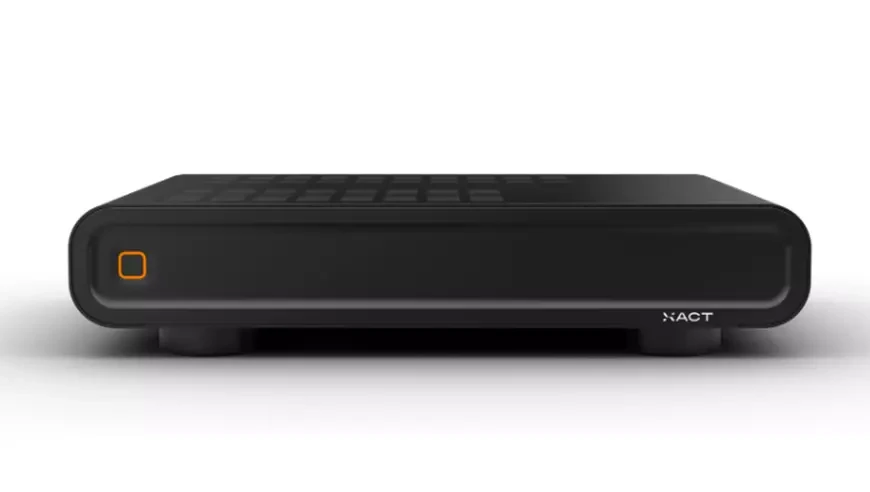
The S1 EVO uses what XACT calls its Master’s exclusive OCXO Clock, while its new IMMOTUS™ feet combine ceramic and aluminium to isolate sensitive internal parts from vibration. Neither feature is a substitute for a capable DAC, good network implementation or sympathetic system matching; indeed, XACT has not supplied details here on the server’s outputs, supported services and formats, control platform, storage, DAC compatibility or networking provision. But the stated engineering priorities clearly position the S1 EVO as a specialised source component for listeners building a no-compromise digital front end around an external DAC.
Why clocking matters in an audio server
Digital audio is frequently described as a sequence of ones and zeroes, which can make it seem as though timing should not matter once a music file has been read correctly. The reality is more nuanced. A digital playback chain must turn that stored data into a continuous, accurately timed stream for conversion into analogue audio. The clock is the reference that governs that timing.
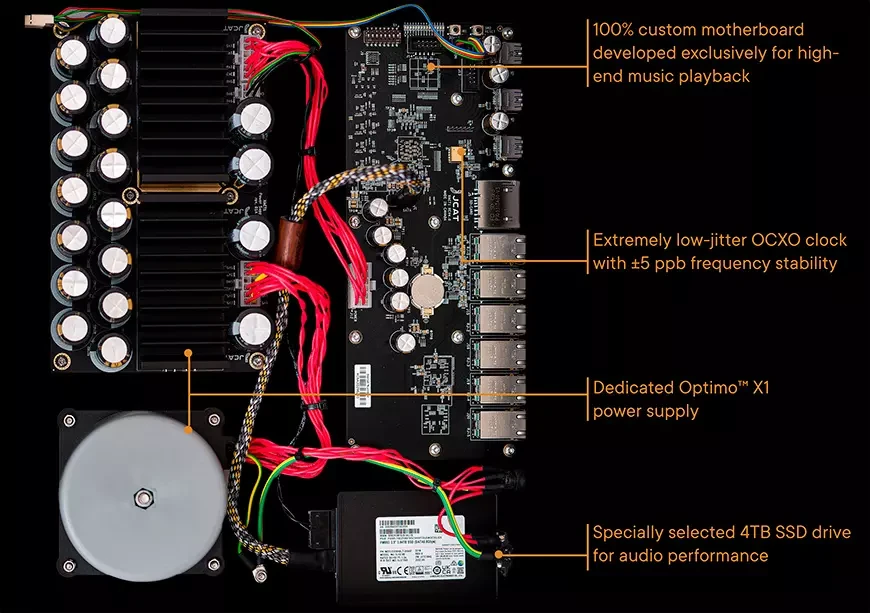
An OCXO, or oven-controlled crystal oscillator, is designed to maintain a stable operating temperature around its crystal element. Crystal frequency can shift slightly with temperature, so regulating its environment is a well-established way of pursuing greater frequency stability than a conventional free-running crystal oscillator can usually offer. In a component intended for high-end audio use, the objective is to provide a more consistent timing reference and minimise timing uncertainty, commonly discussed under the broad heading of jitter.
It is worth separating the general principle from a guaranteed sonic result. The audible importance of clock performance depends on the entire architecture of the digital chain: how the server transmits data, how an attached DAC receives and reclocks it, the interface in use, and the quality of power supplies and grounding throughout the system. A DAC with robust asynchronous input and local clock recovery, for example, is designed to reduce its dependence on upstream timing. Conversely, some server-and-DAC combinations may be more sensitive to the quality of the source’s digital output implementation.
What the S1 EVO’s OCXO specification tells us is that XACT has made timing stability a central part of its design brief rather than treating the server as simply a general-purpose computer in an audio chassis. The company says the clock is intended to deliver stability and precision in the reproduction of musical detail. That is a meaningful distinction in this sector, although prospective buyers will need to establish how the clock is deployed within the S1 EVO and which digital interfaces benefit from it before drawing conclusions about compatibility with a particular DAC.
IMMOTUS feet address mechanical vibration
The other notable change is the introduction of XACT’s IMMOTUS™ feet. Constructed from ceramic and aluminium, these feet are intended to isolate delicate audio circuitry from internal vibration. XACT says the approach is designed to improve detail and bass precision.
Mechanical isolation is familiar territory in analogue replay, where a turntable cartridge is deliberately transducing tiny mechanical movements into an electrical signal. Its relevance to a digital server is less immediately obvious, but not necessarily irrelevant. Servers contain powered electronic circuits, oscillators, storage and network hardware, and may include components that can generate or transmit vibration. There can also be airborne vibration from loudspeakers and vibration conducted through furniture or equipment supports.
The exact effect of vibration on a given digital component depends on its internal layout, enclosure design, power supply, clock circuitry and the system in which it is installed. XACT’s stated rationale is to reduce the passage of such energy to sensitive components. Ceramic is commonly selected in isolation systems for its hardness and rigidity, while aluminium offers a light, stiff and practical structural material. The performance of any footer, however, comes from the complete mechanical design—including contact surfaces, geometry, loading and the equipment rack—not merely the material list.
In practical terms, the IMMOTUS feet mean the S1 EVO is designed to be used as a complete mechanical system rather than placed on generic pads or an arbitrary shelf without thought. Owners should still begin with a stable, level support that has sufficient load capacity and is not prone to rocking. It would also be sensible to avoid immediately adding further isolation products on top of XACT’s own footers. Stacking multiple compliance systems can produce unpredictable results, and there is no information yet from XACT on whether the IMMOTUS design is intended to be used with alternative supports.
A source component for an external-DAC system
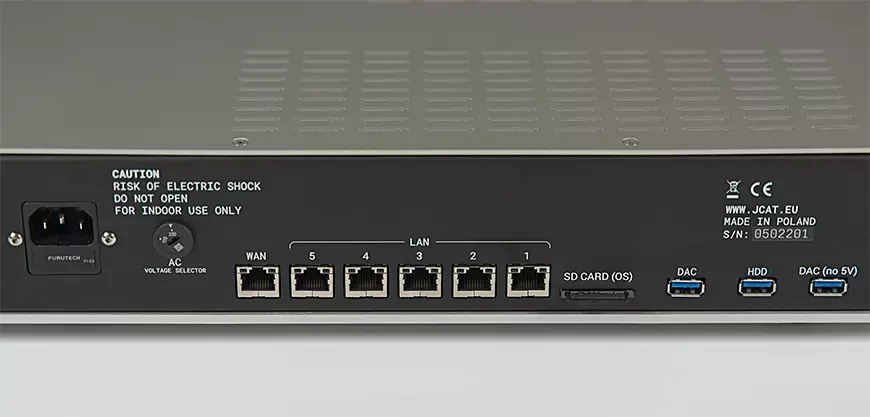
The term audio server can cover a wide range of products. At one end are compact network players that combine streaming, conversion and analogue outputs in one box. At the other are dedicated digital transports and servers intended to store or organise a library, run playback software and feed a separate DAC. The available launch information does not specify which connections, operating system or playback ecosystem the S1 EVO uses, so it would be premature to assume particular streaming services, Roon capability, USB outputs, Ethernet provision, internal storage options, PCM or DSD support, or app control.
That missing information is particularly important at this price. A €16,000 server will normally be judged not only by its engineering but by how smoothly it fits into the owner’s daily music habits. Before ordering, buyers should confirm:
- the available digital outputs and their supported resolutions;
- compatibility with the intended DAC and preferred connection type;
- whether music is stored internally, on a network-attached drive or accessed only through network services;
- the playback and library-management platform, including control-app support;
- network connection requirements and whether wired Ethernet is recommended or required; and
- software update policy, support arrangements and regional dealer assistance.
These are not minor housekeeping questions. The server is the point where a locally stored library, streaming catalogue and user interface meet the DAC. Even an exceptionally engineered transport can become frustrating if its software, metadata management or service integration does not align with the owner’s listening habits.
System matching: where the S1 EVO’s approach makes sense
The S1 EVO is likely to make most sense in a system where the source is treated as a distinct performance-critical component. That generally means partnering it with an external DAC of comparable ambition, then feeding a preamplifier, integrated amplifier or active loudspeaker system through the DAC’s analogue outputs. The server itself does not replace the DAC, amplification or speakers; it is the digital source and library/streaming endpoint within that chain.
Connection choice should be determined by the facilities of both the server and DAC, once confirmed. USB, AES/EBU, S/PDIF and network-based DAC approaches each handle clocking and data transfer differently. There is no universal “best” interface independent of implementation. A sensible approach is to start with the manufacturer-supported connection for the chosen DAC, use a properly specified cable of sensible length and ensure the server and DAC are placed on stable supports with adequate ventilation.
Network quality also deserves attention, though it should be approached rationally. Lossless music playback does not inherently demand exotic networking hardware, but a stable wired connection can be advantageous for reliability, especially when browsing large libraries or streaming high-resolution material. If a system uses a network switch, NAS drive and server together, orderly cable routing and a dependable local network will do more for trouble-free ownership than indiscriminate accessory swapping.
What is known—and what still needs confirmation
XACT’s announcement makes a focused case for the S1 EVO: this is a premium audio server whose headline upgrades are the Master’s OCXO clock and the IMMOTUS ceramic-and-aluminium isolation feet. The company presents the clock as a route to improved stability and precision, and the feet as a means of protecting sensitive internal components from vibration in pursuit of greater detail and bass definition.
Those are credible areas of engineering attention for an ambitious digital source, particularly for enthusiasts who already have a revealing DAC and system capable of exposing small differences in source implementation. Equally, the currently available information leaves major purchasing questions unanswered. There are no supplied details on digital connectivity, storage, streaming services, playback software, format support, dimensions or internal architecture. Those details will determine whether the S1 EVO is merely technically interesting or genuinely suitable for an individual system.
The XACT S1 EVO can now be ordered through the official XACT Audio website and authorised retailers, with a suggested retail price of €16,000. At that level, auditioning where possible and verifying day-to-day software and DAC integration should be as important as assessing the company’s clocking and isolation claims.