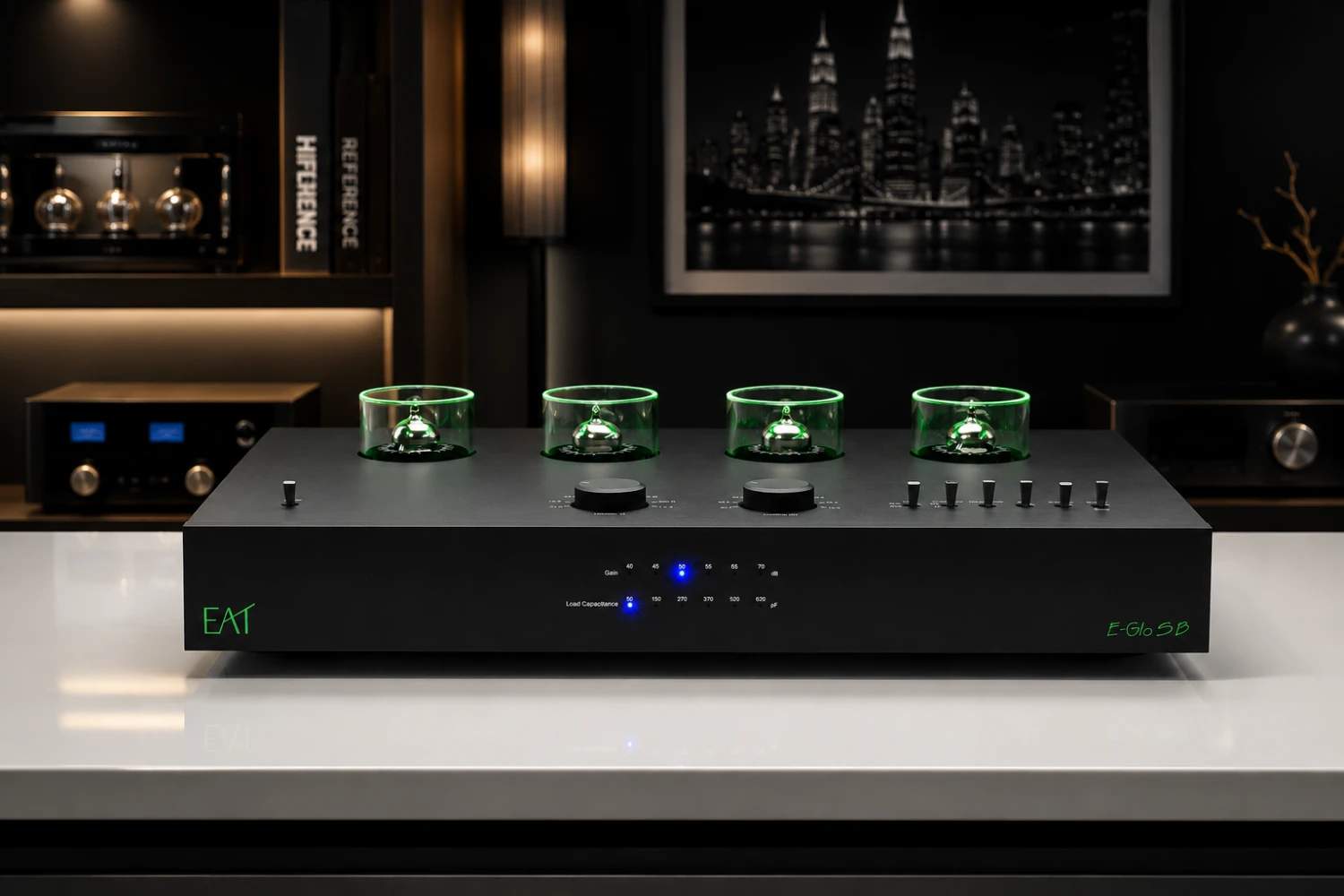
European Audio Team (EAT) has expanded its E-Glo phono-stage family with two substantial new models: the E-Glo CB and E-Glo SB. Both sit between the compact Petit B and the company’s flagship E-Glo FB, and both address a familiar analogue-system problem: extracting the best from a cartridge is as much about correct electrical matching and noise management as it is about adding gain.
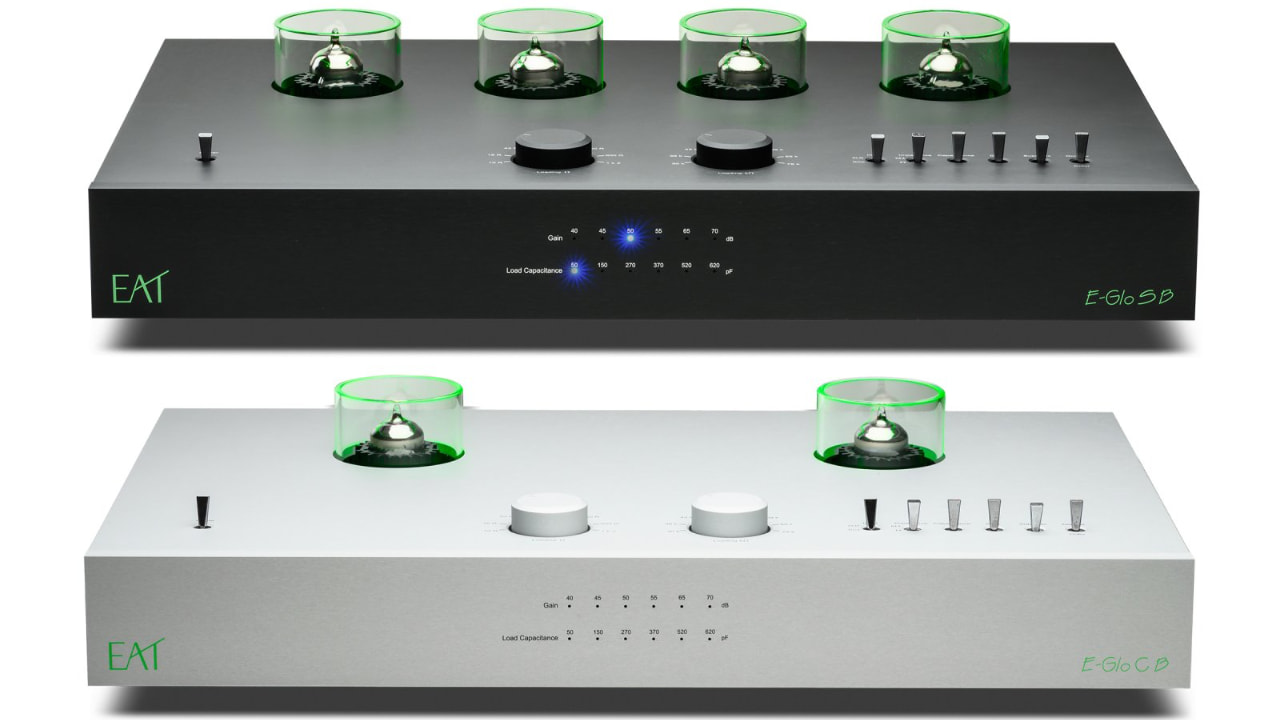
The two models share an unusually broad adjustment range for moving-magnet (MM) and moving-coil (MC) cartridges, discrete three-stage amplification, tube circuitry and balanced XLR facilities. But they are not simply the same phono preamplifier with a different tube count. Their crucial distinction is the architecture of the second gain stage. The E-Glo CB uses a hybrid, single-ended tube/transistor arrangement, while the E-Glo SB takes a more fully symmetrical tube-based route that more closely resembles the flagship E-Glo FB.
That makes this a meaningful choice for vinyl listeners considering a balanced MC cartridge connection, a highly adjustable phono stage for multiple cartridges, or a long-term upgrade from an entry-level MM/MC design. Here is what the circuit decisions and specifications mean in a real-world system.
Two intermediate E-Glo models, with a shared cartridge-matching brief
A phono stage has an unusually demanding task. A cartridge produces a very small signal: particularly with low-output moving-coil designs, output can be measured in fractions of a millivolt. Before that signal can be passed to a line-level preamplifier or integrated amplifier, it needs substantial, quiet amplification and precisely applied RIAA equalisation.
The E-Glo CB and E-Glo SB are intended to cover both common cartridge families. Their RCA inputs accept MM and MC cartridges, while their XLR inputs are reserved for balanced MC use. Both units offer adjustable resistive and capacitive loading, six selectable gain levels, simultaneous balanced and single-ended outputs, and a switchable subsonic filter. This is a far more adaptable proposition than a fixed-gain phono input, and it should be useful to owners who change cartridges, run more than one turntable, or simply want scope to optimise an existing cartridge rather than accept a one-size-fits-all input setting.
However, the shared controls should not obscure the central hierarchy. The E-Glo SB is the model for buyers specifically interested in maintaining balanced operation through the second amplification stage. The E-Glo CB still offers balanced MC input, common-mode noise suppression and balanced output, but it does not remain fully differential from the cartridge input all the way to the outputs.
Three gain stages and split RIAA equalisation
Both phono stages use three amplification stages constructed from discrete components rather than integrated operational amplifiers. That description alone does not guarantee a particular sonic result, but it does establish the design approach: EAT is using individual active devices and surrounding components to implement the gain and equalisation circuits, rather than relying on an all-in-one op-amp gain block.
The RIAA curve is split between passive and active sections. RIAA equalisation is essential in vinyl replay because records are cut with bass reduced and treble boosted. On playback, the phono stage must apply the inverse curve—restoring bass and reducing treble—to recover the intended tonal balance while improving the practical signal-to-noise ratio of the disc medium.
In a passive section, the frequency response is shaped by a network of components without gain; an active section combines equalisation with amplification. Neither approach is automatically superior in every implementation. A split arrangement gives a designer flexibility in where gain is applied and how the equalisation network interacts with the amplification stages. EAT specifies RIAA accuracy within 0.5dB from 20Hz to 20kHz for both models, a stated tolerance that covers the main audible band.
The first stage contains three separate semiconductor amplifier circuits. Two process the positive and negative phases of the signal separately, while a third sums those phases to help reject common-mode noise. The high-frequency part of the RIAA curve is also implemented in this first stage. Common-mode noise is interference that appears similarly on both legs of a balanced connection; a differential circuit can reject it by responding to the difference between the two signals rather than to shared noise. This is especially relevant where a very low-level MC cartridge signal must travel through cabling in the presence of mains transformers, digital equipment or other potential interference sources.
Dedicated DC servo circuits are also used to minimise DC offset at the outputs. In practical terms, DC offset is unwanted direct-current voltage that can appear alongside the audio signal. Keeping it under control is important for downstream equipment and helps avoid the need to rely exclusively on large coupling capacitors to block DC at an output.
The important difference: hybrid CB versus symmetrical tube SB
The E-Glo CB and E-Glo SB diverge at the second amplification stage, which handles the low-frequency portion of the RIAA equalisation. This is not a cosmetic difference, since that stage is a key part of how each model processes the delicate cartridge signal.
E-Glo CB: a hybrid, single-ended second stage
The E-Glo CB employs a hybrid single-ended tube and transistor circuit comprising two ECC83S triodes and one transistor. The ECC83 family—also commonly known by the 12AX7 designation—is widely used in low-level valve gain applications because it offers high voltage gain. In the CB, this hybrid stage performs the lower-frequency RIAA equalisation and incorporates the switchable subsonic filter.
After the first stage, the CB’s signal becomes unbalanced before the output stage generates its balanced output signal. This is an important point of terminology. A component can have XLR inputs and outputs without being fully differential throughout its entire circuit. The CB retains useful balanced-system benefits at its MC input and its output, but its internal signal handling is not balanced end to end.
For many systems, that may be entirely appropriate. The balanced MC input can still be valuable where cartridge wiring and tonearm cabling support a true balanced connection, while the XLR outputs remain convenient for a preamplifier or integrated amplifier with balanced line inputs. The design simply should not be confused with a fully symmetrical topology.
E-Glo SB: balanced operation retained through stage two
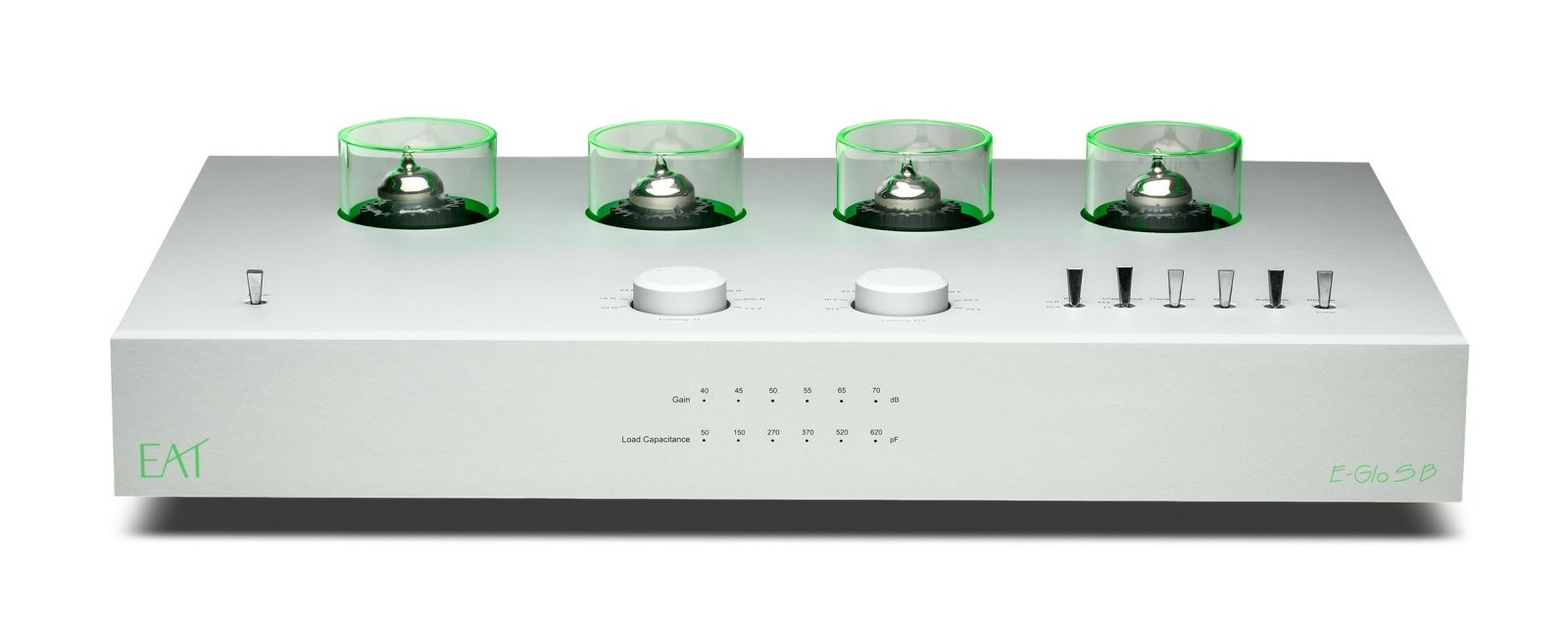
The E-Glo SB is closer in concept to the E-Glo FB. Its second gain stage is a symmetrical tube design using two ECC83S and two E88CC triodes. The E88CC is a dual-triode type often associated with low-noise small-signal applications; EAT’s specified complement here indicates that the SB uses more active tube devices than the CB in this part of the circuit.
Crucially, the SB preserves balanced operation through its second amplification stage. In a properly implemented differential signal path, the positive and negative phases remain separate until the relevant point in the circuit, which can support common-mode noise rejection. Whether that benefit is realised in a particular installation depends on the cartridge, tonearm wiring, cable routing and the balanced architecture of the following component, but the SB’s topology is clearly aimed at analogue systems built around balanced MC replay.
EAT also specifies semi-crystalline hydrocarbon polypropylene capacitors for the SB’s amplification and RIAA networks. Capacitors used in an equalisation network directly contribute to the frequency-shaping circuit, so their electrical tolerance and stability matter to maintaining the intended response. EAT has not supplied component values or further details of the networks, so it would be inappropriate to draw conclusions beyond the stated parts choice. Still, it is a concrete component-level distinction between the SB and the more hybrid-focused CB.
Loading and gain: enough range for MM, high-output MC and low-output MC
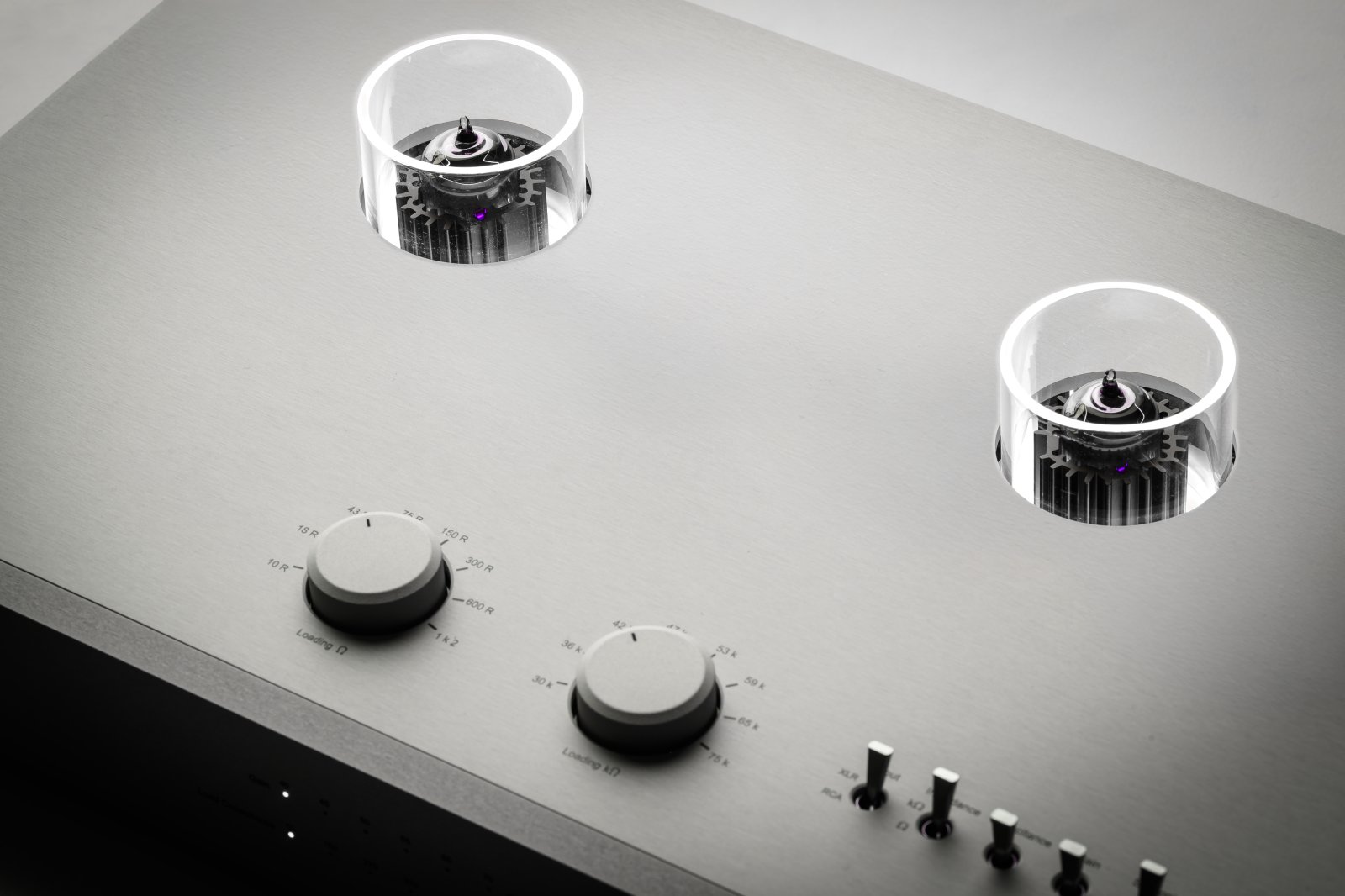
Both models offer the same extensive cartridge adjustment options. For MM cartridges, resistance can be selected between 30kΩ and 75kΩ, while capacitive loading is adjustable from 50pF to 620pF. MC loading ranges from 10Ω to 1.2kΩ.
Those figures matter because different cartridge generator types react differently to the load presented by the phono stage. MM cartridges are generally designed around a 47kΩ resistive input, but total capacitance—including tonearm wiring, interconnects and the phono-stage input—can affect high-frequency behaviour. Having 50pF to 620pF available gives the user scope to account for cable capacitance and cartridge-maker recommendations, rather than assuming that a nominal setting produces the intended total load.
MC cartridges are normally more sensitive to resistive loading choices. A lower resistance places a heavier electrical load on the cartridge, while a higher setting loads it more lightly. There is no universal “correct” number: the cartridge manufacturer’s recommendation is the sensible starting point, followed by careful adjustment if required. With options from 10Ω to 1.2kΩ, the E-Glo CB and SB cover a wide spread of MC requirements.
Six gain settings are available: 40, 45, 50, 55, 65 and 70dB. The 40–50dB region is potentially useful for many MM and higher-output MC cartridges, while the 55–70dB choices provide the additional voltage gain often required by lower-output MC models. EAT specifies that the balanced XLR outputs add a further 6dB of gain.
The right setting is not necessarily the maximum one. Too little gain can force an owner to turn the main amplifier’s volume control unusually high and can expose background noise; too much may overload the next gain stage or leave little usable range on the volume control. The objective is to achieve sensible listening levels and comfortable headroom with the phono stage, line preamplifier and cartridge working as a system. Owners should begin with the cartridge manufacturer’s output specification and their amplifier’s input sensitivity, then make changes one step at a time.
Balanced MC input, dual outputs and system integration
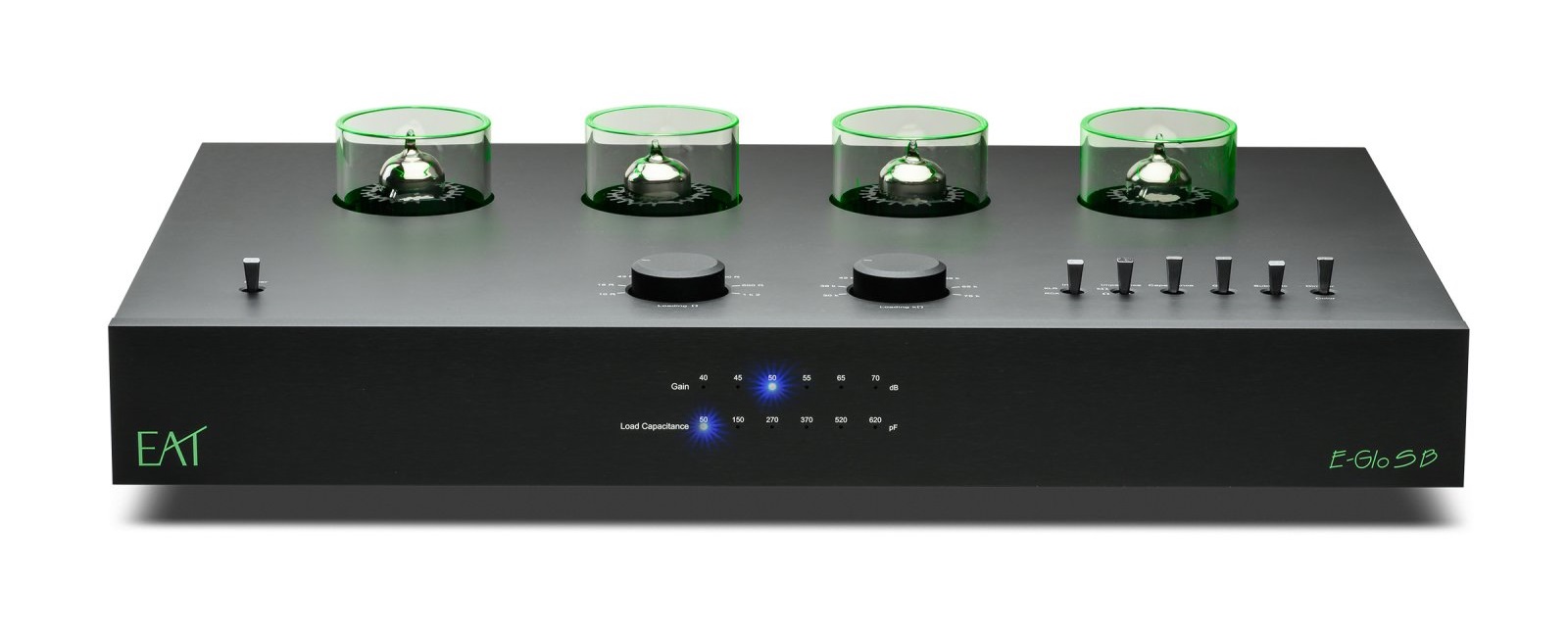
The balanced XLR inputs on both models are specifically for moving-coil cartridges. A phono cartridge is inherently a balanced source: its generator produces two signal connections, and neither is inherently tied to a chassis ground. If the tonearm wiring and cable arrangement preserve that separation, an MC cartridge can be connected differentially to a suitable balanced phono input.
This approach is particularly relevant to MC designs because their output voltage is so low. Noise picked up before substantial gain is applied can be difficult to remove later. A differential input can reject noise common to both signal legs, provided the whole connection is correctly implemented.
EAT does not position the XLR input for balanced MM cartridges. The reason is practical rather than arbitrary: while a cartridge generator is fundamentally balanced, the internal wiring of many MM designs does not expose a complete differential signal in a way that supports a balanced connection. The RCA inputs therefore accommodate both MM and MC cartridges, while XLR is the dedicated route for compatible MC installations.
Both XLR and RCA outputs can operate simultaneously. This could be useful for a system that requires two feeds—for example, balanced connection to a main preamplifier and an unbalanced feed to another compatible component—without recabling the phono stage. It is a flexibility feature rather than a substitute for careful gain management: where two downstream components are connected, their input requirements and grounding arrangements should be considered individually.
External power supply, filter choice and ownership considerations
The E-Glo CB and E-Glo SB each measure 395 x 86 x 262mm and use an external 18V power supply. Moving the transformer outside the main enclosure is a sensible engineering measure in a phono stage, where the earliest gain circuits are amplifying extremely small signals. A mains transformer can create magnetic fields and mechanical vibration, so physical separation reduces the opportunity for transformer-related hum or interference to couple into sensitive low-level circuitry.
The dimensions indicate that these are full-width, relatively low-profile components rather than compact desktop units. Buyers should also allow shelf space for the external supply and plan cable routing with care. In a vinyl system, keeping low-level tonearm and phono cables away from mains leads, power supplies and network equipment remains worthwhile even when a component includes balanced circuitry and external power provision.
Each model has a switchable 20Hz subsonic filter with an 18dB-per-octave slope. Such a filter is not primarily about altering audible bass; its principal job is to reduce infrasonic energy below the musical band. Record warps, off-centre pressings, footfall, acoustic feedback and movement in a suspended turntable can generate very low-frequency signals that make a woofer pump, consume amplifier headroom or unsettle a subwoofer. On a well-isolated turntable playing flat records, some users may prefer to leave such a filter disengaged. In systems troubled by visible woofer excursion or turntable-related low-frequency instability, it can be a valuable option.
Which E-Glo model suits which analogue system?
The E-Glo CB appears to be the more direct route into EAT’s upper-tier phono-stage concept: discrete three-stage amplification, tube involvement, broad MM/MC loading options, balanced MC input and balanced output, but with a hybrid single-ended second stage. It should be of particular interest to listeners who need the flexibility to accommodate very different cartridges and want XLR connectivity without making fully differential circuitry the defining requirement.
The E-Glo SB is the more topology-led choice. Its symmetrical second tube stage, four-tube complement and specified polypropylene capacitors move it closer to the flagship E-Glo FB’s approach. For an owner with a suitably wired MC cartridge, balanced tonearm cable and a genuinely balanced downstream preamplifier or integrated amplifier, its ability to preserve balanced operation through the second stage is the meaningful technical attraction.
Neither model’s supplied information establishes performance differences in noise, overload margin, distortion, channel separation or subjective sound quality, so those should not be assumed from the circuit descriptions alone. Likewise, EAT has not announced pricing or regional availability. What is clear is the intended division: the CB and SB provide the same unusually comprehensive adjustment platform, while offering two distinct answers to the question of how far balanced tube operation should extend through the phono circuit.
For analogue enthusiasts whose cartridge has outgrown a fixed-loading phono input—or who want an upgrade path that accommodates future MM and MC changes—the new E-Glo pair offers more than a simple step up in casework. The decision between them will rest on the system’s balanced capability, the cartridge connection available at the tonearm, and whether the SB’s more symmetrical tube architecture justifies its likely higher positioning once local prices are confirmed.