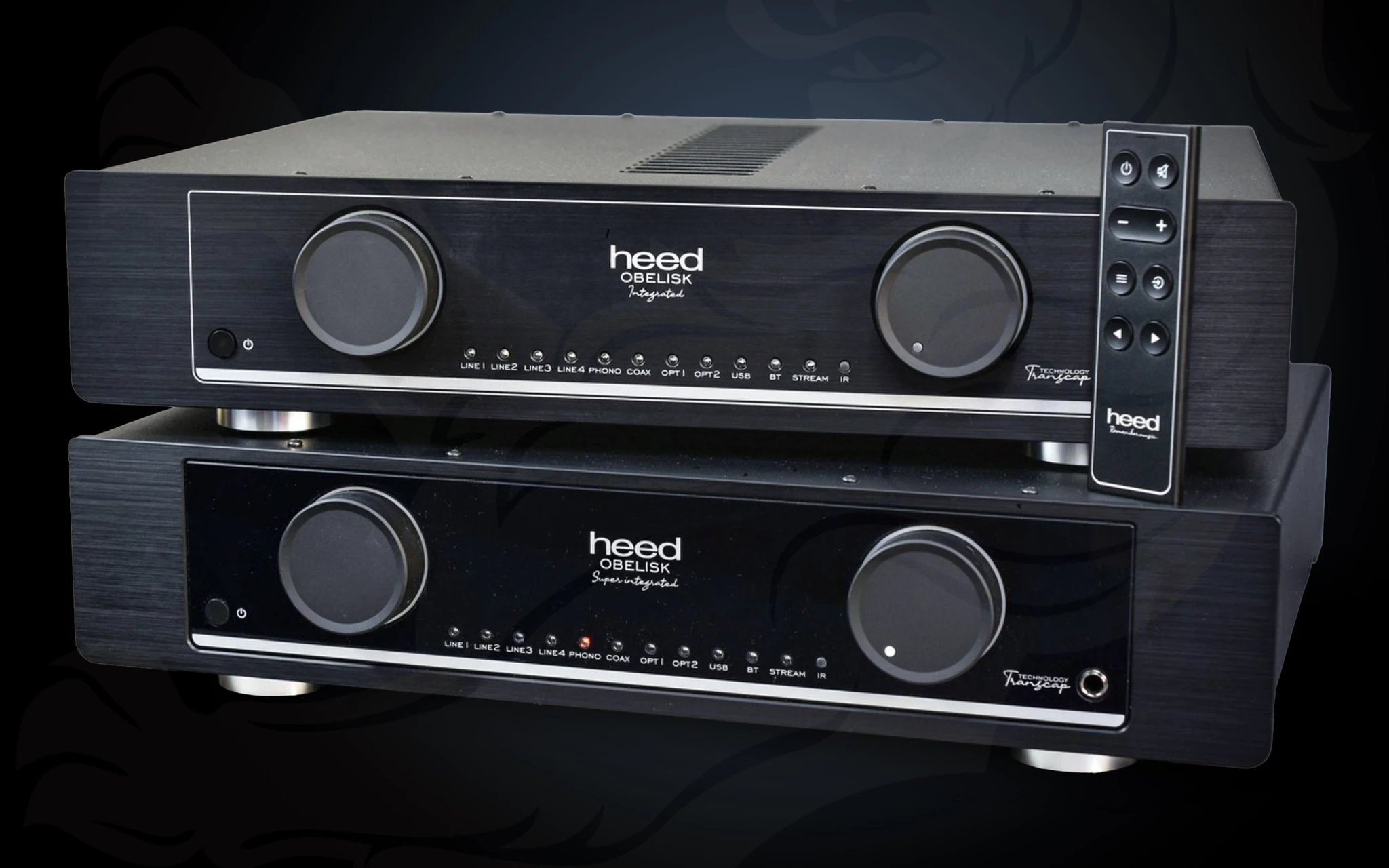
Heed Audio is bringing back one of its best-known amplifier names, but the new Obelisk is not simply a cosmetic revival of the compact models that helped establish the Hungarian brand’s following. The Obelisk Integrated and Obelisk Super Integrated move the range into a full-width 43cm enclosure, with more room for the power supply, output circuitry and optional digital hardware that a modern integrated amplifier may be expected to accommodate.
That change of format is significant. Heed has long made a virtue of compact, half-width “shoebox” cases, yet the new Obelisk models are intended to offer a more expansive proposition: an analogue integrated amplifier at their core, with a moving-magnet phono stage and Bluetooth included, plus the option to add DAC and streaming modules. There are two power levels, too, with the Super Integrated receiving a more substantial output stage and supply than the standard model.
For existing Heed owners, the return of the Obelisk name will matter in its own right. For buyers approaching the brand for the first time, these amplifiers look like an attempt to combine a traditionally analogue-focused integrated with the connection flexibility expected of a contemporary system hub—without making digital functionality compulsory.
A larger platform for a more complete integrated amplifier
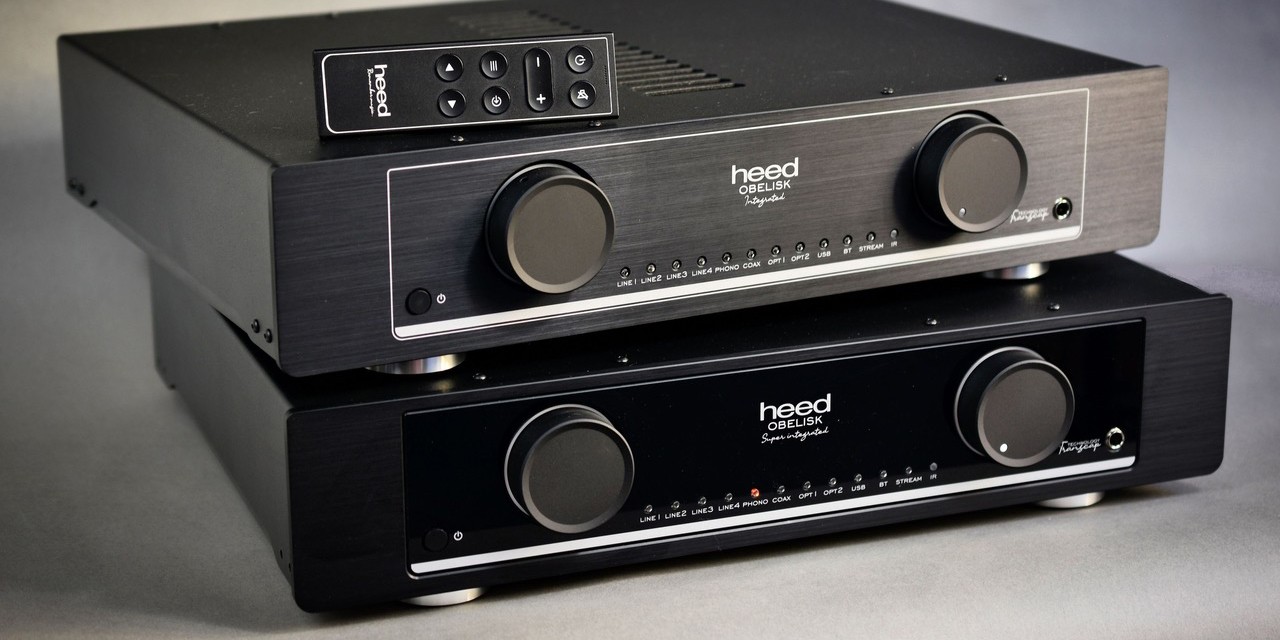
The headline change is physical: both new models use a 43cm-wide chassis, aligning their proportions with Heed’s Lagrange series rather than the brand’s smaller components. Only the Asterisk and Elixir lines remain in the half-size format. The Lagrange itself has evolved into the Lagrange S in recent years, while the Obelisk now takes a different route: it brings a familiar Heed name into a roomier, more modular architecture.
A full-width case is not automatically a guarantee of better sound, of course. Its practical importance lies in what it permits an amplifier designer to do. More internal volume can allow the transformer, reservoir capacitors, output devices and low-level input circuitry to be arranged with greater separation. That can be valuable because an amplifier contains both high-current power circuitry and small-signal stages; sensible physical layout is one part of controlling electrical interference and heat.
It also addresses a straightforward engineering and manufacturing reality. The original compact format places strict limits on component size, internal spacing and expansion options. As Heed notes, smaller specialised parts have become harder to source and more expensive. Moving to a standard-width chassis gives the company scope to use larger parts where appropriate and to provide space for optional boards, rather than attempting to force every possible feature into a tightly packed enclosure.
For a buyer, the rack-friendly width may be as relevant as the technical headroom. A 43cm amplifier will sit naturally alongside most full-size CD transports, streamers and turntables on standard furniture, while the enlarged platform should make the Obelisk a more plausible centrepiece for a system that may grow over time.
Analogue first, with digital upgrades available
Both models retain Heed’s proprietary Transcap topology. The supplied information does not detail the circuit implementation, so it would be premature to draw conclusions about its precise amplifier class or internal layout. What is clear is that Heed continues to position the Obelisk as an analogue-led integrated rather than an all-in-one network component with amplification added around it.
That philosophy is reflected in the configuration options. Buyers can specify either amplifier as a purely analogue machine, or choose an optional DAC module, an optional streaming module, or both. This is a useful distinction from the increasingly common fixed-feature integrated amplifier. Someone already committed to an external streamer and DAC is not obliged to pay for duplication, while an owner who wants to simplify a system can add functionality within the amplifier.
Modularity can also be a sensible answer to the uneven pace of digital change. Amplifier sections and their power supplies tend to have long useful lives, whereas network platforms, control apps and digital interfaces can change far more quickly. An optional module does not inherently guarantee future upgrades, and Heed has not announced an upgrade policy here, but separating the digital proposition from the basic analogue amplifier is a more flexible approach than permanently fixing every function at the point of purchase.
The optional AKM-based DAC
The DAC board is based on one of AKM’s latest conversion chips, from the same family used elsewhere in Heed’s DAC range, including the soon-to-be-retired Abacus S. A DAC chip is only one element of digital performance: power regulation, clocking, analogue output stages, digital filtering and implementation all influence the finished component. Still, using a current AKM platform indicates that Heed intends the board to be a substantive part of the amplifier rather than a token digital input added merely to satisfy a feature list.
Heed has not yet specified the DAC module’s supported PCM or DSD rates, digital input complement, USB implementation, filter options or output architecture. Those details will be important for prospective owners. In particular, users of a computer or dedicated transport will want to know which physical connections are supported, while network-streaming buyers will need confirmation of formats, services, control-app support and whether Ethernet, Wi-Fi or both are provided by the streaming module.
Bluetooth and a built-in MM phono stage
Bluetooth is included as standard. It is a practical convenience for casual playback from a phone, tablet or computer, although codec support has not been announced. That omission matters because Bluetooth implementation can range from basic SBC transmission to higher-bandwidth codec support; it should therefore not be assumed that every Bluetooth device will connect at its best available quality.
Vinyl users receive a standard moving-magnet phono input. This removes the need for a separate phono stage when using a conventional MM cartridge, or a moving-coil cartridge paired with a suitable step-up device. The supplied information does not state gain, loading or moving-coil compatibility, so the Obelisk should be regarded as directly ready for MM use rather than assumed to be a universal phono solution. Even so, including the input reinforces the amplifiers’ analogue-system credentials and could make for a particularly tidy turntable-based setup.
Two output stages, two approaches to system matching
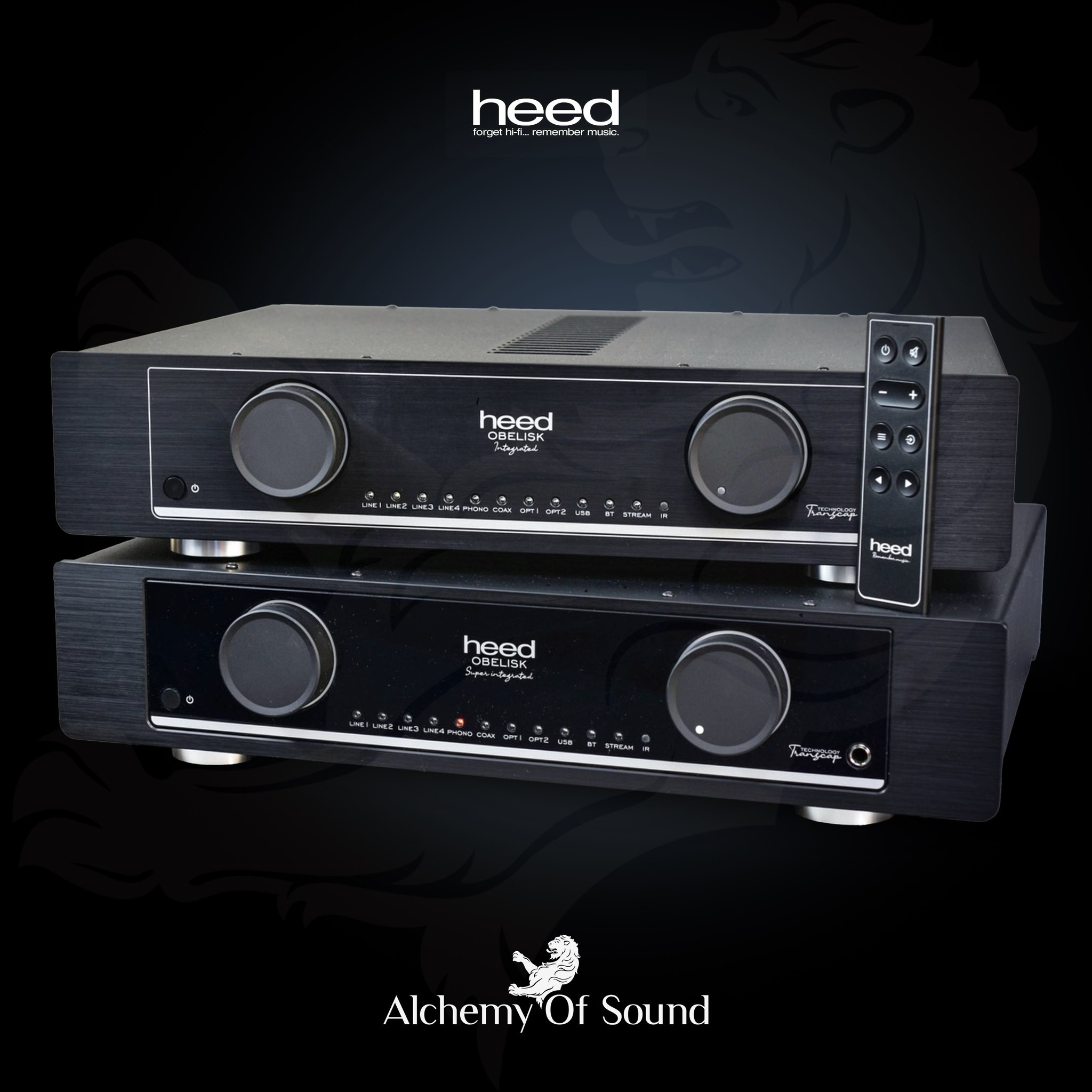
Heed is offering a meaningful choice between the two Obelisk models. The standard Obelisk Integrated is rated at approximately 2 x 50W into 4 ohms, a figure said to place it on a par with the previous Si3 when partnered with Heed’s external X2 power supply. The Obelisk Super Integrated is specified at 2 x 100W into 4 ohms, achieved through a strengthened output stage and a much larger power supply.
These figures need to be read in context. Power ratings tell us the output available into a stated load under the manufacturer’s specified conditions; they do not, by themselves, describe how an amplifier will behave with every loudspeaker. Sensitivity, impedance variation and the phase angle of a speaker’s crossover all influence the electrical demand seen by the amplifier. Room size and listening distance matter, too.
Nevertheless, the distinction between the models is clear enough in practical terms. The standard Obelisk Integrated should suit systems where moderate output requirements and loudspeaker friendliness are the priorities. The Super Integrated’s larger supply and upgraded output stage should give it more electrical reserve for louder playback, larger rooms or speakers that become more demanding at particular frequencies. Those are system-matching considerations rather than promises of a particular sonic result; impedance and sensitivity specifications for a prospective speaker remain worth checking before purchase.
The emphasis on power-supply capacity is especially relevant in an integrated amplifier. The supply must support the output stage when music asks for short-term dynamic current, while also feeding the quieter preamplifier and source circuitry. A more substantial supply can therefore be central to an amplifier’s ability to retain composure when music becomes busy or when the speaker load is less accommodating. Heed’s claim here is not merely about a larger headline wattage, but about the more robust platform behind the Super Integrated’s rating.
Notably, the new chassis lets Heed bring this capacity inside the amplifier rather than requiring the separate X2 supply associated with the older Si3 comparison. For users, that potentially means a neater installation: fewer boxes, fewer mains leads and less shelf space required to reach that level of output.
Connections and day-to-day use
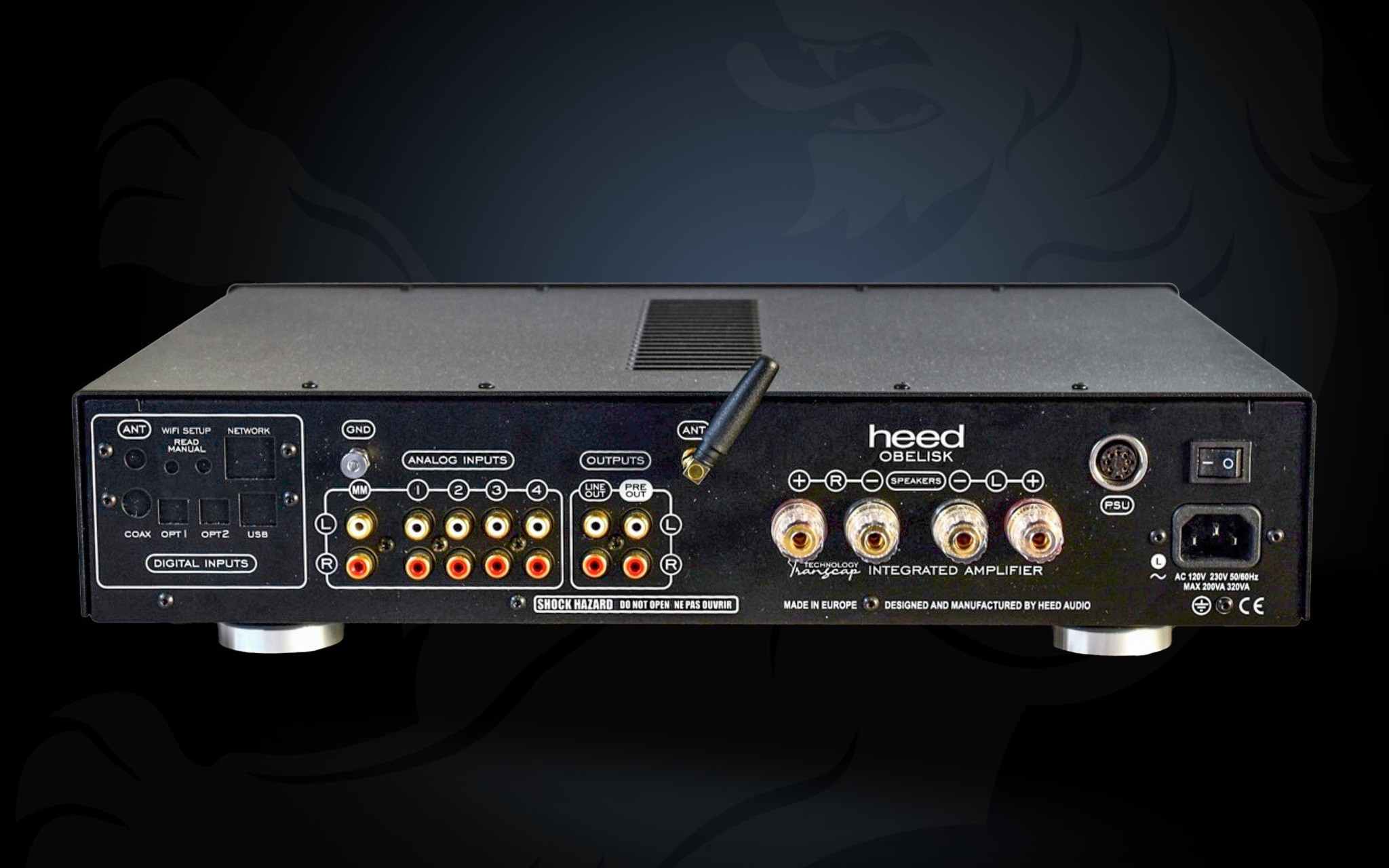
Each amplifier provides four analogue inputs, alongside the MM phono input, giving enough scope for a conventional source-led system. A turntable, external streamer or DAC, CD player and another line-level source could all be accommodated without a switch box. The final assignment and connector formats have not been detailed, so buyers with balanced sources or recording-loop requirements should wait for the full connection specification rather than assume XLR, pre-out or fixed-level output provision.
A full-size 6.35mm headphone socket is built into the front panel of both models. This is the traditional larger headphone connector found on many dedicated hi-fi components and avoids an adapter for headphones terminated with a standard 6.35mm plug. Heed has not published output power, output impedance or headphone compatibility guidance, so it is not yet possible to say how the socket will suit low-impedance planar magnetic designs or particularly high-impedance dynamic headphones. It is, however, a welcome direct listening option for owners of conventional wired headphones.
The modular strategy introduces a sensible purchasing decision. An owner who mainly listens to records, CD or an established external streamer may find the analogue configuration the most rational choice. Those assembling a compact system around a turntable and network playback could see value in adding the streaming and DAC boards from the start, subject to confirmation of the platform’s features. Conversely, anyone with a preferred outboard DAC may wish to use the four analogue inputs and leave the internal digital options aside.
What the revived Obelisk represents
The new Obelisk range is not a nostalgic reissue in a vintage-sized case. It is Heed’s recognition that an integrated amplifier is now expected to do more, whether that means serving a turntable, handling a Bluetooth connection, accepting a digital module or becoming the basis of a streaming system. The company’s response is unusually clear: retain an analogue core, enlarge the physical platform and let the buyer decide how much digital functionality belongs inside.
The most compelling aspect is the separation of the two models by more than a badge. The Super Integrated has a specified 2 x 100W output into 4 ohms, a larger supply and a beefier output stage; it appears to be the version for systems where loudspeaker demands or room scale justify the additional electrical capacity. The standard model’s approximate 2 x 50W into 4 ohms will likely be the more natural fit for uncomplicated, sensibly matched systems.
There are still key questions to answer before a final buying decision: retail pricing, availability, detailed digital and streaming specifications, supported Bluetooth codecs, and the complete input/output layout are all yet to be announced. But the essentials are already established. Heed’s Obelisk returns as a pair of full-width, Transcap-based integrated amplifiers with MM phono capability, Bluetooth, a headphone output and an optional route to onboard DAC and streaming functions—an evolution designed around present-day system building rather than a simple recreation of the past.