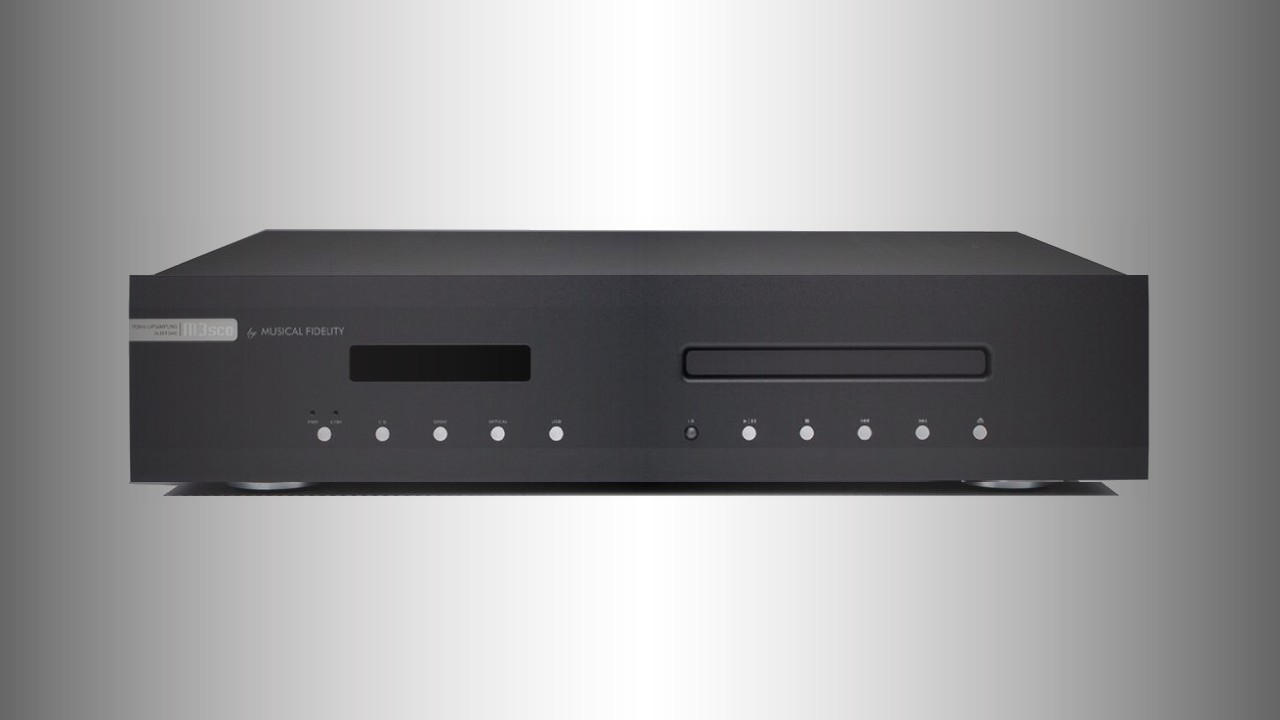
The Musical Fidelity M3SCD is not simply a CD player in the old sense of the term. While its principal role is to play compact discs, it also incorporates a 24-bit delta-sigma DAC and accepts external digital sources through USB, coaxial S/PDIF and optical Toslink. That makes it a potentially sensible choice for a listener who still values a physical-disc collection but wants one component to handle a computer or conventional digital transport as well.
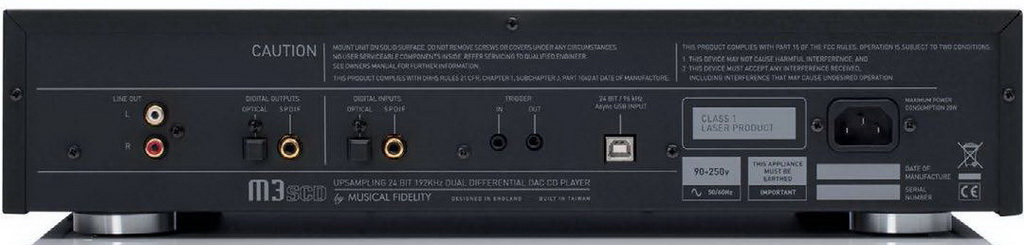
It is a deliberately conventional-looking full-width hi-fi component, yet its specification points towards a more flexible role than a basic disc spinner. Analogue output is provided for connection to an integrated amplifier or preamplifier, while coaxial and optical digital outputs allow the M3SCD’s transport section to be used with an outboard DAC. Trigger input and output connections also support tidy, coordinated power control in a wider M3-series installation.
![musical-fidelity-m3scd-black-cd-player-1072-p[ekm]1000x1000[ekm]уу.png](https://thatshifi.com/wp-content/uploads/2024/03/16ddf871542a56ced62ab9712ce596ac.png "musical-fidelity-m3scd-black-cd-player-1072-p[ekm]1000x1000[ekm]уу.png")
A CD player that can also serve external digital sources
The important distinction here is between the CD transport and the DAC section. A transport reads the information encoded on a disc and outputs digital data; a DAC converts that digital data into the analogue signal required by an amplifier’s line input. In an all-in-one CD player these stages are housed together, but the M3SCD’s additional digital inputs mean its internal DAC is not limited to CD playback.
The supplied specification identifies a 24-bit delta-sigma DAC. Delta-sigma conversion is a long-established approach in modern digital audio, using high-rate processing and noise shaping before the signal is reconstructed as analogue audio. The presence of a 24-bit converter does not by itself establish the maximum resolution accepted on every input, nor does the supplied material specify supported PCM sample rates, DSD capability, USB driver requirements or asynchronous USB operation. Those are details worth confirming for anyone intending to use the USB-B socket with a current computer-based music library.
Nevertheless, the connection provision is useful in practical system terms. The USB Type-B input is the familiar computer-audio connection: a laptop or desktop computer can act as source, with the M3SCD taking over digital-to-analogue conversion. The RCA coaxial and Toslink optical inputs accommodate the more conventional S/PDIF outputs found on some streamers, televisions, set-top boxes, games consoles and disc transports. Optical can be particularly useful where electrical isolation is desirable, since light rather than a conductive cable carries the signal. Coaxial S/PDIF is often the more common option on dedicated hi-fi digital transports.
For a system based around an analogue integrated amplifier, the M3SCD’s RCA line outputs are the primary connection. They should be connected to a standard line-level input such as CD, AUX or LINE—not to a turntable’s phono input, which is designed for the far smaller signal from a cartridge and applies RIAA equalisation.
Power supplies, noise control and the filter claims
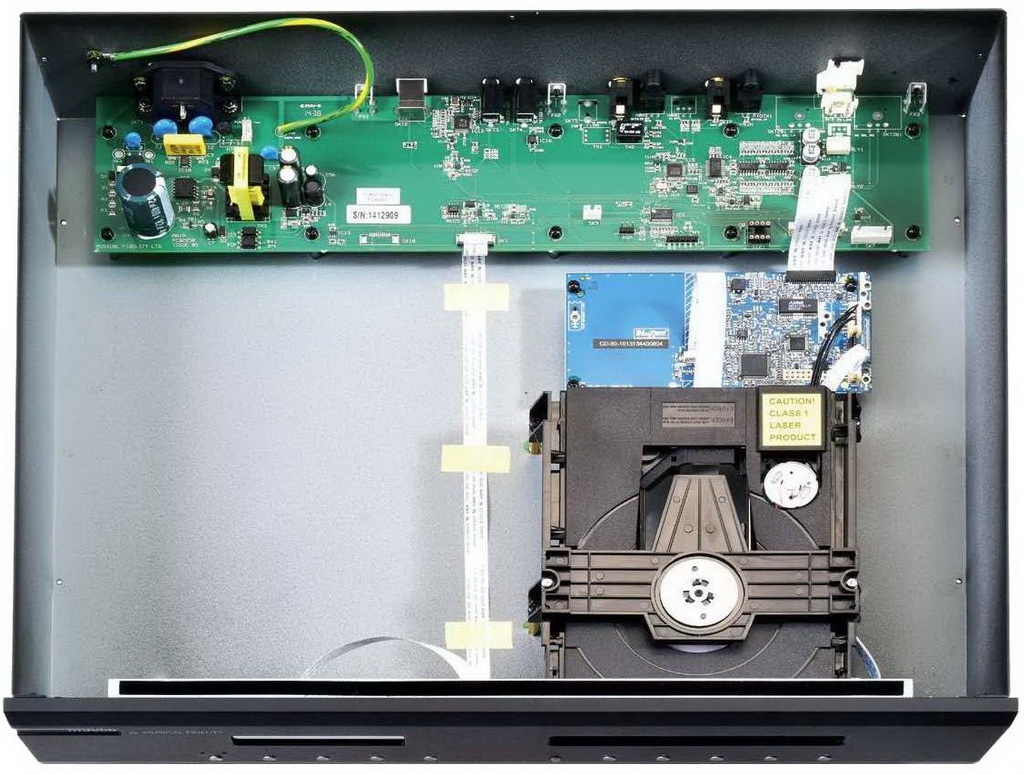
Musical Fidelity’s supplied description places considerable emphasis on power-supply treatment. It states that the M3SCD has a surge-protection arrangement intended to limit unwanted noise arriving via electrical cabling, and that the player uses five independent power supplies. Separating supplies can be a purposeful engineering choice in a digital component: motors, digital processing, display/control circuits and sensitive analogue stages have different current demands, and unwanted interaction between them is something designers seek to minimise.
In principle, isolating or regulating supplies for separate subsections can help prevent a fluctuating load in one area—such as a transport mechanism or digital logic—from modulating the reference conditions of another. It is not a guarantee of a particular sonic result, but it is more meaningful than treating the power supply as a mere utility section. A CD player’s analogue output stage and DAC reference circuitry depend on stable, low-noise power in order to operate as intended.
The original information also refers to a built-in “digital streaming filter” and links it to the unit’s acoustic performance. However, it does not specify what that filter does, where it is applied, or whether it relates to incoming digital signals, DAC reconstruction filtering, supply filtering or another part of the design. Digital filters can perform several different tasks in audio, from removing unwanted high-frequency images after conversion to managing signal processing inside a DAC. Without a fuller technical description, it would be unsafe to attach a more precise function to this particular implementation.
The same caution applies to broad claims about distortion, jitter and frequency response. The provided figures do give one useful, concrete indication of performance: Musical Fidelity specifies a signal-to-noise ratio of greater than 117dB and frequency response from 10Hz to 20kHz, within a maximum deviation of -0.2dB. A response that remains this close to level across the conventional audible band suggests that the player is engineered not to impose an obvious tonal roll-off within that range. The S/N figure describes the relationship between wanted signal and background noise; a higher number indicates that the noise floor is lower relative to the music signal.
These figures should be read as manufacturer specifications rather than as an independent measurement set. No total harmonic distortion, channel separation, output voltage or digital-input resolution figures are included in the source material, so they should not be assumed.
Construction and system integration
The M3SCD belongs to Musical Fidelity’s M3 series and uses a full-size chassis measuring 440 x 100 x 380mm (W × H × D), with a weight of 6.05kg. Before buying, allow extra rear clearance for RCA and digital cables; the 380mm depth is the cabinet dimension and does not account for plugs or cable bend radius. This is particularly relevant with stiff digital coaxial cables or USB leads.
The casework is described as having extruded metal side panels, machined to a high standard, with metal keys and switches. Beyond appearance, a rigid metal enclosure can be beneficial in a disc player because the transport is a mechanical device: the disc spins, the optical pickup must track accurately, and the electronics need protection from external interference. The draft does not provide details of the transport mechanism, internal damping, feet or vibration-control measures, so it is best not to infer a particular mechanical-isolation scheme from the exterior construction alone.
Its trigger facilities are more significant than they may first appear. The 3.5mm mono trigger input accepts ±4.5V to ±15V DC, while the trigger output provides +12V DC. In compatible systems, this lets an amplifier, preamplifier or control component switch the M3SCD on as part of a one-button start-up sequence. For a rack system containing multiple separate boxes, this can be a neater alternative to reaching behind each component or leaving everything permanently powered.
Connection options at a glance
- Analogue output: RCA line output for an integrated amplifier, preamplifier or active speakers with a suitable line-level input.
- Digital inputs: USB Type-B, coaxial RCA and optical Toslink, allowing the internal DAC to be used with external sources.
- Digital outputs: Coaxial RCA and optical Toslink for using the CD transport with a separate DAC.
- Control: 3.5mm mono trigger input and +12V trigger output for compatible system automation.
Who the M3SCD makes sense for
The M3SCD’s strongest practical argument is consolidation. A listener with a substantial CD collection, an analogue integrated amplifier and one or two digital sources does not necessarily need a separate transport, DAC and USB interface. This component can occupy the CD-player position in the rack while offering digital inputs that broaden its usefulness. Conversely, the inclusion of digital outputs leaves an upgrade route open: owners can later experiment with an external DAC while continuing to use the M3SCD to read discs.
It will be best suited to systems that still place CD at the centre, rather than those seeking a modern network-streaming appliance. The supplied information does not list Ethernet or Wi-Fi, a streaming platform, Bluetooth, an app, or support for services such as Qobuz, Tidal Connect, Spotify Connect, AirPlay or Roon. Anyone expecting those facilities should treat a separate network streamer as a likely companion, connected to one of the M3SCD’s S/PDIF inputs if appropriate.
Nor is it a replacement for a phono stage or analogue preamplifier. Its RCA outputs are fixed line-level outputs, according to the information supplied, and there is no stated variable-volume control or headphone output. In other words, the natural partner is an integrated amplifier or pre/power combination, with loudspeakers chosen around that amplification rather than around the CD player itself.
What the specifications tell us—and what they do not
The M3SCD presents a sensible combination of traditional CD playback, external DAC functionality and system-control features in a substantial M3-series enclosure. Five independent power supplies, the stated input/output complement and the >117dB signal-to-noise specification are the key technical points supplied by Musical Fidelity. Its 10Hz–20kHz response, specified to -0.2dB maximum, also indicates a carefully controlled audible-band response on paper.
There are, however, important unknowns for a buyer comparing digital components closely. The provided material does not state the maximum accepted resolution via USB, coaxial or optical; it does not identify the DAC chip; and it does not detail transport type, supported disc formats, output level, remote control or streaming capability. Those omissions do not diminish the usefulness of the stated design, but they do define the questions that should be answered before matching the player to a high-resolution computer or streamer-based system.
For the right owner, the M3SCD’s appeal is uncomplicated: it is a physically substantial CD player that can remain relevant when external digital sources enter the system, rather than becoming a single-purpose legacy box. Its digital outputs also ensure that the transport can be retained should the owner later choose a different DAC. That flexibility is often more valuable in a two-channel system than an overloaded feature list—provided its specific digital-format support suits the sources you plan to connect.
Musical Fidelity M3SCD specifications
- DAC: 24-bit delta-sigma
- Signal-to-noise ratio: >117dB
- Frequency response: 10Hz–20kHz (-0.2dB max)
- Digital inputs: Coaxial (RCA), optical (Toslink), USB Type-B
- Analogue output: Line out (RCA)
- Digital outputs: Coaxial (RCA), optical (Toslink)
- Trigger input: 3.5mm (⅛in) mono jack, ±4.5V to ±15V DC
- Trigger output: 3.5mm mono jack, +12V DC
- Dimensions (W × H × D): 440 × 100 × 380mm
- Weight: 6.05kg