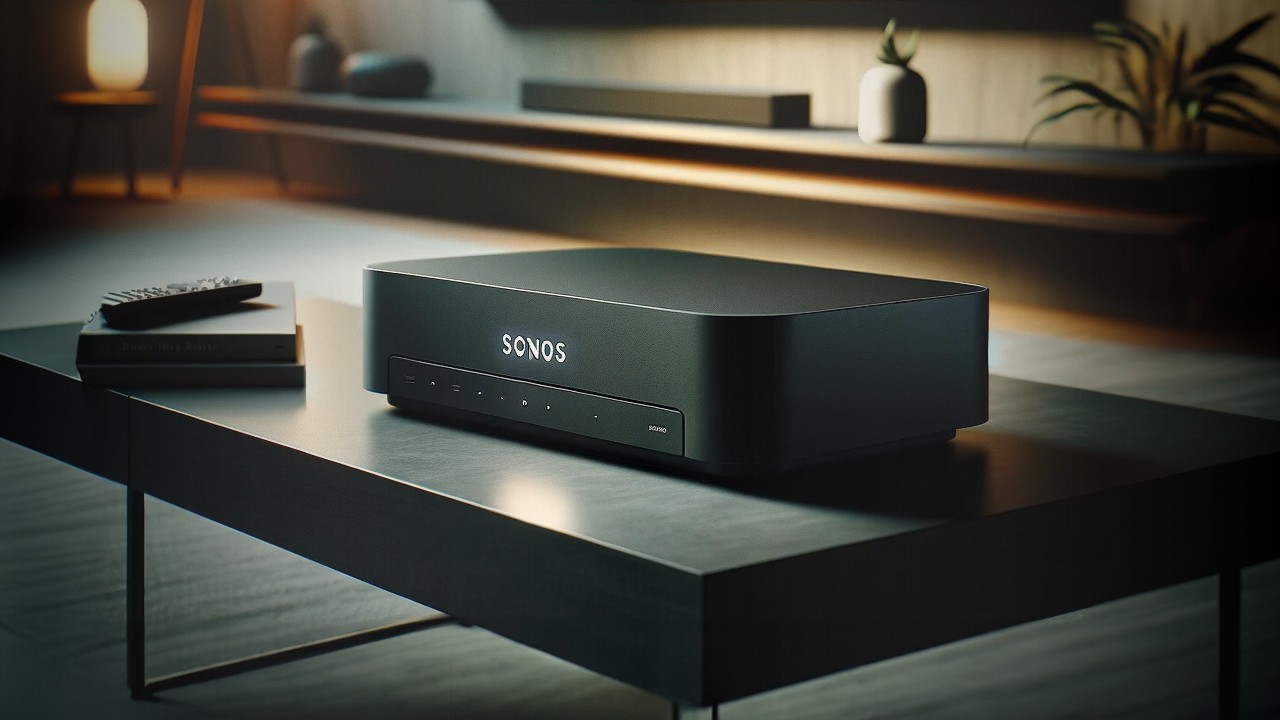
Sonos may be preparing to move from the audio rack to the space beneath the television. Reports suggest the company is developing a video-streaming set-top box codenamed Pinewood, a device expected to combine a universal streaming interface with the ability to send sound wirelessly to Sonos speakers.
That basic description makes Pinewood more consequential than another smart-TV accessory. Sonos already has a substantial presence in home cinema through its soundbars, surrounds and subwoofers, but it has traditionally relied on the television, a games console or an external streamer to provide the video source and apps. A Sonos-branded hub could potentially place the company much closer to the centre of an AV system: selecting programmes, handling streaming services and coordinating playback across its own multi-room audio ecosystem.
There is no public product to assess and Sonos has not confirmed Pinewood. The available details should therefore be treated as rumour rather than final specification. Still, the reported $200 to $400 price range and the apparent emphasis on a unified TV interface offer useful clues to the product Sonos may be considering—and to the difficult questions it would have to answer.
A streaming hub rather than simply a Sonos speaker accessory
Pinewood is said to be a set-top box for video streaming, with access to services including Netflix, HBO Max and Disney+. Its proposed role appears to extend beyond launching individual apps. Reports point to a universal interface, which generally means a single front end designed to help users search, browse and resume viewing across multiple services rather than treating every platform as a separate destination.
That distinction matters in a modern home-cinema system. The best streaming hardware is not defined only by whether it can open popular apps—nearly every current smart-TV platform can do that—but by how quickly and reliably it helps the viewer find a programme, manages profiles and watch lists, and hands sound to the preferred audio system. A well-integrated Sonos interface could make a television-and-soundbar setup feel more cohesive, particularly in rooms where the Sonos system already handles music throughout the house.
Wireless transmission of audio to Sonos speakers is the other key reported capability. Sonos has long built its appeal around controlled, synchronised wireless playback, and the company already has experience of distributing television sound to compatible speakers in its home-theatre arrangements. For Pinewood, the important technical issue would be how this works in practice: television audio demands stable synchronisation with the picture, while grouped multi-room playback must avoid audible delay or dropouts. The reports do not specify the wireless protocol, supported speaker combinations, surround formats, latency, or whether the box would add new home-theatre configurations. Those details would be central to judging its value.
Why Sonos might want to own the source component
Sonos built its reputation by making networked audio easier to live with than many traditional hi-fi systems. Its speakers, amplifiers and soundbars are designed around an ecosystem in which music services, local playback and room grouping are controlled from one platform. Television audio, however, has remained dependent on an external display and its operating system, or on a separate HDMI-connected player.
A dedicated streamer could give Sonos more control over that experience. Instead of asking users to navigate one interface for video and another for music and speaker management, Pinewood could in theory offer a common control point. That is a logical ambition in a living room where a Sonos soundbar is the main audio device and a pair of compatible speakers may be used for rear channels or for music elsewhere in the home.
It could also address a familiar practical weakness of smart-TV ownership: the screen maker’s software support may not match the useful lifespan of the panel itself. External streamers are commonly used because their app platforms can be updated independently of the television. Whether Pinewood would offer an advantage here depends entirely on its software support policy and service integration—neither has been confirmed—but this is one reason a separate video hub can make sense even in an already connected TV system.
The reported Android link raises questions about the interface
One report suggests Sonos is working with advertising technology firm The Trade Desk on an Android-based streaming operating system. That does not establish the final software platform, commercial model or feature set, but it raises an important issue: how much of the user experience would be designed around Sonos, and how much around advertising and content discovery?
Android-based TV platforms are widely used across the industry, so choosing an Android foundation would not in itself be unusual. The potential benefit is access to a mature application ecosystem and familiar development tools. The challenge is differentiation. Sonos would need to make its own interface, discovery tools and audio integration feel materially better than simply using the app environment already available on a television, a Google device or another streaming box.
Advertising is particularly sensitive in this category. Streaming-platform home screens increasingly promote programmes and services, while some lower-cost devices use advertising as part of their business model. A product expected to cost between $200 and $400 would sit above the entry-level end of the market, so buyers will reasonably scrutinise whether the interface prioritises their subscriptions and preferences or paid placement. The reports provide no confirmation that Pinewood will carry advertising, nor of how any advertising relationship might work. It is nevertheless a question Sonos would need to answer clearly.
What a $200–$400 price would demand
The reported $200 to $400 retail range is broad, but it positions Pinewood as more than a commodity streaming stick. At that level, it would be compared not just with budget media players but with premium streaming boxes and the smart-TV platforms many people already receive at no additional cost.
For a Sonos customer, the strongest case would not be video playback alone. The product would need to reduce friction in a real system: make setup straightforward, reliably select the correct Sonos room or home-theatre group, maintain picture-to-sound synchronisation, and offer an interface that is fast enough to use every evening. It may also need to provide a convincing reason to use it with a Sonos soundbar rather than connecting the TV directly through its existing audio-return-channel connection.
Connectivity will be decisive, yet it remains unknown. A credible home-cinema source typically needs a clear HDMI strategy, including how it connects to a television and how audio travels to a soundbar or receiver. Network stability is equally significant, because video services and wireless speaker playback can both place demands on a home network. The draft contains no confirmed information on HDMI connections, Ethernet, Wi-Fi, Bluetooth, remote control, voice control, video resolutions, HDR support, surround formats or service availability. Those are not minor omissions; they are the foundations of a set-top box purchase.
A crowded category with little room for a vague proposition
Sonos would enter a fiercely competitive market. Apple, Amazon, Google and Roku already offer well-established streaming ecosystems, while smart-TV makers bundle their own interfaces directly into screens. Each alternative benefits from scale, existing app relationships and a familiar control environment. Consumers may be reluctant to add another box, another remote and another account unless the benefits are obvious.
That makes Pinewood’s apparent audio angle both its opportunity and its limitation. Sonos has a meaningful installed base of speakers and soundbars, and those owners may value an interface that treats TV, film and music as parts of one system. But wireless Sonos integration on its own may not justify a new source component for every household. The most compelling proposition would need to be specific: perhaps easier whole-home control, more elegant home-theatre setup, or a materially better way to move between video and music. At present, none of those implementation details has been confirmed.
There is also a strategic backdrop. Sonos has faced scrutiny following the rollout of a redesigned app that prompted widespread user criticism. The company’s software experience is therefore likely to receive unusually close attention if it launches a product whose main interface is software. A television streamer is used constantly and often by several members of a household; reliability, clarity and rapid recovery from errors matter as much as ambitious features.
What prospective buyers should wait to learn
Until Sonos announces Pinewood, it is too early to determine whether it is a natural expansion of the company’s home-cinema business or an unnecessary move into a mature category. The concept does have a coherent rationale: Sonos is already responsible for the sound in many living rooms, and a streamer could give it greater control over the source side of the experience.
But the product will be judged on the details. Enthusiasts considering a Sonos-based TV system should look for confirmation of the following before drawing conclusions:
- Video and HDMI support: the formats supported, the connection arrangement and how the box works with current televisions and soundbars.
- Audio integration: compatible Sonos products, supported surround configurations and how reliably wireless playback remains locked to the picture.
- Network requirements: Wi-Fi and wired-network options, plus the expected behaviour in busy households.
- App and service support: the actual streaming platforms available at launch and how universal search or recommendations handle separate subscriptions.
- Interface and advertising policy: whether the home screen remains user-led and whether paid promotion affects programme discovery.
- Long-term support: the cadence of software updates and how Sonos plans to maintain a product that depends on changing video-service apps.
Pinewood could be significant if Sonos can turn its multi-room audio expertise into a genuinely more coherent television experience. If it amounts only to another way to open the same streaming apps, however, the company will have a hard time persuading buyers to make room for it. For now, it remains an intriguing but unconfirmed project—and one whose success would depend far more on execution than on the Sonos badge.