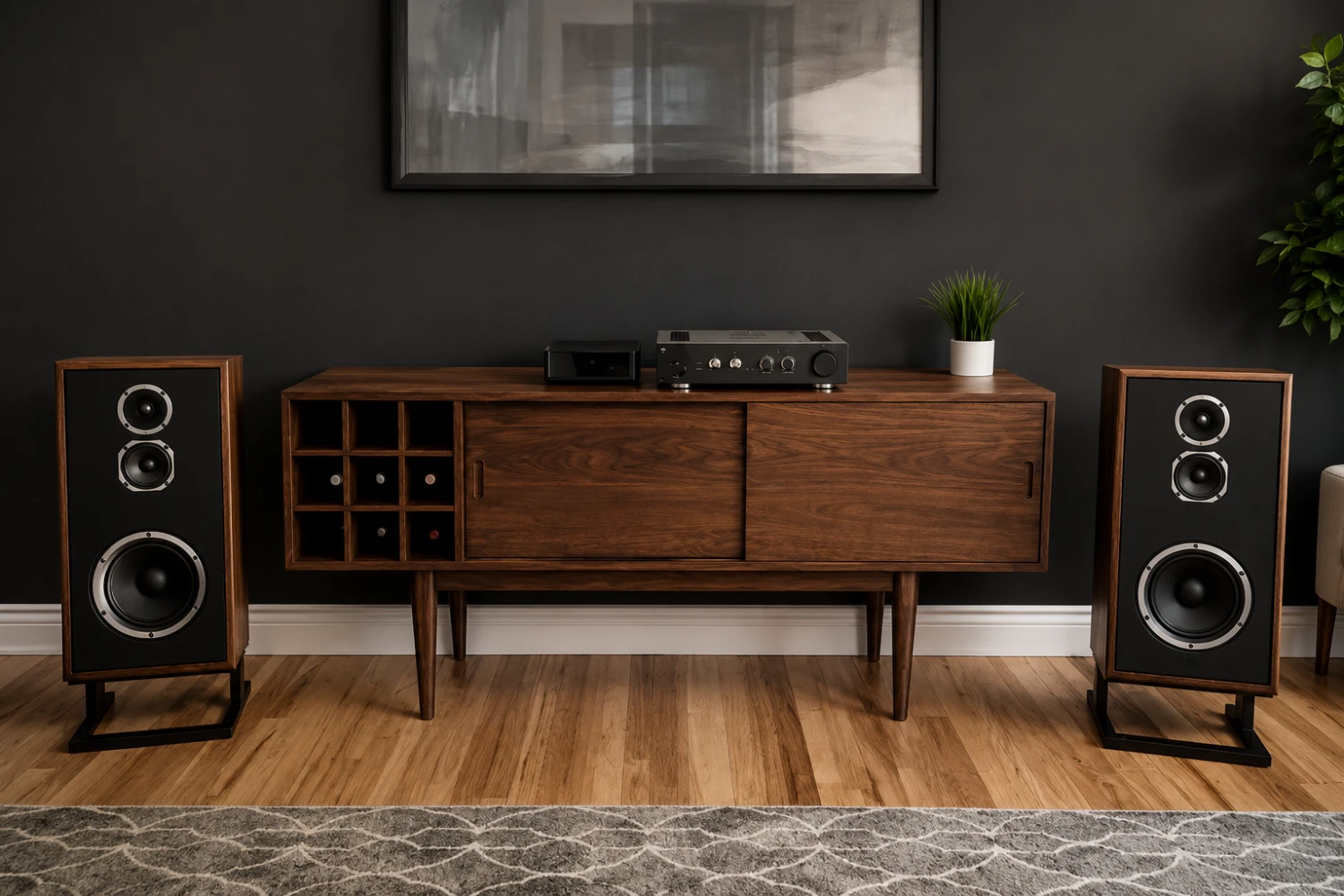
KLH Audio has added a new middle model to its retro-styled Model Collection: the Model Four, a compact three-way floorstanding loudspeaker positioned between the Model Three and Model Five. Its central proposition is more interesting than a simple size change. KLH has combined an 8-inch woofer used in the Model Three with the Model Five’s midrange driver, tweeter and crossover architecture, then placed that system in a wide but unusually shallow sealed cabinet.
That makes the Model Four a potentially sensible alternative for listeners who want the driver separation and scale of a three-way design, but do not have the room for a conventional deep floorstander or a standmount-plus-stand arrangement projecting far into the room. At 13 inches wide and only 8.25 inches deep before its supplied stand is fitted, it takes a notably different physical approach from the narrow, deep tower speakers that dominate this category.
A Model Collection speaker designed around depth, not height
KLH’s Model Collection draws heavily on the visual language and acoustic principles associated with classic American loudspeakers. The Model Four continues that direction with a wide front baffle and shallow enclosure, an approach inspired by the company’s flagship Model Seven. Rather than making the cabinet slender at the front and extending its depth behind the drivers, KLH has kept the front broad while reducing how far the speaker protrudes into the living space.
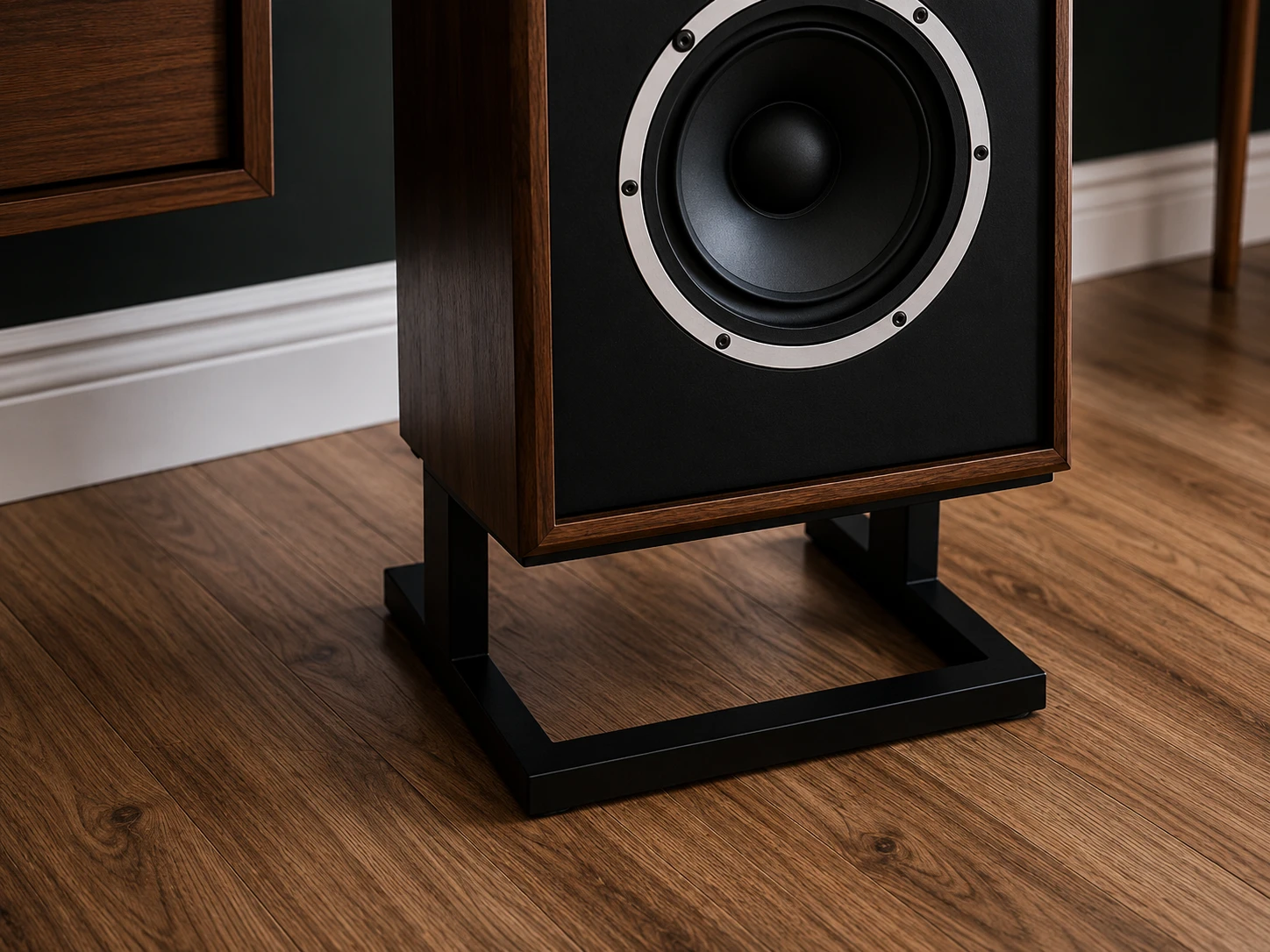
In practical terms, this is likely to matter most in apartments, lofts and multipurpose rooms. A shallow loudspeaker can be easier to accommodate beside furniture, across a narrower room or on a wall where a deep cabinet would obstruct a walkway. The included stand angles the speaker upwards by 6 degrees and takes overall depth to approximately 11 inches. That upward tilt is not merely cosmetic: where a loudspeaker’s acoustic centre sits lower than a seated listener’s ears, angling the baffle can help direct the upper-frequency drivers more appropriately towards the listening position.
There is an important distinction, however, between a shallow cabinet and a speaker that can simply be placed anywhere. KLH specifically presents the Model Four as a more placement-friendly design, but final bass balance will still be determined by the room, wall distance and corner proximity. Even a sealed speaker benefits from trying more than one position, making sure the two speakers have broadly similar surroundings, and adjusting toe-in after the basic placement has been established.
Why KLH has chosen a sealed acoustic-suspension enclosure
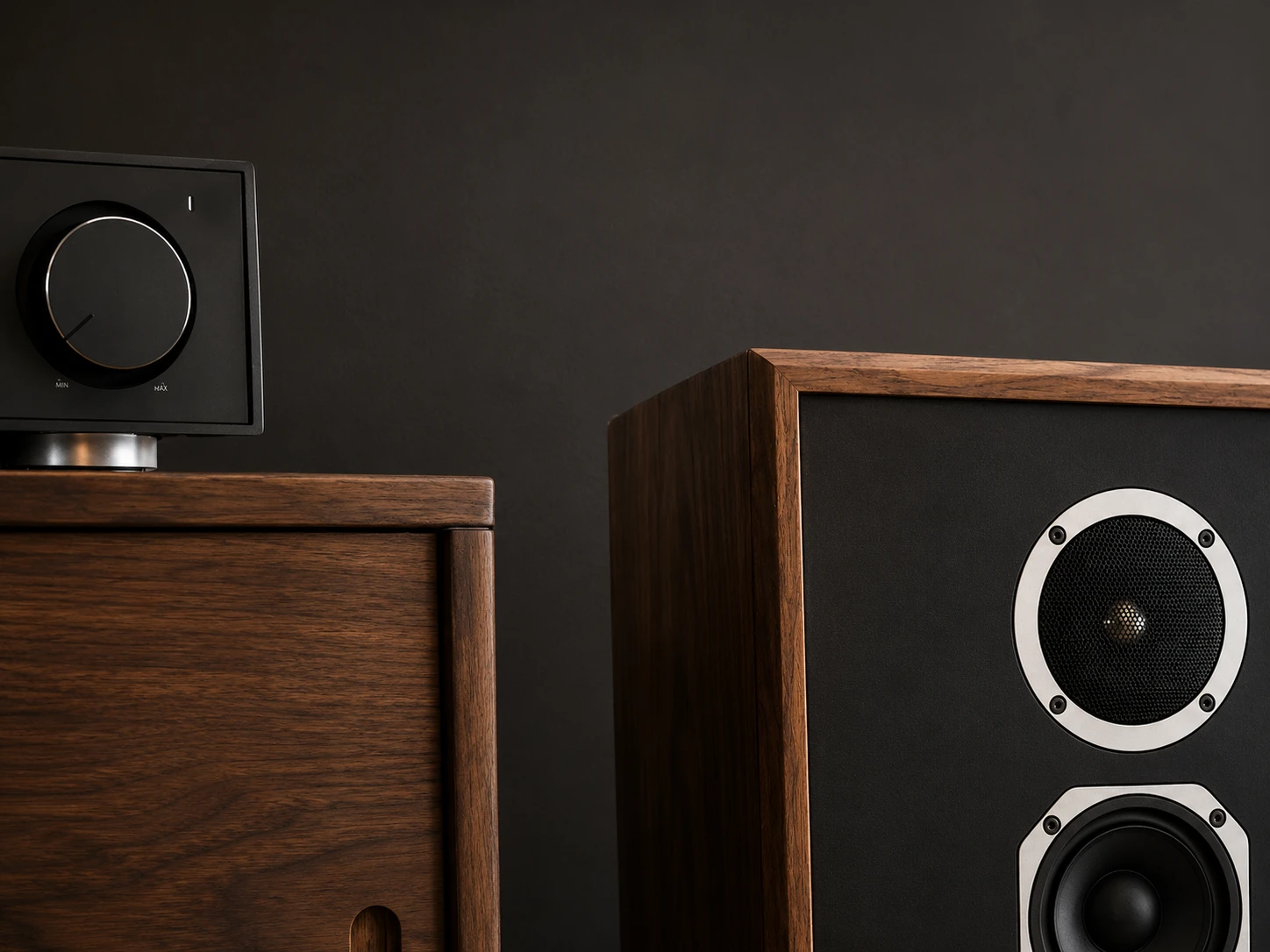
The Model Four uses a sealed, or acoustic-suspension, enclosure rather than a ported bass-reflex cabinet. In a sealed design, the air trapped inside the enclosure acts as part of the woofer’s restoring force. This is a long-standing KLH design theme, and it is relevant to the Model Four’s room-friendly brief.
A bass-reflex loudspeaker uses a tuned port to reinforce output around a chosen low-frequency region. Done well, that can produce useful bass extension and efficiency from a modest enclosure, but the port also contributes energy which can interact strongly with a nearby rear wall or corner. A sealed system has no port output to manage. It does not remove room modes or guarantee identical results close to boundaries, but it often gives the designer a different set of trade-offs in low-frequency alignment and placement behaviour.
KLH quotes a frequency response of 46Hz to 20kHz, within ±3dB, with bass extension to 35Hz at -10dB. These figures need reading in context. The ±3dB response is the more useful indication of the speaker’s nominal operating bandwidth; 46Hz suggests that the Model Four is intended to cover the main bass range rather than behave like a small satellite speaker. The 35Hz figure indicates that output continues below that point, albeit at a substantially lower level. Neither figure alone predicts how much bass a particular room will add or subtract, but they establish that this is a full-range-oriented floorstander rather than a compact speaker reliant on a subwoofer for ordinary music listening.
For systems that do use a subwoofer, a sealed main speaker can also be an attractive partner because its low-frequency roll-off is often easier to integrate in theory than the combined output of a woofer and port. Actual integration still depends on the subwoofer’s crossover, level, phase and placement, none of which KLH specifies here for the Model Four.
A genuine three-way driver complement
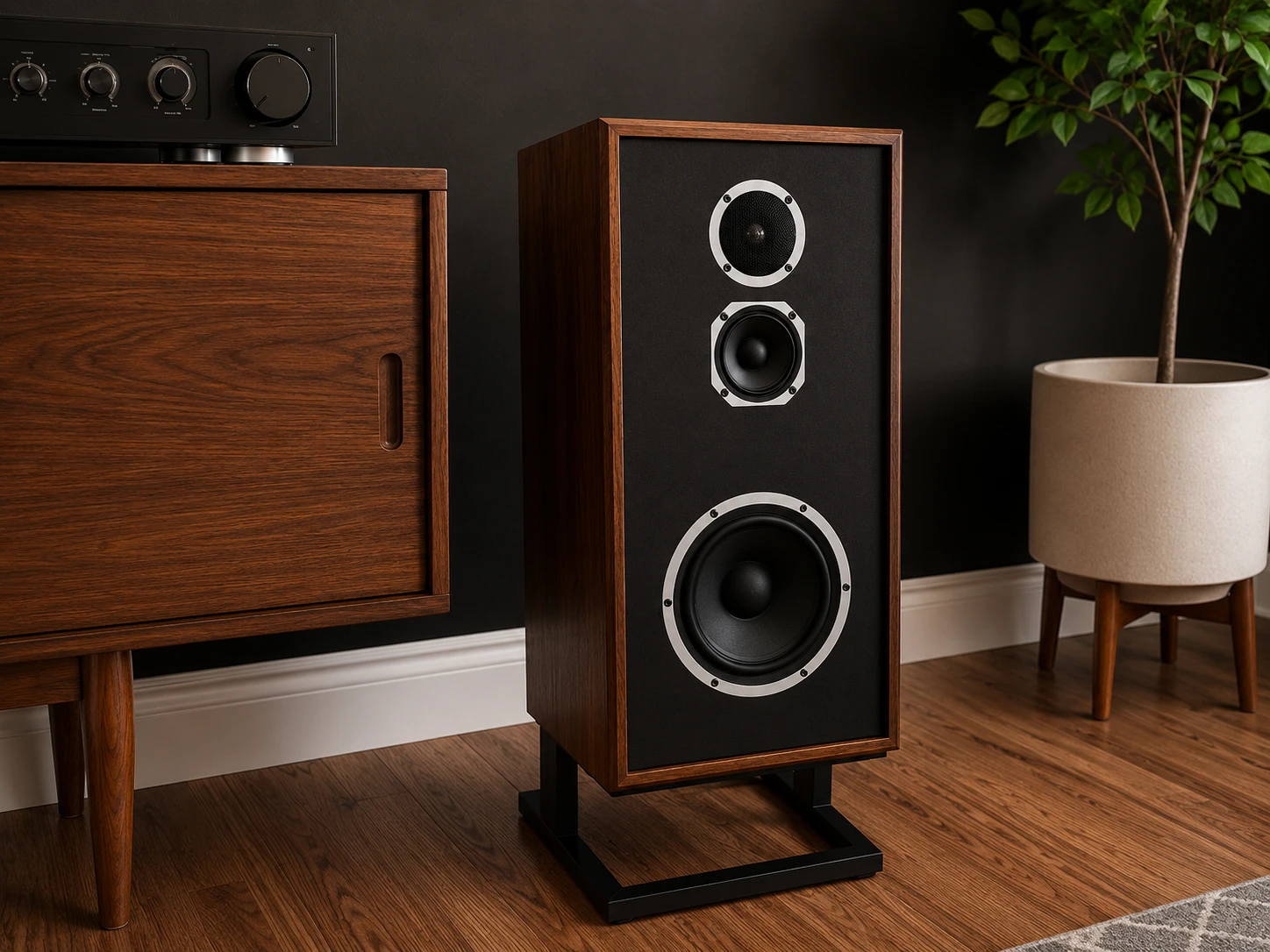
The Model Four is a true three-way loudspeaker, using dedicated drivers for bass, midrange and treble:
- An 8-inch pulp-and-paper cone woofer
- A 4-inch pulp-and-paper cone midrange driver
- A 1-inch aluminium-dome tweeter
Three-way architecture can be especially useful when a speaker is expected to deliver convincing bass while retaining composure through vocals and complex instrumental material. The larger 8-inch woofer can concentrate on the frequencies where cone area and excursion are most valuable, while the 4-inch driver is assigned the midrange. Keeping this crucial band away from the woofer means the midrange driver does not have to reproduce the largest bass excursions at the same time as speech, voices and much of the instrumental range.
Likewise, the 1-inch aluminium-dome tweeter is dedicated to high frequencies. A dome tweeter’s small radiating area is well suited to the short wavelengths at the top of the audible band, while an aluminium diaphragm is a familiar solution for a stiff, light high-frequency driver. How smoothly the three units combine is determined at least as much by crossover design, driver behaviour and the baffle as by the driver list itself. KLH says the Model Four borrows its crossover architecture from the larger Model Five, but has not provided crossover frequencies, slopes or impedance information in the supplied details, so those remain important specifications to confirm for prospective amplifier matching.
The shared pulp-and-paper cone material of the woofer and midrange also fits the Model Four’s deliberately traditional design language. Paper-based cones remain widely used because their properties can be tailored through pulp composition, coatings and profile. Material alone does not define performance, but the relevant advantage of a purpose-designed midrange unit is that KLH does not ask the large bass driver to cover the whole vocal range.
Acoustic Balance Control gives owners a useful room-tuning option
One of the Model Four’s more practical features is KLH’s Acoustic Balance Control, a three-position switch intended to adjust midrange and treble output. This is valuable because the tonal balance arriving at the listening seat is affected not only by the speaker’s direct output, but also by reflections from nearby walls, windows, floors, furnishings and the room itself.
A bright or sparsely furnished room may produce more high-frequency reflected energy than a heavily carpeted, curtained space. Conversely, a speaker placed in a relatively damped room, or listened to well off-axis, can benefit from a different balance. A three-position control is not a replacement for thoughtful positioning or room treatment, but it gives the owner a straightforward final adjustment after the speakers are installed.
The most sensible way to use it is to begin in the central setting, live with the system long enough to identify a consistent issue rather than reacting to one recording, then compare the alternative positions at matched volume. It should be treated as tonal tailoring, not as a bass-control function: the supplied information says it affects the midrange and treble rather than the low frequencies.
Connections, stands and finishes
KLH equips the Model Four with gold-plated five-way binding posts. These accept the common termination types used in passive-speaker systems: bare wire, spade connectors, banana plugs and pin connectors. Gold plating is principally useful for resisting surface oxidation at the connection point; it does not alter the fundamental need for a secure, correctly polarised cable connection between amplifier and speaker.
The cabinet is supplied with magnetically attached grilles and the dedicated angled stands are included. Including the stands is significant in this case, because their 6-degree angle forms part of the stated physical arrangement and removes the usual extra cost and compatibility question that accompanies many standmount loudspeakers. The Model Four will be offered in English Walnut, Black Ash and White Oak finishes, described by KLH as real-wood-inspired options.
As with any passive loudspeaker, buyers will need a separate amplifier. KLH has not stated sensitivity, nominal impedance, recommended amplifier power or minimum impedance in the information supplied, so it would be premature to make a precise amplifier recommendation. Those specifications are particularly useful when selecting amplification because they indicate how demanding the electrical load may be and how much voltage and current an amplifier may need to deliver. Prospective owners should seek those details before assuming suitability with a low-powered amplifier.
Where the KLH Model Four fits
The Model Four’s appeal is in its particular combination of priorities. It is not simply a smaller version of the Model Five: KLH has paired a Model Three-derived 8-inch woofer with Model Five-derived midrange, tweeter and crossover architecture, then designed the package around a shallow sealed enclosure. The result is aimed at someone who wants more than a two-way standmount’s driver allocation, but who finds a large conventional floorstander visually or physically impractical.
The likely trade-off is inherent in the brief. A cabinet only 8.25 inches deep is unusually easy to accommodate, but buyers should not equate its shallow profile with carefree placement. The room still determines the final bass response, stereo imaging still benefits from careful left-right symmetry, and the three-position Acoustic Balance Control should be used to fine-tune rather than compensate for an unsuitable location.
What is clear from the announced specification is that KLH is offering a purposeful alternative to the prevailing slim-tower formula: a broad-baffled, sealed three-way with an 8-inch woofer, a dedicated 4-inch midrange and supplied angled stands. For music systems where footprint depth is the hard constraint, that combination could be more relevant than cabinet height alone.
KLH Model Four price and availability
The KLH Model Four is scheduled to be available in September 2026. Pricing is set at $999.99 USD / €999 per speaker, with the dedicated KLH stand included.