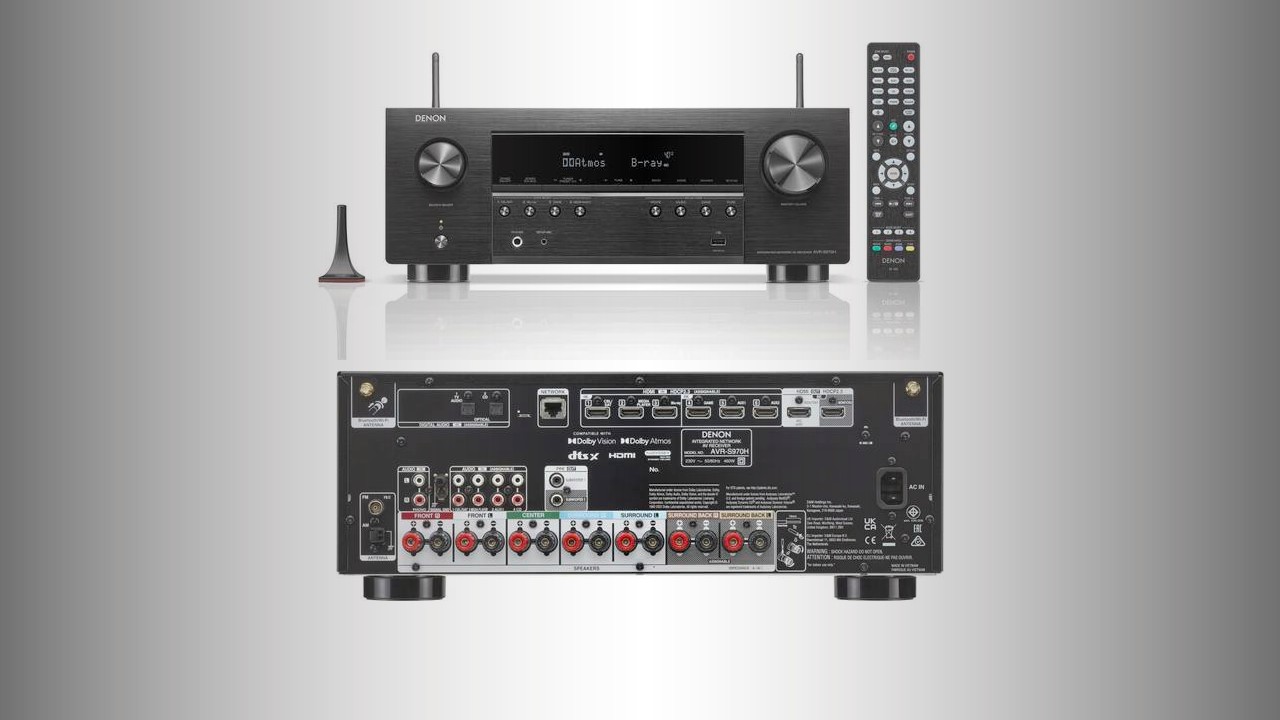
Denon has introduced the AVR-S970H in Europe at a recommended price of €549, positioning it as a comparatively accessible route into a full seven-channel home-cinema receiver with current-generation video switching. The headline features are support for Dolby Atmos and DTS:X, a choice of 7.2 or 5.1.2 loudspeaker layouts, and three HDMI 2.1 inputs specified to accept 8K/60Hz and 4K/120Hz signals.
That combination matters because AV receivers are often asked to be the hub of a mixed system: they must decode film soundtracks, amplify several loudspeakers at once, switch between television, console and disc-player sources, and increasingly accommodate high-bandwidth video. The AVR-S970H’s specification suggests that Denon is addressing buyers who want immersive surround sound and a degree of gaming and video future-proofing, but do not need the channel count or installation flexibility of a larger nine- or eleven-channel model.
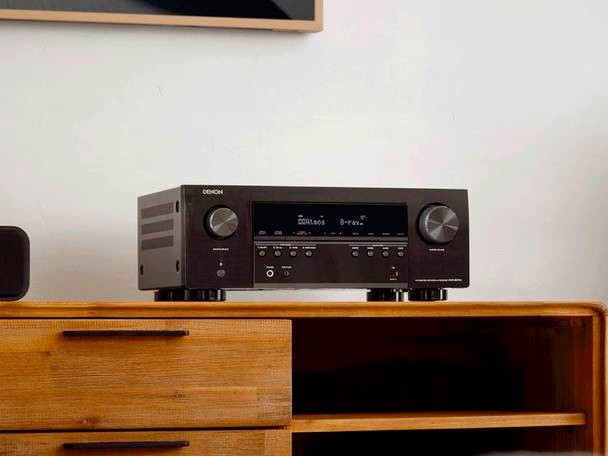
Seven channels: 7.2 surround or 5.1.2 Dolby Atmos
The AVR-S970H is specified for either 7.2 or 5.1.2 operation. In practical terms, its seven main amplification channels can be allocated in two principal ways. A conventional 7.2 system uses left, centre and right front speakers, two surround speakers and two rear-surround speakers, plus connections for up to two subwoofers. This arrangement suits listeners who prioritise a complete horizontal surround field and have space behind the seating position for rear speakers.
Alternatively, a 5.1.2 layout retains the front three speakers and a pair of surrounds, while assigning the remaining two channels to height speakers. These may be installed in or on the ceiling, or used in another compatible height-channel arrangement. With Dolby Atmos and DTS:X material, height channels can add a vertical element to effects and ambience rather than simply extending sound around the room. The receiver’s seven-channel architecture means a user chooses between rear-surround and height duties; it is not a platform for running both 7.1 and 5.1.2 simultaneously.
The “.2” designation indicates provision for two subwoofer channels in the system configuration. Two subwoofers can be useful in larger rooms or rooms with uneven bass response, as carefully positioned subs can help reduce the seat-to-seat variation caused by standing waves. However, the supplied specification does not state whether the subwoofer outputs have independent processing or calibration, so that should be confirmed by buyers for whom dual-subwoofer optimisation is a priority.
Dolby Atmos and DTS:X support also makes the AVR-S970H relevant beyond discs. These object-based formats are available from compatible streaming services and players as well as UHD Blu-ray, although the exact format delivered will depend on the source device, app and connection method. For a system based around a TV’s internal apps, users should check the television’s own audio-output capabilities and the receiver’s full HDMI connection specification before planning the installation.
HDMI 2.1 video switching for 8K and 4K/120Hz sources
Three of the AVR-S970H’s HDMI 2.1 inputs are specified to receive UHD 8K video at up to 60Hz, or UHD 4K at up to 120Hz. The latter is particularly relevant to PlayStation 5, Xbox Series X and suitably equipped PCs, where 4K/120Hz can allow compatible games to run at a higher frame rate than the long-established 4K/60Hz standard. An AV receiver needs sufficient HDMI bandwidth to pass such a signal transparently from source to display; otherwise, users may have to connect a console directly to the television and route audio separately.
For film and television, the supported high dynamic range formats are Dolby Vision, HDR10+ and HLG. HDR is not simply a resolution feature: it carries picture information that enables compatible displays to reproduce a wider brightness range and, depending on the format and content, richer tonal detail. Dolby Vision and HDR10+ use dynamic metadata, while HLG is commonly associated with broadcast-oriented HDR workflows. The receiver is therefore specified to pass the major HDR variants rather than forcing a source or television into a more limited picture mode.
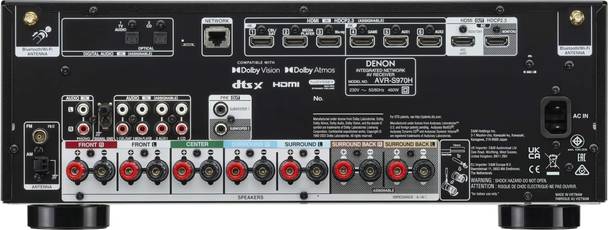
Three high-bandwidth inputs should be enough for a focused system comprising, for example, a games console, 8K-capable media source and disc player. It is worth planning connections before buying, though. The draft specification does not list the total number of HDMI inputs, HDMI outputs, or specific TV-audio-return features, so installations involving several legacy sources, a projector and television, or multiple current consoles should verify the full connection panel before committing.
Amplification: what the quoted power ratings mean
Denon quotes 95W per channel into 8 ohms from 20Hz to 20kHz with 0.08% total harmonic distortion, with two channels driven. A second rating is 125W per channel into 6 ohms at 1kHz and 0.07% THD, again with two channels loaded. Including the frequency range, distortion figure, load impedance and number of channels driven is important: amplifier-power figures are only meaningful when their test conditions are made clear.
The 8-ohm, full-bandwidth rating is the more useful of the two for comparing broad amplifier capability, because it covers the audible frequency range rather than a single 1kHz test tone. Equally, the “two channels loaded” qualification should be read realistically. During a demanding multichannel film sequence, all seven amplification channels may be active, and the receiver’s available power supply is shared across the system. That does not make the published rating invalid; it simply means that buyers should not assume that seven channels can each continuously deliver the same output under all conditions.
The stated 4–16-ohm load range makes the AVR-S970H suitable on paper for a broad range of passive home-cinema loudspeakers. Yet nominal impedance is only one part of speaker matching. Some loudspeakers have impedance dips, low sensitivity or demanding phase behaviour that require more current at certain frequencies. In a modest or medium-sized room, a sensibly matched 4- to 8-ohm speaker package should be a more straightforward proposition than unusually inefficient floorstanders in a large open-plan room at high playback levels.
Placement and crossover settings are central to extracting the most from any seven-channel receiver. Using one or two active subwoofers and setting the main speakers to an appropriate bass-management crossover can remove the deepest bass burden from the AVR’s internal amplifiers. That may provide more headroom for dialogue, effects and music across the main speakers, while allowing the subwoofer to handle the frequencies it is specifically designed to reproduce.
Room correction, Pure Direct and system calibration
The AVR-S970H is listed with Audyssey MultEQ XT32 room correction, along with Audyssey Dynamic EQ and Dynamic Volume. Room correction uses measurements from several microphone positions to identify how loudspeaker output and room acoustics interact at the listening seats. The aim is not to eliminate a room’s character entirely, but to compensate for problems such as uneven bass and tonal imbalance that can arise from speaker placement, boundaries and reflections.
This is particularly valuable in a multichannel installation, where matching levels, distances and tonal balance across several speakers by ear alone is difficult. The result will still depend heavily on fundamentals: a symmetrical front-speaker layout where possible, a centre speaker placed close to screen height, surround speakers positioned to create an enveloping field, and sensible subwoofer placement. Calibration is best treated as a final refinement rather than a substitute for good physical setup.
Dynamic EQ and Dynamic Volume serve different purposes. Dynamic EQ is intended to maintain perceived tonal balance and surround involvement at lower listening levels, where human hearing is less sensitive to bass and treble. Dynamic Volume is designed to reduce large level swings, which can be useful for late-night viewing or broadcast material with inconsistent loudness. Both are convenience tools, not mandatory modes; enthusiasts may prefer them disabled for higher-level film sessions if they want to preserve the soundtrack’s full dynamic contrasts.
Denon also lists Pure Direct amplification technology. Direct modes on AV receivers generally minimise or bypass selected processing stages for a simpler signal path, which may appeal when listening to two-channel sources. The precise functions bypassed in Pure Direct, and its availability with each input type, are not detailed in the supplied information, so prospective owners should consult the manual if two-channel use is a deciding factor.
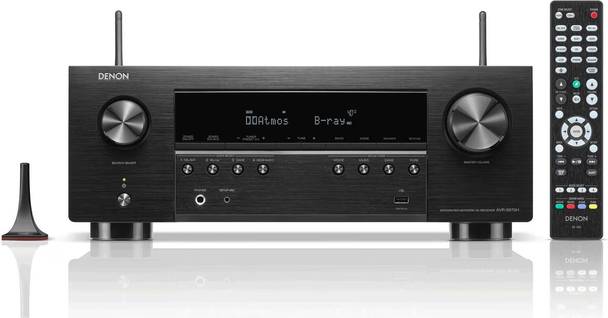
Wireless playback and HEOS integration
Network connectivity is provided by Wi-Fi, with AirPlay 2 and DLNA protocol support listed, alongside Bluetooth. AirPlay 2 gives owners of compatible Apple devices a familiar route to send audio to the receiver, while DLNA support can be useful for accessing music files held on a compatible local network server. Bluetooth remains the quick, low-friction option for guests or casual playback, although it is typically less flexible than a properly configured network playback setup.
The AVR-S970H also supports Denon’s HEOS network technology. HEOS is relevant to users considering a wider multi-room ecosystem built around compatible Denon and HEOS products. The supplied information does not enumerate particular music services, file-format limits, control-app functions or wired-network provision, so those details should be checked against local model documentation—especially for buyers with a large hi-res music library or a specific streaming-service requirement.
Size, ownership considerations and who it suits
Measuring 434 x 167 x 330mm and weighing 9.5kg, the AVR-S970H follows the conventional full-width AV-receiver format. It should fit standard hi-fi furniture, but its 167mm height and the heat generated by multichannel amplification mean that a cramped enclosed cabinet is unlikely to be ideal. Allowing ventilation space above and around the receiver is good practice, particularly where several channels are being driven during long film sessions.
At €549, the AVR-S970H’s appeal is its concentration on the features that matter to a contemporary 5.1.2 or 7.2 setup: immersive-format decoding, three 8K/60Hz and 4K/120Hz HDMI 2.1 inputs, HDR pass-through, room correction and network connectivity. It looks most convincing for someone building a first serious cinema system around one television, a modest number of high-bandwidth sources and a compatible seven-speaker or five-speaker-plus-height-speaker layout.
The trade-off is inherent in its position and channel count. Buyers wanting more than two height channels, separate rear surrounds and heights, or a more elaborate multi-display installation will need to investigate higher-channel-count alternatives and their connection options. But for the stated €549 asking price, the AVR-S970H brings together a notably current set of video and immersive-audio essentials in a conventional all-in-one receiver.
Key Denon AVR-S970H specifications
- Recommended European price: €549
- Speaker configurations: 7.2 or 5.1.2
- Surround formats: Dolby Atmos and DTS:X
- HDR video: Dolby Vision, HDR10+ and HLG
- HDMI 2.1: three inputs supporting UHD 8K/60Hz or UHD 4K/120Hz
- Power output: 95W per channel into 8 ohms, 20Hz–20kHz, 0.08% THD, two channels driven
- Power output: 125W per channel into 6 ohms, 1kHz, 0.07% THD, two channels driven
- Supported speaker impedance: 4–16 ohms
- Room correction: Audyssey MultEQ XT32, Dynamic EQ and Dynamic Volume
- Wireless: Wi-Fi with AirPlay 2 and DLNA, plus Bluetooth
- Network platform: HEOS
- Dimensions (W x H x D): 434 x 167 x 330mm
- Weight: 9.5kg