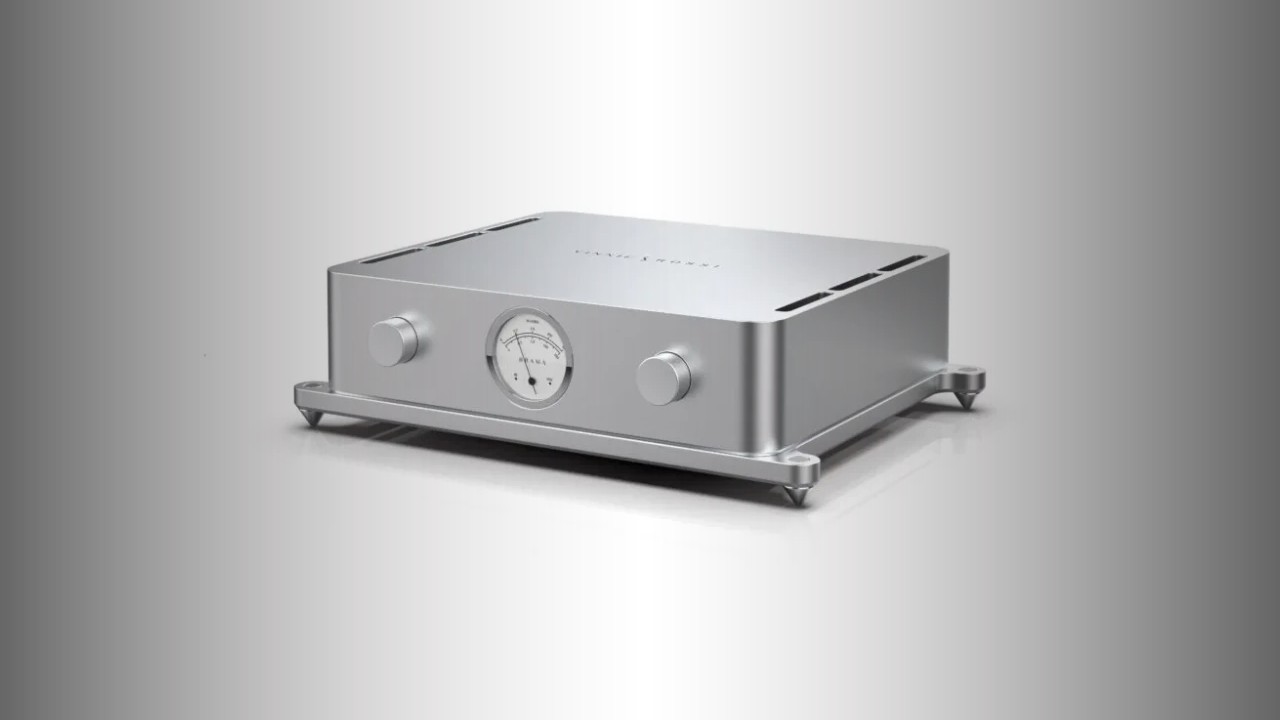
Vinnie Rossi has unveiled the second-generation Brama amplifier range, a three-model statement system comprising the Brama Integrated Amplifier, Brama preamplifier and Brama Monoblock Power Amplifier. The new range retains an unapologetically ambitious hybrid premise: in the Brama PRE and INT, a high-voltage 300B valve line stage sits ahead of solid-state amplification, while the INT and MPA employ Class AB MOSFET output stages.
That combination is significant because it addresses two quite different jobs in an amplifier. A line stage establishes the signal’s voltage gain and drives the following circuitry; a power stage supplies the current and voltage swing required to control loudspeakers. Vinnie Rossi’s approach puts a matched pair of Western Electric WE300B triodes at the line-stage end of the system, rather than asking the 300B directly to deliver loudspeaker power. The claimed result is a design that can pursue the electrical authority associated with a transistor output stage without abandoning the particular operating conditions and valve choice that define the Brama’s front end.
The second-generation range also receives revised power-supply designs, a central but often underappreciated part of any serious amplifier. Rossi cites lower noise, improved transient response, substantial EMI filtering and active power-factor correction across the new Brama platform, alongside higher output power in the INT and MPA models. Exact output figures, load ratings and connection specifications have not been provided in the launch information, so prospective owners will need those details before assessing speaker compatibility.

A three-component Brama system
The range gives buyers three distinct routes into the Brama architecture. The Brama Integrated Amplifier combines preamplification and power amplification in one chassis, making it the most direct path to a complete two-channel system. It is likely to appeal to listeners who want a minimal component count without moving away from a full-sized, high-end amplifier platform.
The Brama preamplifier separates source switching and line-level amplification from the speaker-driving duties. In a conventional separates system, this permits the preamp to be partnered with power amplification chosen around a particular loudspeaker and room. The Brama PRE is one of the two models confirmed to use the updated 300V Class A line stage and matched Western Electric WE300B pair.
The Brama Monoblock Power Amplifier, sold as a pair, is intended for systems that take separation a stage further. A monoblock arrangement gives each loudspeaker its own dedicated amplifier chassis. Beyond the potential practical advantages of siting amplifiers close to each speaker and using shorter speaker cables, this approach can keep the power amplification for left and right channels physically separate. Whether that is the right route will depend on a system’s space, budget and loudspeaker demands; the available announcement does not specify the MPA’s rated power, dimensions or weight.
Why the 300B line stage matters
The 300B is among the best-known directly heated triodes in high-end audio. It is traditionally associated with low-power single-ended valve amplifiers, where the valve itself is used to produce loudspeaker power. Vinnie Rossi is using it differently in the Gen 2 Brama PRE and INT: the valves form a Class A line stage running at 300V, while a separate MOSFET stage handles power amplification in the integrated model.
This is not merely a cosmetic use of a famous valve. A line stage must maintain low noise, preserve signal integrity and provide a suitably controlled drive signal to the circuitry that follows it. Running a valve line stage in Class A means its active device remains conducting throughout the signal cycle, avoiding the handover between devices that occurs in push-pull stages. That can have design benefits, but it also demands carefully managed operating conditions and a power supply capable of supporting them quietly and consistently.
The specified matched pair of Western Electric WE300B triodes is equally noteworthy. Matching refers to selecting valves with closely aligned electrical characteristics, which is especially important in channel-balanced stereo circuitry. Western Electric’s current-production WE300B is a premium, high-cost valve, so its inclusion places the Brama models firmly in the cost-no-object end of the market. Since directly heated triodes are consumable components, buyers considering the PRE or INT should also factor long-term valve ownership into their purchase decision: replacement availability, cost and any manufacturer guidance on fitting and biasing should be confirmed with a dealer.
Importantly, the announcement does not provide circuit diagrams, gain figures, valve-life estimates or details of the implementation around the 300B. Those are all meaningful questions at this level, particularly for owners planning to use sensitive power amplifiers or seeking a very quiet system. What is confirmed is the basic architecture: a newly updated 300V Class A 300B line stage in the Brama PRE and INT.
MOSFET output stages and a revised power supply
For the Brama INT and MPA, Vinnie Rossi has increased the power of the Class AB MOSFET output stages while saying it has minimised the number of output devices. The manufacturer has not stated a watts-per-channel figure, nor how that figure changes with loudspeaker impedance, so it would be premature to draw conclusions about ultimate loudspeaker drive capability. In high-end amplifier design, headline power is only one part of the matching picture. Current delivery, protection behaviour, thermal headroom and stability into difficult reactive loads also matter, but none is specified here.
MOSFETs are field-effect transistors commonly used in audio power stages. Their operating characteristics differ from bipolar transistors, and the choice has implications for a designer’s preferred biasing, driver circuitry and protection strategy. Class AB operation, meanwhile, is widely used where designers want higher output capability and more manageable heat dissipation than a high-power pure Class A design can typically offer. The point is not that one topology automatically sounds better than another; execution and the whole circuit around the devices are decisive. Brama’s notable proposition is that its solid-state output section follows a 300B valve line stage rather than being an all-transistor design.
The Gen 2 power-supply changes may be as consequential as the active circuitry. An amplifier’s supply must replenish energy quickly when music demands it while preventing mains-borne noise and switching interference from reaching low-level audio stages. Rossi says the new supplies lower noise and improve transient response, and add significant electromagnetic-interference filtering.
Active power-factor correction is also specified. In broad terms, power-factor correction shapes the way a product draws power from the AC mains, bringing current draw into closer alignment with the incoming voltage waveform. It can be useful in high-power equipment and is one indication that mains behaviour has been considered as part of the Brama Gen 2 redesign. It should not, however, be confused with a guarantee of a particular sonic result, and it does not remove the usual requirement for sensible mains installation and system grounding.

Chassis construction, heat and installation
Every Brama Gen 2 chassis is made from aircraft-grade aluminium. Rossi says this is intended to provide low resonance and maximum heat dissipation. Aluminium is a logical material for an amplifier enclosure because it can combine stiffness with comparatively low mass and can act as an effective thermal path when used in heatsinking and chassis structures. Keeping mechanical vibration under control is particularly relevant where valves are used, as valve structures can be susceptible to microphonic effects. The precise internal isolation methods and chassis dimensions have not been disclosed, however.
Thermal management also deserves attention with the integrated amplifier and monoblocks. Even though their output stages are Class AB, substantial high-end amplifiers can still generate significant heat, especially at idle and under sustained demand. Owners should plan for open-air installation rather than a tightly enclosed cabinet, and should follow Vinnie Rossi’s eventual clearance instructions rather than assuming that a metal chassis alone makes ventilation irrelevant.
At these prices, practical details should be established before purchase. It will be useful to confirm each model’s dimensions, mass, mains-voltage variant, number and type of inputs, balanced-operation implementation, loudspeaker terminals, trigger facilities, service arrangements and warranty. None of these details appears in the launch material, and they will determine how straightforward the Brama models are to integrate with existing sources, power amplifiers and loudspeakers.
Remote control for the PRE and INT
The Brama preamplifier and integrated amplifier include the new RMT remote control, which has an LCD display, Bluetooth connectivity and an updated user interface. At this level, remote-control design is more than a convenience. A display can provide clearer feedback from the listening seat, while Bluetooth connectivity potentially makes the handset part of a more flexible control ecosystem. The announcement describes the system as intended for intuitive operation and seamless integration, but does not say whether Bluetooth is used solely for remote communication or supports any audio function. It should therefore not be assumed to be a Bluetooth music input.
There is no corresponding claim that the Brama line includes network streaming, a DAC, a phono stage or headphone output. Buyers should treat the Brama products as amplification components unless fuller specifications confirm otherwise, and plan source equipment accordingly. For an analogue-led system, that may mean a separate phono stage; for digital playback, a streamer and DAC or an integrated digital source; and for a PRE/MPA system, suitable interconnects between the two stages.
Pricing and prospective buyers
Vinnie Rossi has set the Brama Gen 2 range firmly in ultra-high-end territory:
- Brama Integrated Amplifier: $47,995
- Brama preamplifier: $38,995
- Brama Monoblock Power Amplifier: $59,995 per pair
The integrated amplifier is the obvious choice for an owner who wants the Brama’s valve/solid-state concept in a single primary component. The PRE and MPA route will make more sense for those building a full separates system, or for listeners whose loudspeakers and room justify the physical and financial commitment of monoblocks. The Brama PRE may also have appeal for an owner with an existing power amplifier who specifically wants the 300B-based line-stage section—although output level, gain and impedance information should be checked before committing.
The central appeal of Brama Gen 2 is not simply the presence of premium valves or a substantial aluminium case. It is a particular system architecture: a high-voltage, Class A 300B line stage in the preamp and integrated models; higher-power Class AB MOSFET stages in the integrated and monoblocks; and a redesigned supply intended to support lower-noise operation and faster dynamic behaviour. The remaining specification details will be essential, but the direction of travel is clear: Vinnie Rossi is refining a high-end hybrid amplifier platform rather than following the increasingly common all-in-one streaming amplifier route.