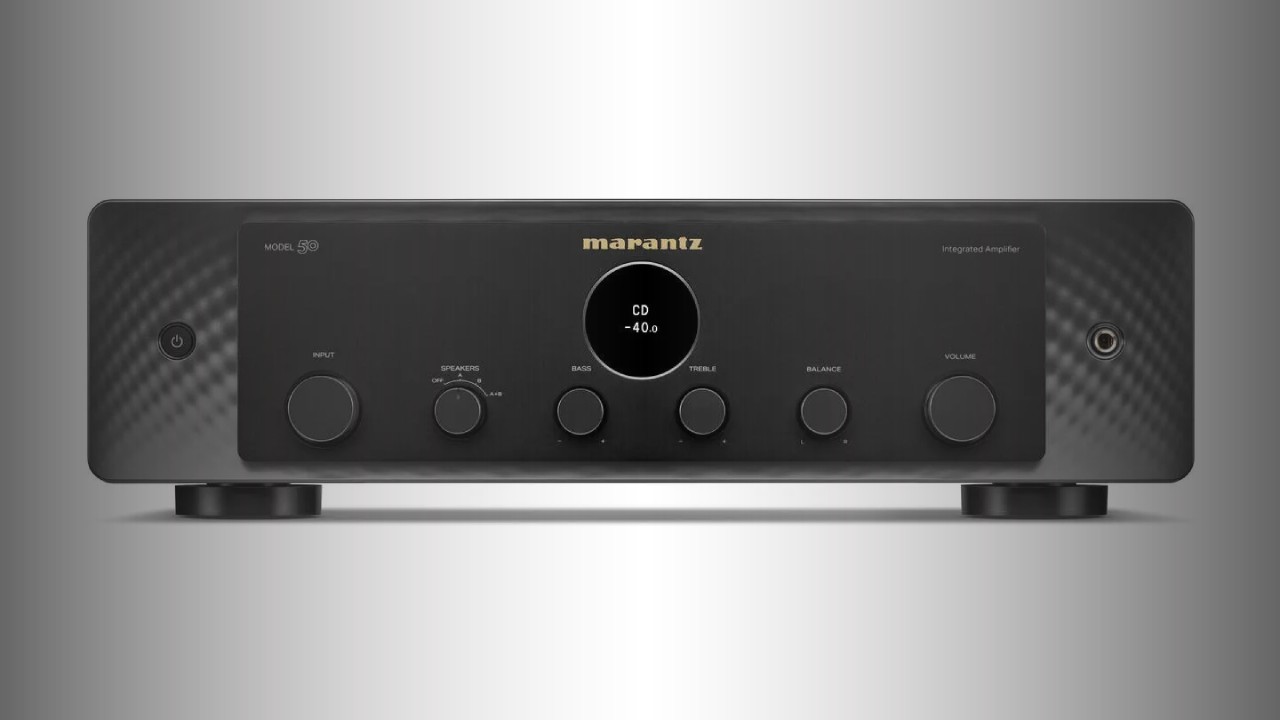
The Marantz Model 50 is the company’s successor to the long-running PM8006, but it is not simply the familiar integrated amplifier in a new case. It adopts the visual language of Marantz’s current premium separates, moves production of this series from Japan to Vietnam, and combines a claimed 70W per channel into 8 ohms with a useful 100W per channel into 4 ohms.
More importantly, its priorities are firmly analogue. The Model 50 is built around a discrete current-feedback preamplifier, a linear power supply with a toroidal transformer, four line-level RCA inputs and an MM phono stage. There are no digital inputs listed in the supplied specifications, so owners wanting to connect a TV, streamer or computer digitally will need a source component or external DAC with analogue outputs. For listeners whose systems are based around a turntable, CD player, network streamer and conventional passive loudspeakers, that can be a sensible division of labour rather than a missing feature.
It also provides pre-out and subwoofer outputs, making the Model 50 more adaptable than a strictly closed-box integrated amplifier. It can serve as the control centre for a 2.1 system, or potentially feed an external power amplifier if the rest of the system evolves.
Current-feedback amplification and Marantz HDAM modules
At the heart of the Model 50 is a fully discrete preamplifier circuit using current feedback, a longstanding Marantz approach. In broad terms, current-feedback amplifier circuits use a different feedback arrangement from conventional voltage-feedback designs. The potential benefit is wide bandwidth and fast response to rapid signal changes, though the final result depends on the entire circuit, power supply and component selection rather than topology alone.
Marantz says this circuit has been developed over many generations to provide high speed, low distortion and a strong signal-to-noise ratio. The stated frequency response is 10Hz–70kHz, while total harmonic distortion is specified at 0.08%. The wide bandwidth should not be read as a promise of ultrasonic musical content; rather, it indicates that the amplifier’s gain structure extends well beyond the conventional audible band. In practice, careful stability and noise control matter just as much as bandwidth in an integrated amplifier.
The preamplifier uses Marantz’s discrete HDAM modules, listed here as HDAM-SA2 and HDAM-SA3. HDAM, or Hyper Dynamic Amplifier Module, is Marantz’s alternative to using a conventional integrated-circuit op-amp in selected gain stages. A discrete module allows the manufacturer to specify the constituent components and operating conditions rather than accepting the architecture of an off-the-shelf chip. It is an engineering choice with implications for layout, power supply decoupling and tuning; it is not automatically superior in every implementation, but it is central to the Model 50’s identity.
Marantz also retains a symmetrical physical board arrangement, with the left and right channel paths laid out in parallel and at equal lengths. This is a rational way to pursue matching between channels and reduce the opportunity for one channel to pick up different interference or have a materially different path through the circuit. Channel matching matters to stable stereo imaging, although loudspeaker placement, room reflections and the recording itself remain equally important factors.
A 100W-per-channel output stage with a substantial linear supply
The power-amplifier section is rated at 2 x 70W into 8 ohms and 2 x 100W into 4 ohms. That 4-ohm rating is particularly relevant when choosing loudspeakers: many nominally 8-ohm designs dip below that figure across parts of the frequency range, while some compact standmounts and floorstanders are specified as 4 ohms. The Model 50’s stated output into 4 ohms suggests it has been designed to accommodate more demanding loads than an amplifier that is rated only into 8 ohms, although it does not remove the need to consider a speaker’s full impedance and sensitivity specifications.
Marantz attributes the amplifier’s instantaneous current capacity to a parallel push-pull output-stage configuration, quoting 66A. Current delivery is important because loudspeaker impedance changes continuously with frequency, and bass transients in particular can demand short bursts of current. A quoted peak-current figure is not directly comparable with continuous power, but it helps describe the intended capability of the output stage and supply under dynamic conditions.
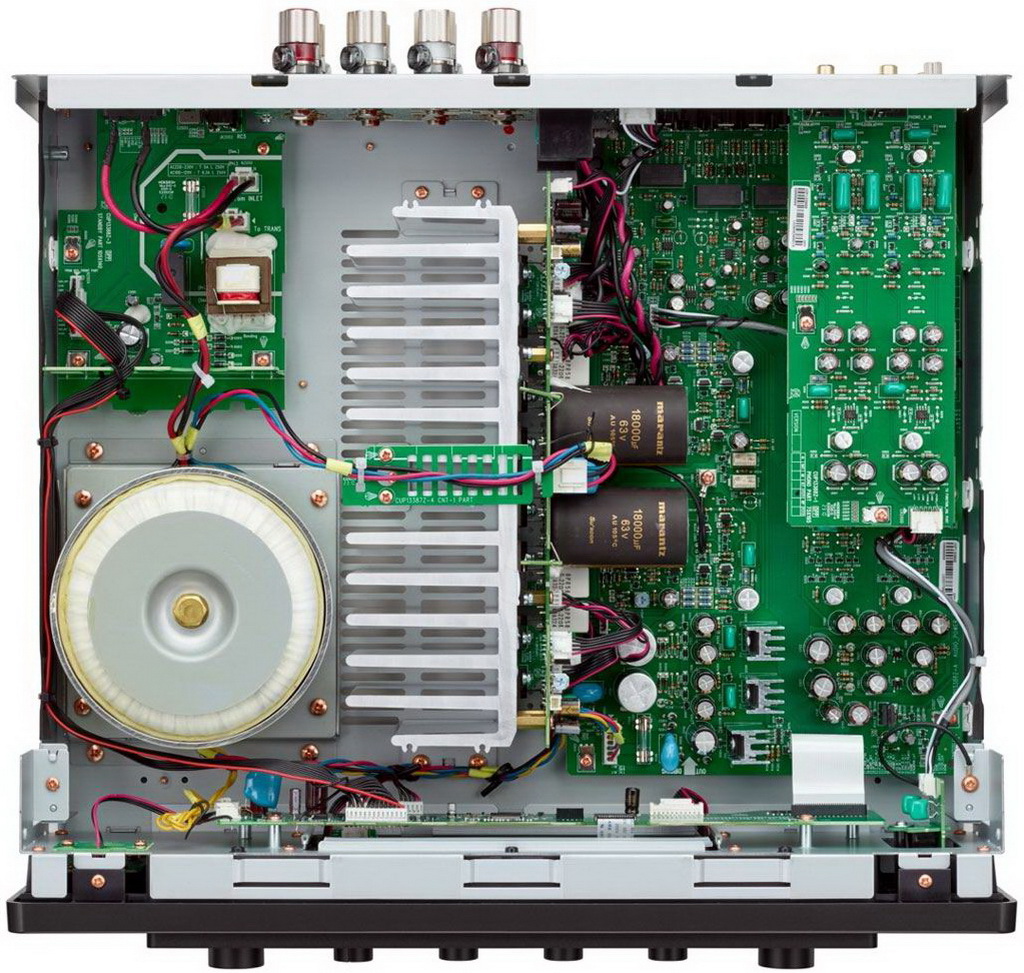
Power comes from a linear supply with a toroidal transformer, Schottky diodes and two bespoke Marantz smoothing capacitors rated at 18,000µF/63V. The transformer converts mains power to the voltages required by the amplifier, while the reservoir capacitors store energy between the peaks of the rectified AC waveform. Their job is to maintain stable supply rails when the output stage calls for energy. Schottky rectifiers are valued for their low forward voltage and fast switching behaviour; Marantz specifically highlights their low leakage current here.
Heat management is handled by a large extruded aluminium heatsink. This is a practical requirement in a conventional high-power integrated amplifier: the output transistors must transfer heat efficiently to maintain stable operating conditions. The Model 50’s 220W power-consumption figure is a reminder that this is not a low-power, cool-running switching design. It should be placed on a rigid, well-ventilated equipment shelf rather than tightly enclosed in cabinetry, with space above and around the chassis for heat to dissipate.
Electronic level control and a chassis designed to resist vibration
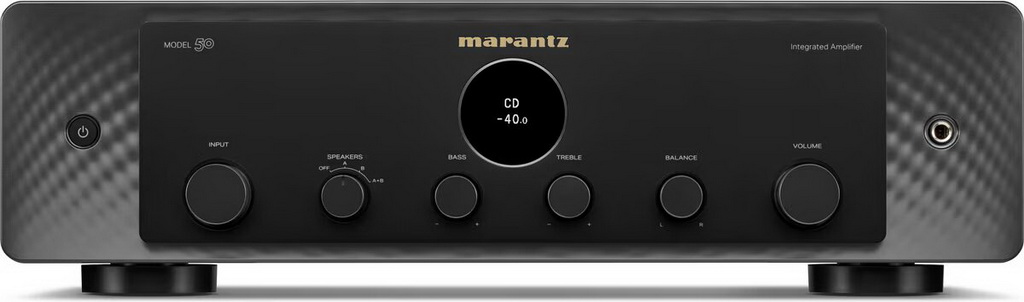
Rather than a conventional mechanical potentiometer, the Model 50 uses a high-performance volume-control chip. An electronically controlled analogue attenuator can offer closer left/right tracking at low listening levels than a mechanical control, where small component tolerances can lead to one channel becoming fractionally louder than the other. Accurate channel balance is especially useful for maintaining a centred vocal image during quiet evening listening.
Marantz pairs this level-control device with its HDAM circuitry to form what it describes as a linear control/volume circuit. The important practical point is that volume adjustment is intended to preserve channel matching and minimise unwanted interaction between the two channels. The source material does not state the exact attenuation architecture, so it would be unwise to infer whether it operates as a resistor ladder or another specific arrangement.
Mechanical design receives unusual attention for an amplifier at this level. Beyond the main chassis, the Model 50 employs a four-layer construction using three 1.0mm steel plates to support the circuit boards and transformer. A power transformer is physically heavy and can transmit vibration, while loudspeakers in the same room generate airborne and structure-borne energy. A stiff, low-centre-of-gravity chassis is intended to provide a stable platform for the electronics and reduce the effects of mechanical vibration. It also contributes to the Model 50’s 14.4kg weight.
The chassis measures 442 x 130 x 431mm (W x H x D). The depth is worth checking before purchase: it is a full-width component and needs more shelf depth than a slimline streaming product, particularly once RCA plugs and speaker cables are connected at the rear.
MM phono stage: a useful route for a turntable-based system
The Model 50 includes a moving-magnet phono equaliser, specified for a 2.2mV input sensitivity and 47kΩ input impedance. A 47kΩ load is the conventional standard for MM cartridges, so the integrated stage should be a straightforward match for most moving-magnet and high-output moving-coil cartridges intended to work into an MM input. It is not, however, presented as a moving-coil phono stage; low-output MC cartridge users will require a suitable external phono preamplifier or step-up solution.
Marantz uses a J-FET input and a passive DC servo circuit in this phono stage. J-FET devices are often selected at sensitive analogue inputs for their high input impedance and low-noise potential. The passive DC servo is intended to eliminate AC-coupling capacitors from the signal path. Put simply, coupling capacitors can block unwanted DC between stages, but their electrical behaviour can influence the low-frequency response and phase characteristics. A servo arrangement addresses DC offset by another route, allowing those capacitors to be omitted in the relevant path.
The company also cites copper-foil film capacitors used for sound tuning, drawing on components employed in its higher-end models. Component choice alone cannot predict sound quality, but film capacitors are commonly used in signal-path and filtering duties because of their stability and low loss characteristics. For an owner, the more immediate benefit is convenience: a turntable can connect directly to the Model 50’s dedicated phono sockets without adding another box, mains lead and interconnect.
Connections, expansion and speaker-cable compatibility
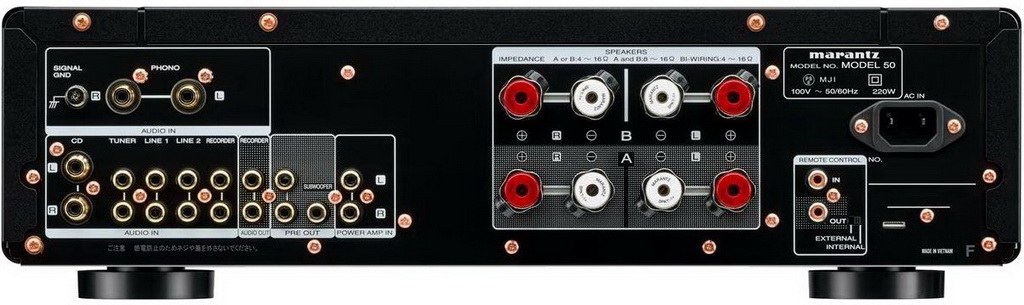
Four gold-plated RCA line inputs cover traditional analogue sources such as a CD player, DAC, streamer with fixed or variable analogue output, tape deck or external phono stage. The dedicated MM phono input is also gold-plated. Marantz specifies machined-brass RCA connectors for the CD and phono inputs, where a robust socket can be useful given the repeated connection and disconnection that often comes with source upgrades and turntable setup.
Outputs include a 6.3mm headphone socket, RCA record output, pre-out and a subwoofer output. The record output is useful for connecting an external recorder without routing it through the volume control. The pre-out allows the Model 50 to be used as a preamplifier with a separate power amplifier, while the subwoofer output offers a direct route to an active subwoofer. Exact bass-management behaviour is not specified, so prospective 2.1 users should not assume that connecting a subwoofer automatically applies a high-pass filter to the main loudspeakers.
There are four pairs of gold-plated screw terminals, using Marantz’s SPKT-1+ terminals. Their solid-brass core, thick nickel plating and large tightening screws are designed for secure contact. They accept bare cable up to 4.5mm in diameter, plus spade connectors and banana plugs. The four pairs may be helpful for users who want to connect two pairs of speakers, but they should not be mistaken for four independently amplified channels: this remains a two-channel integrated amplifier. Anyone considering simultaneous operation of two speaker pairs should check the combined impedance presented to the amplifier.
Two D-Bus system-bus connectors and an IR connector provide integration options within an appropriate Marantz system. A ground terminal is included for turntable grounding, helping to minimise hum in an analogue setup. Standby consumption is specified at 0.3W.
Who should consider the Marantz Model 50?
The Model 50 makes the strongest case for the listener building a conventional, source-led hi-fi system rather than seeking an all-in-one digital hub. Its feature set prioritises a serious analogue line stage, MM vinyl playback, a substantial linear supply and useful system expansion. Pair it with a separate network streamer or DAC, a CD player and reasonably capable passive loudspeakers, and it has the connectivity required for a well-rounded stereo system.
Its 70W/8-ohm and 100W/4-ohm ratings, 66A claimed current capacity and damping factor of 100 point towards an amplifier intended to retain control with a broad range of real-world loudspeakers. Yet power ratings cannot replace careful matching. In a large room, with insensitive speakers or models whose impedance falls very low, buyers should examine the loudspeaker manufacturer’s amplifier recommendations and arrange a demonstration where possible. Conversely, the Model 50’s output should be more than adequate for many sensibly matched standmount and floorstanding speakers in typical domestic rooms.
The trade-off for its analogue-first approach is clear. There are no listed digital, HDMI or network facilities, despite the specification list mentioning slow-roll-off and sharp-roll-off digital filters; without a listed digital input or DAC section, the precise function of those filters should be confirmed with Marantz. Those who need TV integration, USB audio or built-in streaming will need additional equipment. For enthusiasts who would rather choose each digital source separately, however, the Model 50’s separation of duties may be exactly the point.
Marantz Model 50 specifications
- Output power: 2 x 70W (8 ohms); 2 x 100W (4 ohms)
- Frequency response: 10Hz–70kHz
- Total harmonic distortion: 0.08%
- Damping factor: 100
- Signal-to-noise ratio: 102dB; MM phono equaliser: 83dB
- Line input sensitivity/impedance: 200mV/20kΩ
- Phono input sensitivity/impedance: 2.2mV/47kΩ
- Digital filters: Filter 1 (slow roll-off), Filter 2 (sharp roll-off)
- Discrete amplifier modules: HDAM-SA2, HDAM-SA3
- Inputs: four gold-plated line RCA inputs; gold-plated RCA MM phono input
- Outputs: 6.3mm headphone output, RCA record output, pre-out, subwoofer output
- Other connections: two D-Bus system-bus connectors, IR connector, ground terminal
- Speaker outputs: four pairs of gold-plated screw terminals
- Power supply: linear supply with toroidal transformer and Schottky diodes
- Power consumption: 220W; 0.3W in standby
- Dimensions (W x H x D): 442 x 130 x 431mm
- Weight: 14.4kg