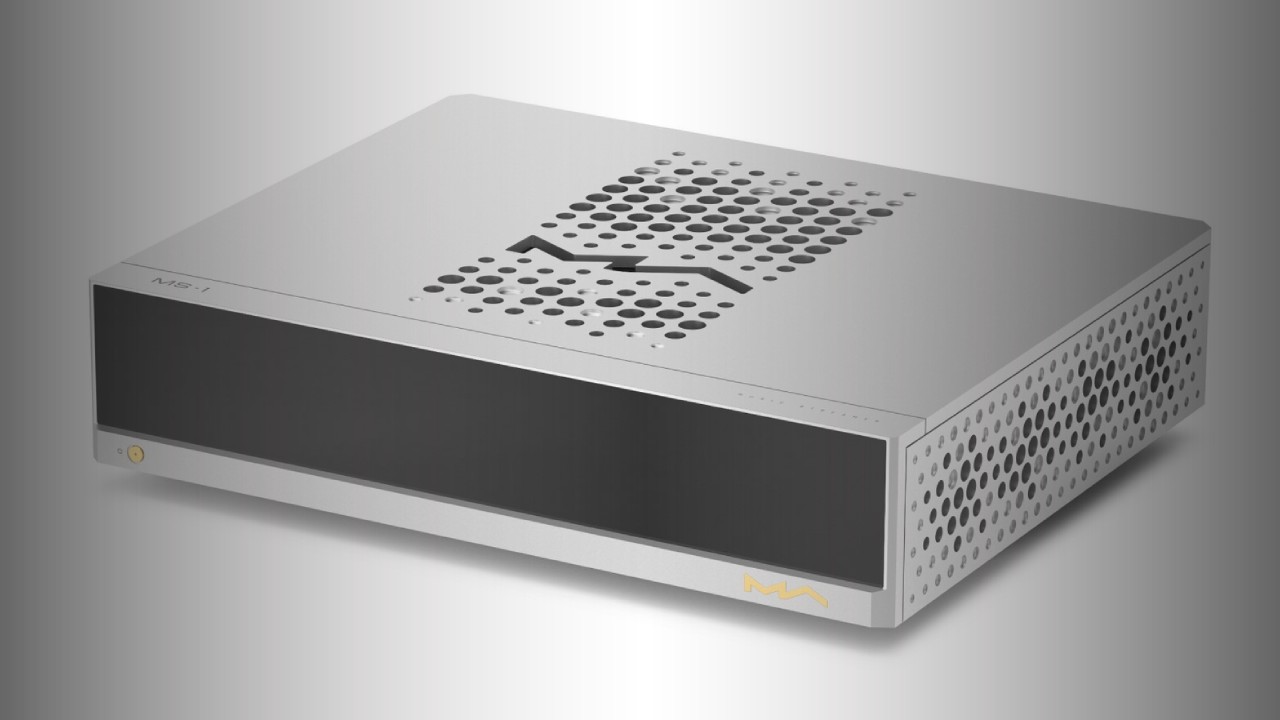
Matrix Audio has introduced the MS-1, the source component in its new flagship M Series. Although described primarily as a music streamer, the MS-1 is intended to occupy a much broader role in a two-channel system: it combines network playback, digital-to-analogue conversion, analogue and phono inputs, and a variable-output preamplifier in one substantial component.
That makes the MS-1 a potentially interesting proposition for listeners who want a modern streaming front end without building a rack around separate DAC, preamp and phono-stage boxes. Connect a power amplifier or active loudspeakers and it can act as the system’s central controller; add a separate DAC via its IIS-LVDS output and it can also be used as a high-level transport. The MS-1 sits alongside the MP-1 preamplifier and MA-1 power amplifier in Matrix Audio’s M Series, a range that signals the company’s move towards more conventional full-size hi-fi separates.
A streamer designed to be the system hub
The MS-1’s feature set reaches beyond the usual network player. It accepts USB, optical, coaxial and IIS-LVDS digital sources, so a computer, CD transport, games console or other digital device can feed its internal DAC. Matrix Audio also specifies two pairs of line-level analogue inputs, provided on XLR and RCA connections, plus a dedicated phono input with moving-magnet and moving-coil modes.
The analogue provision is notable because these inputs are not simply passed through an analogue preamplifier. Matrix Audio says they are converted to digital by a high-precision ADC before being handled in the MS-1’s digital processing section, where PCM filtering can be applied. This architecture allows analogue sources to be incorporated into the same volume-control, DSP and output framework as streamed or digital material. It also means the analogue signal undergoes A-to-D and D-to-A conversion rather than following a wholly analogue signal path. That is a meaningful system-design choice: it creates a consistent, flexible control platform, but vinyl traditionalists seeking an uncompromised all-analogue route may prefer a separate phono stage and analogue preamp.
For turntable users, MM/MC compatibility means the MS-1 should accommodate the two broad cartridge families, but Matrix Audio has not supplied loading, gain or capacitance figures in the announcement. Those details matter, particularly with low-output moving-coil cartridges, whose performance can be sensitive to gain and loading. They are worth confirming before treating the MS-1 as a direct replacement for a dedicated phono stage.
The digital inputs, meanwhile, position the unit as a DAC as well as a network endpoint. Its IIS-LVDS connection is especially relevant in a system built around compatible digital transports and DACs. I²S carries digital audio data and clock-related signals separately, rather than encoding them into a single S/PDIF connection, but implementation is not universally standardised between brands. Users should therefore check pin compatibility before assuming an IIS-LVDS source and destination will work together.

AKM conversion, dual-mono layout and configurable processing
At the heart of the MS-1 is an AKM-based conversion platform, the first such implementation from Matrix Audio. The company specifies AK4191 and AK4499 DAC chipsets, with each chipset operating in parallel mono mode. The left- and right-channel PCB assemblies are physically separated and installed on opposite sides of the chassis, creating a full dual-mono arrangement.
In engineering terms, a dual-mono layout seeks to minimise interaction between channels through physical separation and dedicated circuit implementation. Channel separation and noise performance depend on the complete design rather than layout alone, but separating left and right analogue circuitry is a rational approach in a component designed for low-level signal accuracy. Using DAC sections in mono configuration can also allow the converter resources to be concentrated per channel. Matrix Audio’s stated objective is accurate reproduction and high dynamic range; the company has not published measured dynamic-range, distortion or channel-separation figures in the supplied information, so the eventual technical performance will need to be assessed from independent measurements or a full specification.
Matrix Audio also includes asynchronous PCM upsampling and DSD conversion. These modes process incoming audio in the digital domain before conversion. Asynchronous resampling uses the product’s own clock domain rather than directly following the timing of an incoming source, which can help isolate the conversion process from timing variations carried by that input. Interpolation is an essential part of modern digital reconstruction, creating the intermediate samples required by a higher sample-rate data stream.
The DSD conversion option converts played material to DSD, while the PCM and DSD processing configurations are user-selectable. Such options are best understood as alternative processing paths rather than a universal upgrade: converting one format to another does not restore information absent from the original recording. Nevertheless, different filters and conversion schemes can alter noise-shaping behaviour and the way the final reconstruction stage is fed. The practical benefit here is that owners can compare the available configurations in their own system rather than being locked into a single approach.
Clocking and external-clock provision
The MS-1 uses a DPLL clock-synthesis circuit, paired with an ultra-low-phase-noise reference clock. Matrix Audio quotes 45fs of jitter for the clock signal generated in real time as the reference for the digital audio circuitry. In digital audio, clock jitter describes unwanted timing variation; keeping it low is an important part of preserving accurate conversion, especially where the clocking system must accommodate several inputs and sample rates.
An input for a 10MHz external clock is also included. This will be of interest to users with a compatible high-precision master clock, but it is not a necessary accessory for ordinary operation: the MS-1 has its own internal clock system. As always with external-clock connections, compatibility and the performance of the complete implementation matter more than the mere presence of a connector.
Resistor-array preamplification and flexible outputs
Matrix Audio describes the MS-1’s preamplifier as using a precision resistor-array volume control rather than relying on conventional digital attenuation. Its voltage-divider arrangement comprises four volume-control units, each with 64 precision 0.001 resistors and 32 sealed relays, switched by an MCU. The intention is to retain close left/right channel matching and predictable attenuation at low listening levels.
This is important in a one-box digital preamp because volume control is not merely a convenience feature. A poorly matched control can shift the stereo image at low levels, while excessive digital attenuation can reduce the effective signal level presented to the DAC or following stages in some architectures. A relay-switched resistor network selects physical resistor values for each level, though it can make faint relay clicks when changes are made. Matrix Audio says the operating noise is practically inaudible during continuous volume changes.
The preamplifier itself is a multi-stage operational-amplifier design with +10dB gain and a claimed maximum output of 16Vrms. That is a generous output capability on paper, intended to drive a power amplifier directly or feed active loudspeakers. The MS-1 also provides a pair of fixed XLR line outputs that can operate simultaneously with the variable pre-out, allowing a separate recording or monitoring device to be connected without following the volume setting.
In practical system terms, 16Vrms is more than many downstream inputs need. Owners should begin with sensible volume settings and check the input sensitivity of the connected amplifier or active speaker, especially when using efficient loudspeakers. The fixed XLR output is a useful distinction: it is suited to equipment that needs a constant line-level feed, whereas the variable output is the connection for normal power-amplifier volume control.

Network isolation, local storage and Matrix software
Network playback runs on MA Player, Matrix Audio’s Linux-based playback system, and the company positions the MA Remote app for iPhone, iPad and Android as the primary control interface. From a phone or tablet at the listening position, owners can control playback and volume, select tracks, adjust digital filters and operating modes, and set display brightness. The emphasis is on leaving the equipment rack untouched during routine use, with the component’s screen principally used to show music information.
The supplied information does not list supported streaming services, network protocols, file formats, maximum sample rates, Roon status or wireless connectivity. Those are central buying questions for a modern streamer, so prospective purchasers should establish the current MA Player feature list and local-service availability before making a decision. The app and software ecosystem can be as consequential as DAC hardware in day-to-day ownership.
For wired networking, the MS-1 has conventional Ethernet and an SFP port for an optical-fibre network connection. Fibre can electrically isolate the streamer from an upstream network switch because light, rather than an electrical conductor, bridges that part of the network. This may appeal to systems where network noise isolation is a design priority. It does require compatible SFP modules, fibre cabling and a suitable network arrangement, however; Ethernet remains the straightforward choice for most installations.
An NVMe SSD slot is fitted beneath the chassis, enabling internal music storage without repeatedly connecting USB drives. NVMe is a compact solid-state storage format, and an SSD has no spinning platters or mechanical motor noise. Matrix Audio says music on the internal drive can be maintained through network sharing or copied from external storage using MA Remote. Local storage will be useful for listeners with a substantial downloaded library, though prospective owners should confirm compatible SSD capacities, formatting requirements and library-management procedures.
Chassis structure and separated power supplies
The MS-1 introduces Matrix Audio’s new M Series industrial design, dominated by a hexagonal panel patterned with hundreds of circular holes of differing diameters and depths. Beneath the styling is what the company calls its H-shaped structure: a 20mm CNC-machined aluminium plate acts as the main structural beam, carries the components and supports the unit through feet attached to that beam.
Once the outer panels are fitted, this central structure creates separate internal cavities for different circuit modules. In a component housing network, digital, conversion, analogue and power-supply sections, physical partitioning is a sensible means of managing interference between stages. Matrix Audio also arranges the channel modules symmetrically on either side of the chassis, complementing its dual-mono DAC layout.
Power is supplied by two high-power toroidal transformers, assigned to the digital and analogue sections. Matrix Audio says these use square copper wire, along with Mundorf M-Lytic AG series filter capacitors and numerous low-noise and ultra-low-noise LDO regulators. Splitting the digital and analogue supplies aims to limit the transmission of processor and network-related noise into sensitive analogue circuitry. The extensive local regulation is similarly intended to provide each circuit block, including the SSD, with a stable supply close to its point of use.
Who the Matrix Audio MS-1 is for
The Matrix Audio MS-1 is not a minimalist streaming bridge. It is a statement source-and-control component for a system based around a power amplifier, active loudspeakers or Matrix Audio’s matching MA-1 power amplifier. Its strongest appeal lies in the breadth of integration: a streamer, DAC, digitally managed analogue inputs, MM/MC phono stage, relay-resistor preamp, local storage option and external DAC transport function all share one chassis.
That integration brings clear installation benefits and can reduce cable and box count, while the internal architecture suggests considerable attention to channel separation, power-supply partitioning and mechanical structure. The trade-off is that analogue sources are digitised, and several practical details remain unspecified, including streaming-service support, file-format capability and phono-stage loading options. For buyers whose priorities align with Matrix Audio’s software ecosystem and digital-first control philosophy, the MS-1 presents a notably comprehensive take on the contemporary flagship streamer.