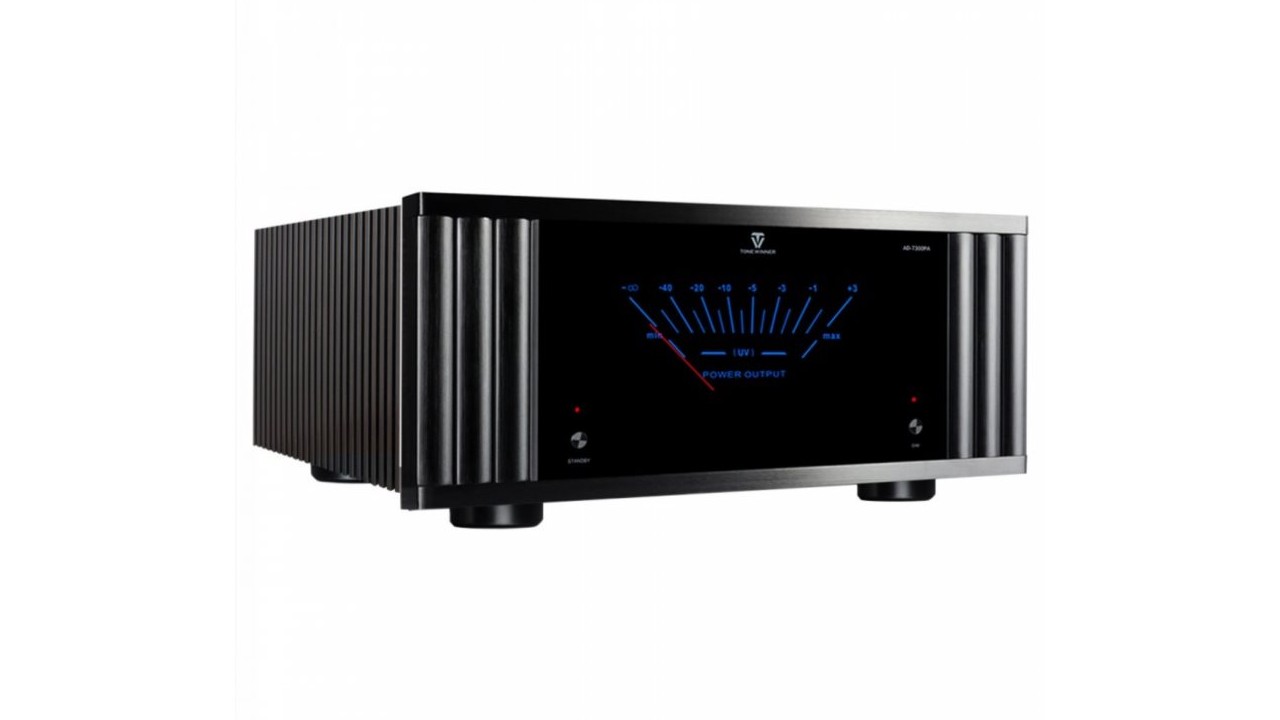
The Tonewinner AD-7300PA+ is a seven-channel Class AB power amplifier aimed squarely at serious home-cinema systems that need more authority than an AV receiver’s internal amplification can realistically provide. Its headline specification is a claimed 190W RMS into 8 ohms with all seven channels operating, while the amplifier is also specified at up to 584W RMS into 4 ohms when a single channel is driven.
Those figures need to be read in context: a multichannel power amplifier is rarely asked to deliver its maximum continuous output from every channel simultaneously in normal film use. Nevertheless, the all-channels-driven 8-ohm rating is the more relevant number for judging the power supply and output-stage provision in a surround system. On paper, it gives the AD-7300PA+ considerably more headroom than many receiver-based installations, particularly where loudspeakers are moderately demanding or the room is large.
Rather than attempting to be an all-in-one cinema component, this is a dedicated power amplifier. It has no decoding, streaming platform, DAC, room correction or volume control specified. It therefore requires an AV processor, a receiver with multichannel pre-outs, or another suitable preamplifier to provide source switching and level control. That separation is important: the AD-7300PA+ is designed to take care of the current-hungry work of driving seven passive loudspeakers.
Seven discrete Class AB amplifier modules
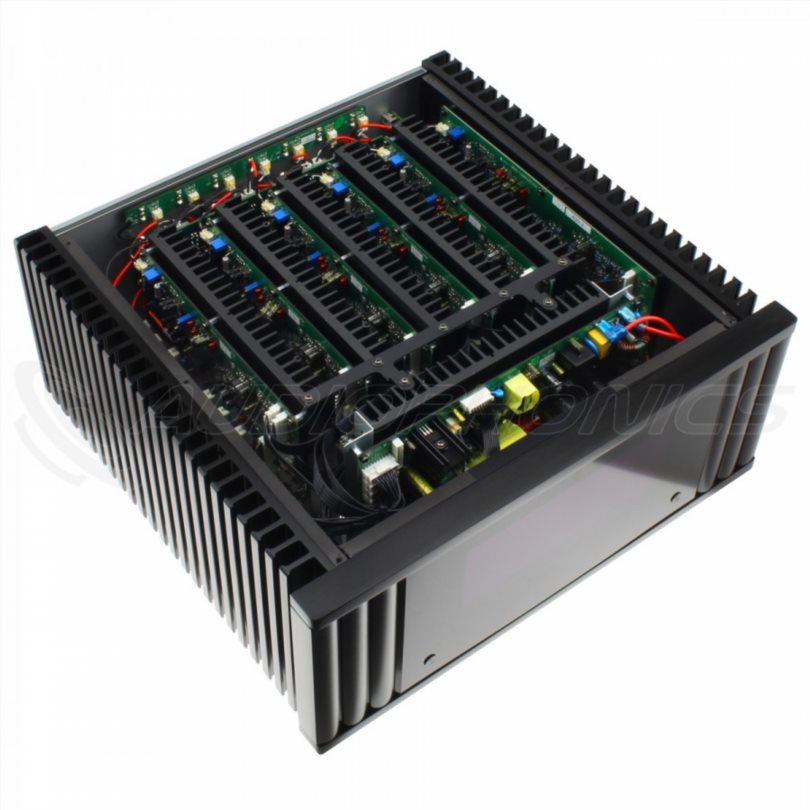
The AD-7300PA+ uses seven independent discrete mono amplifier modules. In practical terms, each channel has its own amplifier circuitry rather than sharing an integrated multichannel amplifier chip. Discrete output stages are common in substantial power amplifiers because they allow the designer to specify individual driver and output devices, thermal management and current capability for the intended application.
Each module uses three pairs of Onsemi NJW0281G and NJW0302G transistors. These are complementary bipolar output devices: one type handles one half of the audio waveform and the other works on the opposite half. In a conventional push-pull Class AB circuit, this arrangement seeks to combine much of the efficiency of Class B operation with lower crossover distortion around the waveform’s zero crossing. The result is substantial output capability without the continuously high idle power and heat associated with a pure Class A design.
Tonewinner says the front left and right channels employ a high-current configuration that approaches the performance of a Class A architecture. It is worth treating that wording carefully. The AD-7300PA+ is specified as a Class AB amplifier, not a Class A design, and no bias-current figure or Class A power rating is given. What can be said is that the manufacturer has apparently prioritised current delivery in the two main channels, which are usually the busiest and most sonically important channels in a music-capable cinema system.
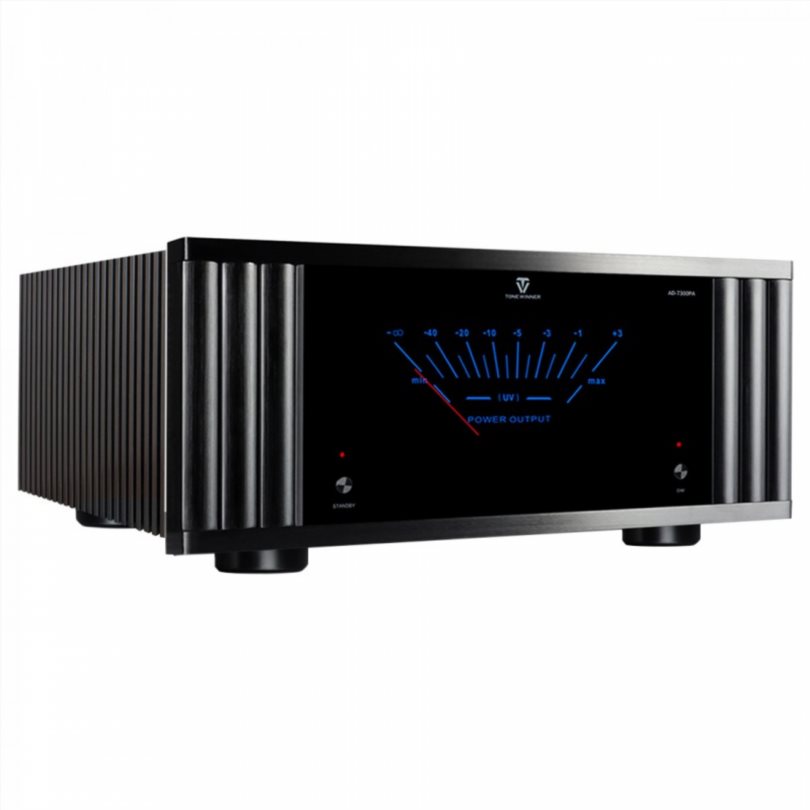
Current capability matters alongside headline wattage. Loudspeakers are not constant resistive loads: their impedance changes with frequency and their electrical phase can make an amplifier work harder than a nominal 8-ohm label suggests. A robust output stage and adequate power supply are valuable when reproducing the transient demands of action-film effects, orchestral crescendos and dynamic music at realistic levels. The available specifications do not establish how the AD-7300PA+ behaves into every difficult real-world load, but the separate transistor-based modules and its substantial mass point to an amplifier conceived for higher-power duties.
What the power ratings tell us
Tonewinner quotes several output-power conditions, which is useful because each reveals a different aspect of a power amplifier’s operating envelope:
- 584W RMS into 4 ohms, one channel driven, 20Hz–20kHz, at 0.1% THD
- 307W RMS into 8 ohms, two channels driven, at 0.1% THD
- 500W RMS into 4 ohms, two channels driven, at 0.1% THD
- 190W RMS into 8 ohms, all seven channels driven, at 0.1% THD
The 584W figure is an indication of the output available when the amplifier’s resources are concentrated on one 4-ohm channel. It should not be confused with the power available to all seven channels at once. Conversely, the 7 x 190W figure is a notably more demanding test condition because the power supply is feeding every channel. For someone planning a 5.1, 7.1 or seven-channel height/surround arrangement, that is the specification most likely to inform system matching.
The two-channel figures are also relevant for owners who use their cinema system for stereo music. With the front pair driven, the stated 307W into 8 ohms and 500W into 4 ohms suggest useful reserve for left and right speakers. However, output power alone does not determine sound quality, speaker compatibility or maximum playback level. Speaker sensitivity, listening distance, room size, impedance behaviour and the preamplifier’s output voltage all affect the final result.
The amplifier’s nominal impedance is listed as 8 ohms. Buyers with nominally 4-ohm loudspeakers, or speakers known to dip significantly below their rating, should avoid assuming compatibility solely from the one- and two-channel 4-ohm figures. They should consult Tonewinner or their dealer regarding the intended load range and ensure that the amplifier has adequate ventilation.
Other published figures include a signal-to-noise ratio of at least 100dB, A-weighted; total harmonic distortion of no more than 0.09% at 1kHz; and THD+N of 0.006% at 100W RMS, 1kHz into 8 ohms. These are manufacturer specifications rather than independent measurements, but the THD+N condition is especially meaningful because it is quoted at a substantial 100W output rather than only at a very low power level. The stated frequency response is 20Hz–50kHz, +1/-3dB, while the damping factor is specified at greater than 149 into 8 ohms.
Damping factor describes the relationship between an amplifier’s output impedance and the loudspeaker load. A higher figure generally implies better electrical control of a driver, especially around bass resonances, although the loudspeaker’s crossover, cable resistance and room have major roles in the bass ultimately heard. It is not a standalone predictor of performance, but the published figure indicates that low output impedance has been a design objective.
Balanced and RCA inputs on every channel
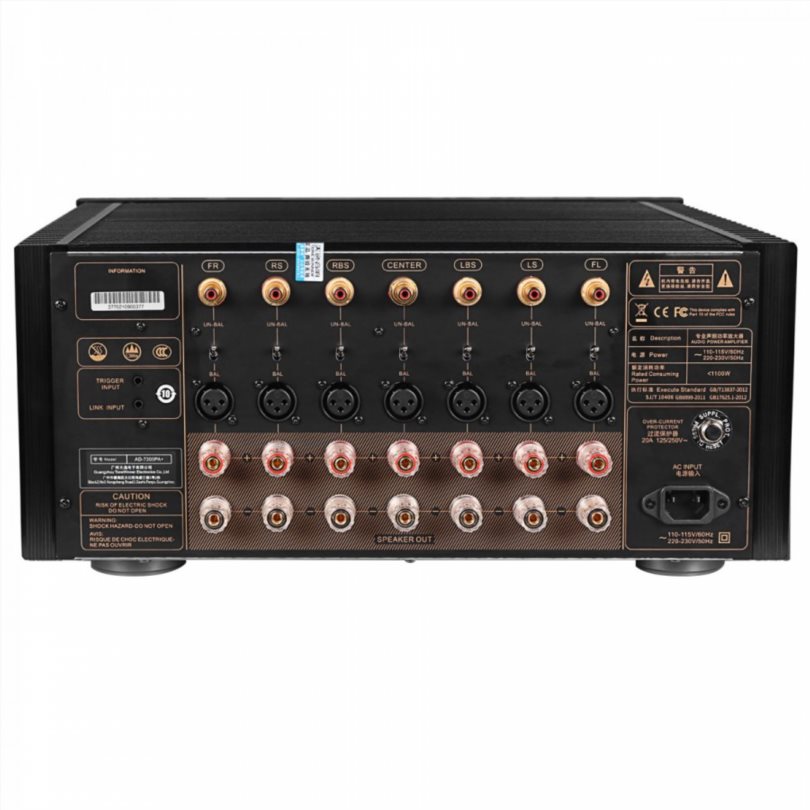
System integration is unusually flexible for a seven-channel power amplifier. Every channel has both a single-ended RCA input and a balanced XLR input, with a dedicated switch to select the input for that channel. This is valuable in mixed systems: an AV processor with XLR outputs can use balanced connections throughout, while an owner with RCA pre-outs is not excluded. It also means the amplifier can accommodate installations where a source component or preamp uses one connection standard and another component uses the other.
Balanced XLR connections are principally useful where cable runs are long or where there is a risk of noise caused by ground differences or electromagnetic interference. A balanced interface uses a differential signal arrangement that can reject common noise picked up along the cable, assuming the source and receiving equipment implement it correctly. In a compact rack with short interconnects, RCA can work perfectly well; XLR is not automatically a sound-quality upgrade. Its practical strength is noise rejection and the secure, locking connector.
As the AD-7300PA+ has input selection separately for each channel, care is required during installation. The selected input must match the cable actually connected for that channel. It is sensible to power the system down before changing inputs or connections, then verify channel assignments at low volume using the processor’s test tones. In a seven-channel installation, a swapped surround or centre connection can be less obvious than a misplaced stereo pair.
The quoted input sensitivity is 1.5V into 8 ohms and gain is 28dB. These figures describe how much signal voltage is needed to reach the amplifier’s rated output and how much the amplifier increases that incoming signal. In a conventional cinema setup, an AV processor or AV receiver’s pre-outs should supply the necessary signal, but gain matching remains important. A processor’s calibration routine can establish the relative level of each speaker, while manual users should begin with conservative levels and confirm channel balance before serious listening.
There is also a 12V trigger input and a LINK input. A trigger connection is a useful ownership feature in a separate system: it allows a compatible processor to turn the power amplifier on and off automatically, avoiding the need to access a 25kg chassis each time the system is used. The precise function and connection behaviour of the LINK input are not detailed in the supplied information, so prospective owners should consult the manual before planning to use it.
Substantial chassis, cooling and protection
The AD-7300PA+ measures 440 x 445 x 197mm and weighs 25kg. That is a genuinely substantial enclosure, so a rack or cabinet must have both the physical depth and the load capacity to accommodate it. The 445mm depth is particularly worth checking: many furniture units that appear suitable from the front are too shallow once speaker cable, XLR or RCA plugs and airflow clearance are factored in.
The chassis is clad in aluminium and uses two large heatsinks on its sides. Heat management is fundamental in a multi-channel Class AB amplifier. The output transistors dissipate heat both when delivering power and while idling, and an amplifier enclosed in a restricted cabinet may reduce its lifespan or enter thermal protection prematurely. The side-mounted heatsinks should not be pressed against a cabinet wall; leave clear space at the sides and above, follow the manufacturer’s installation guidance, and avoid stacking another heat-producing component directly on top.
To protect the amplifier and connected loudspeakers, Tonewinner lists short-circuit, overload, overheat, overvoltage and overcurrent protection. Such circuits are essential rather than optional on a product with this potential output. They can disconnect or limit operation when a speaker cable is shorted, a load is excessive, temperature rises too far, or a supply fault occurs. Protection is a safeguard, not a licence to ignore installation basics: terminate speaker cables carefully, prevent stray wire strands from touching adjacent terminals, and switch the system off before altering connections.
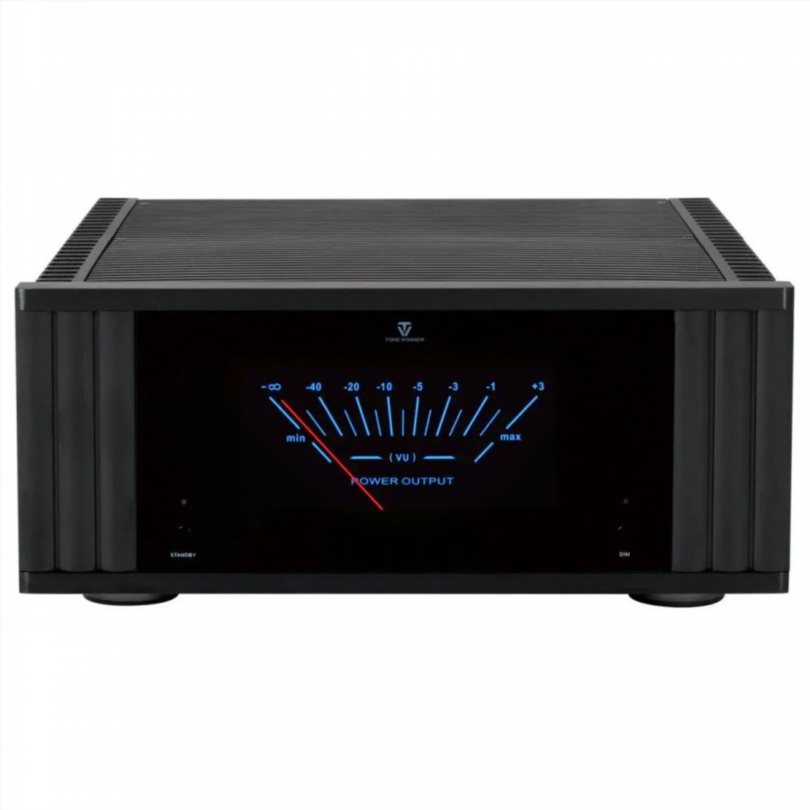
A blue front-panel meter with adjustable brightness adds an overtly traditional power-amplifier visual cue. Adjustable illumination is more useful than it may sound in a cinema room, where a permanently bright display can be distracting during film viewing. Beyond that, the source does not specify whether the meter is a precision power readout or a display feature, so it should not be treated as a calibrated indicator of output level.
Who should consider the AD-7300PA+?
The strongest case for the Tonewinner AD-7300PA+ is an owner building a proper separated home-cinema system around a processor or receiver with seven pre-out channels. It offers one chassis for the front, centre and surround loudspeakers, potentially simplifying a system that might otherwise require multiple stereo or monoblock power amplifiers. Its stated power reserves should be of interest to users of less sensitive speakers, larger rooms and installations where clean dynamic headroom is more important than keeping the amplification compact.
It may also suit a hybrid music-and-film system. The manufacturer’s emphasis on the front left and right channels recognises that these are used for stereo playback as well as the bulk of a film soundtrack’s musical and directional information. The availability of XLR and RCA inputs per channel supports a wide variety of processor and preamplifier arrangements, although users should plan their gain structure and wiring carefully.
The trade-off is clear: this is a large, heavy, heat-generating Class AB power amplifier that needs a separate control component. It is not the neatest solution for a small living-room system, and it does not provide the switching, HDMI connectivity, streaming or room correction found in an AV receiver. But for a system where those jobs are already handled upstream, the AD-7300PA+ takes a more single-minded approach: seven discrete amplification channels, substantial claimed output, flexible analogue inputs and the physical engineering needed to support them.
Key specifications
- Type: Seven-channel power amplifier
- Amplification: Class AB
- Inputs: 7 x mono RCA, 7 x balanced mono XLR, 1 x trigger input, 1 x LINK input
- Outputs: 7 x speaker terminals
- Output power: 584W RMS at 4 ohms, one channel driven, 20Hz–20kHz, 0.1% THD; 307W RMS at 8 ohms, two channels driven, 0.1% THD; 500W RMS at 4 ohms, two channels driven, 0.1% THD; 190W RMS at 8 ohms, seven channels driven, 0.1% THD
- Signal-to-noise ratio: ≥100dB (A-weighted)
- THD: ≤0.09% (1kHz)
- THD+N: 0.006% at 100W RMS, 1kHz, 8 ohms
- Frequency response: 20Hz–50kHz (+1/-3dB)
- Nominal impedance: 8 ohms
- Gain: 28dB
- Damping factor: >149 at 8 ohms
- Input sensitivity: 1.5V at 8 ohms
- Power supply: 110–230VAC, 50/60Hz
- Dimensions (W x D x H): 440 x 445 x 197mm
- Weight: 25kg