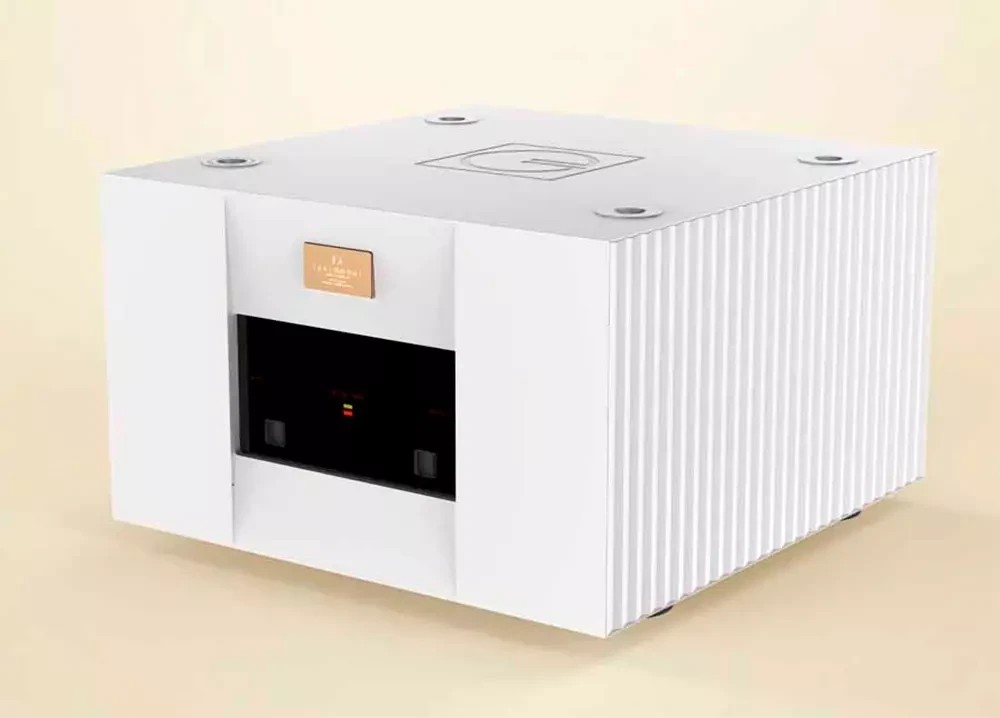
Goldmund has announced the Telos 1800, a flagship-priced monoblock power amplifier that combines conventional analogue amplification duties with coaxial digital input and output. Rated at 420W into 8 ohms at 1% THD, the Swiss manufacturer’s new model is aimed at systems requiring considerable power in a physically substantial, single-channel chassis: each Telos 1800 measures 44 x 28 x 46cm and weighs 51kg.
The headline specification is only part of the story. Goldmund’s published figures also point to an amplifier designed to keep its own electrical noise and output impedance low: noise is specified at less than 3µV across the audible band, while damping factor is quoted at 600 at 1kHz into 8 ohms. At CHF 70,000, £77,500 in the UK or $83,000 in the US per monoblock, this is unequivocally a cost-no-object proposition rather than a conventional high-power power amp.

A monoblock with analogue and coaxial digital connections
In the usual sense, a monoblock is a power amplifier devoted to one loudspeaker channel. A stereo pair therefore requires two chassis, with one Telos 1800 connected to each speaker. This approach can place the power amplification close to the loudspeakers and gives each channel its own casework and power-amplifier hardware. It is often chosen in very high-end systems where physical separation, channel independence and the ability to accommodate large amplifier assemblies are priorities.
The Telos 1800 is described as an all-in-one model because it offers more than a purely analogue power-amp input stage. Connections include both balanced XLR and unbalanced RCA analogue inputs, plus coaxial RCA digital input and output. That makes it potentially relevant to a system using a digital source with a coaxial S/PDIF output, as well as to a conventional separate preamplifier or DAC with analogue outputs.
Goldmund has not supplied detail here on the digital-to-analogue conversion architecture, supported PCM or DSD formats, clocking method, digital volume implementation or the function of the coaxial digital output. Those details will matter to buyers considering the Telos 1800 as a direct-connected digital amplifier rather than simply as an analogue monoblock. In particular, a digital source connected directly to a power amplifier needs a safe and properly implemented means of level control; the presence of a digital input alone does not establish how that is handled in a complete system.
The specified maximum analogue input level is 1V, while the maximum digital input level is -6dBFS. The latter indicates that attention will be needed when configuring a digital source or upstream digital processor. It should not be read as a general recommendation to lower every source by 6dB; instead, owners should follow Goldmund’s connection guidance and ensure that source output and gain structure are set correctly before connecting loudspeakers.
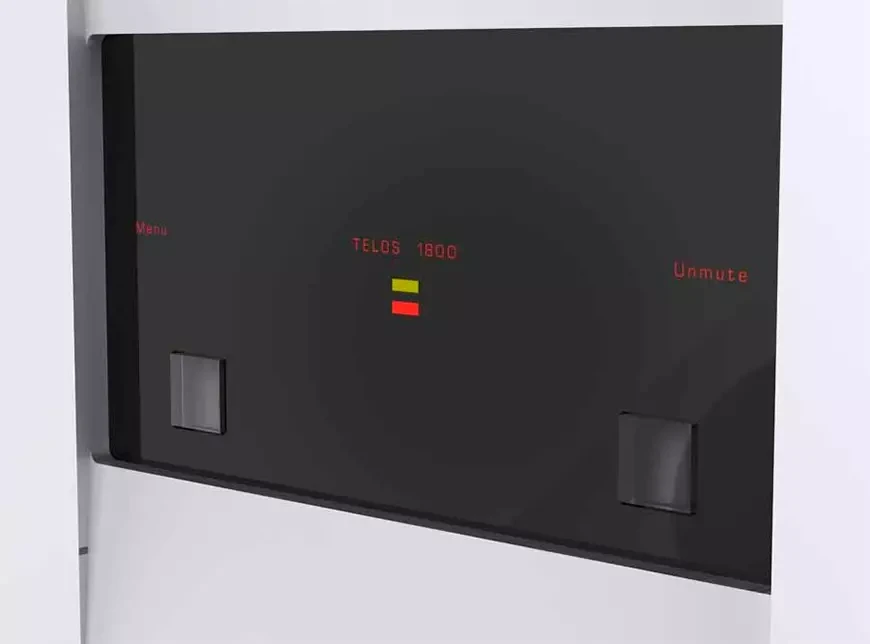
Power, gain and the figures that matter with loudspeakers
Goldmund rates the Telos 1800 at a maximum of 420W into 8 ohms at 1% THD. This is a high output figure, giving the amplifier substantial voltage capability on paper for loudspeakers that need wide dynamic headroom. However, power figures should always be considered alongside a speaker’s impedance behaviour, sensitivity, room size and intended listening level. A loudspeaker’s nominal impedance is not its impedance at every frequency, and Goldmund has not provided a 4-ohm power rating or a minimum-load specification in the announced information.
For that reason, the 420W figure should not be extrapolated into a claim about output into lower impedances. What it does establish is that the Telos 1800 has been specified for serious output into an 8-ohm load. Prospective owners with difficult-to-drive loudspeakers should seek confirmation from the manufacturer or distributor about compatibility, especially where a speaker has demanding low-impedance regions or an unusually reactive crossover load.
The amplifier’s gain is quoted as 35dB. Gain describes how much the amplifier increases the incoming signal voltage before delivering it to the speaker terminals. In a system built around a conventional analogue preamplifier, this is an important matching parameter: high total system gain can make the usable range of a preamp’s volume control narrower and can reveal residual noise more readily at the listening seat. Conversely, it permits full output from a relatively modest input voltage. The Telos 1800’s stated 1V maximum analogue input figure is particularly relevant when selecting or configuring an upstream preamplifier.
Goldmund also specifies less than 0.05% THD from 20Hz to 20kHz at 30V output. Total harmonic distortion is a measurement of harmonic content added by an amplifier to the reproduced signal under the stated test conditions. The key qualification is the operating point: distortion measurements vary with output level, frequency and load. The given figure is useful as a defined benchmark, but it is not a complete description of behaviour at every power level or with every loudspeaker.
Low noise and damping factor in practical terms
The claimed output noise level of less than 3µV from 20Hz to 20kHz is notably low. In practical terms, a low noise floor helps reduce the likelihood of audible background hiss at sensitive loudspeakers and preserves the gap between quiet musical information and the amplifier’s self-noise. Whether any noise is audible in a particular installation will still depend on speaker sensitivity, listening distance, cable routing and the gain of the upstream electronics.
Goldmund quotes 110dB dynamic range. Dynamic range compares the intended maximum signal level with the residual noise floor. It is relevant to the amplifier’s ability to accommodate large signal swings without its own noise intruding on low-level material, although the final dynamic performance of a music system also depends on the source, preamplifier, recording and loudspeaker.
The damping factor of 600 at 1kHz into 8 ohms describes the relationship between the load impedance and the amplifier’s output impedance under that particular condition. A higher damping factor generally corresponds to lower output impedance and stronger electrical control of the loudspeaker’s motor system. This can be especially relevant around bass-driver resonance, but damping factor is not a standalone prediction of bass quality: speaker design, room modes, placement and amplifier performance across the entire frequency range all contribute. The published 1kHz/8-ohm condition should also be kept in mind rather than treating 600 as a universal figure for all frequencies and loads.
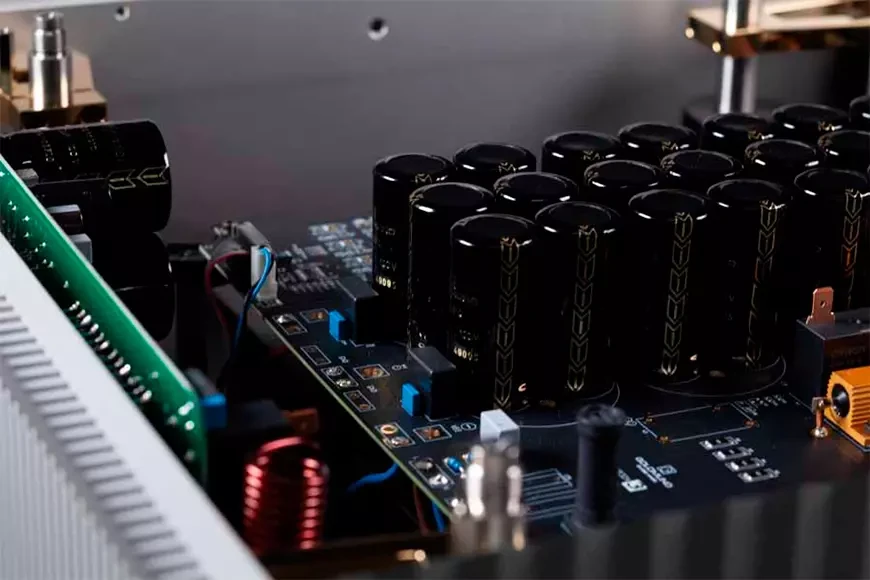
12mm casework and a 51kg installation
Goldmund has placed considerable emphasis on the Telos 1800’s enclosure. The amplifier uses a housing with 12mm-thick panels, compared with the 6-8mm panels used on earlier Goldmund products. According to the company, the added thickness increases cabinet rigidity and improves the case’s ability to dissipate vibration.
That is a credible area of engineering attention in a component of this scale. Large metal panels can store and radiate mechanical energy; increasing stiffness can move resonant behaviour and reduce the degree to which panels flex. In a power amplifier, robust casework also provides a stable mounting structure for heavy internal assemblies and connectors. It should not be confused with a complete account of mechanical isolation, however: Goldmund has not specified the Telos 1800’s feet, transformer arrangement, internal compartmentalisation or thermal-management strategy in the information released so far.
At 51kg per chassis, ownership will demand planning. A stereo installation means handling two very heavy amplifiers, so a rigid, level support or floor placement is likely to be preferable to furniture not designed for such loads. There should also be sufficient space around each unit for safe installation and cooling. Exact ventilation clearances have not been stated and should be confirmed in the operating documentation rather than assumed.
The standard finish is Goldmund’s familiar silver-grey, with a choice of gold or silver-grey ring. In a product category often dominated by visually imposing separate power amplifiers, the Telos 1800’s large 44cm-wide footprint and substantial casework are as much a system-installation consideration as an aesthetic one.
Who the Telos 1800 is for
The Telos 1800 is not a conventional integrated amplifier: the published connectivity contains no mention of multiple line inputs, network streaming, Bluetooth, HDMI, phono stage or headphone output. Its role is centred on driving one loudspeaker channel at a very high level of build and power capability, while its digital coaxial connection potentially reduces the number of boxes needed in a suitable digital-front-end system.
For a conventional separates system, the XLR input will be the natural option where an upstream preamplifier offers a true balanced output and the installation benefits from the common-mode noise rejection associated with balanced signal transmission. RCA provides compatibility with single-ended equipment. Balanced connections do not automatically guarantee better sound, but they can be useful with long interconnect runs or in electrically noisy environments when the equipment is correctly implemented.
The main trade-off is clear: a two-channel system requires two £77,500 monoblocks in the UK, before allowing for a source, control component and loudspeakers. Buyers will also need to establish precisely how the onboard coaxial digital input fits their chosen source and volume-control arrangement. But for installations that value a one-channel-per-chassis architecture, high specified 8-ohm power, extremely low quoted noise and unusually heavy mechanical construction, Goldmund’s Telos 1800 is a technically focused new flagship.
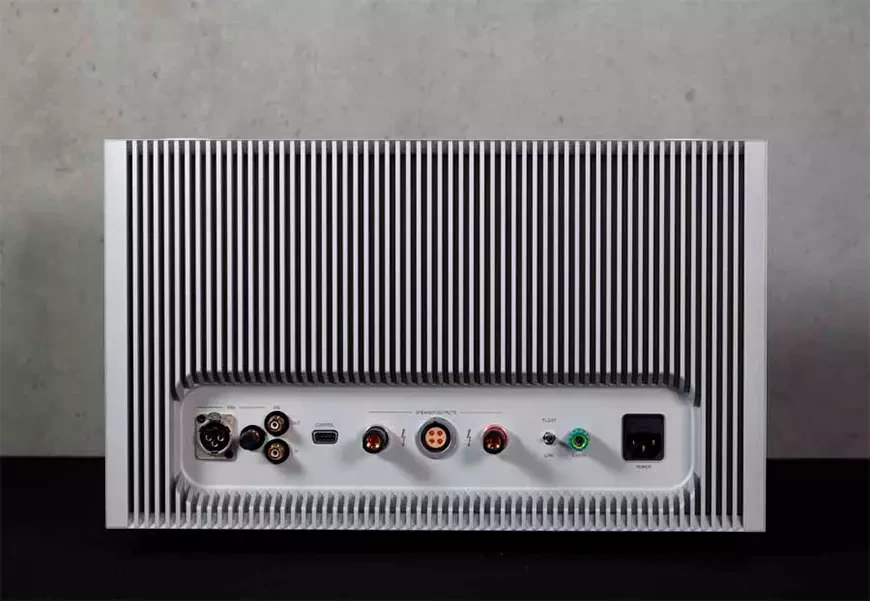
Goldmund Telos 1800 specifications
- Maximum power: 420W (8 ohms / 1% THD)
- THD: <0.05% (20Hz-20kHz at 30V output)
- Noise level: <3µV (20Hz-20kHz)
- Gain: 35dB
- Dynamic range: 110dB
- Damping factor: 600 (1kHz / 8 ohms)
- Analogue inputs: unbalanced RCA / balanced XLR
- Digital input: coaxial RCA
- Digital output: coaxial RCA
- Maximum analogue input level: 1V
- Maximum digital input level: -6dBFS
- Dimensions (W x H x D): 44 x 28 x 46cm
- Weight: 51kg
Price: CHF 70,000, £77,500 in the UK and $83,000 in the US, per monoblock.