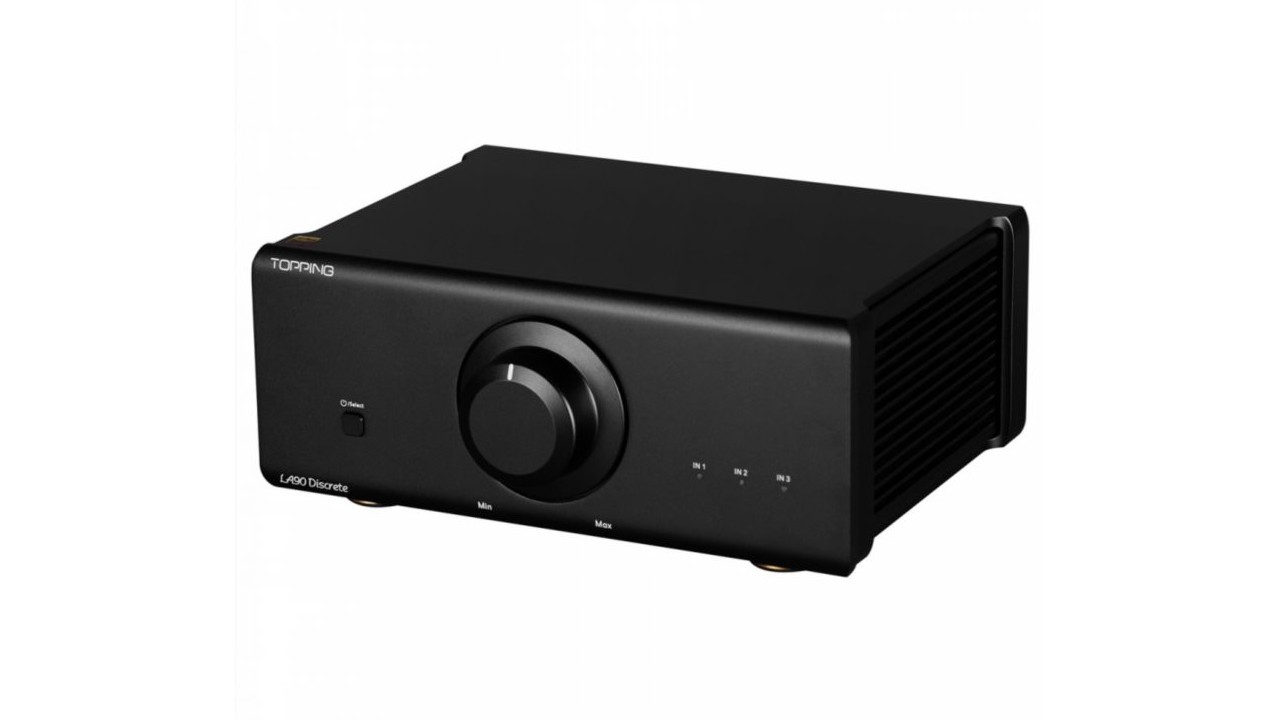
Topping has introduced the LA90 Discrete, a compact power amplifier that takes the basic flexibility of the original LA90 and substitutes a discrete implementation of the company’s NFCA amplification circuit. It is intended for systems built around balanced sources and preamplifiers, with three combo XLR/6.35mm TRS balanced inputs, adjustable gain, a defeatable volume control and the option to use two amplifiers as mono blocks.
The headline here is not an advertised wattage figure—none is supplied in Topping’s published information—but the amplifier’s low-noise, low-distortion engineering and unusually comprehensive measurement claims. Topping specifies THD+N below 0.0001% at 5W into 4 or 8 ohms, along with A-weighted signal-to-noise ratio and dynamic-range figures of 141dB in stereo and 143dB in mono. Those are very ambitious laboratory specifications, and they position the LA90 Discrete as an amplifier designed to add as little measurable noise and distortion as possible to the signal path.
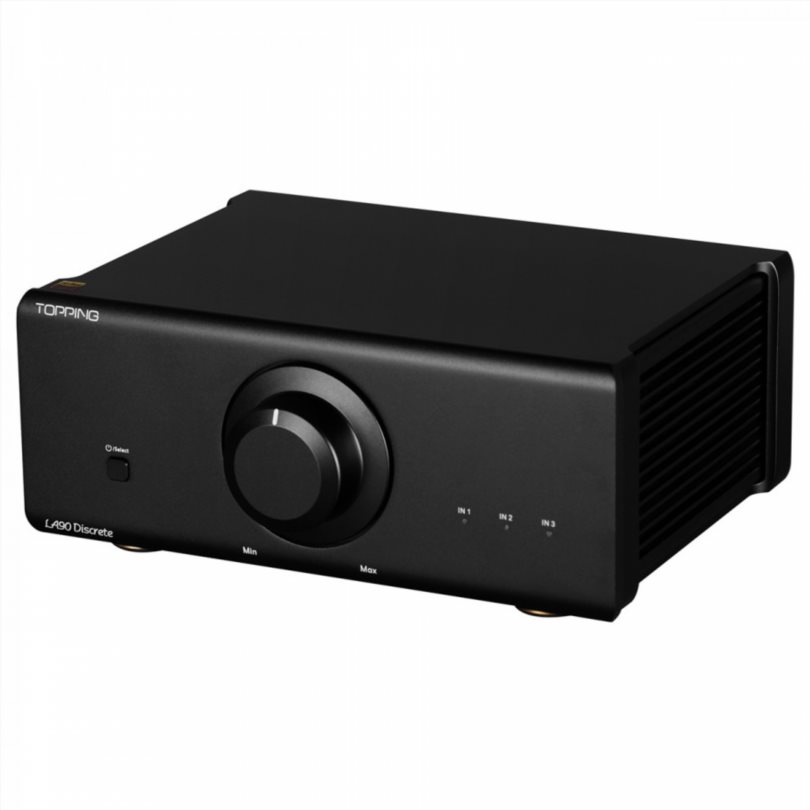
A discrete version of Topping’s NFCA amplifier approach
“Discrete” is an important part of this model’s name. In electronics, a discrete circuit is constructed from individual active components—such as transistors—rather than relying on an integrated amplifier chip for the entire amplification stage. That description alone does not determine sound quality: circuit design, component matching, biasing, power supply implementation, protection circuitry and thermal management all remain crucial. But it does tell us that the LA90 Discrete is a distinct engineering approach rather than simply a cosmetic revision.
Topping describes the circuit as discrete NFCA. NFCA, short for Nested Feedback Composite Amplifier, is Topping’s established amplifier topology name. Feedback is widely used in audio amplification to reduce distortion, lower output impedance and improve consistency between channels. In broad terms, a nested-feedback design applies feedback around more than one section of a circuit. Done well, it can help a designer achieve very low noise and distortion while retaining stable operation. The practical aim is straightforward: the speaker should receive an amplified version of the input signal with as little added character or error as possible.
That objective is reflected in the published THD+N figure of less than 0.0001% at 5W into both 4- and 8-ohm loads. THD+N combines harmonic distortion—the unwanted frequency multiples created by an amplifier—with noise. Measurements at modest output are especially relevant because much domestic listening takes place well below an amplifier’s maximum output. However, this single figure does not tell us the LA90 Discrete’s maximum continuous power, its clipping behaviour, or how distortion changes at higher levels. Those details would be needed to establish how it will suit a particular loudspeaker in a large room.
What the published measurements suggest
Topping quotes an A-weighted signal-to-noise ratio of 141dB in stereo and 143dB in mono, with identical dynamic-range figures. A-weighting is a measurement filter that reduces the contribution of frequencies to which human hearing is less sensitive; it is a standard way of expressing noise performance, but figures taken with different weighting, bandwidth and reference conditions are not directly comparable. Even so, the stated numbers indicate that very low self-noise is a central design target.
In practical system terms, a low noise floor matters most with efficient loudspeakers, close listening distances and high-gain systems, where transformer hum or amplifier hiss can otherwise become audible between tracks. It also helps preserve the usable dynamic range arriving from a capable DAC or preamplifier. It should not be confused with an assurance of unlimited loudness: noise and dynamic-range figures describe one aspect of performance, whereas an amplifier’s ability to drive a speaker also depends on output voltage, current capability and thermal limits.
The LA90 Discrete is also specified with channel crosstalk of -138dB at 1kHz in stereo operation and channel balance within 0.2dB. Crosstalk describes unwanted leakage from one channel into the other. Very low crosstalk supports accurate left/right separation, although stereo imaging in a real room is also strongly affected by loudspeaker matching, positioning, reflections and the recording itself. The specified output impedance is below 5 milliohms, an extremely low figure. Generally, a low amplifier output impedance helps it maintain control over the voltage delivered to a loudspeaker as the speaker’s impedance varies with frequency.
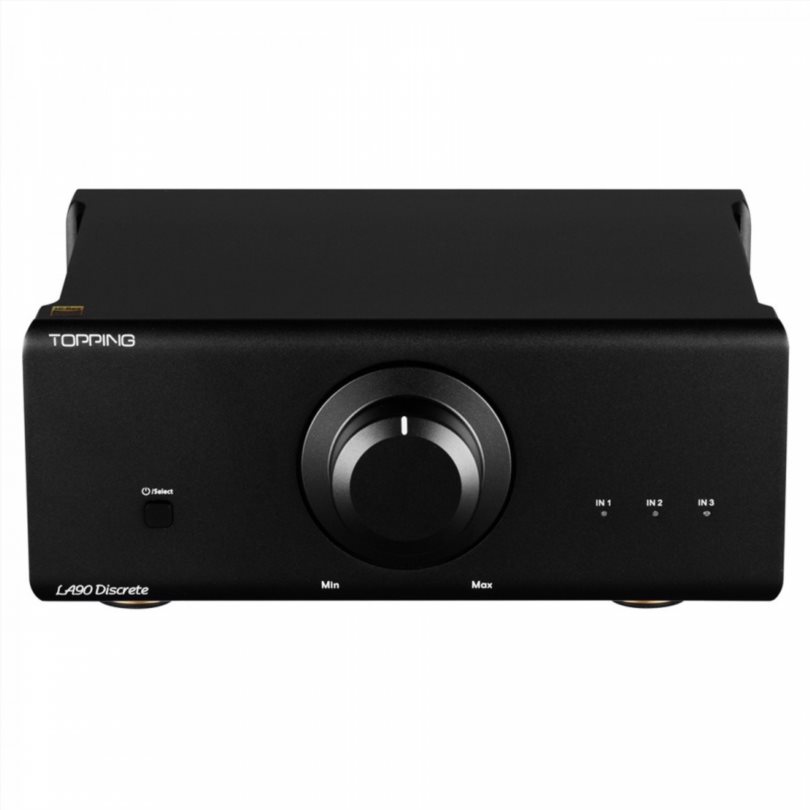
Balanced inputs, three source connections and stereo/mono flexibility
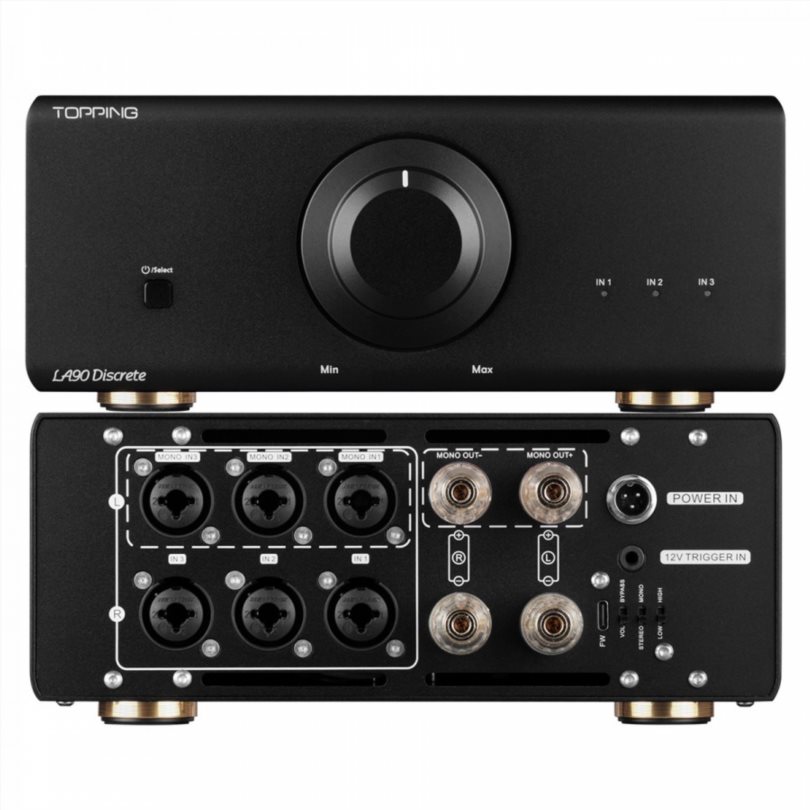
The LA90 Discrete provides three balanced analogue inputs, each on a combination connector that accepts either a conventional three-pin XLR plug or a 6.35mm TRS jack. This is a practical choice for users of professional and studio-derived equipment as well as domestic hi-fi components. XLR is the familiar connector on balanced DACs and preamplifiers, while 6.35mm TRS is common on pro-audio interfaces and monitor controllers.
A balanced connection carries the audio signal as two opposite-polarity versions, allowing noise picked up equally by both conductors to be rejected at the receiving stage. It can be useful where components are separated by long interconnects or placed near mains supplies and network equipment. Balanced cabling is not automatically superior in every short domestic connection, but the LA90 Discrete is clearly designed around a balanced signal path. Buyers should therefore check that their source has genuine balanced outputs, or use an appropriate converter where necessary; the supplied information does not list RCA inputs.
The three inputs give the amplifier more scope than a basic one-input power amp. A user could, for example, connect a balanced DAC/preamp alongside two other balanced line-level sources or controllers, subject to the system’s output-level and volume-control arrangements. Topping has not stated how input selection is controlled in the available specifications, so prospective buyers should confirm the operational details before planning a multi-source installation.
One LA90 Discrete can operate as a conventional stereo power amplifier. Alternatively, two units can be configured for monaural operation, with each amplifier dedicated to one loudspeaker. Mono-block operation can be attractive in systems that need more output capability than a single stereo chassis can provide, or where shorter speaker cables and a physically symmetrical installation are desirable. Topping specifies a minimum load impedance of 4 ohms in mono mode.
That 4-ohm minimum is a meaningful constraint. Loudspeakers rarely present one fixed impedance across their entire frequency range, and some models dip substantially below their nominal rating at certain frequencies. Anyone considering a pair of LA90 Discretes in mono should check the loudspeaker manufacturer’s recommended amplification and minimum impedance guidance rather than assuming every nominally 4- or 8-ohm design will be equally suitable. The same minimum load specification of 4 ohms is listed for stereo operation.
Gain settings and a volume control that can be bypassed
On the front panel, the LA90 Discrete has a large volume knob, allowing it to be used directly with a source that has a suitable fixed or controlled line-level output. This can simplify a minimal all-balanced system: for example, a DAC with fixed balanced outputs connected straight to the power amplifier. As always with a direct-to-power-amplifier connection, care is essential when setting levels. A source that outputs at full level can produce very high sound levels quickly, so the amplifier volume should be turned down before playback starts.
The volume control can also be bypassed for use with a separate hi-fi preamplifier. That is the more conventional arrangement for listeners with several sources, an analogue front end, tone controls, home-cinema integration or a preferred dedicated preamp. It is also particularly useful with two LA90 Discrete units in mono, since one external preamplifier can control both channels together. Using the bypass avoids placing two independent volume controls in the signal chain, which could otherwise make accurate left/right level matching inconvenient.
Two gain settings are provided:
- Low Gain: +9.4dB in stereo mode; +15.4dB in mono mode.
- High Gain: +19.4dB in stereo mode; +25.4dB in mono mode.
Gain is not power. It tells us how much the amplifier increases the incoming voltage, so it has a major effect on volume-control range and system noise. Low gain is often the sensible starting point with a modern DAC or preamplifier capable of a healthy output level. It can provide more usable rotation from the volume control and reduce the chance of audible background noise. High gain may be appropriate where the preceding component has a lower output voltage or where more level is required. Mono operation increases the stated gain in either setting, so a system moving from one stereo amplifier to two mono amplifiers should be re-levelled carefully.
Compact dimensions and trigger integration
Measuring 220 x 205 x 90mm, the LA90 Discrete occupies considerably less rack space than many conventional full-width power amplifiers. That can make it appealing for desktop-adjacent systems, media furniture or installations where a pair of mono amplifiers needs to fit into a relatively restrained space. Compactness should not be treated as a substitute for ventilation, however. The manufacturer information does not state the amplifier’s heat output or required clearances, so owners should follow the manual’s installation guidance and avoid enclosing any power amplifier tightly.
A 12V trigger input and output are included. Trigger connections are a small but valuable integration feature: a compatible preamplifier, streamer or processor can switch the amplifier on and off automatically, while the trigger output can pass the command on to another component. In a two-chassis mono system, this can make daily use much neater than manually powering up each amplifier.
Who should consider the Topping LA90 Discrete?
The LA90 Discrete makes the most sense for an enthusiast assembling a balanced, measurement-conscious system and wanting flexibility beyond a conventional integrated amplifier. Its three combo balanced inputs, selectable gain and volume bypass mean it can work either as the central level-controlled amplifier in a simple digital setup or as a dedicated power stage behind a separate preamplifier. The ability to begin with one stereo unit and later add a second for mono operation offers a clear upgrade route, assuming the loudspeakers remain within the stated 4-ohm minimum load requirement.
Its limitations are equally worth recognising. The supplied information lists only balanced inputs, so it is not an obvious plug-and-play choice for an RCA-only source. Nor does the available specification state output power, maximum current delivery, weight, remote-control provision, input-switching method or price. Those are all important buying details, especially when matching an amplifier to low-sensitivity speakers, demanding impedance curves or a large listening room.
What is clear is that Topping is aiming the LA90 Discrete at users who value low measured noise and distortion, balanced-system compatibility and a compact chassis that can serve in stereo now or as part of a future mono-block pair. The combination of a discrete NFCA circuit, quoted 141dB stereo A-weighted SNR, three balanced combo inputs and preamp bypass gives it a more specialist brief than a conventional all-in-one amplifier—and one that could be highly relevant in a carefully planned modern hi-fi system.
Topping LA90 Discrete key specifications
- Product type: Discrete amplifier
- Inputs: 3 x 6.35mm TRS/XLR combo jack
- Outputs: Speaker terminals
- THD+N: Less than 0.0001% at 5W into 4/8 ohms
- SNR, A-weighted: 141dB stereo; 143dB mono
- Dynamic range, A-weighted: 141dB stereo; 143dB mono
- Channel crosstalk at 1kHz: -138dB stereo
- Channel balance: 0.2dB stereo
- Output impedance: Less than 5 milliohms
- Load impedance: 4 ohms or higher in stereo and mono
- Gain: +9.4dB / +19.4dB stereo; +15.4dB / +25.4dB mono
- Control: Front-panel volume control, with bypass option
- System control: 12V trigger input and output
- Dimensions: 220 x 205 x 90mm
- Finish: Black