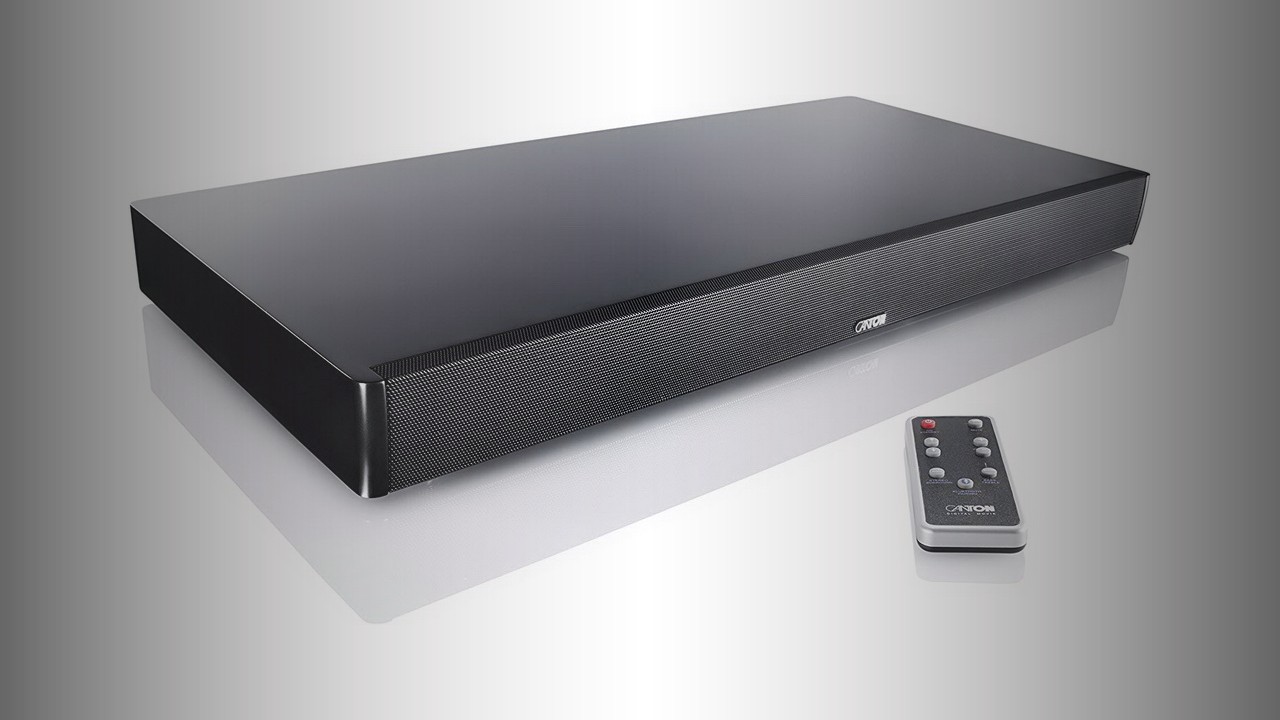
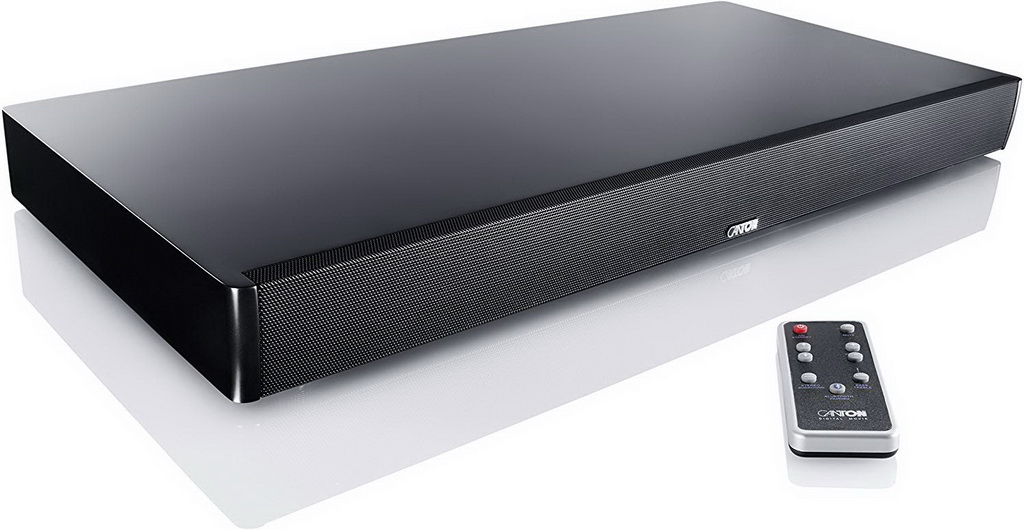
The Canton DM 75 is not a conventional slim soundbar designed to sit beneath a television. It is a sound base—a broad, low platform intended to support the TV itself while housing the loudspeakers and amplification below. That form factor makes sense for viewers who want a substantial improvement over thin-screen TV audio without adding separate speakers, an AV receiver or an external subwoofer.
Its design is deliberately self-contained: Dolby Digital and DTS decoding are built in, the cabinet incorporates midrange, treble and bass drive units, and an external subwoofer can still be added if the internal low-frequency system proves insufficient for a particular room or listening level. With analogue RCA, optical and coaxial digital inputs, the DM 75 is aimed at straightforward TV and source integration rather than the HDMI-centric connectivity expected of more recent soundbar designs.
The supplied assessment describes a sound that can deliver film effects with weight and energy while retaining enough control to make voices and quieter scenes intelligible. Just as importantly, the DM 75 includes practical provisions often overlooked in simple TV speakers: lip-sync adjustment, three installation-related EQ modes, and the ability to learn commands from another remote control.
A sound base rather than a separate speaker system
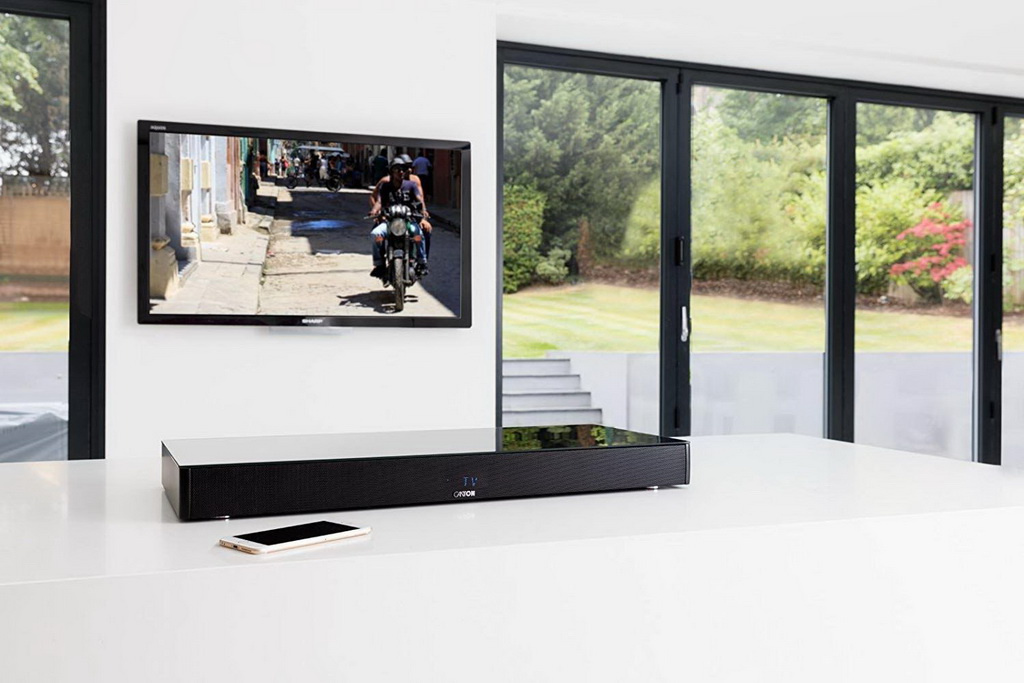
At 72.5cm wide, 32cm deep and 6.95cm high (the original specification also describes the height as 70mm), the DM 75 is made to occupy the footprint normally taken by a television pedestal. The maximum stated vertical load is 40kg, which should accommodate many flat-panel sets, but it is important to check more than the television’s mass. The TV’s own stand needs to sit fully and securely on the Canton’s glass-topped platform, without overhang or an unstable contact point. If the geometry is unsuitable, the DM 75 can instead be placed on the shelf of an existing TV rack.
This is a meaningful distinction between a sound base and a wall-mounted soundbar. A sound base can place a larger cabinet volume beneath the screen, potentially allowing more ambitious bass output than an ultra-thin bar. In return, it needs furniture space and is best suited to televisions that use a central pedestal rather than widely spaced feet. The DM 75 weighs 7.7kg, so it is not an insubstantial accessory; its supporting furniture should be level and rigid.
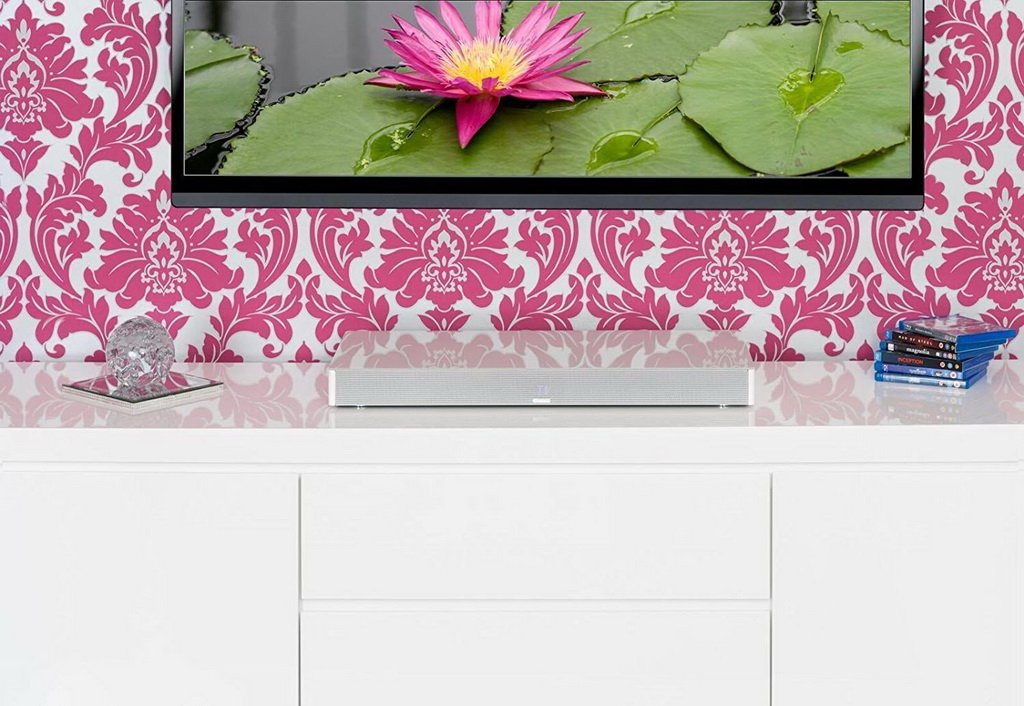
Canton offers the DM 75 in black, white and silver. A glass upper panel and metal feet give it a more furniture-like appearance than a fabric-wrapped bar. The feet also serve an acoustic purpose: they create clearance below the enclosure for its down-firing bass section. Keeping that gap unobstructed matters, since placing the unit on a thick rug or a surface that blocks the underside could alter the way its low frequencies couple to the room.
Driver layout and what ‘triphonic’ means here
The DM 75 is described as acoustically configured as “triphonic”. In practical terms, this means it uses a left/right stereo arrangement with an integrated bass section, rather than deploying discrete front, centre, surround and subwoofer channels as a full 5.1 system would. The supplied material calls it an emulation of multichannel sound using a stereo pair—a common approach in compact TV audio systems.
This is an important expectation-setting point. Dolby Digital and DTS decoding allow the unit to accept those digital sound formats, but the physical loudspeaker arrangement remains a compact, front-facing system. Surround processing can broaden or open up the apparent soundstage, yet it cannot place dedicated surround loudspeakers behind the listener. Anyone seeking precise rear effects or separate centre-channel control will still need a genuine multichannel installation.
On the front of the DM 75 are 50mm midrange drivers and 19mm silk-dome tweeters. A 19mm dome is a relatively small high-frequency diaphragm, and its role is to reproduce treble detail and dispersion above the handover to the midrange section. The 50mm drivers cover the vocal and much of the presence region, which is crucial to speech clarity in television and film sound. A compact driver working in this range can respond quickly, but it cannot move enough air for deep bass on its own—hence the separate low-frequency system in the base.
The specification says that four 100mm woofers are built into the middle section of the cabinet and fire downward. Elsewhere, the supplied text refers to “the two down-firing woofers”; Canton’s exact woofer count should therefore be confirmed against the final product documentation. What is clear is that the bass drivers are downward firing and supported by a rear-ported bass-reflex enclosure.
A bass-reflex design uses ports to reinforce output around the enclosure’s tuning frequency, extending bass response from a cabinet that would otherwise be physically limited. Rear-facing ports mean the DM 75 should not be packed tightly into a closed cabinet or pushed hard against a rear wall. The exact clearance will depend on the furniture and room, but giving the ports some breathing space is sensible. Corner placement may increase bass level, although it can also make bass less even or more boomy.
Film sound: processing, placement EQ and lip-sync correction
The 90W RMS total power rating tells us the system has considerably more available output than the small speakers built into most televisions. It does not, by itself, indicate how loudly the DM 75 will play in every room, nor how it will behave at high levels; those outcomes also depend on amplifier design, driver sensitivity, cabinet tuning and the programme material. Nevertheless, integrating dedicated bass drivers and 90W of amplification is a clear step beyond the restricted cabinet volume and modest power typical of a flat-panel TV.
In the supplied listening comments, action effects are said to spread convincingly across the room, with explosions and ricochets delivered with energy, while bass reaches deeper than expected without dominating the rest of the frequency range. The same assessment reports that the DM 75 retains agility and subtlety in demanding scenes, with vocal texture and low-level detail still apparent. These are encouraging observations, but they should be read as the characterisation supplied in the original material rather than as a new measured or independently verified listening test.
Two selectable playback modes are highlighted: Stereo and Surround. Stereo is said to produce a tighter, more focused sound, while Surround increases the sense of openness and space without a major loss of midrange precision. This is exactly the comparison worth making with familiar material. Stereo may be preferable for news, dialogue-led programmes and music, where a stable central image and vocal focus are often more valuable than artificial spaciousness. Surround processing can be more satisfying with cinema mixes when the priority is scale and envelopment.
Canton also provides three EQ modes intended for different installation positions. That is more useful than it may initially sound. A sound base can sit on a low rack, directly beneath a screen, or closer to ear height on taller furniture; each position changes the balance of direct sound and reflections from the floor, cabinet top and nearby surfaces. Rather than treating the modes as arbitrary presets, choose the one that gives the clearest dialogue and least excessive bass at the main seat.
The DM 75 further includes lip-sync correction. Digital processing in televisions and external video sources can delay the picture relative to audio, producing the distracting effect of voices arriving before or after lip movement. An adjustable audio delay allows the two to be brought back into alignment. This feature is especially worthwhile when the DM 75 is connected to a TV’s optical output and the TV is performing video processing.
Connections: simple, functional and worth planning around
Connectivity consists of a stereo analogue line input on RCA connectors, optical digital input, coaxial digital input and a subwoofer output. Bluetooth 3.0 is also included. This is a relatively focused connection set: it covers a TV with an optical output, a legacy source with coaxial S/PDIF, and an analogue device with line-level RCA outputs. Bluetooth offers a convenient route for casual music playback from a phone or tablet, though the supplied information does not identify supported Bluetooth codecs, so no assumptions should be made about aptX, AAC or other codec support.
Notably, no HDMI input or HDMI ARC/eARC connection is listed. That means the most logical TV hookup is likely optical digital, where available. Optical avoids electrical noise travelling along a metal cable between devices, although its practical benefit here is simply broad compatibility with televisions. Coaxial digital can be useful for a disc player, set-top box or other source that provides S/PDIF output. The RCA input should be used only with a line-level source; it is not a direct connection for a turntable unless that turntable has an integrated phono stage or is used with an external phono preamplifier.
The low-level subwoofer output provides a sensible upgrade path. The internal woofer system keeps the installation compact, but a separate powered subwoofer can offer greater room-filling capability and more flexible placement in a larger space. As no crossover controls or bass-management details are specified, prospective owners should establish how the DM 75 handles the handover to an external subwoofer before buying one. Integration between the sound base and sub will depend heavily on level, placement and any crossover adjustments offered by the subwoofer itself.
Controls and daily use
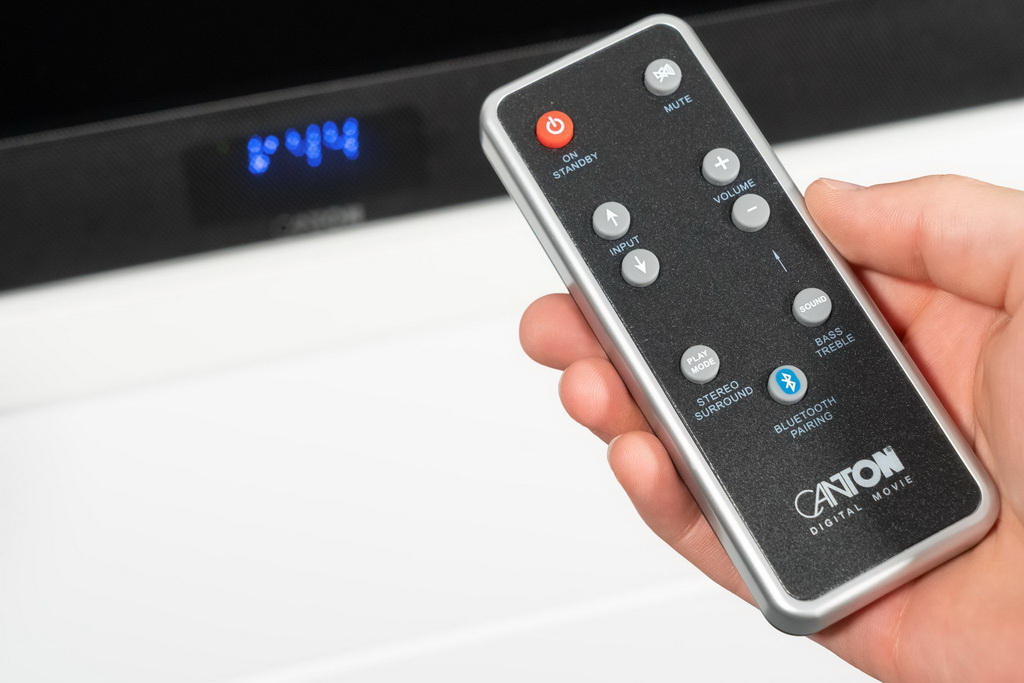
The DM 75 uses a large LED display and is supplied with a substantial remote control with clearly labelled buttons. That sounds unglamorous, but direct feedback of input and mode selection is genuinely useful on a TV speaker. It makes it easier to establish whether a source has switched correctly and to compare Stereo and Surround settings without relying on vague indicator lights.
More significantly, Canton allows the sound base to learn commands from another remote. In practice, this should enable core functions such as volume adjustment to be assigned to the television remote, reducing the need to keep multiple handsets at hand. For a living-room system used by several people, this may matter more over time than a long feature list: a TV sound system is most successful when everyone can operate it without changing remotes or explaining input selection.
The supplied advice is not to assume that bass and treble require substantial alteration. Begin with Canton’s standard tonal balance, then assess the placement EQ and the Stereo/Surround choice first. If bass is too prominent, investigate room position and proximity to walls before reaching for tone controls. Conversely, if dialogue sounds recessed, a more focused mode or a different installation EQ setting may be more productive than simply raising the treble.
Who the Canton DM 75 suits
The DM 75 is best understood as a compact, all-in-one upgrade for a compatible TV, not as a replacement for a fully separated home-cinema system. Its strongest proposition is the combination of a TV-supporting cabinet, integrated bass capability, Dolby Digital and DTS decoding, conventional digital inputs and thoughtful day-to-day features such as lip-sync adjustment and remote learning.
It should appeal most to viewers who want fuller television, film and music sound from a single box and who have a centrally mounted TV stand or a suitable equipment shelf. The 40kg load rating and 72.5 x 6.95 x 32cm platform dimensions must be checked before purchase. Those needing HDMI ARC/eARC, current wireless streaming standards or true discrete surround channels should look for a system designed around those requirements instead.
Within its stated brief, however, the Canton DM 75 takes a sensible engineering route. The sound-base format creates room for dedicated low-frequency drivers; the rear-ported, down-firing arrangement is intended to add scale; and the placement, processing and control options recognise that a TV speaker must work in real rooms, not just on a specification sheet.
Canton DM 75 specifications
- Total speaker power (RMS): 90W
- Built-in decoders: Dolby Digital, DTS
- Inputs: stereo line input (RCA), optical digital input, coaxial digital input
- Output: subwoofer output
- Bluetooth: Bluetooth 3.0
- Maximum vertical load: 40kg
- Platform dimensions (W x H x D): 72.5 x 6.95 x 32cm
- Weight: 7.7kg
- Finishes: black, white and silver