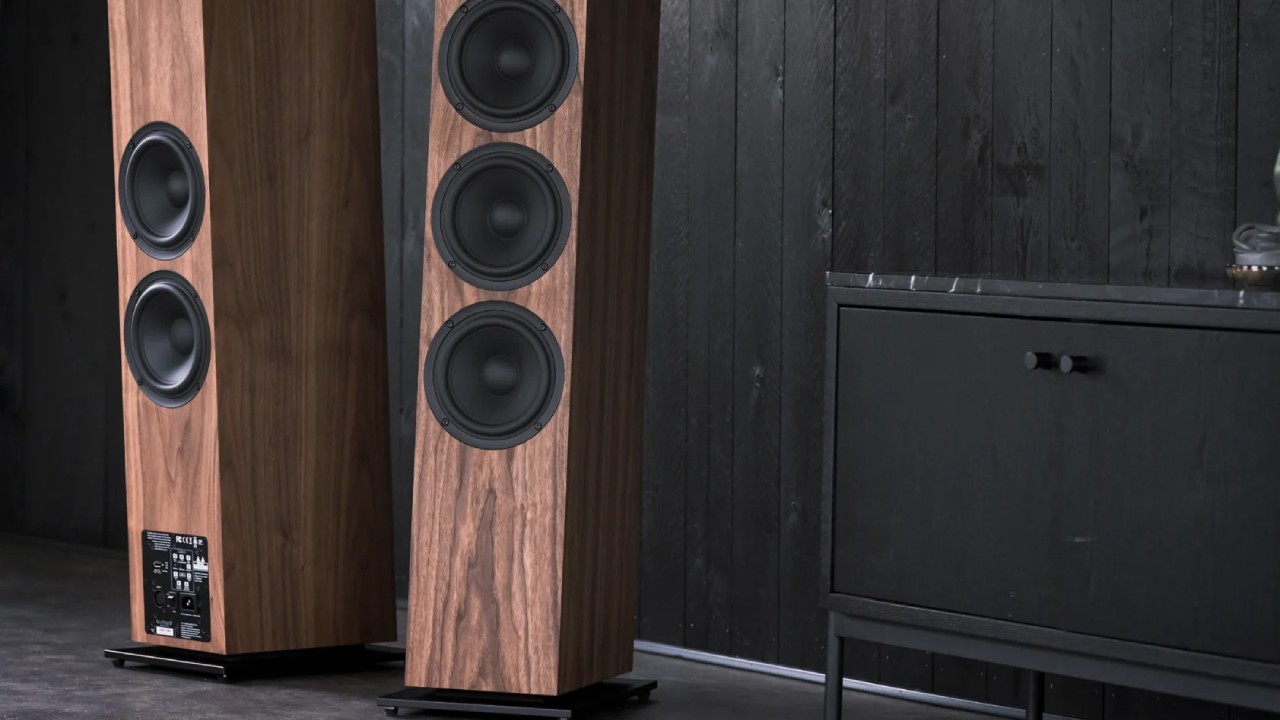
Buchardt Audio has introduced the A700 Limited Edition (LE), a revised and limited-run take on its active A700 floorstanding loudspeaker. The new model keeps the unusually compact proportions and fully active architecture of the original, but changes several ingredients that matter to enthusiasts: it receives Buchardt’s proprietary RFA19 tweeter, revised system tuning including adjustments to the rear-bass-driver polar pattern, and assembly in Denmark rather than Asia.
That combination makes the A700 LE more than a cosmetic special edition. It remains a speaker system in the fullest sense: amplification, DACs, DSP crossover and driver integration are built into each cabinet. Consequently, the buyer is not simply choosing a pair of passive loudspeakers but a complete active front end that can accept wired analogue signals or WiSA wireless audio. It is an approach intended to remove the conventional matching exercise of selecting separate power amplification, while placing considerable importance on source choice, positioning and the available software tunings.
The regular A700 reportedly sold out some time ago despite strong demand. Buchardt has not disclosed the number of A700 LE pairs it will produce, so “limited edition” should be understood as a production designation rather than a stated numerical cap.
A Danish-built A700 with a revised high-frequency driver
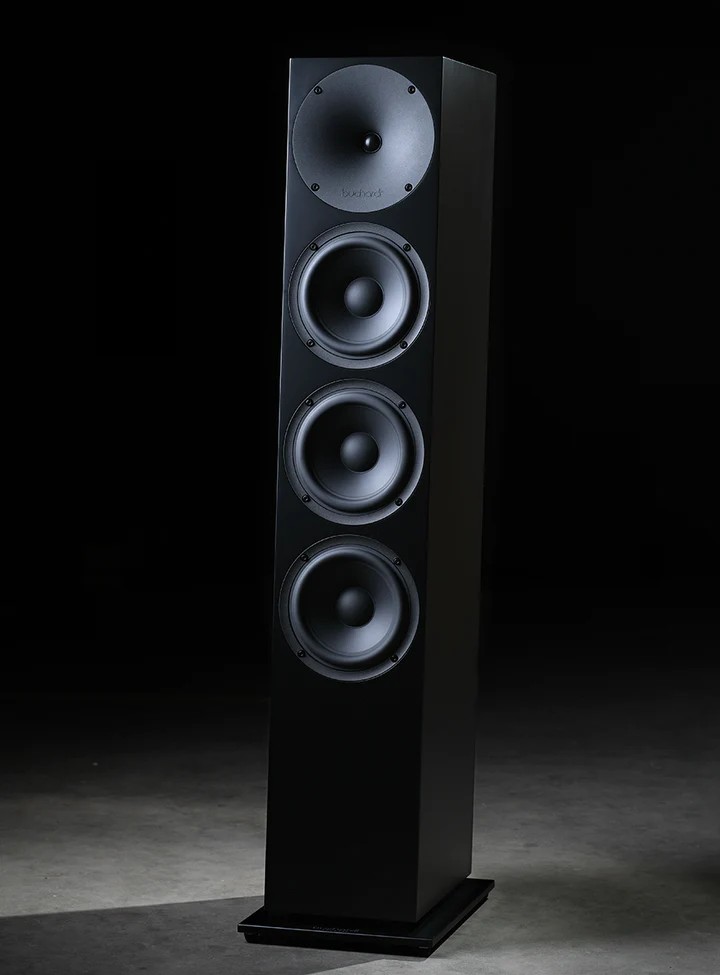
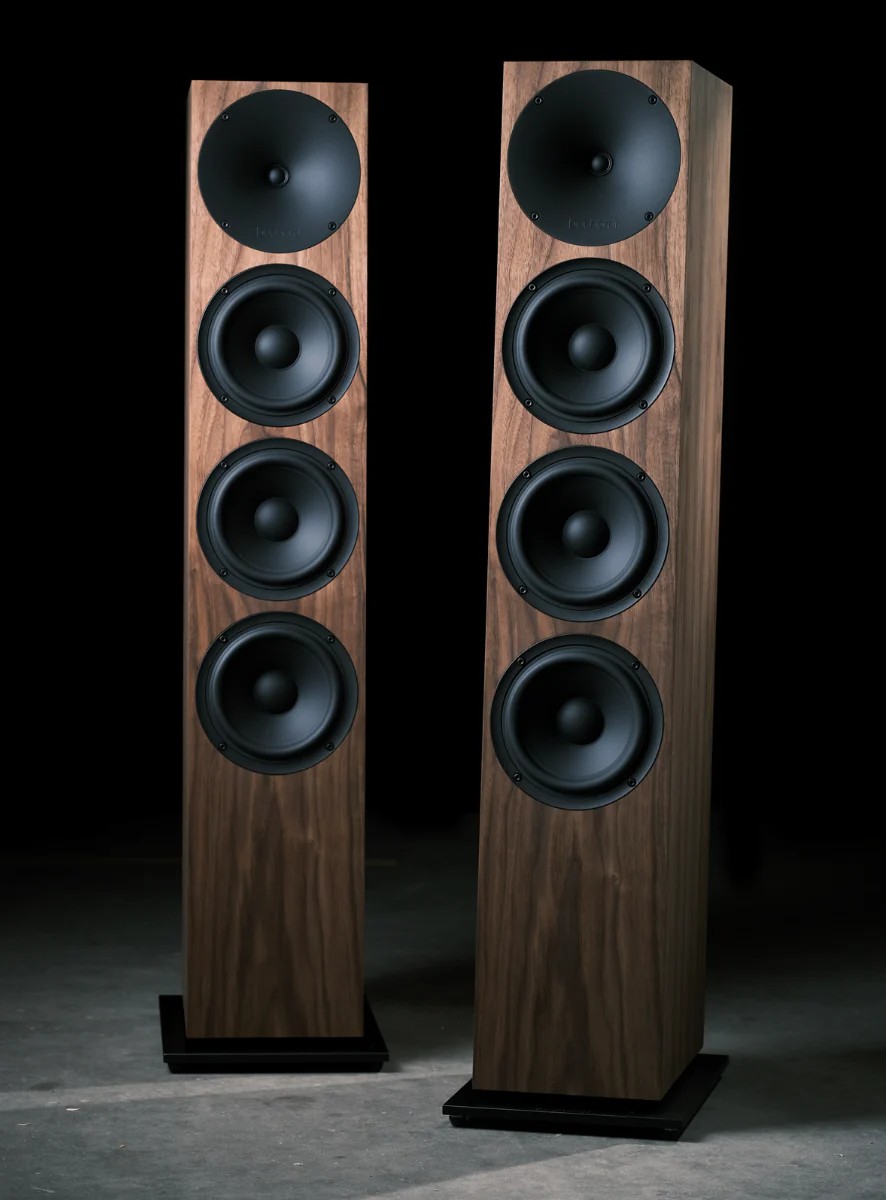
At the heart of the LE changes is the RFA19, a 19mm (0.74in) Resonance Free Aluminium dome tweeter that first appeared in Buchardt’s Anniversary 10 model. The tweeter is fitted with a CDC aluminium waveguide. A waveguide is not merely decorative: by controlling how a tweeter disperses into the room, it can help its radiation behaviour meet that of the mid/woofer more smoothly around the crossover region. That matters because a speaker’s perceived tonal balance is influenced not only by its direct output at the listening seat, but also by early reflections from side walls, ceiling and furnishings.
Buchardt says the RFA19 offers enhanced resolution in its operating range. That is the manufacturer’s claim, rather than a conclusion from an independent listening test, but the engineering rationale for a revised tweeter and waveguide is clear. In an active speaker, the crossover is implemented in DSP, so the designer has direct control of the filter slopes, level matching and driver protection. The change can therefore be accompanied by a tailored digital crossover and equalisation programme rather than being constrained by a passive crossover network made from fixed components.
The A700 LE maintains the standard model’s dimensions: 1000mm high, or 1035mm with its feet fitted, by 180mm wide and 280mm deep (39.3 x 7 x 11in). Those are slender floorstanding-speaker dimensions, particularly given the number of drive units and amplifiers specified. A narrow front baffle can be helpful in managing diffraction and can make placement in a domestic room less visually imposing than a wide, conventional high-output tower. It does not, however, make careful setup unnecessary: the A700 LE’s rear-facing bass system is an explicit part of its acoustic design.
Four amplifiers per speaker and a cardioid bass strategy
Each A700 LE contains four Class D amplifier channels rated at 150W RMS and 330W peak apiece. The total is therefore not directly comparable with a conventional single-channel integrated-amplifier rating: each channel is allocated within the speaker’s active system and can be optimised for the driver section it serves. The practical attraction of this arrangement is that the DSP and amplifiers can be designed together, with the manufacturer able to apply driver-specific filtering, equalisation and protection before the signal reaches the power stage.
Buchardt describes the system as a 3.5-way sealed enclosure and a 3-way cardioid design. The driver complement comprises the RFA19 tweeter, one 6in linear long-stroke paper-cone mid/woofer, two 6in linear long-stroke paper-cone front/subwoofers and two 6in linear long-stroke paper-cone rear/subwoofers.
The phrase “cardioid” is particularly significant. In broad terms, a cardioid loudspeaker arrangement aims to direct more low-frequency energy forward while reducing radiation to the rear. This is unlike the more common omnidirectional behaviour of bass in a typical box speaker at low frequencies. Rearward bass energy can interact strongly with the wall behind a loudspeaker, so controlling it has the potential to make speaker-to-wall placement less problematic and to reduce some room-related coloration. It is not a substitute for room consideration: wall distance, corners and the listening position still profoundly affect bass. But it is a different design priority from simply using a rear port or adding more conventional woofers.
The sealed-enclosure element is also worth noting. A sealed system does not use a reflex port to augment low bass. Its low-frequency performance instead depends on driver displacement, amplifier power and DSP equalisation, among other factors. With long-stroke drivers, active power and digital control available, Buchardt can pursue extension without the port noise or port-resonance considerations associated with bass-reflex loading. The trade-off is that meaningful low-frequency output from a compact cabinet demands substantial driver excursion and amplifier capability, which helps explain the active architecture.
The published frequency response is 19Hz–29kHz within ±3dB, and 25Hz–27kHz within ±2dB. Buchardt notes that these figures can change with its Mastertunings. Those are important qualifications. A response tolerance tells us how tightly a stated range is held, while the lower figure does not on its own state maximum sound-pressure capability in a particular room. Equally, the availability of alternative tunings means the exact tonal and bass balance need not be fixed in the way it is with a traditional passive loudspeaker.
The stated crossover points are 100Hz, 250Hz and 2800Hz, again with the proviso that Mastertunings can change them. In a multi-way active design, crossover choices are inseparable from dispersion, excursion management and the system’s desired directivity. The 100Hz and 250Hz points indicate that the multiple bass drivers are being used as controlled sections of a broader acoustic system rather than as a simple “woofer plus tweeter” layout.
DSP, conversion and wired or WiSA system integration
The A700 LE uses a quad-core DSP processor and is specified with four CS4398 DAC chips in each speaker. Digital signal processing is central to an active loudspeaker of this kind. It performs crossover duties, can apply equalisation and time alignment, and enables the alternative Mastertunings mentioned by Buchardt. In practical terms, this gives an active manufacturer tools that are difficult to replicate with a passive crossover and an external amplifier, although it also means the speaker’s voicing and upgrade path are tied more closely to the manufacturer’s DSP ecosystem.
For a wired source, the A700 LE offers a cabled analogue input using a 24-bit/192kHz ADC, with balanced and unbalanced XLR connection options and a 20kΩ input impedance. The ADC specification means an analogue signal is converted to digital before DSP processing and subsequent conversion for the amplifier sections. This is normal for a DSP-based active speaker; even an analogue preamplifier or phono stage connected to it will pass through that conversion stage. Users who value an all-analogue signal path should recognise that this is not the product’s design philosophy. Conversely, the approach allows the speaker’s crossover and correction to remain consistent whichever analogue source is connected.
Balanced XLR connectivity can be useful in an active installation, especially where source-to-speaker cable runs are long or where electrical noise is a concern. The availability of unbalanced XLR accommodates equipment without a true balanced output, though owners should select the connection that matches their preamplifier, DAC or source component rather than assuming that one connector type is inherently superior.
Wireless operation is via WiSA at up to 24-bit/96kHz. Buchardt says the speakers can be paired across brands in a setup of up to 7.1 channels. This broadens the A700 LE’s appeal beyond a strictly two-channel system: with a compatible hub and ecosystem components, it may form the front pair of a wireless surround arrangement. WiSA is a speaker-link technology, rather than a complete music-streaming platform in itself, so prospective owners should establish which transmitter, hub or source device they need for their intended system.
The Platin hub is offered as part of the package. Pre-order pricing is €6,100 per pair for the speakers alone and €6,400 per pair with the Platin hub. Once regular deliveries begin, those figures rise to €6,300 per pair and €7,000 per pair respectively. The relatively larger difference in the later hub-inclusive price makes it sensible to decide at the time of ordering whether WiSA system functionality is central to the installation.
Installation: small footprint, but not a plug-and-forget floorstander
The A700 LE is supplied with decoupling feet, rubber spikes and speaker grilles. The feet take the cabinet height to 1035mm, and the different supplied interfaces give owners options according to flooring. Spikes are commonly used to provide stable mechanical contact on carpeted floors, while rubber interfaces can be more appropriate where a hard surface needs protecting. Their ultimate effectiveness depends on the floor construction and stability of the installation, but getting both speakers level and secure should be considered basic setup rather than a finishing detail.
The quoted shipping weight is 60kg per pair. That figure should not be confused with a net weight for each loudspeaker, but it still indicates that delivery and installation deserve planning. Despite their narrow width, these are mains-powered active speakers, so each cabinet needs access to power. Their universal 100–240V AC input adjusts automatically, and 1.8m IEC C13 power cords are included in EU, UK or US versions.
Because the A700 LE is designed around controlled rear radiation, it should not be assumed that it can simply be pushed against a wall. A sensible starting point is to give both speakers symmetrical surroundings where possible, then use the available tuning options and position adjustments to establish bass balance. The manufacturer has not supplied placement distances, maximum output data or room-size guidance, so those details should be confirmed before purchase, particularly for a very large room or an installation close to boundaries.
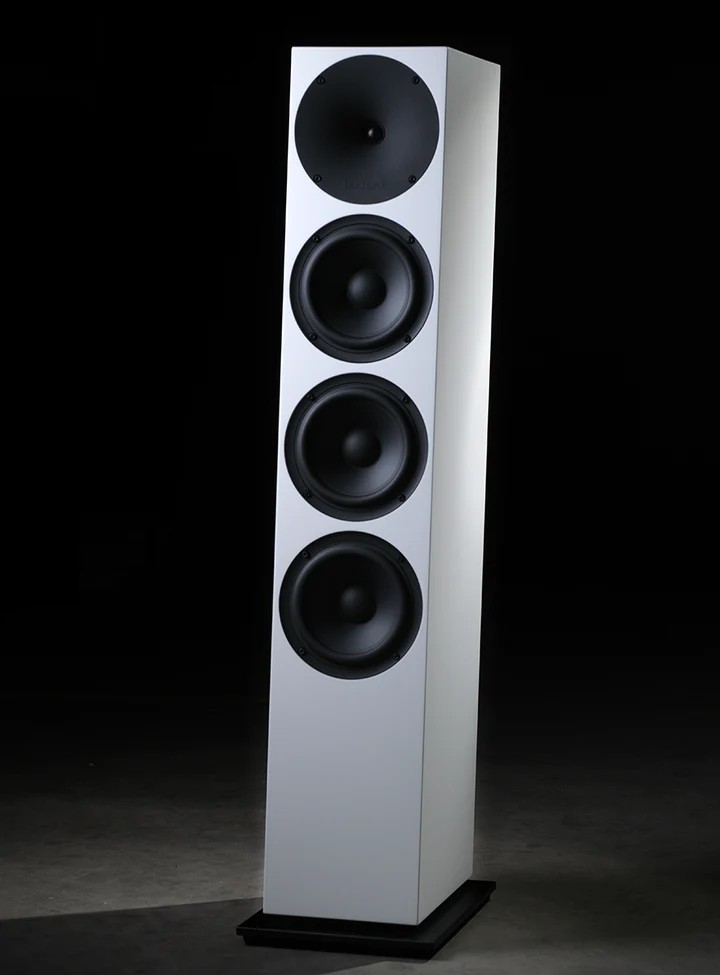
Finish choices are white or black as standard, with walnut veneer available for a €200 supplement. The key distinction, however, is internal and systemic: the A700 LE is a Danish-built, DSP-controlled active loudspeaker with amplification and conversion built in, not a conventional passive tower dressed in a limited finish.
Who is the A700 LE for?
The A700 LE will make most sense for listeners who want a high-specification, compact active floorstander and are comfortable letting the loudspeaker manufacturer determine the amplifier, crossover and DSP relationship. It could be particularly appealing to those who want to simplify a system built around a preamplifier, analogue source or wireless hub, without giving up the flexibility of a multi-driver, room-conscious speaker concept.
Its strengths on paper are the substantial amplification allocation, sealed/cardioid bass architecture, flexible DSP-based tuning and balanced/unbalanced analogue connectivity, alongside WiSA support. The LE’s revised RFA19 tweeter and Denmark-based production further differentiate it from the original A700. The principal considerations are equally clear: it needs mains power at both positions, processes analogue inputs through an ADC, and its exact configuration depends on the chosen Mastertuning and, for wireless operation, compatible WiSA hardware. Those are not faults, but defining characteristics of a speaker that treats electronics and cabinet as one integrated system.
Buchardt Audio A700 LE specifications
| Specification | Details |
|---|---|
| Amplification | 4 x 150W RMS / 330W peak Class D per speaker |
| Operating principle | 3.5-way sealed enclosure / 3-way cardioid |
| Tweeter | 1 x RFA19 19mm / 0.74in Resonance Free Aluminium dome with CDC aluminium waveguide |
| Mid/woofer | 1 x 6in linear long-stroke paper cone |
| Front/subwoofer | 2 x 6in linear long-stroke paper cones |
| Rear/subwoofer | 2 x 6in linear long-stroke paper cones |
| Frequency response | 19Hz–29kHz ±3dB; 25Hz–27kHz ±2dB (can change with Mastertunings) |
| DSP | Quad-core processor |
| DAC chips | 4 x CS4398 per speaker |
| Crossover points | 100Hz / 250Hz / 2800Hz (can change with Mastertunings) |
| Cabled analogue input | 24-bit/192kHz ADC; balanced and unbalanced XLR; 20kΩ input impedance |
| Wireless | WiSA, 24-bit/96kHz; can be paired across brands in up to a 7.1 setup |
| Input voltage | 100–240V AC auto-adjusting; 1.8m IEC C13 EU, UK or US power cords included |
| Shipping weight | 60kg per pair |
| Dimensions (H x W x D) | 1000mm (1035mm with feet) x 180mm x 280mm; 39.3 x 7 x 11in |
| Warranty | Five years on speakers, extended to 10 years with registration; two years on amp modules, extended to four years with registration; two years on Platin hub / Primare SC15 |
| Included accessories | Decoupling feet, rubber spikes and speaker grilles |