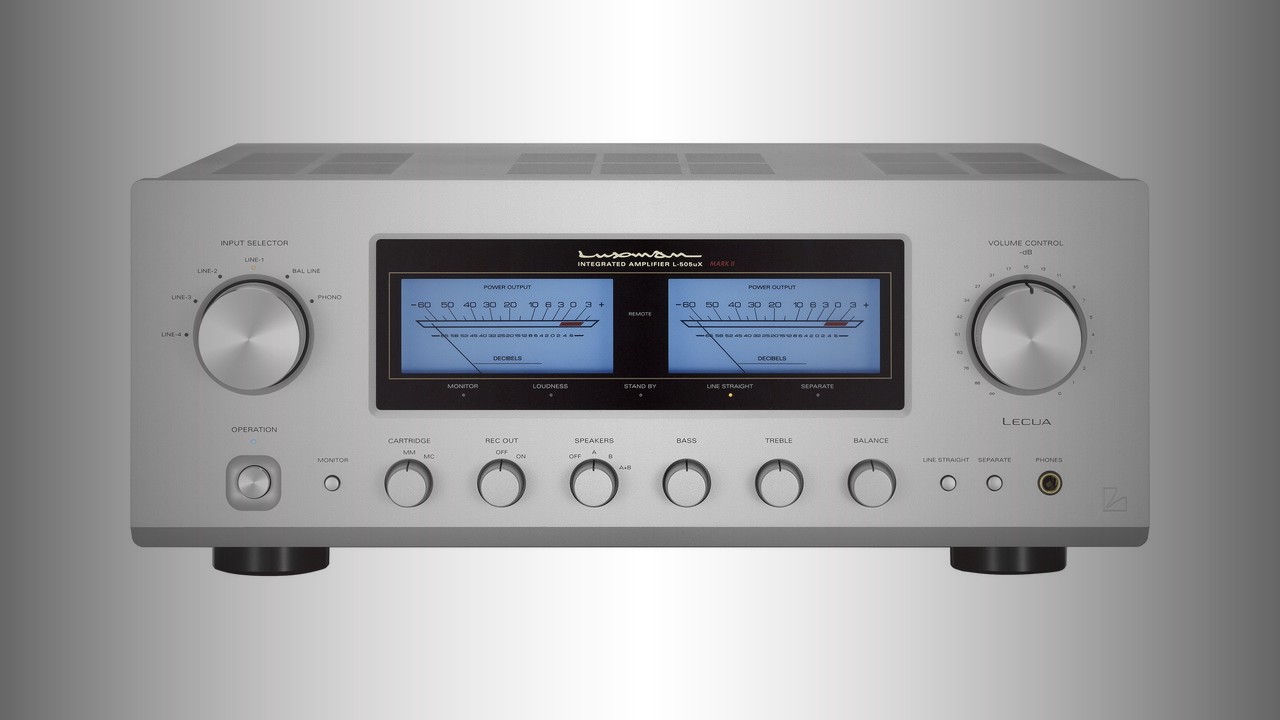
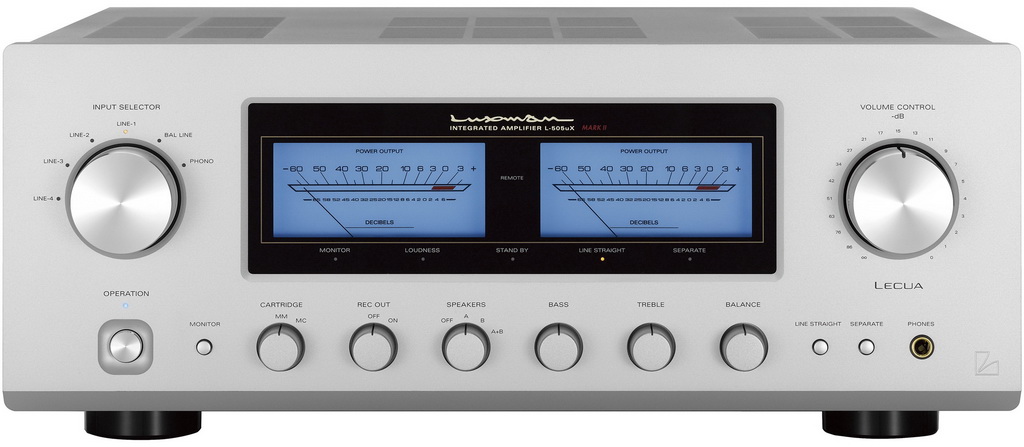
The Luxman L-505uX Mark II is a substantial all-analogue integrated amplifier built for listeners who want a traditional two-channel control centre without giving up the flexibility to accommodate a turntable, multiple line-level sources, headphones, a recorder or a home-cinema system. It succeeds the L-505uX, a model that had been in the range for more than six years, and brings Luxman’s then-current ODNF 4.0 feedback circuit, revised preamp buffering and a carefully specified power supply to the familiar full-width, meter-equipped format.
Its headline figures are straightforward: 100W per channel into 8 ohms, rising to 150W per channel into 4 ohms. But this is not simply an amplifier aimed at producing a large wattage number. The L-505uX Mark II combines a Class AB, bipolar-transistor power amplifier with an MM/MC phono stage, balanced and unbalanced line inputs, a power-amp input and preamp output. In practical terms, that makes it a potentially long-lived hub for a conventional source-based hi-fi system, rather than an integrated amplifier that assumes every listener will stream exclusively.
What the Mark II update changes
Luxman says the Mark II employs the fourth generation of its ODNF (Only Distortion Negative Feedback) circuit, designated ODNF 4.0. Negative feedback is a central technique in amplifier engineering: part of the output signal is compared with the input, allowing the circuit to correct errors generated during amplification. Properly implemented, it can lower distortion, reduce output impedance and improve consistency as the loudspeaker load changes.
Luxman’s ODNF terminology describes a proprietary approach intended to feed back the distortion component rather than treating the complete musical signal in the same way. The company’s stated aims for version 4.0 are improved high-frequency performance and lower output impedance. Those are meaningful targets in a loudspeaker amplifier. A lower output impedance contributes to a higher damping factor, which describes the amplifier’s ability to exert electrical control over a driver—particularly relevant around a woofer’s resonant region. Luxman specifies a damping factor of 210 for the L-505uX Mark II, although, as with all damping-factor figures, the effective result at the speaker terminals also depends on the resistance of the speaker cable and the loudspeaker’s own crossover network.
The specified frequency response from the line inputs is 20Hz to 100kHz at -3dB. That bandwidth extends well beyond the conventional audible band. It should not be read as a promise of extra audible treble by itself, but it indicates that Luxman has designed the line stage and power amplifier for wide high-frequency operation. The phono section is specified from 20Hz to 20kHz at -3dB, which is an appropriately different target for a circuit handling the equalised output of a cartridge.
Class AB output stage and power supply
The L-505uX Mark II uses a Class AB output stage with selected bipolar transistors in a parallel push-pull arrangement. Class AB remains a familiar choice in high-end integrated amplifiers because it can combine low-level operation closer to Class A with substantially better efficiency once more power is required. It does, however, still require serious heatsinking, power-supply capacity and thermal design—especially in an amplifier rated to deliver 150W per channel into 4 ohms.
Luxman specifies 2 x 100W into 8 ohms and 2 x 150W into 4 ohms. The increase into the lower impedance suggests useful current capability, though it is not a doubling of output power and should not be interpreted as one. Real loudspeakers do not present a fixed resistor-like load: their impedance changes with frequency, and phase angle can make an amplifier’s task more demanding. For that reason, the L-505uX Mark II’s 4-ohm rating is useful context for prospective owners of moderately difficult floorstanders, but it does not remove the need to check a speaker manufacturer’s recommended amplification and impedance guidance.
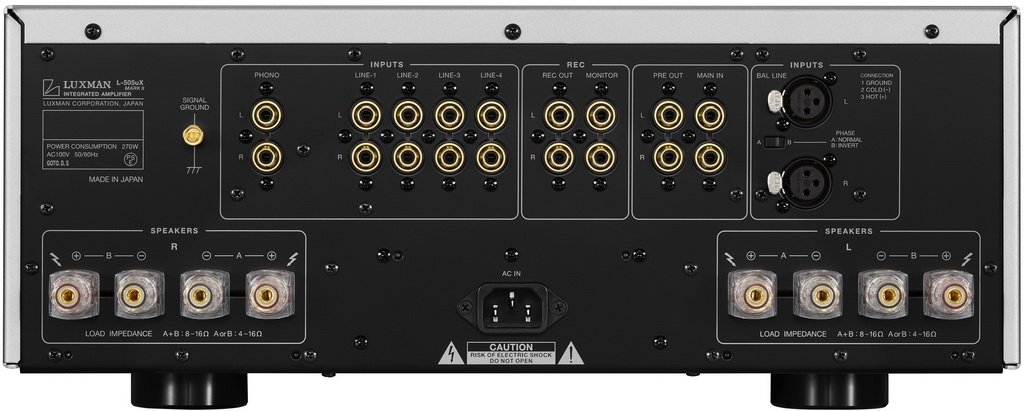
The supply is built around a large W-core transformer and four 10,000µF electrolytic reservoir capacitors. A transformer converts and isolates the incoming AC supply, while the capacitors store energy after rectification so the amplifier has a reserve available for transient musical demands. Luxman also specifies high-speed Schottky rectifier diodes. In a conventional linear supply, rectification and energy storage are foundational to how an amplifier behaves under load; the company’s choice of separate transformer secondary windings for different circuit sections is intended to keep the supply demands of those sections more isolated.
Luxman describes the architecture as fully symmetrical and dual-mono in design. In an integrated amplifier, such separation is intended to minimise unwanted interaction between left and right channels. The practical value is not that the amplifier becomes two physically independent monoblocks, but that careful channel and supply layout can reduce shared interference and preserve stable stereo operation when both channels are working hard.
Total harmonic distortion is specified at less than 0.009% at 1kHz into 8 ohms, and less than 0.09% across 20Hz to 20kHz into 8 ohms. These figures describe added harmonic content relative to the original test signal, rather than a complete prediction of sound quality. They nevertheless give useful confirmation that the amplifier is specified for low measured distortion both at a standard midband test frequency and across the audio band.
LECUA volume control and a discrete preamp buffer
Volume control is often more consequential than its outwardly simple rotary knob suggests. At low listening levels, a conventional analogue potentiometer can exhibit channel imbalance because its two resistive tracks do not track perfectly. Luxman’s LECUA (Luxman Electronically Controlled Attenuator) is an 88-step electronically controlled attenuator intended to maintain accurate left/right level matching while avoiding the mechanical limitations of a basic potentiometer.
That does not mean the amplifier uses digital volume processing: the supplied specification describes an electronically controlled attenuator in an analogue amplifier. The relevant ownership benefit is precise, repeatable level adjustment and potentially more consistent stereo balance, particularly when listening quietly.
The preamplifier output stage also adopts discrete buffer circuitry derived from Luxman’s flagship C-900u preamplifier. A buffer is used to provide a low-impedance, robust drive to the following stage, in this case the power amplifier section. It can help prevent the characteristics of one circuit from unduly loading another, which is particularly relevant in an integrated design where source selection, volume control, tone circuitry and power amplification share one chassis.
Analogue connectivity, phono flexibility and system expansion
This is resolutely an analogue integrated amplifier. No digital inputs, DAC section, network streaming platform or Bluetooth function are listed, so a TV, streamer, CD transport or computer will require an external DAC where appropriate. That absence may be a limitation for buyers seeking one-box digital convenience, but it also makes the L-505uX Mark II well suited to owners who already have a preferred digital front end and do not want an onboard DAC to dictate the system’s upgrade path.
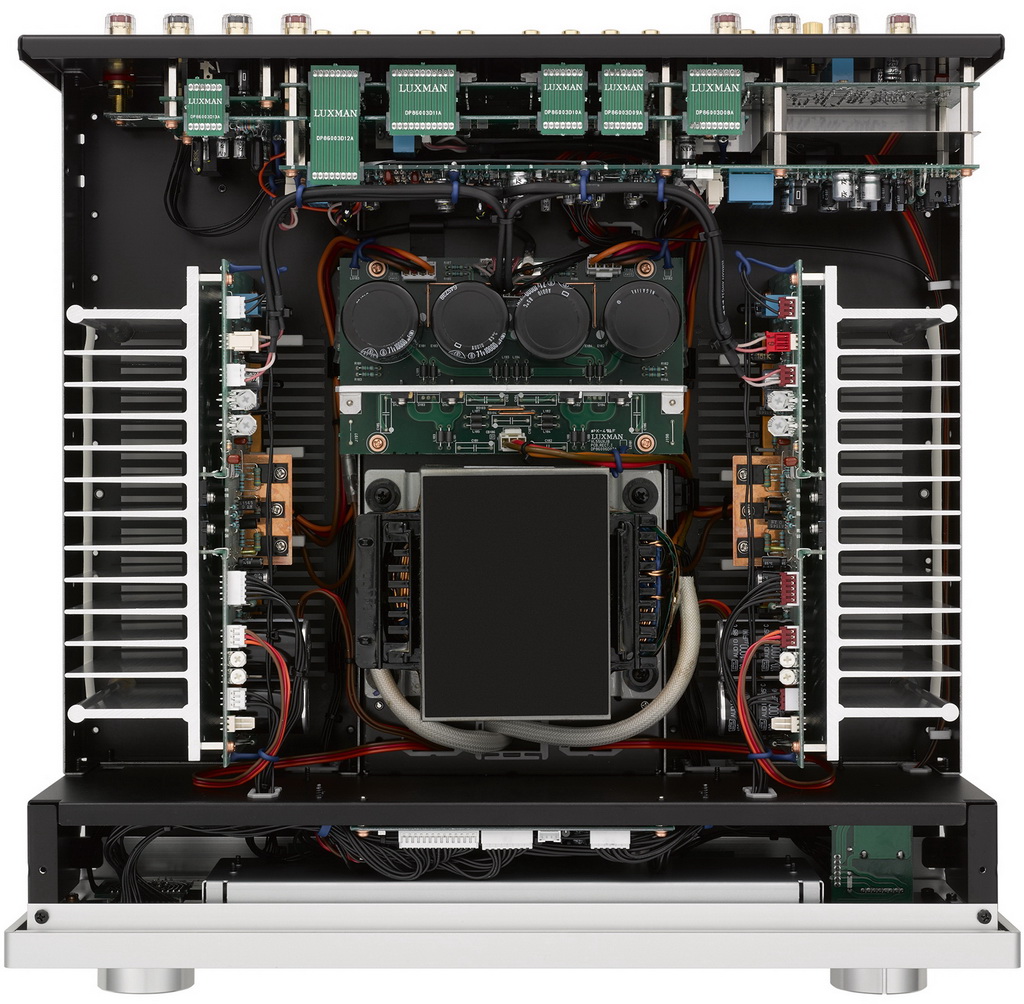
Source connectivity comprises four RCA line inputs, one balanced XLR input and a recorder-monitor connection. The XLR input has slide switches for phase inversion, a useful provision because balanced-source pin assignments are not universally identical. Used correctly with a balanced source, XLR can offer improved rejection of noise picked up along long interconnects; it is not inherently superior to a well-implemented short RCA connection, but it is valuable in systems where balanced outputs are available.
The amplifier provides both a preamp output and a Main In input. The former allows the L-505uX Mark II’s preamp section to feed another power amplifier, active subwoofer or external device with an appropriate line-level input. Main In bypasses the normal preamp path for direct access to the power amplifier, enabling the Luxman to serve as a power amp. This is especially useful in a home-theatre integration arrangement, where the front-left and front-right pre-outs of an AV processor can feed Main In while the Luxman remains the integrated amplifier for music sources.
Its phono input supports both moving-magnet and moving-coil cartridges. The stated input sensitivity is 2.5mV/47kΩ for MM and 0.3mV/100Ω for MC. These are important numbers: moving-magnet cartridges typically generate more voltage and conventionally expect a 47kΩ load, while low-output moving-coil designs need substantially more gain and can be sensitive to loading. The 100Ω MC setting will be a sensible starting point for many low-output moving-coil cartridges, although there is no indication here of user-selectable MC loading. Owners of cartridges that explicitly require an unusual load value may prefer an external phono stage offering broader adjustment.
The stated signal-to-noise ratio is 104dB for line input, 91dB for MM phono and 75dB for MC phono. The lower figures for phono are expected because a phono stage must apply large amounts of gain to a very small cartridge signal. More important in use is careful turntable grounding and cable routing. Luxman provides a ground terminal, so the turntable ground lead should be connected there to reduce the likelihood of hum.
Speaker terminals, controls and everyday use
There are four pairs of screw-type speaker terminals, allowing two pairs of loudspeakers to be connected. They may be selected independently or together, subject to the impedance limitations stated by Luxman. This can be useful for a second listening area or for switching between two speaker pairs. It should not automatically be confused with true bi-amping: while the pre-out and Main In facilities create several expansion possibilities, bi-amping requires the correct speaker connections, suitable amplification arrangement and attention to gain matching.
The front panel retains two large output meters with switchable illumination, a Luxman hallmark that also gives a broad visual indication of output activity. More functionally, the amplifier offers bass and treble controls, each adjustable by ±8dB at 100Hz and 10kHz respectively, plus loudness compensation. The Line Straight button bypasses the tone-control block for listeners who want the shortest listed signal path. Tone controls should not be dismissed as archaic: modest adjustment can be genuinely useful when compensating for a lean recording, a bright room or low-level listening. Conversely, Line Straight gives owners a simple way to remove those controls when they are not needed.
A 6.3mm headphone socket is included, although the supplied material does not specify the headphone output topology or power capability. It is therefore sensible not to assume it will suit every difficult low-sensitivity planar-magnetic headphone. For conventional wired headphones, it adds welcome convenience without requiring a separate headphone amplifier.
At 440 x 178 x 454mm (W x H x D) and 22.5kg, the L-505uX Mark II is neither a compact nor lightweight component. The 454mm depth deserves particular attention when choosing furniture, since rear cable clearance will add further space requirements. Its power consumption is specified as 270W, 85W with no signal and 0.4W in standby. Given the Class AB output stage and substantial supply, it should be installed with sensible ventilation rather than enclosed tightly in a cabinet.
Who is the L-505uX Mark II for?
The L-505uX Mark II’s appeal is in its breadth as an analogue control amplifier. It has enough rated power for a wide range of passive loudspeakers, a dedicated MM/MC phono section for vinyl replay, balanced input for compatible source components, and pre/power separation for future system changes. Its power amplifier input is particularly valuable for buyers who want a serious stereo system that can coexist with an AV setup.
The trade-off is equally clear. Buyers requiring USB audio, HDMI ARC, streaming services or wireless connectivity will need separate components. That is not a flaw in an amplifier designed around analogue sources, but it affects budgeting and system planning. A network streamer with analogue outputs can connect directly to one of the line inputs, while a digital streamer or transport will need a DAC before the Luxman.
For enthusiasts drawn to a substantial Japan-built integrated amplifier with a traditional control set, versatile analogue connections and a properly specified phono stage, the L-505uX Mark II is a thoughtfully equipped proposition. Its design is less about consolidating every modern digital feature into one chassis and more about supplying a stable, flexible amplification foundation around which a carefully chosen source and loudspeaker system can be built.
Luxman L-505uX Mark II key specifications
- Power output: 2 x 100W into 8 ohms; 2 x 150W into 4 ohms
- Amplifier topology: Class AB, parallel push-pull bipolar transistor output stage
- Feedback: Luxman ODNF 4.0
- Volume control: LECUA, 88 steps
- Frequency response: Line input 20Hz–100kHz (-3dB); phono 20Hz–20kHz (-3dB)
- THD: Less than 0.009% (1kHz, 8 ohms); less than 0.09% (20Hz–20kHz, 8 ohms)
- Signal-to-noise ratio: 104dB line, 91dB MM phono, 75dB MC phono
- Damping factor: 210
- Inputs: One balanced XLR, four RCA line, recorder monitor, MM/MC phono, Main In
- Outputs: Pre Out, recorder output, 6.3mm headphone socket, two switchable speaker pairs
- Power supply: W-core transformer, four 10,000µF electrolytic capacitors
- Dimensions (W x H x D): 440 x 178 x 454mm
- Weight: 22.5kg