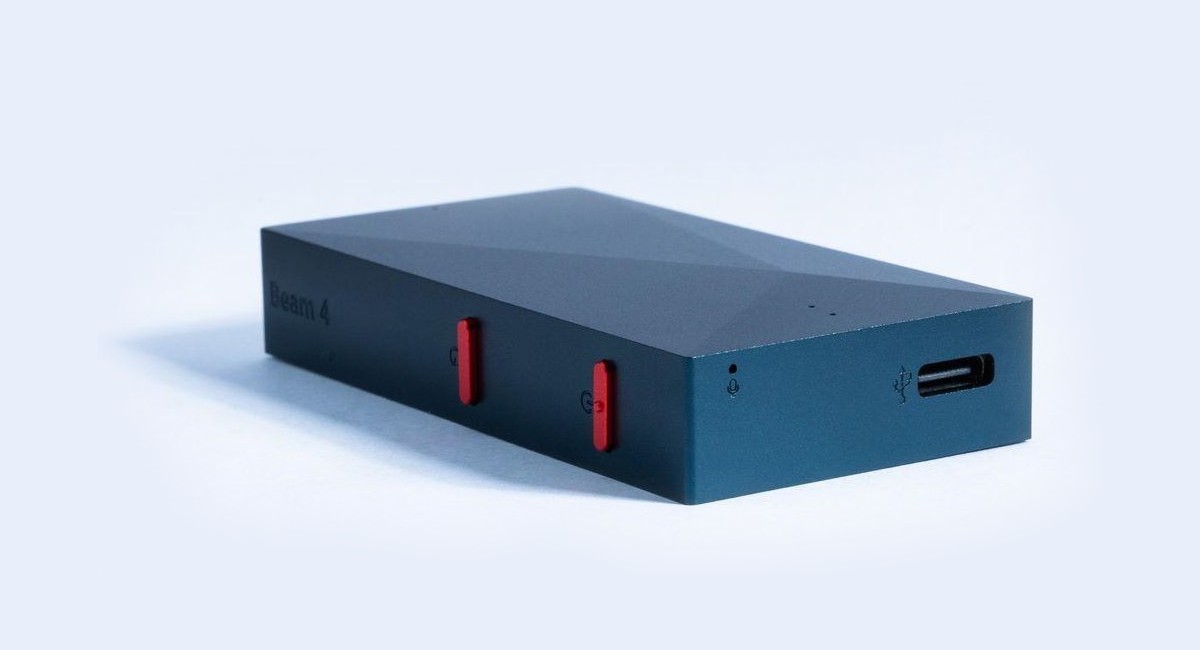
Audirect has announced the Beam 4, a portable DAC and headphone amplifier aimed at listeners who want to use demanding wired headphones away from a full-size desktop system. Its headline features are an ESS ES9281AC Pro DAC, decoding for PCM up to 32-bit/768kHz and native DSD512, a 1,200mAh internal battery, and both 3.5mm single-ended and 4.4mm balanced headphone outputs.
At $240, the Beam 4 sits in the increasingly capable portable DAC/amp category: products intended to take over digital-to-analogue conversion and headphone drive duties from a phone, computer or other digital source. The specification suggests Audirect is prioritising flexibility for listeners who own more than one pair of headphones, particularly those with a balanced cable as well as conventional 3.5mm termination. As ever, format support and output-power figures are only part of the story; the useful question is how those facilities affect system matching and day-to-day use.
An ESS-based portable DAC with high-resolution support
The Beam 4 uses ESS’s ES9281AC Pro DAC chipset. A DAC converts the numerical audio data held in a digital file or stream into the analogue electrical signal that an amplifier can send to headphones. In a compact product such as this, the DAC implementation, headphone-output stage and power supply have to coexist within a very limited physical space, making power management and noise control important practical considerations.
Audirect specifies support for PCM audio to 32-bit/768kHz and native DSD512. PCM is the format used for the vast majority of music files and streaming, including CD-quality 16-bit/44.1kHz material and higher-resolution downloads. The stated ceiling is far beyond the requirements of standard CD playback and most streaming services, but it means the Beam 4 should not be a format bottleneck for users with a library of high-resolution PCM downloads.
DSD is a different form of digital audio encoding. The distinction between native DSD and DSD carried using DoP (DSD over PCM) matters principally to compatibility: native playback refers to a signal path in which the DSD data is handled as DSD rather than packaged for transport in a PCM-style stream. Whether a listener needs DSD512 capability will depend entirely on their music library, rather than being a universal marker of audible quality. More consequential in a portable device is whether it works reliably with the source, the chosen player software and the headphones connected to it—details that Audirect has not set out in the supplied information.
It is also worth treating a maximum sample-rate figure as compatibility information, not a prediction of sound quality. A well-recorded 16-bit/44.1kHz album does not become higher resolution because the DAC accepts 768kHz files. The value here is broad file-format coverage for those who already use such material.
Two headphone outputs, with different system implications
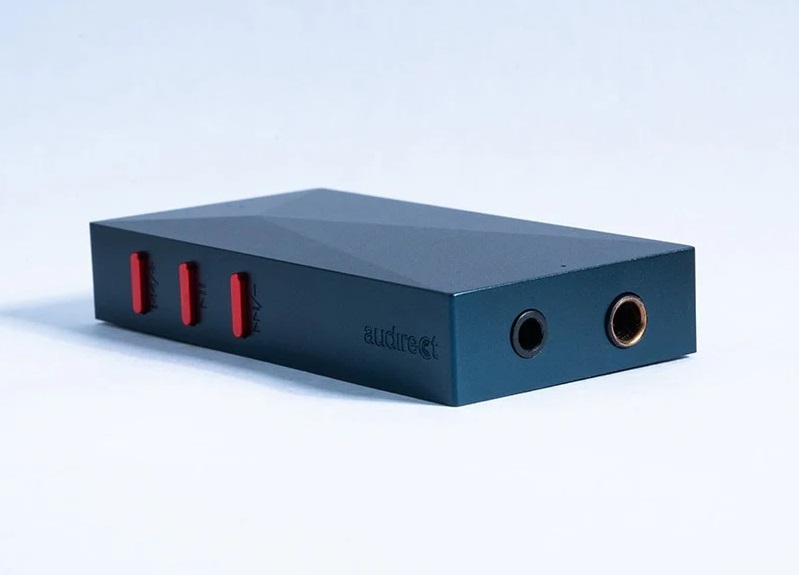
The Beam 4 provides two physical headphone connections: a 3.5mm single-ended output and a 4.4mm balanced output. This is a useful arrangement for an owner moving between conventional portable headphones and models supplied with, or upgraded to, a 4.4mm balanced cable. It avoids the need to choose a single connector standard when buying the DAC/amp.
Balanced headphone operation should not be confused with balanced line-level connections between traditional hi-fi components. At the headphone socket, a balanced connection generally provides separate drive connections for each side of the headphone. In this case, Audirect quotes higher maximum power from the 4.4mm output: up to 230mW balanced, compared with up to 141mW single-ended.
That difference may be helpful with headphones that benefit from more available power, provided they have an appropriate balanced cable. It does not, however, establish that balanced will automatically sound better, nor does it mean that every headphone should be run from the 4.4mm output. The headphone itself, its cable termination, sensitivity and impedance remain decisive. A 4.4mm socket must only be used with a correctly wired balanced headphone cable; it is not a connection for a standard 3.5mm plug via a casual adaptor.
Audirect also specifies three boost modes, alongside a dedicated gain control. Gain settings are useful because headphones vary enormously in sensitivity. Highly sensitive in-ear monitors can expose background hiss and make usable volume adjustment overly narrow if gain is set too high. Conversely, less sensitive or higher-impedance headphones may need more voltage swing and a higher gain setting to achieve satisfying levels. In practical use, the sensible starting point is the lowest boost or gain setting that reaches the desired listening level comfortably. This preserves volume-control range and minimises the chance of overdriving sensitive headphones.
The published output figures are helpful but incomplete as a guide to exact headphone matching. Output power changes according to load impedance, and Audirect has not provided the impedance at which the 230mW balanced and 141mW single-ended figures are measured. Nor are voltage and current limits supplied. Therefore, the Beam 4’s figures indicate a meaningful power advantage through the balanced connection, but cannot by themselves confirm suitability for every difficult headphone load.
A self-powered design intended for portable use
Rather than relying solely on power supplied by its connected source, the Beam 4 has a 1,200mAh internal battery. Audirect says this provides stable power to the decoder and headphone-output circuits. That approach is relevant in portable audio because the quality and available current of power from a phone, tablet or computer can vary, while the amplifier stage must provide clean, controlled power to the headphones.
An internal battery can also reduce the extent to which headphone amplification depends on the host device’s power rail. The trade-off is ownership overhead: battery runtime, charging method, charging time and whether the unit can operate while charging are all important questions for prospective buyers, but none is specified in the available information. Anyone considering the Beam 4 primarily for commuting or travel should confirm those points before purchase, as they shape whether a separate portable DAC/amp is more convenient than a small bus-powered dongle.
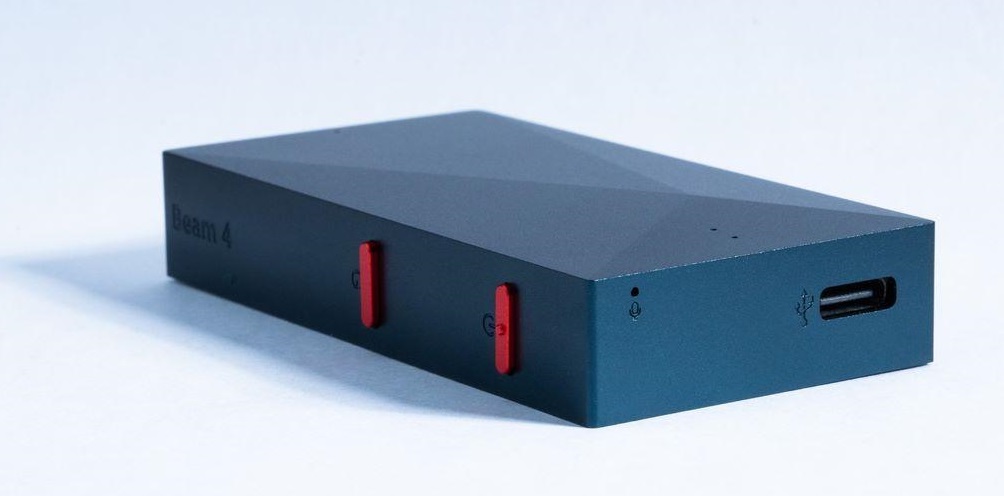
The Beam 4 includes physical controls for playback and volume, as well as separate on/off and gain controls. Hardware controls can be genuinely useful in a portable stack because they allow changes without repeatedly reaching for the host device. Separate volume control also raises a basic setup consideration: establish a sensible source-output level and begin with the Beam 4 at low volume, particularly with efficient earphones. Audirect does not state how its volume control is implemented or whether media commands are supported by every source platform, so users should not assume universal behaviour.
Status lights and what the published specifications tell us
A multicolour indicator is used to show the active signal type or bitrate. Audirect states that it glows red for PCM up to 48kHz, blue for 384kHz PCM, yellow when DoP is in operation, and white during DSD decoding. A separate battery indicator flashes red when battery charge is low.
For users with mixed PCM and DSD libraries, this provides an immediate check that the device has received the expected broad type of signal. It should not be taken as a quality grade: a white DSD light does not necessarily indicate a better recording than a red light for a 44.1kHz PCM file. It is principally a format-status tool. The supplied description does not specify the colour behaviour for every PCM sample rate between the named points, so the stated colours should not be read as a complete rate map.
Audirect publishes a 20Hz–40kHz frequency response. The conventional audible frequency range is often described as extending to around 20kHz, although hearing varies between individuals and tends to reduce at higher frequencies with age. Extension beyond that range does not itself prove audible superiority; it indicates the analogue circuitry is specified to pass ultrasonic content rather than roll it off at 20kHz.
The company also quotes THD+N of 0.0003% and SNR of -119dB. THD+N is a combined measure of harmonic distortion and noise, and a low stated percentage is desirable because it indicates unwanted added signal content is intended to be kept very low. Signal-to-noise ratio describes the relationship between wanted signal and residual noise, although the negative sign in the supplied -119dB figure means the exact measurement convention should be checked against Audirect’s full technical documentation. Crucially, no test level, load, bandwidth or weighting is provided for either specification. Such conditions matter when comparing measurements between DAC/amps, so these numbers are best regarded as the manufacturer’s headline claims rather than directly comparable laboratory results.
Who the Audirect Beam 4 appears to suit
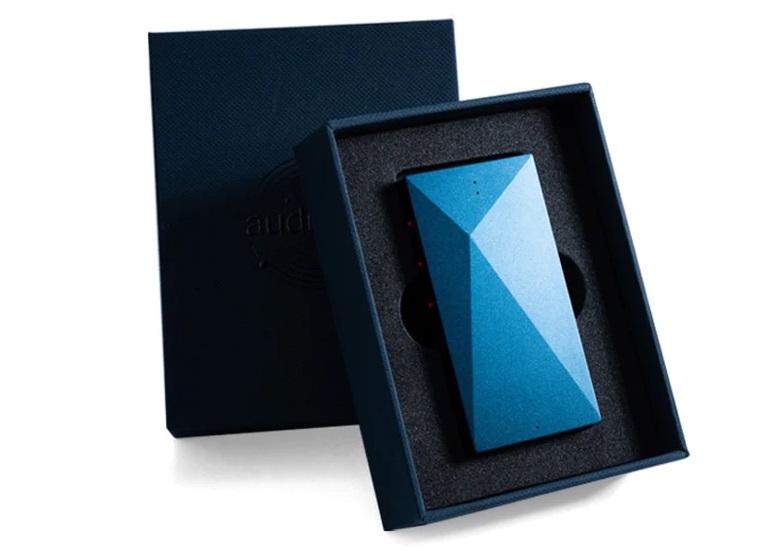
The Beam 4’s strongest practical appeal is its combination of battery power, on-device controls and two headphone-output standards. It should be of particular interest to listeners with both sensitive portable headphones and a less efficient pair that may benefit from the higher stated balanced output, as the three boost modes offer an explicit means of adapting gain to the headphone in use.
Its broad PCM and DSD support will appeal to file-library users, while the format indicator gives those listeners a simple visual confirmation of PCM, DoP or DSD operation. For buyers who only play standard-resolution streaming files into easy-to-drive earphones, some of that decoding headroom may be unnecessary; the more tangible benefits will be the dedicated analogue stage, physical controls and connector choice.
Before buying, potential owners should establish the connection used to link the Beam 4 to their intended phone, tablet or computer, supported operating systems and player apps, battery-life expectations, dimensions and the exact conditions behind the power ratings. Those details are not included in Audirect’s announcement. They are particularly important for anyone planning to use inefficient full-size headphones, or who needs assured integration with a specific mobile device.
Audirect Beam 4 key specifications
- DAC: ESS ES9281AC Pro
- Supported formats: PCM up to 32-bit/768kHz; native DSD512
- Headphone outputs: 3.5mm single-ended and 4.4mm balanced
- Output power: up to 230mW balanced; up to 141mW single-ended
- Frequency response: 20Hz–40kHz
- THD+N: 0.0003%
- Stated SNR: -119dB
- Battery capacity: 1,200mAh
- Price: $240