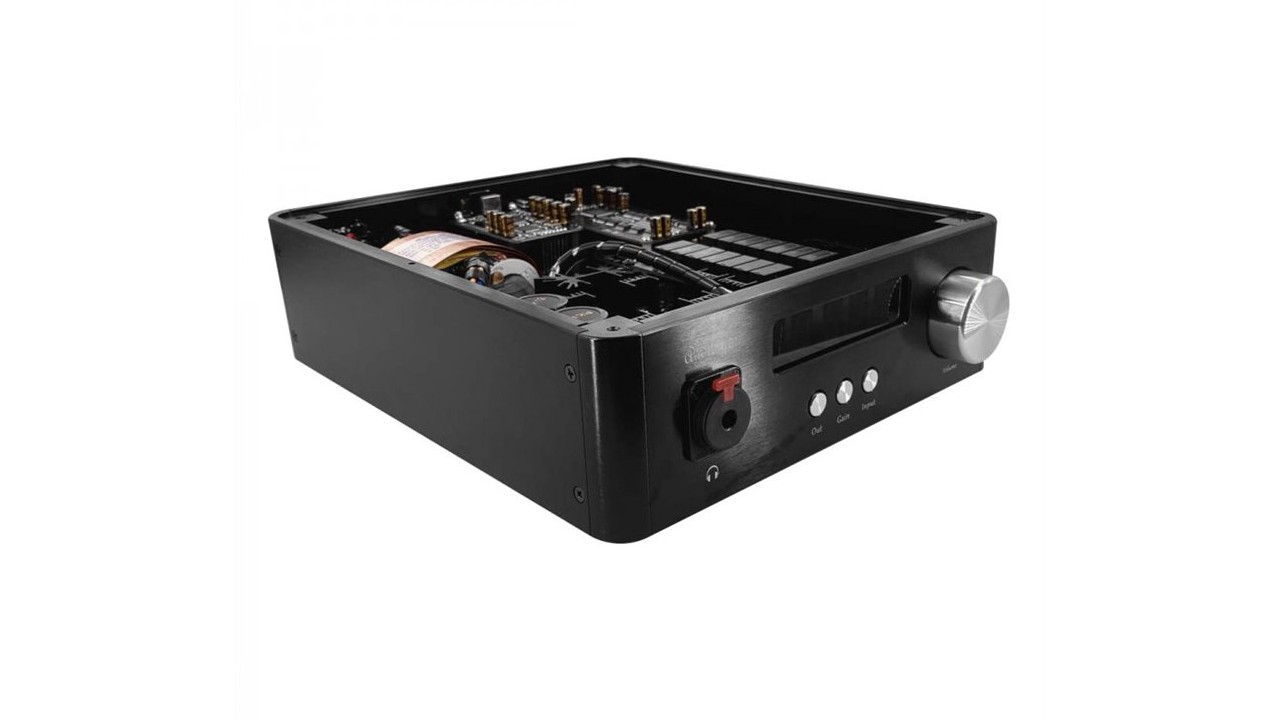
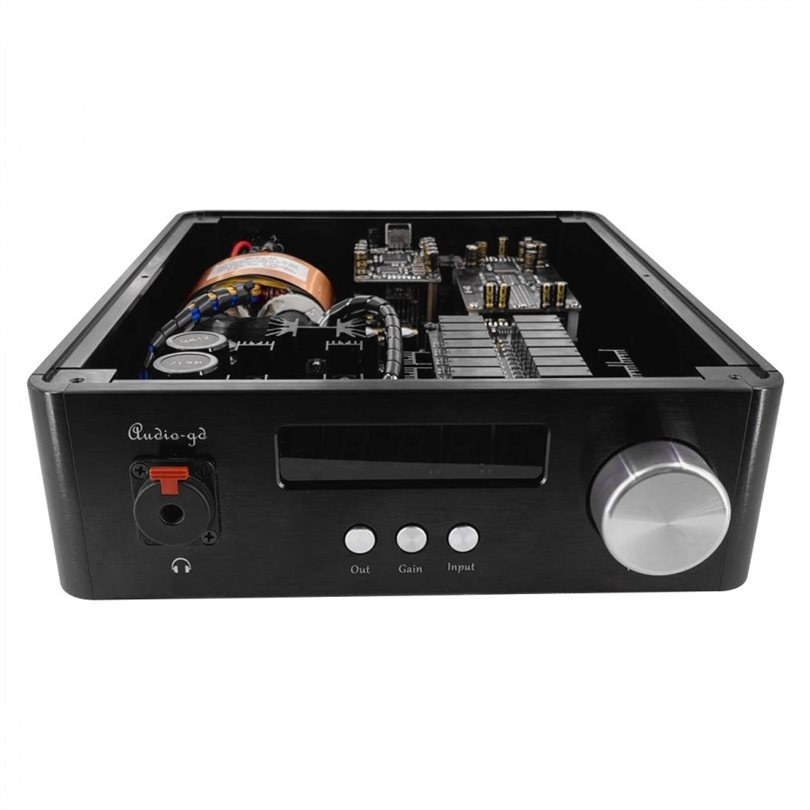
The Audio-GD R2R-11 MK2 is an all-in-one digital front end aimed at listeners who want more than a basic USB DAC on a desk. It combines three functions in one aluminium chassis: digital-to-analogue conversion, a headphone amplifier and an analogue preamplifier with variable-level RCA output. That makes it relevant not only to headphone users, but also to owners of active loudspeakers or a separate power amplifier who need a compact digital control centre.
Its most distinctive feature is the use of discrete R2R digital-to-analogue conversion rather than the delta-sigma DAC chips found in a large proportion of current DACs. Audio-GD also specifies an Amanero Combo 384 USB interface, support for high-resolution PCM and DSD material, and a headphone output with meaningful power figures across a wide range of impedances. The specifications suggest a component designed around flexibility and drive capability, although prospective buyers should consider its connection set carefully: there are no balanced outputs or analogue line inputs listed.
A DAC, headphone amplifier and preamp in one chassis
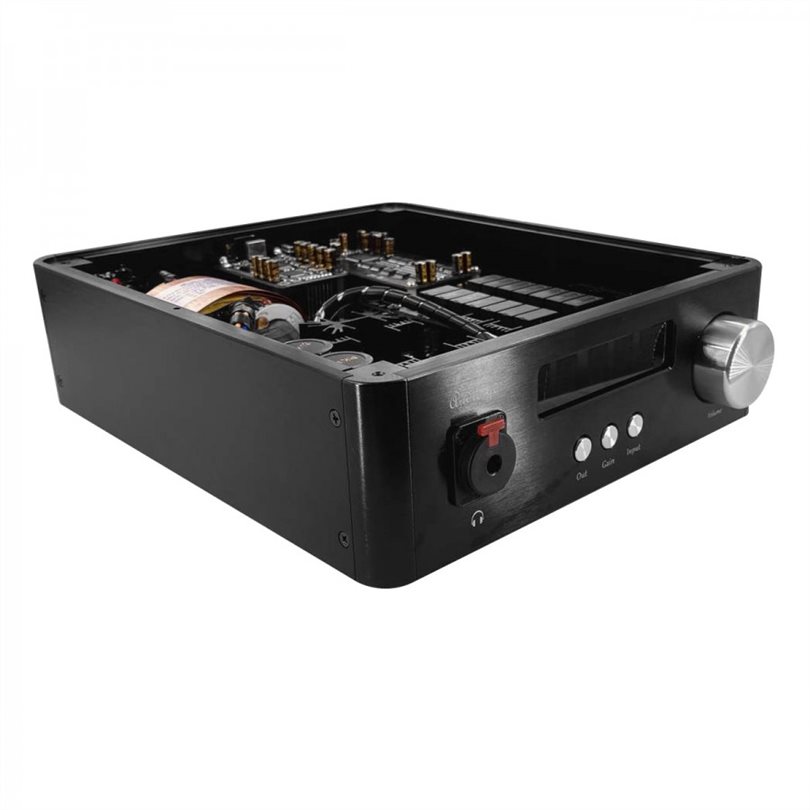
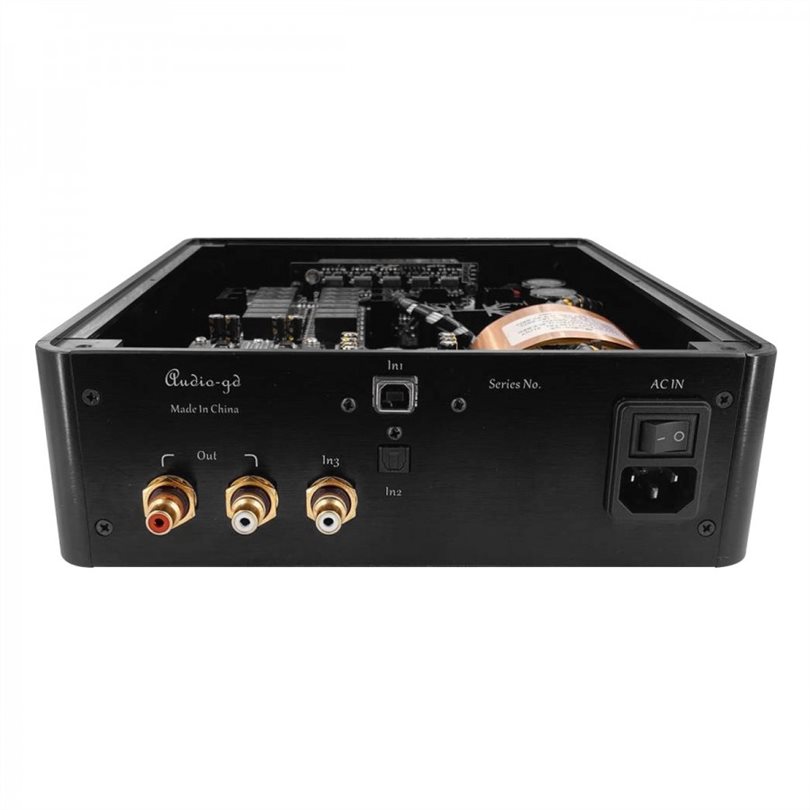
The R2R-11 MK2 accepts three digital sources: USB-B, optical Toslink and coaxial S/PDIF. This is a sensible spread for a computer or streamer-based system. USB is the route for the highest supported data rates, while optical and coaxial allow connection of conventional digital transports, CD players with digital outputs, televisions or network streamers, subject to the capabilities of those source devices.
At the output side, Audio-GD provides stereo RCA sockets and a 6.35mm headphone jack. The RCA output can operate at fixed or variable level. Fixed output is the conventional choice when feeding an integrated amplifier or an existing preamplifier: volume is then controlled downstream, and the DAC supplies a consistent line-level signal. Variable output allows the R2R-11 MK2 to act as a digital preamp directly into a power amplifier or active speakers, reducing the number of boxes in a modest two-channel system.
Audio-GD quotes a maximum variable output of 5Vrms. That is higher than the common 2Vrms nominal level associated with many consumer single-ended DAC outputs, so care with volume control is advisable when connecting to sensitive active speakers or high-gain power amplifiers. The listed fixed-output figures are 2.5Vrms in high gain and 1Vrms in low gain. These options may be useful for matching the unit to downstream equipment, but the manufacturer does not provide further details in the supplied information on how gain is selected or how fixed and variable modes are switched.
The unit’s 280 x 240 x 85mm dimensions and 3.5kg weight put it beyond the ultra-compact desktop-DAC category. Its aluminium housing should offer a more substantial physical platform than lightweight desktop units, while the specified 15W consumption indicates that it is not a high-power, hot-running amplifier. Even so, sensible ventilation and a firm, level shelf remain good practice for any component containing mains-powered digital and analogue circuitry.
Amanero USB and high-resolution format support
For USB playback, the R2R-11 MK2 uses an Amanero Combo 384 USB interface in place of the USB32 interface used in an earlier version. Amanero is a USB interface platform frequently used in specialist DACs. In practical terms, the USB receiver is the section that communicates with a computer, phone or streamer and passes audio data onwards to the DAC section. It is therefore central to compatibility, format support and clock management.
Over USB, the R2R-11 MK2 supports PCM up to 32-bit/384kHz, DXD and native DSD up to DSD512. PCM is the format used by the majority of streamed and downloaded music, while DXD refers to 352.8kHz PCM and is commonly encountered in some high-resolution recording workflows. DSD is a one-bit format available through some specialist download stores and playback libraries. DSD512 support is a considerable headline capability, although it will matter only to listeners with compatible playback software, hardware and a library of such files.
It is worth separating format compatibility from sound quality. Support for a very high sample rate does not automatically make a DAC superior, and much music is distributed at CD quality or at comparatively modest high-resolution PCM rates. More important day to day is reliable playback of the formats a listener actually owns or streams. On that basis, the USB input covers virtually all mainstream PCM use cases as well as enthusiasts’ DSD libraries.
The other inputs have more conventional limits. Coaxial S/PDIF accepts PCM up to 24-bit/192kHz, while optical accepts PCM up to 96kHz. These are normal practical boundaries for the respective interfaces. Optical can be particularly useful where electrical isolation between source and DAC is desirable, since a Toslink cable carries light rather than an electrical signal. Coaxial can support higher PCM rates here, but it requires proper 75-ohm digital cabling for the most dependable result.
Audio-GD says the Amanero implementation is designed for very low jitter. Jitter describes timing variation in a digital audio signal; a DAC’s clock-recovery and conversion design are intended to minimise its influence. The supplied information does not give a measured jitter figure, so it would be inappropriate to draw conclusions about its real-world performance from that claim alone. The more concrete takeaway is that the R2R-11 MK2 uses a dedicated, high-specification USB interface rather than treating USB as a secondary convenience input.
What a discrete R2R NOS DAC approach means
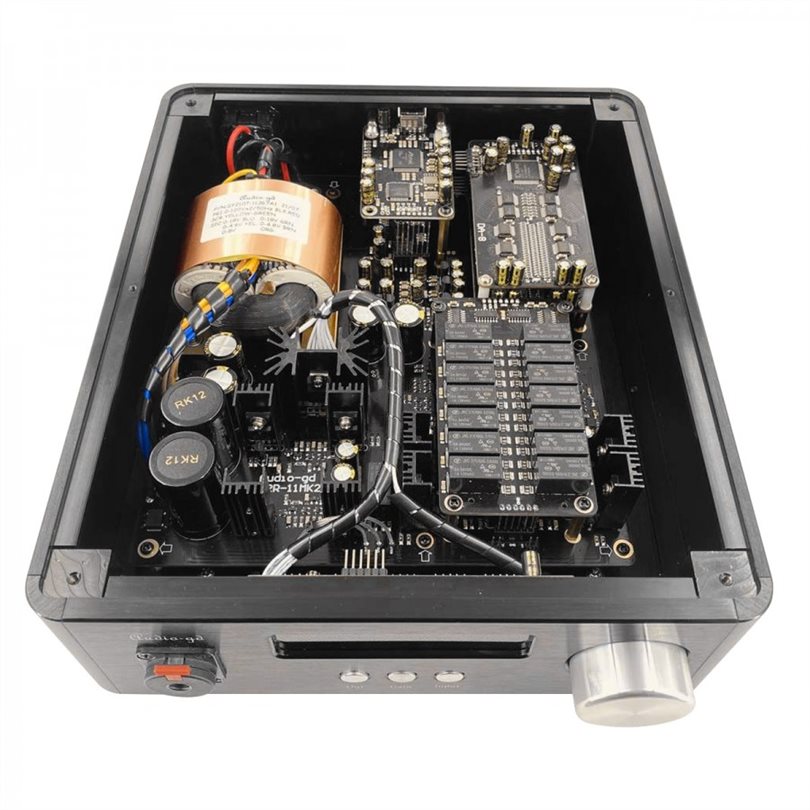
The R2R-11 MK2 is described as a discrete R2R NOS DAC. In an R2R, or resistor-ladder, converter, precisely matched resistors are arranged to create analogue output levels corresponding to the incoming digital word. A discrete implementation means the ladder is assembled from individual components rather than being integrated into a single conventional DAC chip.
That is a fundamentally different conversion approach from delta-sigma DACs, which use oversampling and noise-shaping techniques as part of their normal operation. Neither architecture inherently guarantees a particular sonic result; execution, component matching, analogue output stages, power supplies and implementation all matter. The attraction of a resistor ladder is that it offers a direct and clearly differentiated engineering route for listeners who specifically wish to explore R2R conversion.
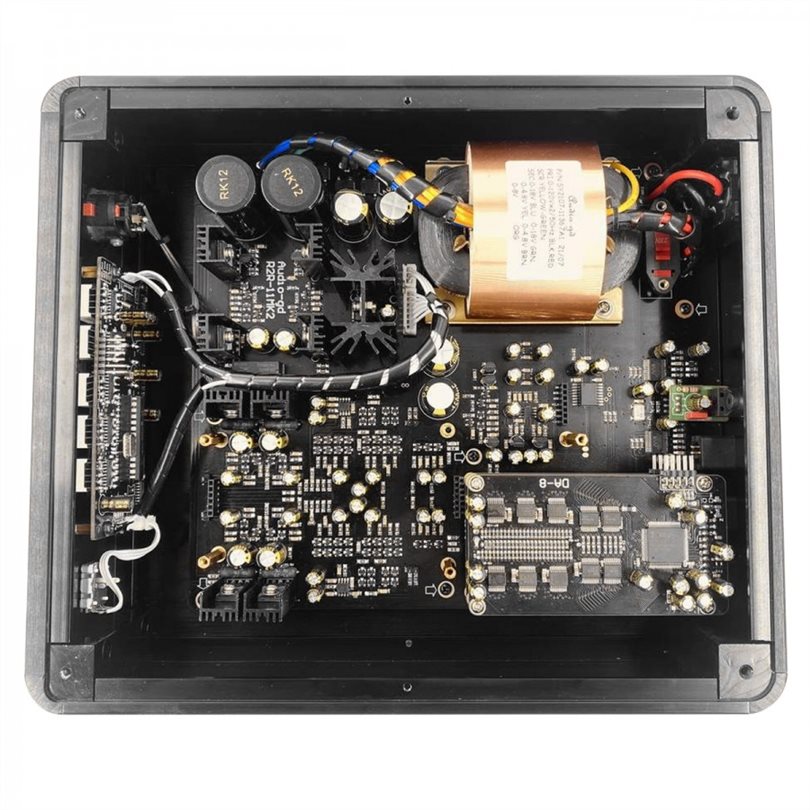
Audio-GD specifies four discrete R2R DACs, with two per DA-8 module, and quotes a 100dB signal-to-noise ratio. Signal-to-noise ratio compares the desired audio signal with the residual noise floor: a higher figure means that noise is further below the music signal. A 100dB specification gives useful context for the product’s stated performance, though specifications are meaningful only when their measurement conditions are known; those conditions are not supplied here.
NOS means non-oversampling. In broad terms, a NOS operation avoids the digital upsampling that is standard in many DAC designs. Audio-GD also lists selectable digital filters, but does not state in the supplied material which filters are available, whether they apply in every operating mode, or how they interact with NOS operation. This is a detail worth confirming in the manual or with the retailer if filter selection is a priority. Digital filters can influence the way a DAC handles frequencies near the top of the audible band and ultrasonic images, but their audible and technical consequences depend on the complete implementation rather than the presence of a filter menu alone.
The manufacturer further refers to its NFB, or Non-Feedback, technology at the ACSS stage. In general amplifier design terms, feedback is used to control gain and reduce certain forms of distortion, while no-feedback or low-feedback approaches pursue a different set of design trade-offs. Audio-GD’s specific ACSS implementation should not be confused with a universal industry standard, and the information supplied does not describe the circuit in enough detail to establish its topology. The company associates the approach with low coloration, low distortion and high linearity; these should be read as manufacturer claims rather than independent measurements.
Headphone power and matching considerations
Where the R2R-11 MK2 stands out on paper is its headphone output. Audio-GD rates it at 3,800mW into 25 ohms, 2,400mW into 40 ohms, 950mW into 100 ohms, 330mW into 300 ohms and 165mW into 600 ohms. These are useful because headphone impedance alone does not determine how difficult a headphone is to drive, but the figures demonstrate that the amplifier is specified to deliver substantial power into low- and medium-impedance loads while retaining output capability into higher-impedance designs.
Low-impedance planar-magnetic headphones often benefit from an amplifier able to supply current, while many 250-, 300- and 600-ohm dynamic headphones require adequate voltage swing. The R2R-11 MK2’s published ratings cover both territories in principle. Its 10Vrms headphone output figure also indicates considerable voltage capability. However, sensitivity varies enormously between headphones, so these numbers cannot establish compatibility with every model without knowing that headphone’s sensitivity and recommended drive requirements.
The quoted headphone output impedance is 2 ohms. Output impedance is relevant because it can interact with a headphone’s impedance curve. As a rule, a relatively low output impedance helps the amplifier exert consistent electrical control and avoids large frequency-response changes with multi-driver headphones whose impedance varies across the band. At 2 ohms, the R2R-11 MK2 should be more straightforward with many headphones than a high-output-impedance design, but exceptionally sensitive in-ear monitors may still demand especially careful volume management because of their sensitivity rather than their nominal impedance.
Audio-GD quotes THD+N of 0.04% and frequency response from 20Hz to 90kHz at -3dB. THD+N combines harmonic distortion and noise into a single figure, while the -3dB frequency-response points identify where output has fallen to roughly 70.7% of its mid-band voltage level. These are useful reference specifications, but they do not replace measurements at several output levels and load conditions. No such independent data are included in the supplied material.
System role, limitations and key specifications
The R2R-11 MK2 appears best suited to a listener building a digital-first headphone system that may later expand into a small speaker system. Connect a computer by USB, use the front headphone output for private listening, then feed a pair of active monitors or a power amplifier through the variable RCA outputs when speakers are required. It can also serve as a fixed-output DAC into an existing integrated amplifier.
There are clear boundaries to that flexibility. The specified connections do not include analogue inputs, balanced XLR outputs, Bluetooth, network streaming, HDMI or a dedicated subwoofer output. It is therefore not a streamer or an all-purpose analogue control preamplifier. Those wanting to connect a turntable, for example, would need a separate phono stage and an amplifier or preamplifier with an appropriate analogue input. Those requiring balanced interconnection will need to look elsewhere or use a system based around single-ended RCA connections.
Audio-GD R2R-11 MK2 specifications
- Type: DAC, headphone amplifier and preamplifier
- Digital inputs: USB-B, optical Toslink, coaxial
- Outputs: stereo RCA; 6.35mm headphone output
- USB formats: PCM up to 32-bit/384kHz; native DSD up to DSD512; DXD
- Coaxial input: PCM up to 24-bit/192kHz
- Optical input: PCM up to 96kHz
- DAC arrangement: four discrete R2R DACs, two per DA-8 module
- Signal-to-noise ratio: 100dB
- THD+N: 0.04%
- Frequency response: 20Hz–90kHz (-3dB)
- Output levels: headphone 10Vrms; variable RCA 5Vrms maximum; fixed RCA 2.5Vrms high gain / 1Vrms low gain
- Headphone output impedance: 2 ohms
- DAC output impedance: 2 ohms
- USB compatibility: Windows, Mac, iOS and Linux
- Power consumption: 15W
- Dimensions: 280 x 240 x 85mm
- Weight: 3.5kg
- Finish and construction: black aluminium housing
For buyers attracted to a discrete resistor-ladder DAC and a properly specified headphone stage, the R2R-11 MK2’s appeal is its concentration of functions rather than an expansive feature list. Its value will depend on whether its USB, coaxial and optical inputs align with the sources already in the system—and whether a single-ended, digital-only control centre is the right long-term fit.