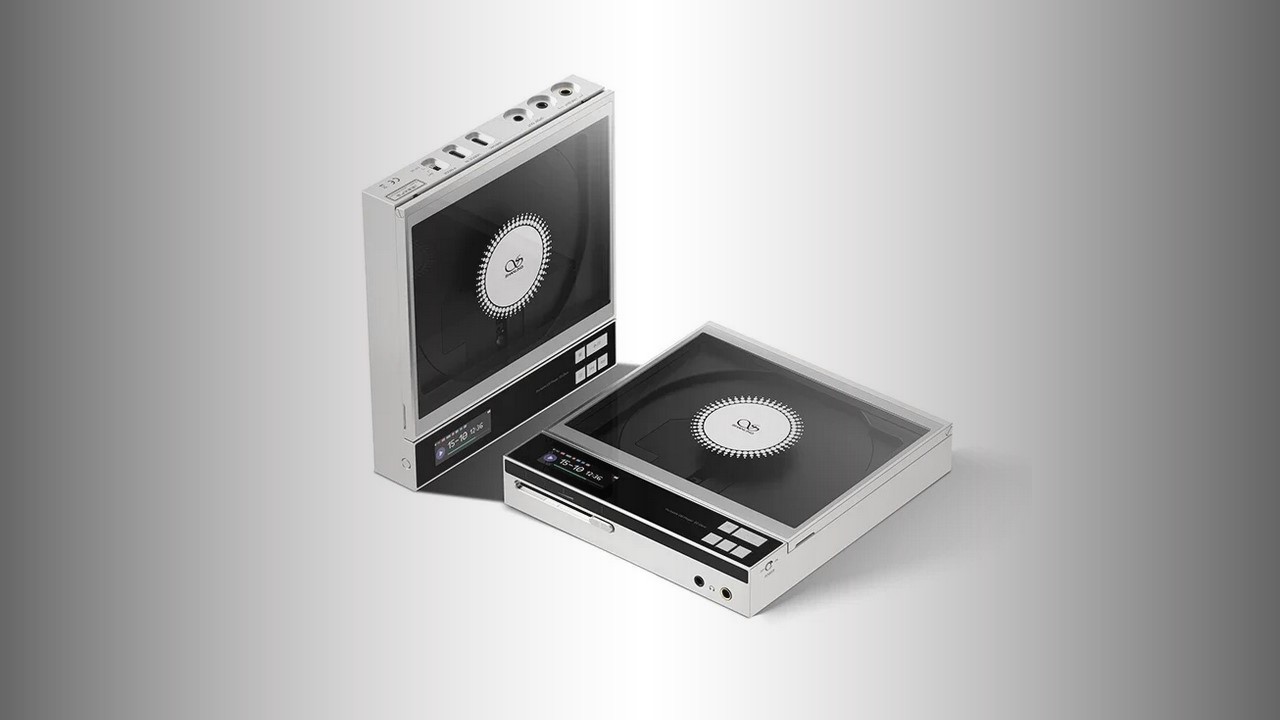
The Shanling EC Zero is a transportable CD player for listeners who still buy, collect and use physical discs, but do not want a CD player limited to a single task. Rather than reviving the lightweight, basic portable CD-player formula, Shanling has built a 575g machine around a dedicated disc mechanism, an AKM DAC, headphone amplification, digital outputs, USB DAC operation and Bluetooth transmission.
That makes the EC Zero potentially useful in several different systems. It can be a self-contained headphone player; a CD transport feeding an external DAC; a fixed-output source for a desktop amplifier or active speakers; or a USB DAC for a computer. It can also send CD playback wirelessly to compatible Bluetooth headphones or speakers. The key point is that it retains a mechanical optical drive while adding the connections and conversion capabilities expected of a modern personal-audio component.
At 158 x 150 x 28mm, this is best understood as a transportable player rather than something intended for a trouser pocket. Its 5,500mAh battery is specified for up to 10 hours of playback, making it more realistic for a desk, hotel room, commuting bag or occasional outdoor listening than for all-day pocket use. The stated USB-C supply requirement is 5V/2A.
A CD mechanism designed for stable reading
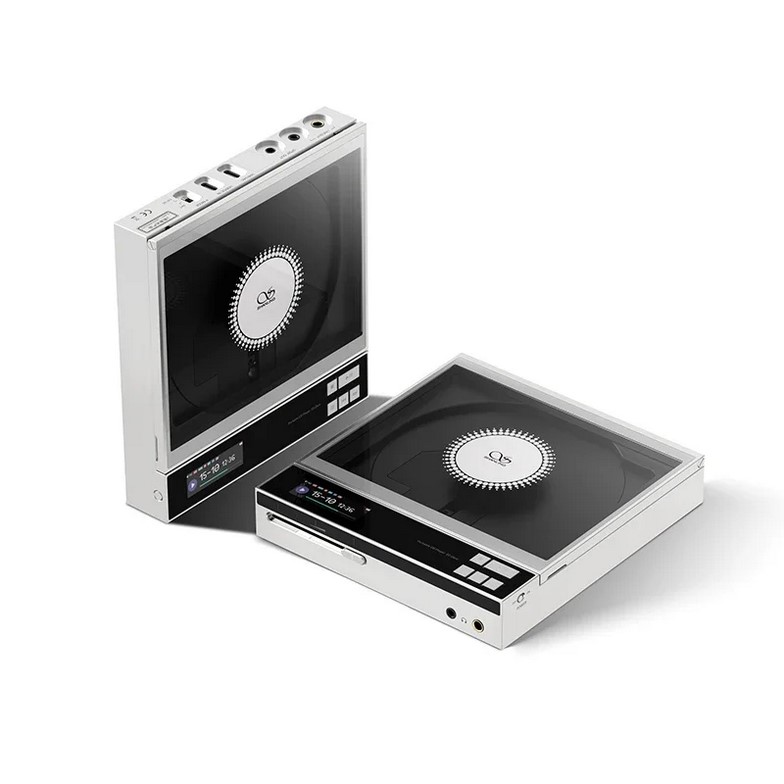
CD is an optical format, so a player’s first responsibility is to read the disc reliably before the digital-to-analogue stage can do its work. Shanling says the EC Zero uses a professional CD mechanism with its own proprietary servo system, along with an active magnetic stabiliser. The company also specifies a separate motor with palladium-coated brushes.
The servo system is the control circuitry that maintains focus on the disc’s data layer and regulates rotational speed as the laser moves from the outer to the inner areas of a CD. In practical terms, a stable mechanical platform and carefully managed disc rotation are intended to minimise read interruptions and allow the player’s error-correction system to do less corrective work. The manufacturer does not provide detailed data on the mechanism, its buffering arrangement or measured resistance to shock, so those areas cannot be assessed from the published specification alone.
The magnetic stabiliser is intended to reduce unwanted movement of the spinning disc. This is particularly relevant in a portable player, where a compact drive is more exposed to vibrations from a table, bag or vehicle than a full-width home CD player. It should not be confused with a claim that a CD’s data become intrinsically “more detailed”; the useful engineering goal is consistent disc reading and dependable playback.
The EC Zero’s physical construction also differs from disposable portable players. Its enclosure is CNC-machined aluminium, with tempered glass and retro-inspired visual details. Aluminium offers a rigid, durable outer structure, while the stated dimensions give the player enough footprint for a disc mechanism, battery and analogue output circuitry. There is a 1.68-inch LCD screen, plus a side-mounted volume slider and button lock. A physical lock is a genuinely useful feature on a portable source: it reduces the risk of an accidental volume change or transport command when the player is handled or carried.
AKM conversion and two ways to drive headphones
At the centre of the EC Zero’s digital-to-analogue section is an AKM AK4493S DAC, supported by two SGM8262-2 operational amplifiers. The DAC receives the digital data from a CD or a USB-connected source and converts it into analogue music; the analogue stages then provide the voltage and current needed by headphones or line-level equipment.
Shanling specifies separate 3.5mm single-ended and 4.4mm balanced headphone outputs. The latter should be viewed as an option for headphones fitted with a properly terminated 4.4mm balanced cable, not as a universal upgrade for every headphone. A balanced headphone output uses separate amplifier connections for the left and right channels, and in this implementation it provides substantially more specified output power. It also has a higher stated channel separation figure: 103dB for the 4.4mm output against 79dB for 3.5mm.
At 32 ohms, the 3.5mm output is rated at 52mW in low gain, 122mW in high gain and 213mW in high gain with external power connected. The 4.4mm output is rated at 211mW in low gain, 525mW in high gain and 836mW in high gain with external power. That final figure is the headline number, but its condition matters: it applies to the balanced output in high gain while the player is connected to external power.
This power arrangement gives the EC Zero a useful degree of flexibility. Low gain is generally the sensible starting point with sensitive in-ear monitors and efficient headphones, where excess gain can make volume adjustment too abrupt and make background noise more noticeable. High gain, especially when externally powered, is the more appropriate setting for headphones that need more voltage or current to reach satisfying levels. However, sensitivity, impedance curve and headphone design all matter; a single power rating at 32 ohms cannot fully predict how every headphone will behave.
The published output impedance is low: 0.6 ohms from 3.5mm and 0.8 ohms from 4.4mm. As a general rule, low output impedance helps an amplifier exert more consistent electrical control and reduces the chance of the headphone’s varying impedance altering its frequency balance. It is especially relevant with multi-driver in-ear monitors, some of which can respond audibly to a source with high output impedance.
For both headphone outputs, Shanling quotes THD+N of 0.0004%. The 3.5mm output is specified with 117dB dynamic range and signal-to-noise ratio, while the 4.4mm output is rated at 119dB for both figures. These are laboratory specification values rather than a substitute for listening evaluation, but they indicate that the analogue stage is designed with a low noise floor and wide dynamic range in mind.
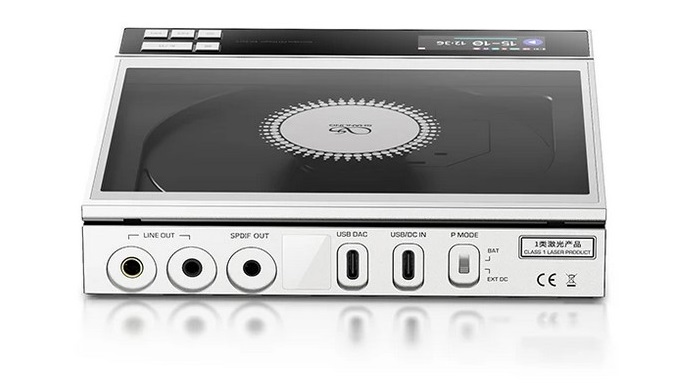
Not only a CD player: USB DAC, transport and Bluetooth transmitter
The EC Zero’s flexibility comes from its ability to move digital and analogue audio in several directions. In USB DAC mode, it supports PCM up to 768kHz/32-bit and DSD512. Those figures concern files sent to the player from a USB host; they do not change the format of a conventional audio CD, which is 16-bit/44.1kHz PCM. Shanling specifies a frequency response of 20Hz–40kHz (–0.5dB) in USB DAC use, while CD playback is quoted at 20Hz–20kHz (–0.5dB), as expected for the CD format’s bandwidth.
For an existing desktop or headphone system, USB DAC operation means the EC Zero can potentially replace a separate computer DAC when playing local high-resolution files or compatible music software. The supplied information does not identify operating-system compatibility, driver requirements or supported playback software, so prospective buyers should verify those practical details for their intended computer or mobile device.
There is also a combined 3.5mm coaxial/optical S/PDIF digital output. This is important because it allows the player’s CD transport section to be used with an external DAC or digital-input integrated amplifier. Optical transmission electrically isolates the connected devices, while coaxial S/PDIF uses an electrical connection; which is preferable will depend on the available input and the wider system. Shanling does not specify cable adaptors or the exact output behaviour in the supplied material, so this is worth confirming when planning an installation.
For analogue system integration, the EC Zero provides a 3.5mm line output rated at 2.05Vrms and a 4.4mm balanced line output rated at 4.1Vrms. The 3.5mm figure is close to the conventional 2V level expected by many integrated amplifiers, preamplifiers and active speakers. The balanced output offers twice the voltage, which can be useful where a downstream balanced input is designed to accept it and where longer analogue cable runs make balanced interconnection desirable. Neither output should be connected directly to a power amplifier unless that amplifier has its own suitable volume control.
Both line outputs are specified at 20Hz–40kHz (–0.5dB), with 0.0005% THD+N. Signal-to-noise ratio is rated at 117dB for 3.5mm and 119dB for 4.4mm. The distinction between headphone and line outputs matters day to day: line out is intended to feed another component at a controlled source level, whereas headphone output is for direct listening and uses the player’s volume control.
Bluetooth 5.3 is included as a transmitter, with aptX Adaptive, aptX and SBC codec support. This enables the EC Zero to send its playback to compatible wireless headphones or speakers. aptX Adaptive is designed to vary its data rate according to conditions and device support, while aptX and SBC provide broader compatibility. Bluetooth transmission remains a coded wireless link rather than a bit-perfect wired connection, so the EC Zero’s wired headphone outputs or S/PDIF output remain the more direct choices for listeners building a fully wired hi-fi chain. The supplied specification does not state Bluetooth receiving capability, so it should not be assumed that the unit can accept music from a phone over Bluetooth.
CD ripping is useful, with clear limits
One unusually practical feature is CD ripping to WAV. Connect a FAT32-formatted drive and the EC Zero can record a CD at 1x speed. WAV is an uncompressed PCM container, so the resulting audio data can preserve the CD’s original 16-bit/44.1kHz content without lossy compression. It is a useful way to make a straightforward archival or travel copy of a disc collection without involving a computer.
There are limits to keep in mind. A 1x rip takes approximately the duration of the disc, and WAV files tend to use more storage than lossless compressed alternatives such as FLAC. The specification only confirms recording to FAT32 drives and does not state metadata retrieval, file naming behaviour, error reporting or support for other file systems. Anyone with a large collection may still prefer dedicated computer-ripping software for its library management and verification options, but the EC Zero’s approach could be appealing for occasional, self-contained transfers.

Who the EC Zero is for
The EC Zero is most compelling for the CD owner whose listening moves between headphones, a desktop system and a conventional hi-fi. A listener with balanced headphones can exploit its highest specified output capability when mains or USB power is available, while the 3.5mm socket offers a conventional connection for single-ended headphones. Its line outputs and S/PDIF output also make it more adaptable than a portable player that can only feed headphones.
Its trade-offs follow directly from the concept. At 575g, it is a substantial item to carry, and the 10-hour maximum battery claim means power management remains part of ownership. High-resolution USB DAC support is welcome, but it does not make the CD mechanism itself a high-resolution source. Meanwhile, Bluetooth transmission adds convenience but is a different proposition from using the EC Zero’s wired outputs.
What stands out is the breadth of the design. Shanling has combined a mechanical CD platform, CD-to-WAV ripping, a modern AKM conversion stage, powerful balanced headphone drive under external power, line outputs and digital transport capability in one compact chassis. For listeners looking to give CDs a more flexible role alongside computer audio and headphones, that combination is considerably more purposeful than a nostalgia-led portable player.
Shanling EC Zero key specifications
- Dimensions / weight: 158 x 150 x 28mm; 575g
- Screen: 1.68-inch LCD
- DAC: AKM AK4493S
- USB DAC: PCM up to 768kHz/32-bit; DSD512
- Battery: 5,500mAh; up to 10 hours of playback
- Power input: USB-C, 5V/2A
- CD ripping: WAV to FAT32 drives at 1x speed
- Digital output: combined 3.5mm coaxial/optical S/PDIF
- Bluetooth: version 5.3; aptX Adaptive, aptX and SBC transmitter codecs
- 3.5mm headphone output: 52mW / 122mW / 213mW at 32 ohms in low gain, high gain and externally powered high gain respectively; 0.6-ohm output impedance
- 4.4mm balanced headphone output: 211mW / 525mW / 836mW at 32 ohms in low gain, high gain and externally powered high gain respectively; 0.8-ohm output impedance
- 3.5mm line output: 2.05Vrms
- 4.4mm balanced line output: 4.1Vrms