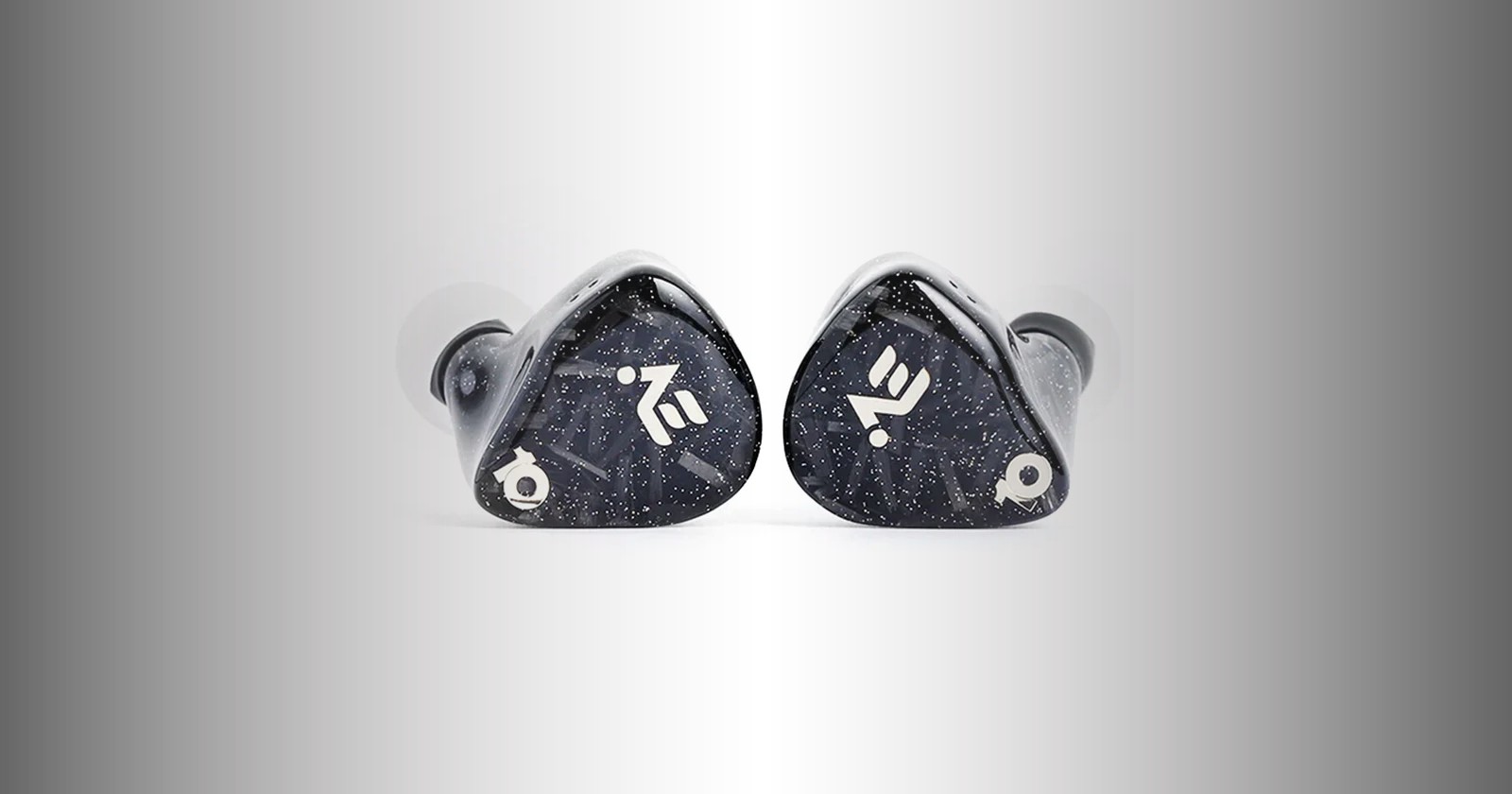
Shanling has introduced the AE10, a flagship-style wired in-ear monitor (IEM) built around an ambitious all-balanced-armature driver array: there are 10 balanced armature (BA) drivers in each earpiece. Priced at $999, the AE10 combines drivers from Sonion and Knowles with Shanling-developed units, then divides their work through a six-band crossover using fourth-order LRC filters.
That is a notably complex approach for an IEM. The AE10 is not simply attempting to fit an eye-catching number of drivers into a small shell; the difficult part is integrating those drivers coherently, controlling their respective operating ranges and maintaining a comfortable physical design. Shanling says each earpiece weighs 5.3g despite the 10-driver architecture, while the supplied cable terminates in a 4.4mm balanced plug for use with compatible portable players, DAC/headphone amplifiers and desktop equipment.
A multi-driver BA design, and why the crossover matters
Balanced armature drivers are a familiar solution in high-end IEMs because they are very small and can be tailored for particular frequency ranges. Unlike a conventional moving-coil dynamic driver, which uses a diaphragm attached to a voice coil, a BA driver uses a tiny armature mechanism within a magnetic assembly. Its compact dimensions make it practical to allocate separate drivers to bass, midrange and treble duties inside one earpiece.
The potential benefit is specialisation. A designer can select and tune drivers that work most effectively over narrower bandwidths rather than asking one driver to reproduce the full audible range. But driver count alone says little about an IEM’s ultimate performance. The acoustic paths, shell volume, nozzle design, driver matching and crossover implementation all determine whether a multi-driver layout behaves as one unified transducer rather than a collection of separate sound sources.
In the AE10, Shanling uses 10 premium BA drivers from Sonion and Knowles, alongside proprietary drivers developed specifically for the model. Both Sonion and Knowles are established specialist suppliers in the balanced-armature field. Shanling has not specified in the supplied information how many drivers cover each part of the frequency range, nor has it published sensitivity, impedance or frequency-response figures. Those remain important details for buyers assessing source matching and likely output requirements.
What Shanling has confirmed is a six-band crossover with fourth-order LRC filters. In broad terms, an LRC network uses inductive, resistive and capacitive elements to shape the electrical signal sent to each driver group. A fourth-order filter has a relatively steep roll-off compared with simpler first- or second-order arrangements. The practical intention is to more firmly limit a driver’s output outside its chosen range, reducing overlap with neighbouring drivers and helping manage unwanted resonances or distortion.
There are trade-offs. Steeper crossover slopes require careful electrical and acoustic alignment: the drivers must meet at their crossover regions without obvious discontinuities in level or timing. That complexity is particularly relevant in an IEM, where tiny changes in acoustic tubing, nozzle geometry and ear-tip seal can affect the final result at the ear. Shanling’s six-way network therefore signals that the AE10 is a highly engineered multi-driver design, but meaningful conclusions about tonal balance, coherence or resolution will require independent auditioning or measurement rather than driver numbers alone.
Resin and carbon-fibre construction in a 5.3g earpiece
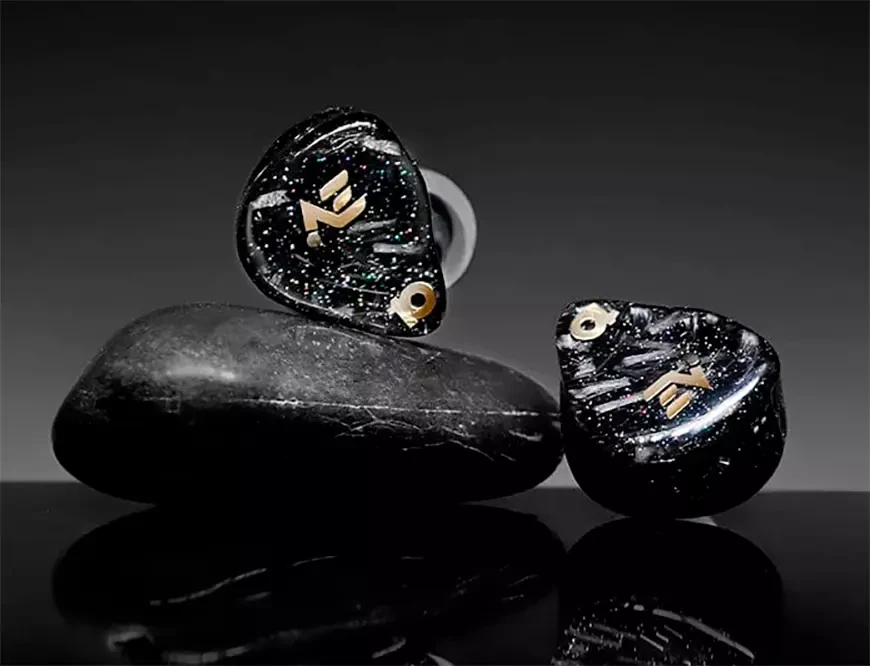
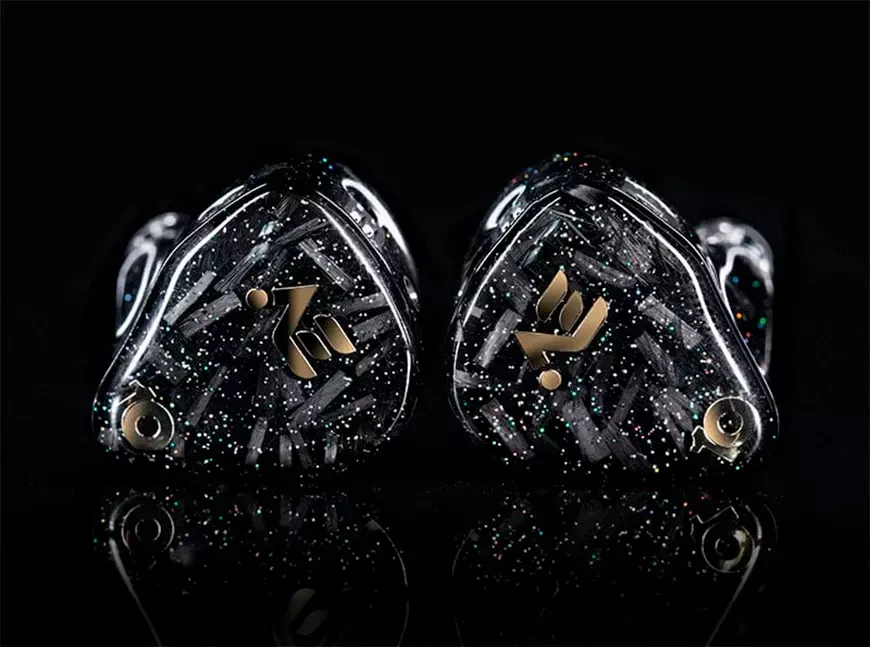
The AE10 uses resin vacuum-moulding technology for its shells, finished with carbon-fibre outer panels. Shanling describes the cosmetic result as a starry-night-sky effect, and the carbon panel gives the earphones a more distinctive appearance than the plain resin shells common in the category.
More importantly, resin is well suited to complex custom-shaped IEM housings. It can be moulded into the curved, ear-following form needed to hold multiple drivers securely while keeping the outer body reasonably small. A good fit matters as much as an IEM’s driver complement. It helps retain the earpiece in position, reduces physical discomfort over longer sessions and, crucially, enables a consistent seal with the supplied ear tips.
That seal has a major effect on bass perception. If an ear tip leaks around the ear canal, low-frequency output can fall sharply and the overall balance may seem thin or bright. Owners should therefore take time to try the included selection of tips rather than assuming the pre-fitted pair is the best option. The correct choice is the one that provides a stable seal without creating uncomfortable pressure; different tip sizes and materials can alter both fit and perceived tonal balance.
At 5.3g per earpiece, the AE10 should not place a great deal of weight on the ear. That figure is especially notable given the number of internal drivers, although comfort will still depend on an individual listener’s ear shape, the cable routing and the tips selected. Shanling calls the form ergonomic and intended for extended listening, but fit is inherently personal with universal-fit IEMs. Prospective buyers should regard an audition as particularly valuable at this price level.
4.4mm balanced termination and 0.78mm cable connectors
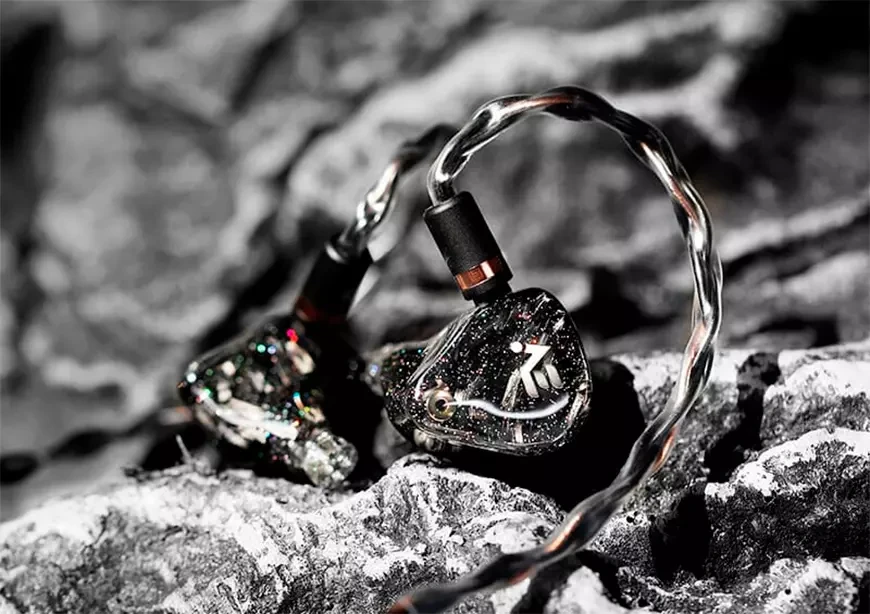
Shanling supplies the AE10 with an 18-core cable made from high-purity monocrystalline copper. Monocrystalline copper is commonly used in premium headphone cables because it is produced with very long crystal structures, minimising grain boundaries in the conductor. The supplied description also states that the cable has robust shielding intended to protect the signal from interference.
For day-to-day use, the most consequential cable detail is its 4.4mm balanced plug. This is the Pentaconn-style connector now widely found on higher-end digital audio players and many dedicated headphone amplifiers. In a balanced headphone output, the left and right channels each have separate positive and negative connections rather than sharing a common return. When implemented properly by the source component, this can allow a higher available voltage swing and better channel separation than an equivalent single-ended output. It does not, however, automatically guarantee a sonic improvement, and it cannot be used with a conventional 3.5mm or 6.35mm headphone socket without the appropriate solution.
Buyers should check their source before purchase. The supplied cable is directly suited to equipment with a 4.4mm balanced headphone output. A phone, laptop or DAC with only a 3.5mm headphone jack will need a correctly wired adapter or, more sensibly in many cases, an alternative cable terminated for that output. The AE10’s standard 0.78mm cable connections make cable replacement possible, subject to confirming connector fit and pin orientation. This is useful for owners who need a different plug type, cable length or wearing arrangement.
It is also worth keeping expectations realistic around cable changes. A replacement cable can be a practical upgrade for termination, ergonomics or durability, but it should not be treated as a substitute for proper ear-tip fit, suitable source output or an IEM whose tuning already suits the listener’s preferences.
Accessories and portable-system considerations
The package includes Shanling’s C5 Carry Case, a protective cover for the earphones, a selection of ear tips and the 18-core connection cable. A proper case is more than a cosmetic extra with a multi-driver IEM: it protects the resin shells and the detachable cable connectors from knocks and avoids stuffing the earphones loosely into a pocket or bag.
The AE10’s wired-only design will appeal to listeners using a dedicated portable player, a dongle DAC/headphone amplifier or a conventional desktop headphone system. A wired connection avoids Bluetooth codec choices and battery management at the earphone itself, while the 4.4mm balanced termination places the emphasis on sources intended for enthusiast headphone use. Shanling has not provided information here on the AE10’s electrical sensitivity or impedance, so it would be premature to state how easily it can be driven by every portable source. In general, a low-noise output is valuable with sensitive multi-driver IEMs, as audible hiss at idle can be more apparent than it is with many full-size headphones.
Users should begin at a low volume whenever connecting an IEM to a balanced output. The available level may be substantially greater than expected from a phone or basic dongle, and the close proximity of in-ear transducers makes careful volume control essential. If a source offers selectable gain, lower gain is often the sensible starting point for IEM use, provided it still offers adequate adjustment range.
Who the Shanling AE10 is for
The Shanling AE10 is aimed at listeners who want a technically elaborate wired IEM and already use, or plan to use, a 4.4mm balanced source. Its headline features are clear: 10 BA drivers per side, a six-band fourth-order crossover, a low claimed earpiece weight, detachable 0.78mm cable connectivity and an extensive accessory package.
The main consideration is that this is a specialised, source-conscious proposition rather than an all-purpose plug-and-play earphone. The supplied balanced plug is ideal for the expanding number of compatible DAPs and headphone amplifiers, but less convenient for equipment limited to conventional single-ended outputs. Equally, the all-BA architecture and sophisticated crossover are signs of serious intent, not a guaranteed description of the AE10’s voicing. Listeners should establish whether its eventual tonal balance and fit work for their music, ears and source chain.
Shanling’s AE10 in-ear headphones are available now at a recommended retail price of $999.