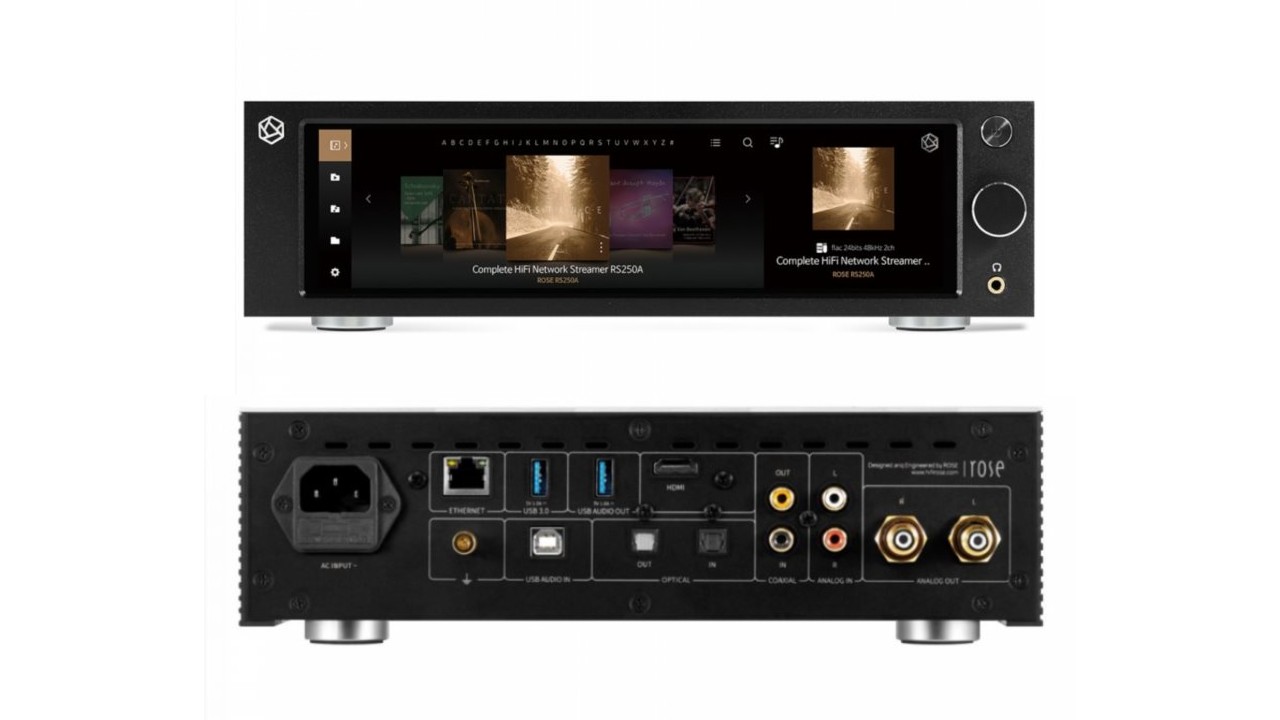
The Rose RS250A is far more than a conventional network streamer. It is a digital hub built around a high-resolution DAC, a substantial touchscreen interface and an Android-based operating system, with the ability to play music from streaming services, a network-attached storage device, USB media or internally fitted storage. It also adds video playback over HDMI—an unusual capability in a component aimed primarily at two-channel audio.
That combination makes the RS250A an intriguing proposition for listeners who want a single, visually engaging front end for a music library and streaming subscriptions, rather than a small black-box streamer controlled exclusively from a phone. Its ESS ES9028Pro conversion stage, support for PCM to 32-bit/768kHz and native DSD512, plus a published low-noise measurement suite, indicate that Rose has given the audio section considerably more attention than is typical of a general-purpose media player.
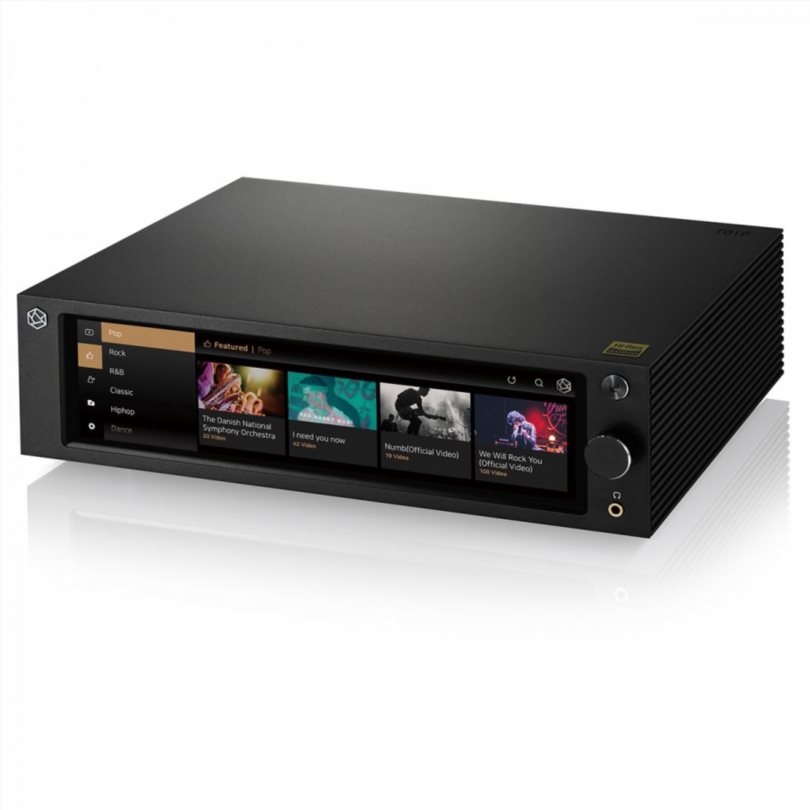
A network player designed as a system hub
In a traditional separates system, the RS250A can operate as the source component feeding an integrated amplifier, preamplifier or active speakers from its single-ended RCA analogue output. Its maximum specified single-ended output level is 2.2Vrms, which is in the usual territory for a line-level source and should suit most conventional line inputs. The specified 150-ohm output impedance is also low enough in principle for normal interconnect runs into a suitably high-impedance amplifier input; as ever, excessively long cables and unusually low input impedances are best avoided.
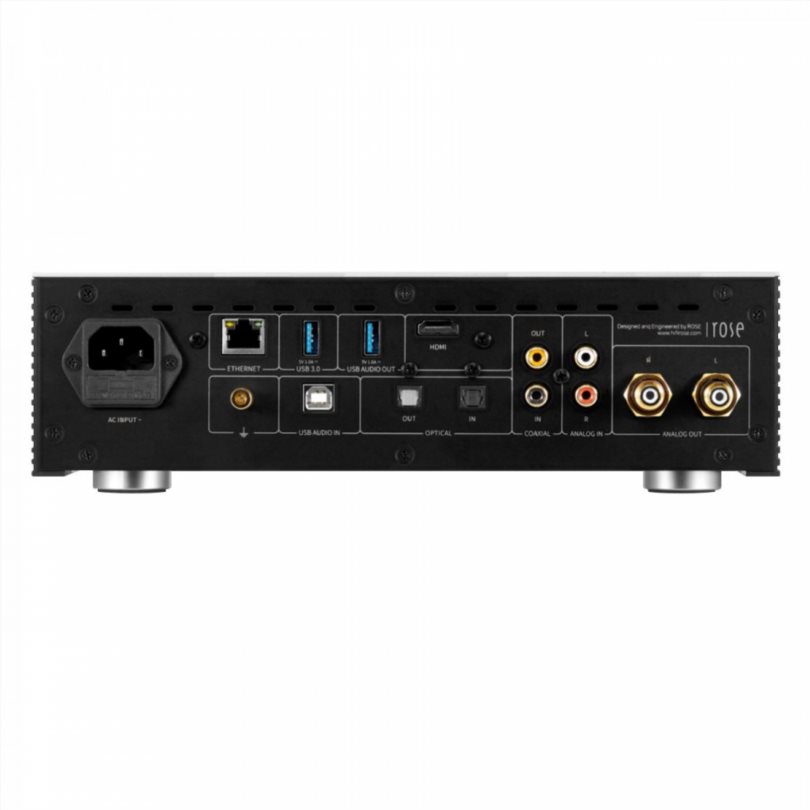
The feature set also permits a wider range of roles. Analogue line input, optical and coaxial S/PDIF inputs, USB-B and USB-A Host are listed, so the RS250A can accommodate external digital sources as well as a computer. Its outputs include analogue RCA, optical and coaxial digital, USB-A and a 3.5mm headphone output. This breadth matters because it allows the owner to begin with the internal DAC and later use the RS250A as a streaming transport into an external DAC, or to integrate legacy digital hardware without adding another switcher.
There is no balanced analogue output listed, so systems built around XLR-only electronics will need to use an appropriate alternative connection elsewhere in the chain. Nor does the supplied information specify headphone output power, gain settings or the range of headphone impedances it can drive. The 3.5mm socket is therefore best viewed as a convenient included listening output until those details are confirmed, rather than as evidence of a dedicated high-power headphone amplifier.
Power supply, chassis and the rationale behind the construction
Rose specifies a linear power supply for the RS250A, with shielding intended to limit interference reaching the audio circuits and processor. In a component that combines a computer platform, display, network hardware and DAC, power-supply management is important: high-frequency activity from processing and displays can create unwanted electrical noise if the layout, regulation and grounding are not properly controlled. A linear supply is not by itself a guarantee of performance, but it is a sensible engineering choice where the objective is a stable supply for analogue and digital sections.
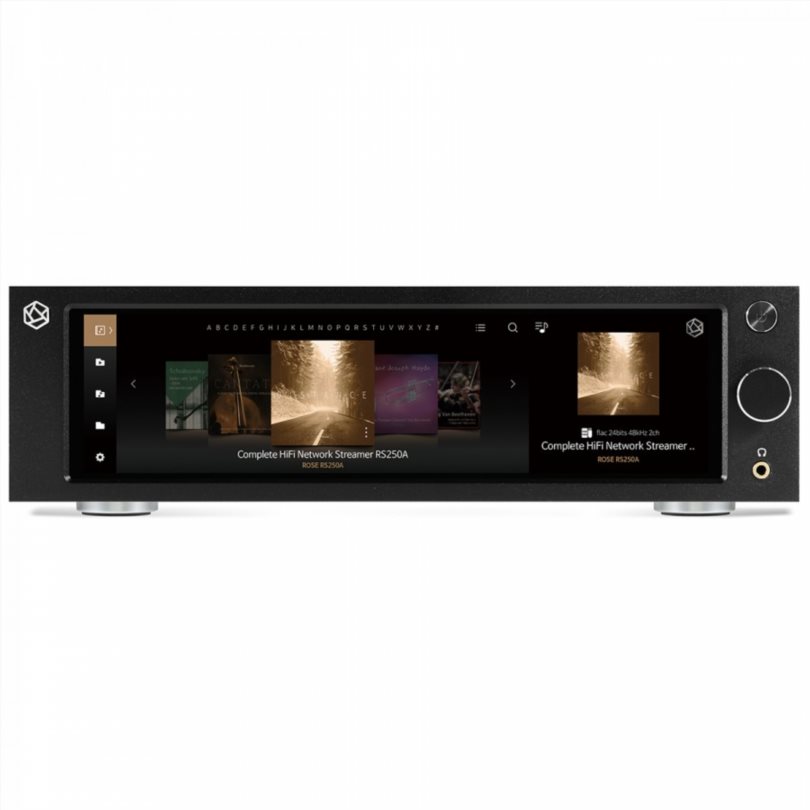
The enclosure is machined from high-purity anodised aluminium. Beyond giving the RS250A its notably premium, minimalist appearance, a rigid metal chassis can provide physical protection and electromagnetic screening. Rose also says the construction helps limit exposure to vibration. The practical benefit is that a well-built case gives the screen and controls a more solid feel while providing a more controlled environment for sensitive circuitry; it should not be confused with a replacement for sensible equipment support and cable management.
At 278 x 231 x 83mm and 3.2kg, the unit is compact enough for a typical hi-fi rack, although its wide display means it is likely to work best where the front panel remains visible. It accepts 100–120V AC and 220–240V AC at 50/60Hz. The supplied specification does not state ventilation clearances or heat output, but giving any network player reasonable airflow remains prudent, particularly where it is installed in enclosed furniture.
The ES9028Pro DAC and what the published figures tell us
The RS250A uses ESS Technology’s ES9028Pro DAC. This is a multi-channel converter chip often deployed in serious digital audio products, though a DAC chip name alone never defines the sound or overall performance. The implementation around it—power regulation, clocking, filtering, analogue output circuitry and software—matters at least as much. Still, the choice provides the processing headroom for the RS250A’s broad format support.
Rose rates the player for PCM up to 32-bit/768kHz, native DSD up to DSD512 and MQA. Such capability means the player will not impose a format ceiling on the vast majority of downloads and streaming material likely to be encountered. It is worth keeping this in proportion: CD-quality 16-bit/44.1kHz music and high-resolution PCM are both well within its reach, and a high sample-rate specification does not automatically mean that every recording benefits from a higher-rate file. Recording and mastering quality remain decisive.
The company also lists an MQA decoder. MQA files and streams package high-resolution information into a bandwidth-conscious format, but their availability depends on the service and catalogue in use. MQA support may be useful to listeners with existing MQA libraries or services offering that format, while it is not essential to the RS250A’s appeal for PCM, DSD, local files or the other streaming options.
Its published performance figures are substantial: THD is quoted as 0.00028% at 1kHz and 2.25Vrms, single-ended, while THD+N is 0.0003% under the same conditions. Signal-to-noise ratio is specified at 122dB A-weighted, dynamic range at 135dB with a CCITT filter, and stereo crosstalk at -137dB from 20Hz to 20kHz. In practical terms, these numbers point to very low measured noise and distortion and excellent separation between channels in the stated test conditions. They should be read as manufacturer specifications rather than independent measurements, but they are consistent with an audio section intended to be more than an afterthought.
The stated frequency response is 17Hz–80kHz within +/-1dB. That comfortably covers the audible band and extends beyond it, while the lower figure indicates a modest roll-off only at the very bottom of the spectrum. It does not tell us how the player will sound in a given system; amplifier, loudspeaker, room and recording choices remain much larger variables.
An 8.8-inch touchscreen changes day-to-day use
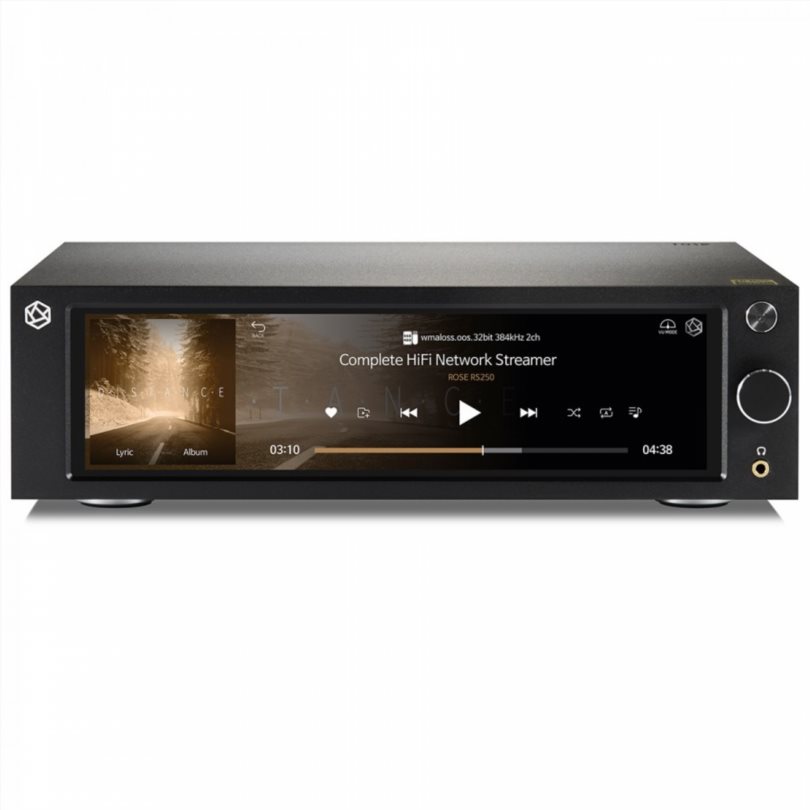
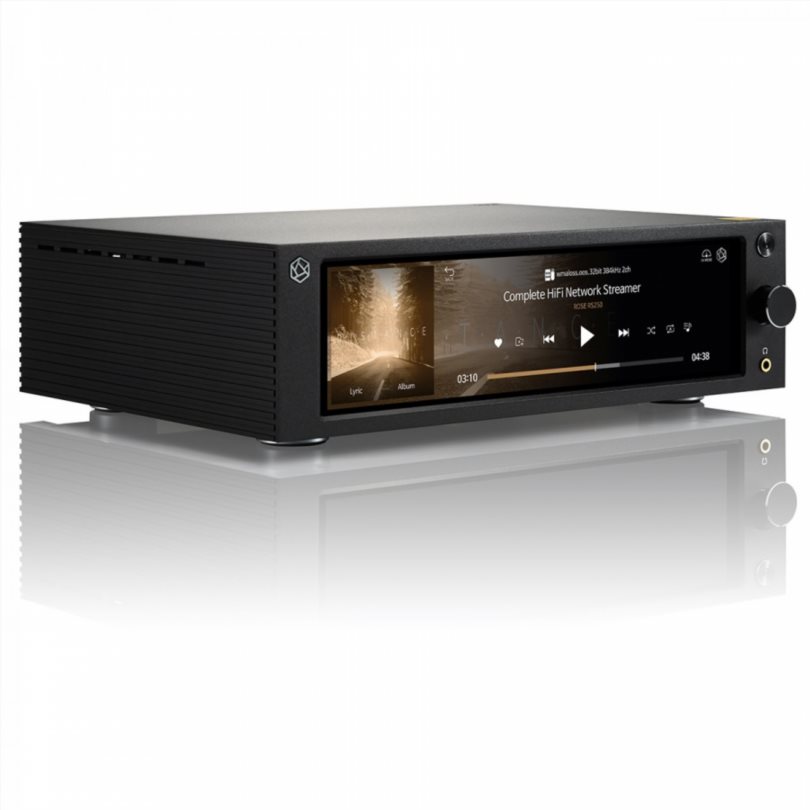
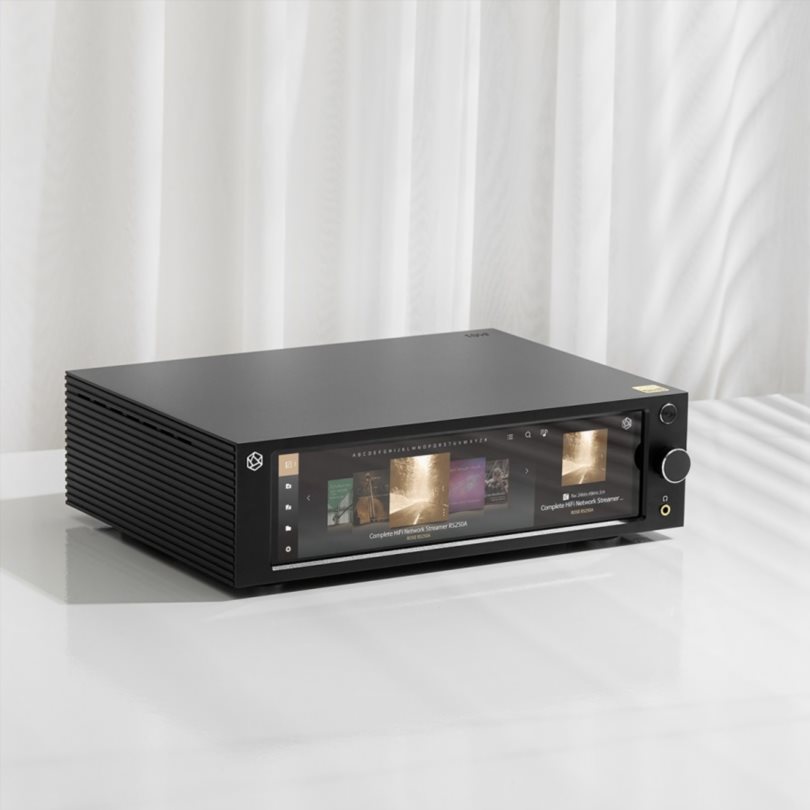
The RS250A’s most distinctive physical feature is its 8.8-inch high-resolution IPS touchscreen. Most network players delegate browsing to an app, leaving only a small display—or none at all—on the component itself. Here, album art, playback data and navigation can be accessed directly at the rack. For an owner who often selects an album while standing in front of the system, that can be genuinely more immediate than unlocking a phone and opening a control application.
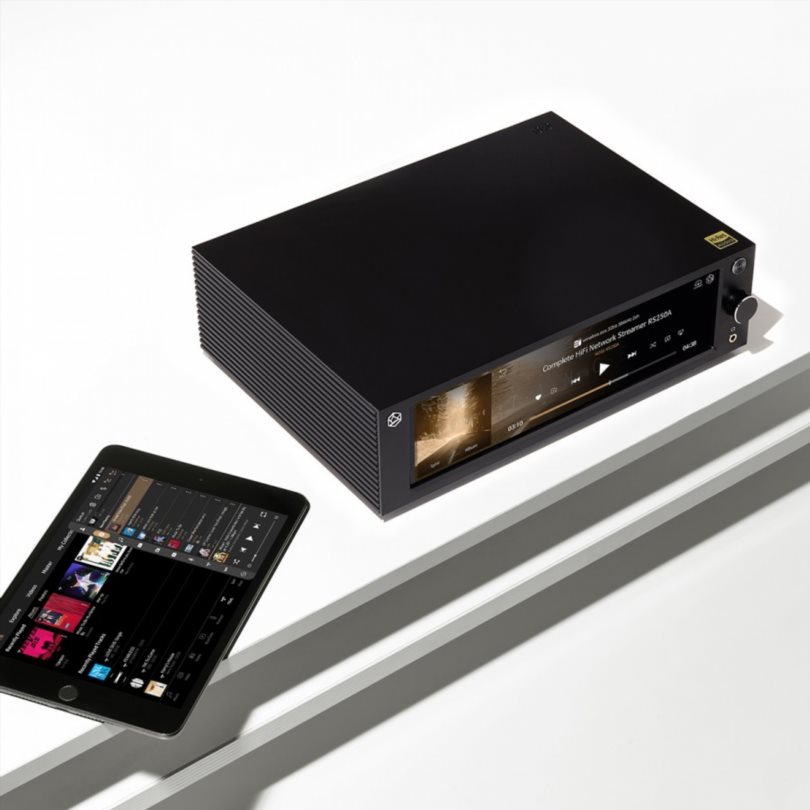
The screen is also specified to play video at 60 frames per second, reflecting the RS250A’s dual audio-and-video remit. A Bluetooth remote is included for seated control, while Rose Connect is available for Android, iOS and Windows. The latter is especially useful when building playlists, browsing a large library or controlling the player from another room.
Underneath is a custom implementation of Android 7.1, running on a Cortex-A72 dual-core processor clocked up to 1.8GHz, a Cortex-A53 quad-core processor up to 1.4GHz, Mali-T864 graphics and 4GB of LPDDR4 RAM. These are computer-platform specifications rather than direct audio specifications, but they explain how the RS250A can present a rich graphical interface, run media services and decode video without relegating everything to a separate mobile device. Rose says services can be updated through its Rose Store; prospective buyers should nevertheless check current app, service and software support for the platforms they rely on, since streaming integrations can change over time.
Streaming, Roon and local-library flexibility
Network connectivity is comprehensive. The RS250A offers Gigabit Ethernet (10/100/1000 BASE-T), dual-band 2.4GHz/5GHz Wi-Fi supporting 802.11 b/g/n/a/ac, and Bluetooth. Ethernet is normally the first choice for a fixed hi-fi installation because it provides the most consistent connection for large local libraries and high-bitrate video; dual-band Wi-Fi brings welcome placement flexibility when a cable route is impractical.
Supported services include Qobuz, Tidal, RoseTube, RosePodcast, Bugs and web radio, with Spotify Connect and AirPlay also listed. Spotify Connect is particularly convenient because playback is handed from the Spotify app to the player, leaving the RS250A to stream directly rather than using the phone as the continuing audio source. Qobuz offers music at up to 24-bit/192kHz, according to the supplied information. DLNA support provides another route to network music libraries, while SMB, FTP and WebDAV network services broaden options for accessing stored files.
The RS250A is Roon Ready certified and is described as fully Roon Core compatible. Roon Ready certification is significant for listeners using Roon: it identifies the device as a network endpoint within the Roon ecosystem, allowing Roon’s library management, metadata and multi-room control to direct playback to the player. A Roon Core is the server element of that ecosystem, so buyers intending to run a Core on the RS250A itself should verify the exact current implementation and requirements with Rose before planning a system around that role.
For local storage, the player can recognise SATA HDDs up to 10TB and SSDs up to 4TB, as well as USB storage. An internal or directly attached library removes dependence on a separate NAS for listeners who prefer an all-in-one approach. SSDs have the advantages of silent operation and quicker access, while a large HDD may suit extensive lossless libraries where capacity is the priority. The RS250A can also access a computer or NAS, and offers filtering options for sorting songs.
Video, CD ripping and broad file support
The HDMI 2.0 output supports up to 3840 x 2160 at 60Hz, making the RS250A capable of feeding a television or display with Ultra HD 4K video. Rose lists RoseTube, Tidal Video and Bugs Video among compatible video services. This may be a niche feature in a dedicated listening room, but it is potentially valuable in a living-room system where one compact component can handle music browsing, online video and locally stored media.
A very extensive audio codec list includes WAV, FLAC, ALAC, AIFF, WMA, MP3, OGG, APE, DFF, DSF, AAC and CDA, among others. The important point is broad compatibility across uncompressed, lossless, DSD and compressed collections, including files accumulated over many years. Its video support is similarly wide, encompassing common containers and codecs including H.264, H.265/HEVC, VP8 and VP9, with the stated H.265/HEVC Main and Main10 support extending to 4K x 2K at 60fps.
CD playback and copying are possible when a suitable USB CD drive is connected, though that drive is not supplied. The ability to rip directly to an SSD or USB drive could appeal to owners digitising a CD collection without immediately committing to a computer-based ripping workflow. Metadata handling and ripping format options are not specified in the supplied material, so those are worthwhile points to establish before purchase if CD archiving is a primary requirement.
Who should consider the RS250A?
The RS250A makes most sense for the listener who values an integrated, screen-first experience without sacrificing serious file-format support or a capable DAC stage. It can simplify a system that would otherwise require a streamer, DAC, digital switcher, local music server and perhaps a separate video box. Its analogue input, multiple digital connections and HDMI output make it unusually adaptable for a mixed-use music and media installation.
Its trade-off is focus. A minimalist streamer without a display may be smaller, cheaper or simpler for somebody who exclusively uses Roon or one phone app. Conversely, users who require balanced analogue outputs, detailed headphone-amplifier specifications or a confirmed on-board Roon Core solution should check those needs carefully. For those who want physical interaction, extensive local storage, mainstream streaming control and 4K video in one finely machined aluminium component, the Rose RS250A is a distinctive take on what a network player can be.
Rose RS250A key specifications
- DAC: ESS ES9028Pro
- Supported formats: PCM up to 32-bit/768kHz, native DSD512 and MQA
- Analogue output: Single-ended RCA; maximum specified output level 2.2Vrms
- Digital and analogue inputs: RCA line in, optical, coaxial, USB-B, USB-A Host and RJ45
- Outputs: RCA, optical, coaxial, USB-A, 3.5mm headphone and HDMI 2.0
- Network: Gigabit Ethernet, dual-band Wi-Fi and Bluetooth
- Streaming and control: Qobuz, Tidal, Spotify Connect, AirPlay, DLNA, Roon Ready and Rose Connect
- Storage: SATA HDD up to 10TB or SSD up to 4TB
- Display: 8.8-inch IPS touchscreen
- Dimensions and weight: 278 x 231 x 83mm; 3.2kg