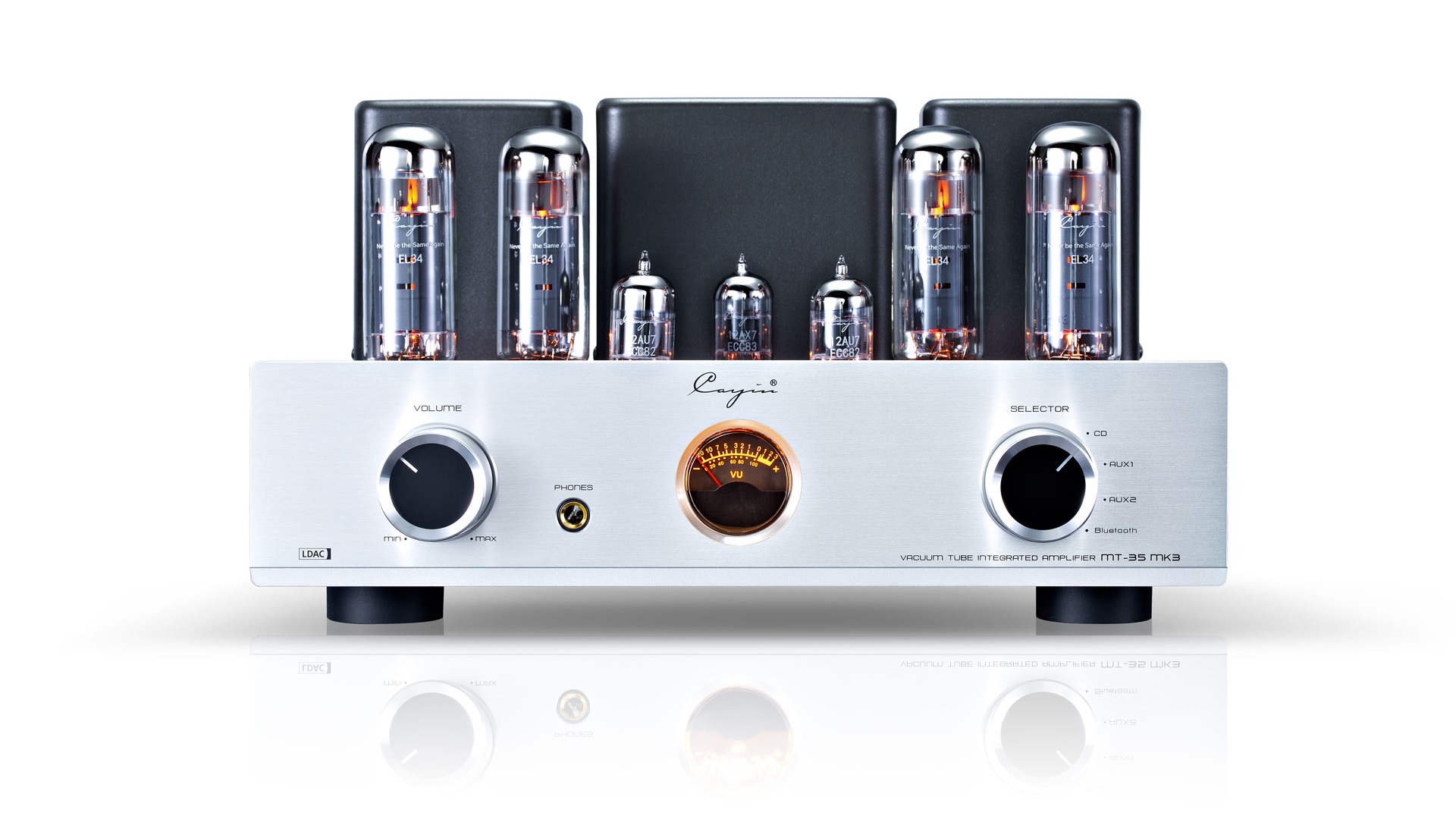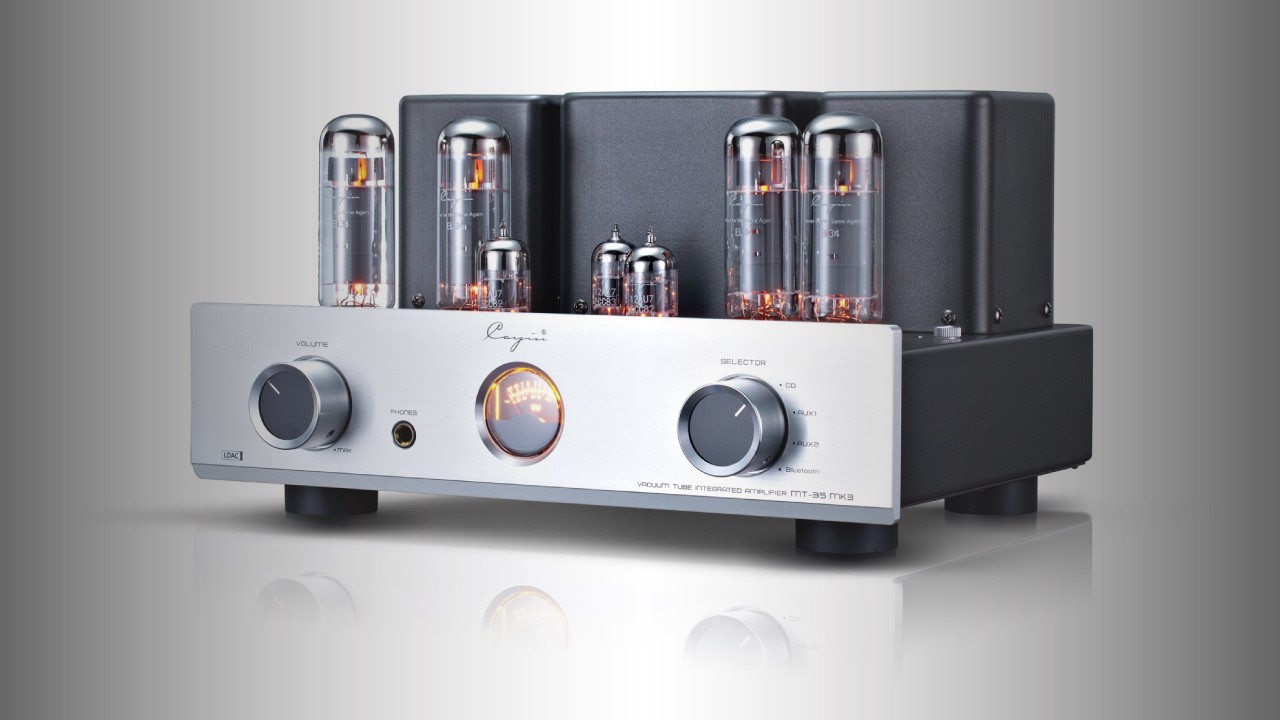
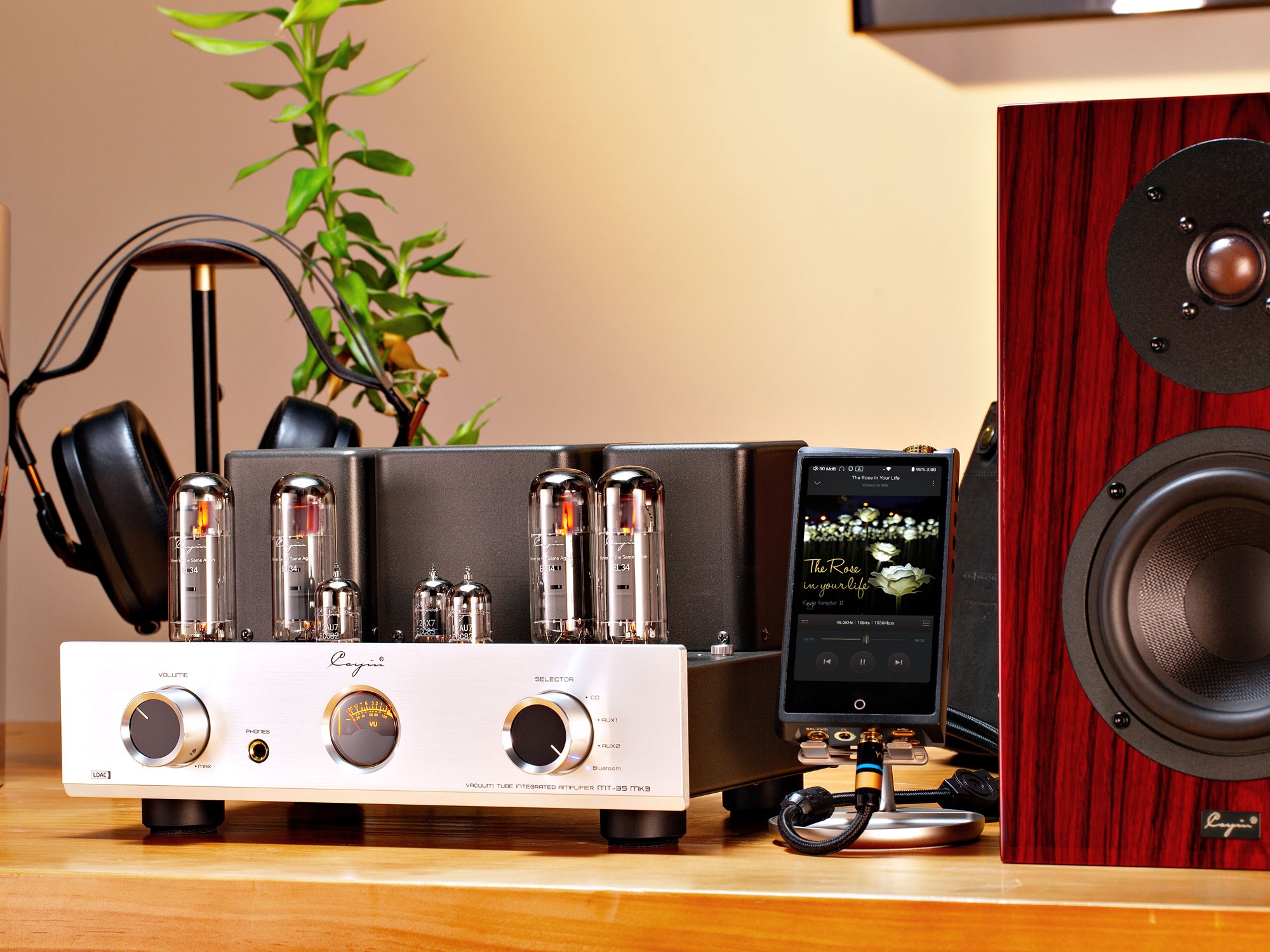
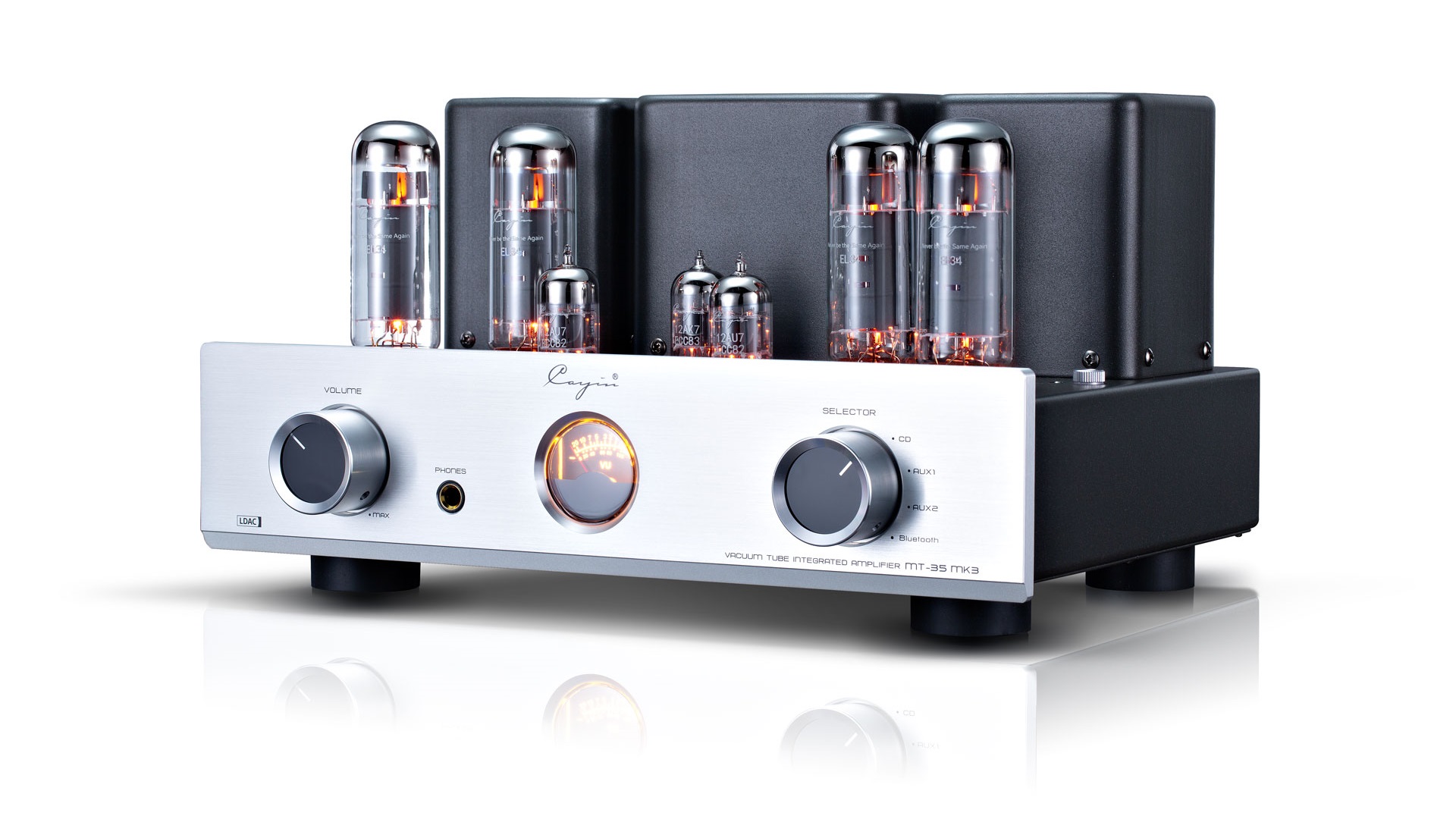
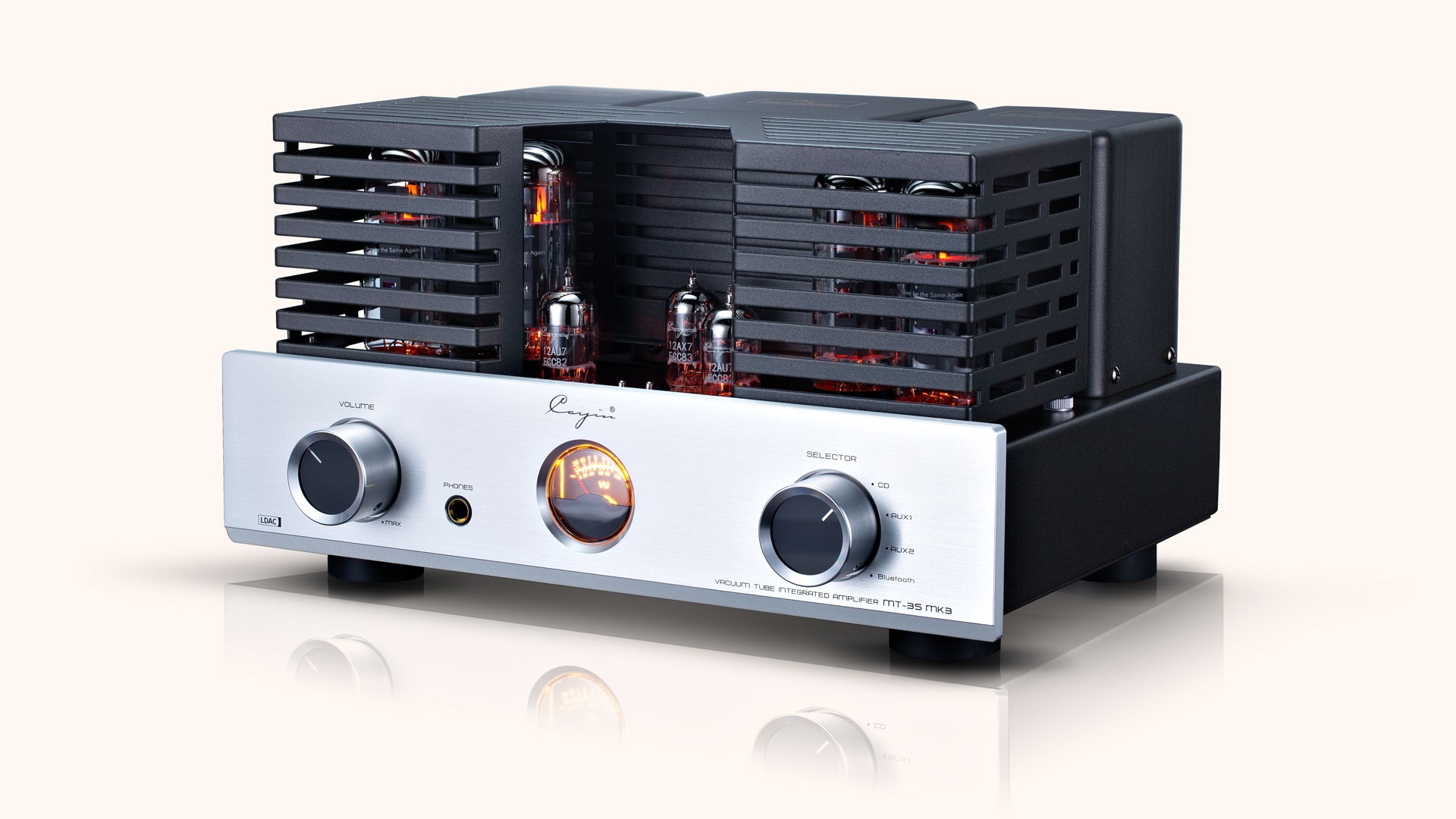
Cayin’s MT-35 Mk3 is a compact integrated valve amplifier that combines a deliberately traditional core – four EL34 output valves, hand-wired point-to-point circuitry and dedicated output transformers – with a few concessions to contemporary system use. Alongside its three analogue line-level inputs, the amplifier includes Bluetooth 5.1 with AAC, aptX HD and LDAC codec support, a front headphone output and switchable ultra-linear and triode operating modes.
That combination makes the MT-35 Mk3 a potentially appealing proposition for listeners who want a self-contained two-channel valve amplifier rather than a separate pre/power arrangement, but do not want to exclude convenient wireless playback from a phone, tablet or computer. Cayin rates it at 2 x 36 watts in ultra-linear mode, or 2 x 18 watts in triode mode, so speaker matching and expectations around room level will be central to getting the best from it.
An EL34 integrated amplifier with two operating characters
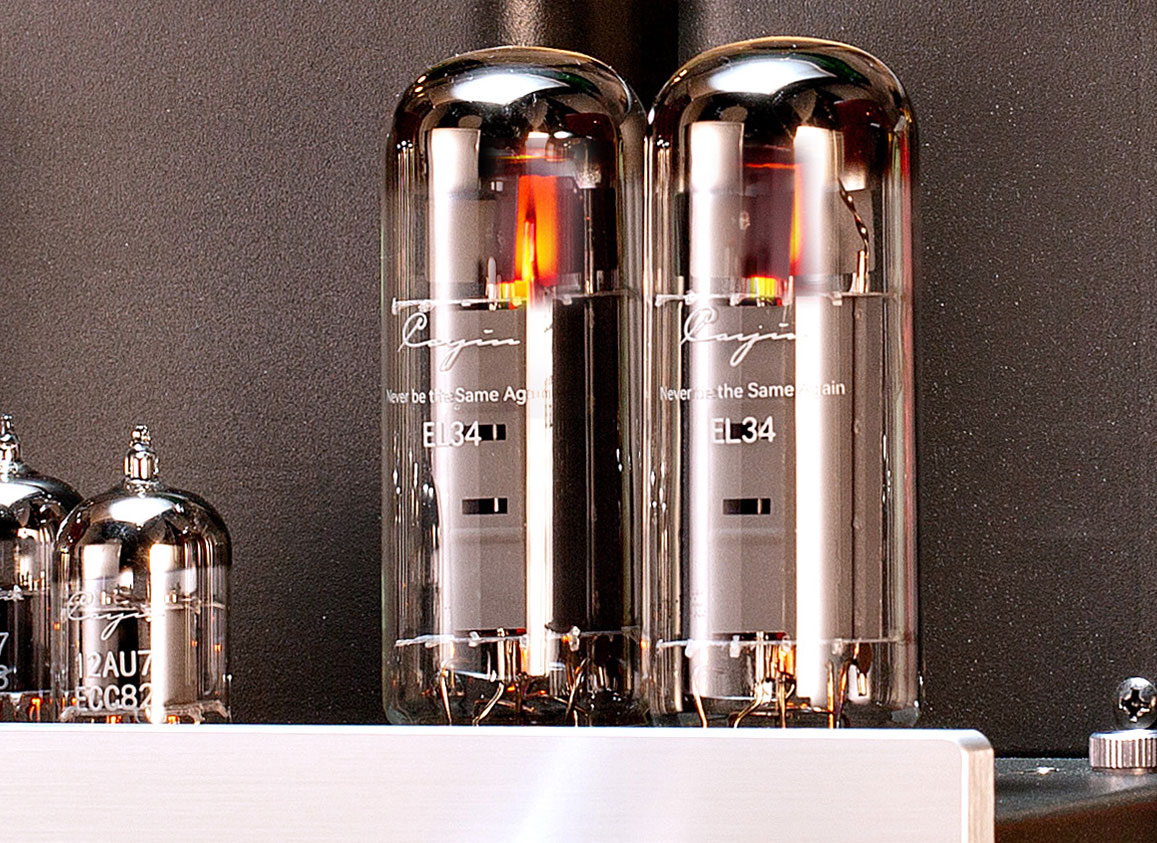
The MT-35 Mk3 uses four EL34 output valves, with two assigned to each channel, and operates in Class AB. The EL34 is one of the best-known audio output valves and is regularly used in push-pull stereo amplifiers because it can provide useful power without requiring the physically large transformers and heat dissipation associated with some higher-powered valve designs. In the MT-35 Mk3, Cayin specifies a maximum of 36 watts per channel in ultra-linear operation.
Class AB means the output stage is designed so that its valves share the work of reproducing the waveform, rather than each valve conducting for the entire cycle as in a pure Class A circuit. In broad terms, this is a practical way to obtain more power and efficiency than a comparable Class A valve output stage. It does not, by itself, establish how an amplifier will sound; the output transformer, power supply, circuit implementation and the loudspeaker load are all important. But it explains why a relatively compact 13.5kg integrated amplifier can offer a meaningful 36W-per-channel rating.
The amplifier can also be switched into triode mode, where Cayin quotes 18 watts per channel. A pentode valve such as an EL34 can be connected in different ways, and triode operation is a long-established option in valve amplification. The trade-off is explicit here: halving the available rated power in exchange for a different operating condition. Cayin describes the triode setting as particularly refined and pure, but that is the manufacturer’s characterisation rather than a substitute for an audition in a properly matched system.
More practically, the choice gives owners two gain-and-power options. Ultra-linear mode will be the sensible starting point with most loudspeakers and in larger rooms, where the additional headroom matters. Triode mode may be more appropriate with efficient loudspeakers, nearfield listening, or listeners who do not require high playback levels. As with any modest-power valve amplifier, running out of headroom can be more consequential than the headline wattage suggests: musical peaks demand considerably more power than average listening levels, particularly with less sensitive speakers or at a long listening distance.
Seven valves, point-to-point wiring and adjustable bias
In addition to its four EL34s, the MT-35 Mk3 uses 12AX7/ECC83 and 12AU7/ECC82 small-signal valves in its preamplifier section. These valve families are familiar choices in audio circuitry. The 12AX7/ECC83 is commonly used where high voltage gain is needed, while the 12AU7/ECC82 is often used in driver or buffer duties. Cayin does not detail the precise allocation of those valves within the MT-35 Mk3’s circuit, so it would be wrong to infer the exact gain-stage topology from the valve complement alone.
Cayin says the amplifier is hand-wired using point-to-point construction. This describes an approach in which components are wired directly together rather than mounted on a conventional printed circuit board. It is valued by many valve-amplifier makers because it can make servicing and component replacement more straightforward, and because high-voltage valve circuits suit physical layouts that can keep sensitive signal paths and power-carrying wiring appropriately separated. It should not be treated as an automatic guarantee of superior sound: careful circuit design, parts selection and build quality matter at least as much. Still, it is a meaningful construction detail in a valve integrated at this price level.
The output transformers are custom-designed, according to Cayin. In a conventional valve power amplifier, these transformers are fundamental rather than incidental components. Output valves operate at high voltage and relatively high impedance, while loudspeakers require a low-impedance, current-capable drive. The transformer performs the impedance matching between those two worlds. Its design can affect bandwidth, bass control, distortion behaviour and the way the amplifier responds to a changing speaker load.
The stated frequency response is 8Hz to 60kHz, at -3dB. The -3dB qualification is important: it identifies the points at which output has fallen by 3dB relative to the midband rather than implying perfectly flat response across that entire range. The low-frequency extension does not mean a loudspeaker system will reproduce 8Hz in-room; that is overwhelmingly governed by the speakers and room. Equally, the ultrasonic 60kHz figure is not directly audible, but it indicates the amplifier is specified to pass well beyond the conventional audible band.
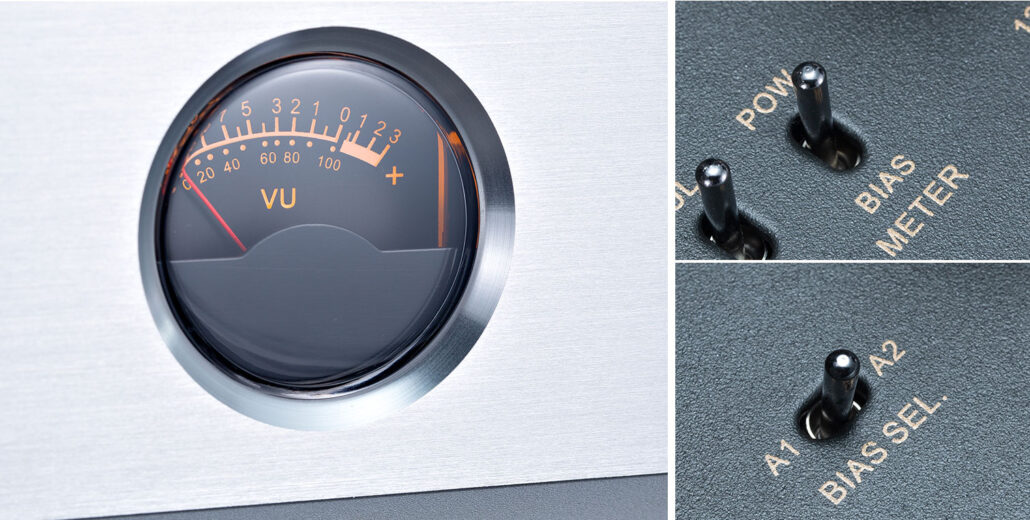
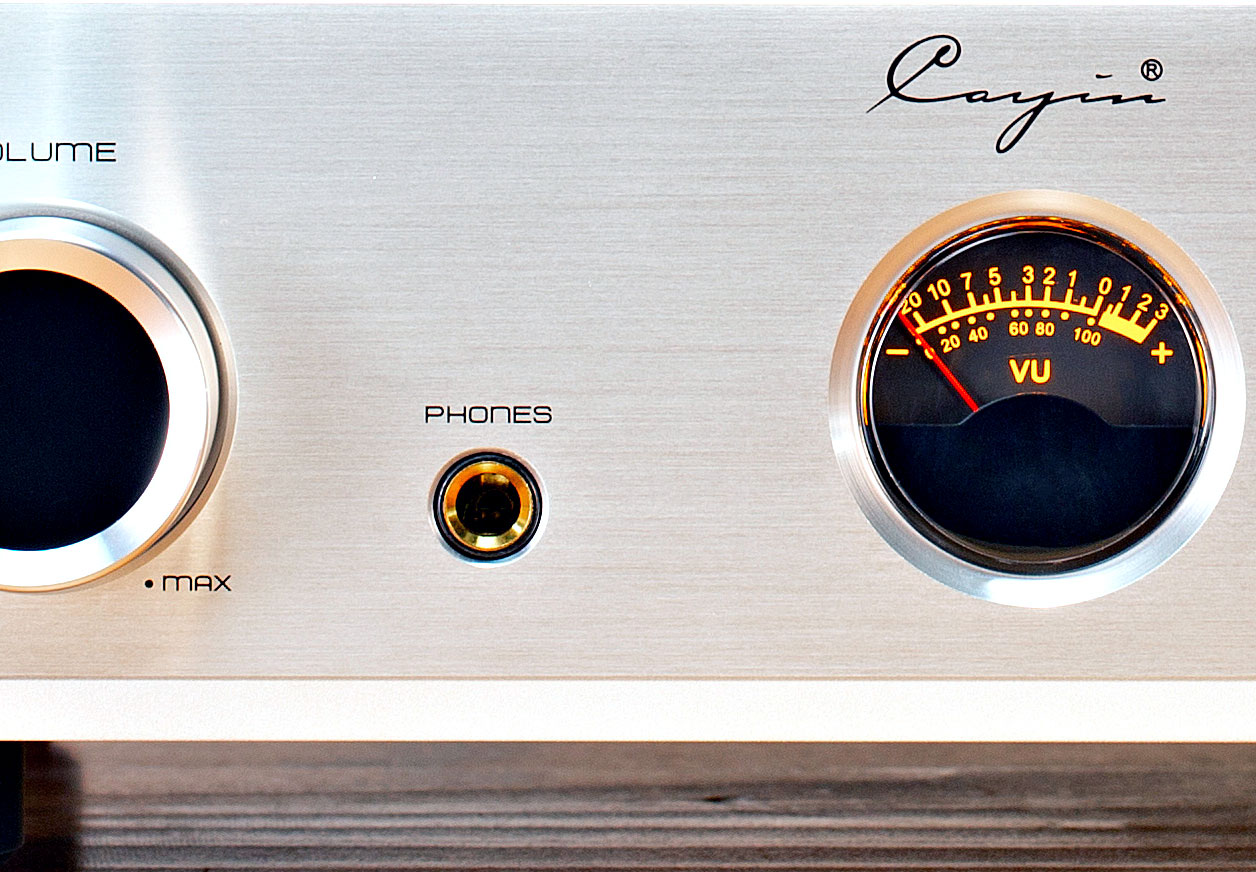
A prominent illuminated VU meter takes centre stage on the front panel. Beyond its visual appeal, Cayin says the meter is used to assist bias adjustment for the output valves. Bias is the standing operating condition of a valve in the output stage. Correct adjustment helps ensure that each EL34 works within its intended range, supporting consistent performance and valve life. The ability to set bias individually for each output valve is particularly useful because no two valves are perfectly identical, and their characteristics can change over time.
Valve rolling is supported, but compatibility is not a reason to be casual
The MT-35 Mk3 is supplied with EL34 valves but is also specified as supporting 6CA7, 6L6 and 5881 types. This gives experienced owners scope to investigate compatible output-valve alternatives, though it should not be read as an instruction to fit any valve with a similar base. These families can have different electrical characteristics, and safe, reliable substitution depends on the amplifier’s approved operating conditions and correct bias adjustment. Owners considering a change should follow Cayin’s guidance for the amplifier and the valves being installed.
The valves sit beneath a removable protective cage. That is a worthwhile practical feature in a domestic environment: output valves operate hot, remain vulnerable to accidental contact and should have adequate ventilation. Removing the cage gives clear access when maintenance or tube replacement is required, while fitting it provides a degree of protection during everyday use. As with all valve amplifiers, the MT-35 Mk3 should be placed in open space rather than enclosed tightly in a cabinet, allowing heat to dissipate safely.
Analogue-first connectivity, plus properly specified Bluetooth
The analogue side of the MT-35 Mk3 is intentionally straightforward. There are three stereo RCA line inputs, suitable for sources such as a standalone DAC, network streamer, CD player with analogue outputs, external phono stage or a conventional line-level preamplifier output. The 100kOhm input impedance is high in the context of line-level equipment, meaning it should be an easy load for the vast majority of modern source components to drive.
There is no phono input specified, so a turntable cannot be connected directly unless it has its own phono preamplifier built in. Most moving-magnet and moving-coil cartridges generate a signal far below line level and require RIAA equalisation as well as gain. A separate phono stage, connected to one of the RCA inputs, remains the appropriate route for a conventional turntable setup.
The inclusion of Bluetooth 5.1 makes the amplifier more flexible than a purely analogue valve design. Cayin lists AAC, aptX HD and LDAC support. Codec compatibility matters because Bluetooth transmission normally compresses audio before it reaches the receiving component. AAC is widely relevant to Apple devices, while aptX HD and LDAC are high-quality Bluetooth codecs available on compatible transmitting devices. LDAC in particular can operate at higher data rates than basic Bluetooth audio, although the actual codec selected is determined by compatibility and settings at the source device.
Bluetooth should be viewed as a convenience input rather than a replacement for a dedicated wired digital front end. It is useful for casual listening, guests, discovering music or giving a phone-based library immediate access to the main system. Listeners building a streaming-led setup may still prefer to connect a network streamer or DAC to one of the MT-35 Mk3’s RCA inputs, preserving the amplifier’s role as the analogue hub of the system.
Headphones and loudspeakers: where system matching matters most
A front-panel headphone output adds another layer of versatility. Cayin specifies compatibility with headphones from 16 to 300 Ohms. That broad range covers many mainstream dynamic headphones, from lower-impedance portable-oriented models to numerous 250- and 300-ohm designs. It does not by itself reveal the headphone output’s power, gain structure or suitability for every difficult planar-magnetic design, none of which is specified. Prospective buyers with unusually insensitive headphones should therefore confirm compatibility before purchase rather than relying on impedance alone.
At the rear, separate loudspeaker terminals are provided for 4-ohm and 8-ohm speakers. These taps are connected to different transformer windings and are intended to help the output stage work into the appropriate nominal loudspeaker load. Owners should use the connection recommended by their loudspeaker manufacturer where possible. A speaker described as 8 ohms nominal may still present substantial impedance changes across the frequency range, which is one reason a home demonstration remains valuable with valve amplification.
The 36W ultra-linear rating places the MT-35 Mk3 in a category where loudspeaker sensitivity is more useful than broad claims about watts alone. Efficient standmounts, easy-to-drive floorstanders and designs with a benign impedance profile are likely to be more natural partners than speakers that combine low sensitivity with demanding impedance dips. This is not to say the amplifier can only be used with high-efficiency speakers; it is a reminder that available level, bass authority and dynamic freedom will vary considerably with the speaker and room.
The 18W triode setting further reinforces that point. In a small or medium-sized room, with suitable speakers and sensible levels, 18W can be entirely workable. In a large open-plan space, or for listeners who regularly play densely arranged music at high level, ultra-linear mode and carefully chosen speakers will make more sense. The key advantage of the MT-35 Mk3 is not that one mode is universally better, but that the owner can select the operating mode that best fits a given speaker, room and listening preference.
Size, finish and availability
Measuring 326mm wide, 278mm deep and 184mm high, the MT-35 Mk3 has a relatively manageable footprint for a transformer-coupled valve amplifier. Its 13.5kg weight is a reminder that the compact dimensions do not imply lightweight construction; power and output transformers contribute substantially to the mass of a valve amplifier. Buyers should allow additional clearance above the 184mm chassis height for the valves and airflow, especially if the tube cage is removed.
Cayin specifies a signal-to-noise ratio of 93dB. While the measurement conditions are not supplied, the figure indicates the manufacturer has identified the residual noise performance relative to signal level. In real use, perceived background noise will also depend on the efficiency of the connected loudspeakers, the listening distance and the gain of upstream sources.
The Cayin MT-35 Mk3 is due to arrive first with a silver front panel in March 2025, followed by a black-fronted version in April 2025. Recommended retail pricing is stated as slightly below €1,600.
At that level, its appeal is clear from the specified feature set: it is not simply a decorative, low-powered valve amplifier, nor is it a feature-heavy all-in-one digital hub. Instead, it is an analogue-first EL34 integrated with practical modern access via Bluetooth, a useful headphone facility, user-adjustable output-valve bias and the flexibility of ultra-linear or triode operation. The principal buying questions will be whether its three analogue inputs suit the intended system, and whether the chosen loudspeakers allow its 36W or 18W modes to operate with comfortable headroom.