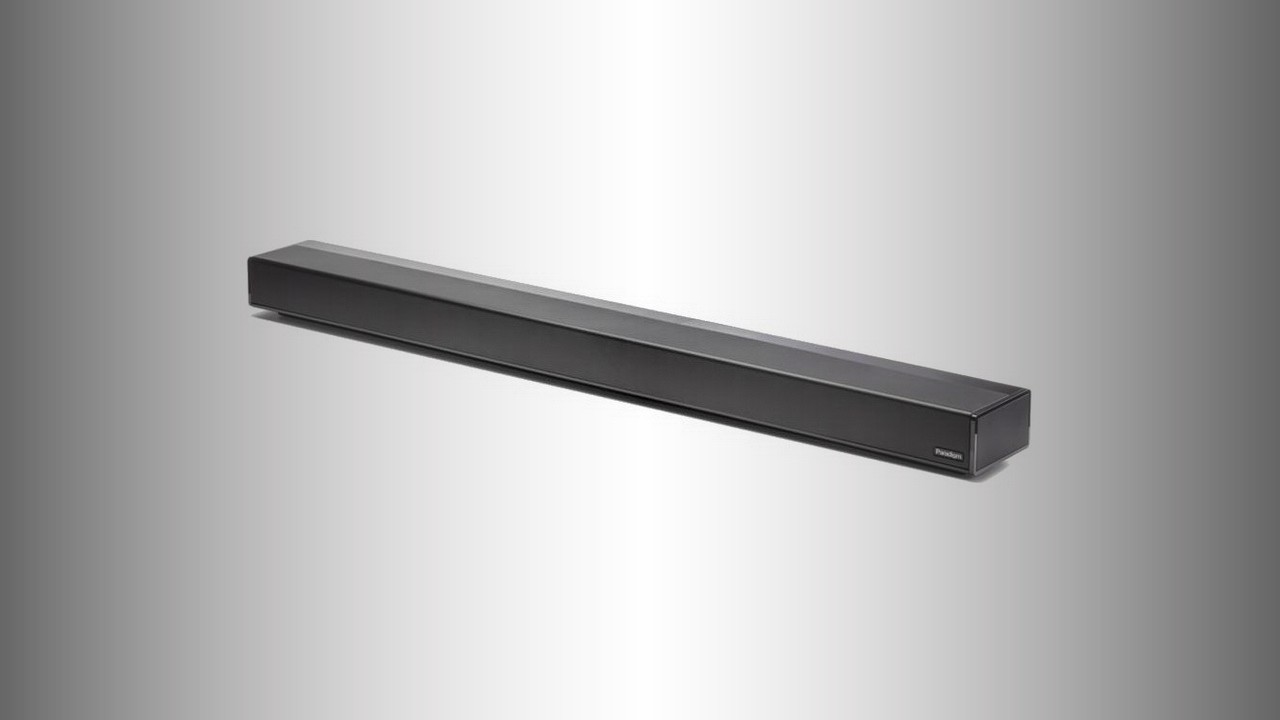
The Paradigm Soundplay takes a more system-minded approach than the average compact television soundbar. Its core brief is familiar—improve on a TV’s built-in loudspeakers with a single, wall-mountable enclosure—but the specification goes further than simple convenience features. Alongside Dolby Digital and DTS decoding, the Soundplay includes Anthem Room Correction (ARC), a 135W RMS Class D amplification section, a subwoofer output and Bluetooth that works in both receiving and transmitting directions.
That makes it a potentially flexible one-box audio hub for a smaller living room, bedroom TV or secondary system. It can accept television audio through HDMI Audio Return Channel (ARC) or optical S/PDIF, take conventional analogue sources through RCA connections, receive music wirelessly from a portable device and send its own audio to Bluetooth headphones. The important distinction is that this is not merely a bar intended to make dialogue louder: Paradigm has provided the connections and processing to integrate it into a wider, if compact, home-entertainment setup.
A self-contained soundbar with practical installation details
The Soundplay measures 110cm wide, 10cm high and 17cm deep, and weighs 5.4kg. Its 110cm width puts it in a natural position beneath many medium-to-large televisions, although prospective owners should check that it does not obstruct the screen or an existing stand. The relatively low 10cm height may help with placement in front of a TV, but exact clearance is still worth confirming, particularly where a television’s infrared receiver sits close to the bottom edge.
Paradigm says the Soundplay can be installed on a table or fixed to a wall, with no separate bracket required. A mounting template is included to make wall positioning more straightforward. This is a useful provision: soundbar mounting is not just cosmetic, since a level installation and sensible clearance from furniture help avoid unwanted rattles and keep the drivers unobstructed.
For installations where the soundbar masks the television’s IR receiver, the package includes an IR signal repeater. This is a practical solution to a common soundbar problem: a physically neat installation should not force the listener to compromise TV remote control. There is also a supplied compact remote, while the Soundplay retains a basic set of controls on the cabinet itself. These are positioned on the rear in tabletop use, or on the top when wall mounted, preserving the clean outward appearance without entirely relying on the remote.

Connection ports are recessed into a dedicated niche, with provision to route cables out of sight in either placement orientation. That may sound like a small design consideration, but it matters particularly with a wall-mounted soundbar, where dangling optical, HDMI and power cables can undermine an otherwise tidy installation.
Connections: TV audio first, but not TV audio only
The Soundplay’s connection set clearly prioritises television integration. It has one HDMI connection with Audio Return Channel, two optical S/PDIF inputs and two analogue stereo RCA inputs. HDMI ARC allows compatible TVs to return audio through the HDMI cable already linking the television and soundbar, rather than requiring a second digital cable. In day-to-day use, ARC can also allow the TV remote to handle volume control when HDMI control is correctly configured.
It is worth being precise about what the supplied specification states. The Soundplay is listed with one HDMI with Audio Return Channel, rather than multiple HDMI source inputs. In other words, it is intended to receive audio returned by the TV, not to act as a multi-input HDMI switcher for a games console, streamer and disc player. Sources connected directly to the television can therefore still be heard through the Soundplay via ARC where the TV supports the required audio return function. Optical S/PDIF provides a useful alternative for older displays or systems where ARC setup proves awkward.
The two optical inputs give the owner scope to connect a second digital source directly. The two analogue stereo RCA inputs are equally relevant for legacy equipment: an older music player, an external DAC with line-level output, or a turntable system that already includes a phono preamplifier can be accommodated. A turntable cannot normally be connected straight to a line input without a phono stage, because a cartridge’s output level and equalisation requirements are fundamentally different from those of a conventional line-level source.
A dedicated RCA subwoofer output provides a clear upgrade path. A soundbar cabinet is inevitably constrained in bass extension and output compared with separate speakers and a standalone subwoofer. Adding an active subwoofer can reduce the demand placed on the Soundplay’s own bass drivers and give film effects, kick drums and low electronic bass more physical weight. The best result will depend heavily on subwoofer position, level and crossover integration; simply turning the subwoofer up is rarely the answer in a room with bass resonances.
Amplification, drivers and surround processing
Paradigm specifies an Anthem Class D amplifier rated at 270W dynamic peak and 135W RMS. The RMS figure is generally the more useful long-term power reference, while a dynamic peak rating describes the amplifier’s ability to accommodate brief musical or cinematic transients. Neither figure alone defines how loudly a soundbar will play in every room, but 135W RMS is a substantial total amplifier rating for a single-cabinet product of this size.
Class D amplification is particularly appropriate for a soundbar because it is compact and efficient. That efficiency helps keep heat and cabinet bulk under control compared with traditional linear amplification, while leaving useful space for drivers, power supply components and digital processing. As always, the quality of implementation matters at least as much as the amplifier class itself; here, the more notable point is the use of an Anthem-branded amplification and processing platform within a Paradigm soundbar.
The acoustic section uses three drivers for each of its two channels, for a total of six. The supplied information does not identify their sizes, materials, crossover arrangement or cabinet loading, so those details should not be assumed. What can be said is that multiple drivers allow a soundbar designer to divide the acoustic workload and create a broader radiating area than a TV’s small built-in speakers can manage. The Soundplay is specified at 89dB room/anechoic sensitivity, though sensitivity figures should be treated cautiously unless their measurement conditions and reference level are fully documented.
Incoming Dolby Digital and DTS Digital Surround soundtracks are processed to create virtual surround sound, with centre- and rear-channel information retained rather than discarded. Virtual surround is not the same thing as installing physical loudspeakers behind the listener. Instead, it uses digital signal processing and, depending on the programme material and room, can create a wider and more enveloping presentation from the front of the room. Its effectiveness will vary with listening position, wall reflections and room symmetry, but it is a useful approach where rear speakers and their cabling are impractical.
Dialogue enhancement is another worthwhile inclusion. Television dialogue often becomes difficult to follow not solely because of poor speakers, but because speech competes with music, effects and modern high dynamic-range mixes. A dialogue mode typically alters the tonal and/or level balance to bring speech cues forward. It may be particularly helpful for late-night viewing or programme material with inconsistent mixing, although listeners should compare it with the standard mode: excessive processing can make voices sound unnaturally isolated.

The DSP suite also includes a mode intended to broaden the frequency range of compressed audio files, plus equaliser presets for different uses. Such processing cannot restore information removed during lossy encoding, but it can change tonal balance and perceived detail in a way some listeners may prefer with low-quality sources. The sensible approach is to use it as an option rather than an assumed improvement. Start with the most neutral setting, then try the alternatives with familiar material at normal listening levels.
ARC room correction is the Soundplay’s unusual advantage
Perhaps the most distinctive feature is Anthem Room Correction, supplied with a calibrated microphone. Room correction addresses a basic but often overlooked reality: once a loudspeaker is placed in a real room, the room becomes part of the system. Nearby walls, a TV cabinet, corners and the listening distance can all affect bass balance and, to a lesser extent, the tonal presentation higher in frequency.
ARC uses measurement data captured through the included microphone to apply digital correction. In principle, this can be especially valuable with a soundbar because placement freedom is often limited: it may have to sit directly beneath a TV, close to a wall, on furniture that adds reflections, or be mounted flat against the wall. These locations are convenient but acoustically far from neutral.
Room correction is not a substitute for sensible positioning. Owners should still avoid placing the Soundplay in an enclosed shelf if possible, ensure that its drivers are not blocked, and use a stable surface that does not buzz at higher levels. If a subwoofer is added, running room correction after the subwoofer has been positioned and initially adjusted should give the system the best chance of integrating properly. The calibrated microphone is important here: it gives the correction platform a known reference point rather than relying on the imprecise response of a phone or generic microphone.
Bluetooth in both directions, plus high-resolution capability
The Soundplay incorporates a Qualcomm aptX Bluetooth receiver for convenient streaming from portable and stationary devices. Bluetooth remains useful precisely because it is simple: guests can play music without joining a network or installing a dedicated control app. aptX is a Bluetooth audio codec intended to improve wireless transmission quality when the source device also supports it, though the actual codec in use depends on both ends of the connection.
More unusually, Bluetooth works in both directions. The Soundplay can operate as a wireless speaker for a smartphone or other compatible source, but it can also transmit its audio to wireless headphones. For television viewers, this can be a genuinely useful late-night feature. It avoids needing a separate headphone transmitter connected to the TV and may be particularly welcome where headphone listening needs to be contained to one person in the room.
There are a few practical considerations. Wireless headphone transmission introduces the possibility of lip-sync delay, depending on the headphone and Bluetooth codec combination, so this should be checked with video rather than assumed to be seamless. Bluetooth also does not bypass the usual limitations of a wireless codec simply because the Soundplay supports high-resolution playback elsewhere in its architecture.
Paradigm states that the Soundplay can play high-resolution audio up to 24-bit/192kHz. This describes the unit’s supported high-resolution audio capability, not necessarily the quality delivered over every connection. In a typical system, the actual format reaching the soundbar is determined by the source, the selected input and any limitations imposed by the TV or transmission method. HDMI ARC, optical and Bluetooth each have their own practical constraints, so users seeking the best available format should consult the source and connection requirements rather than treating “24-bit/192kHz” as an automatic outcome for all content.
Who the Paradigm Soundplay suits
The Soundplay is most compelling for buyers who want a clean TV audio upgrade but do not want to surrender adjustment and expansion options. Its two optical inputs, twin RCA analogue inputs, HDMI ARC connection and subwoofer output are broader than the bare-minimum soundbar formula. ARC room correction adds a potentially meaningful tool for dealing with the compromises of real-world placement, while the bidirectional Bluetooth function makes the product more useful beyond the main television setup.
It will be less suitable for a user who specifically needs several HDMI inputs in the soundbar itself, or for someone seeking the discrete, behind-the-listener effects of a full multichannel speaker installation. Virtual surround can be valuable, but it remains a front-of-room solution. Equally, buyers should establish how their particular television handles ARC and digital surround output before purchase, since TV menus and format pass-through settings can make or break the simplicity of an ARC-based system.
Within its intended role, however, the Soundplay is notable for treating a soundbar as an integrated audio component rather than a sealed appliance. The inclusion of proper system connections, optional subwoofer expansion, calibrated room correction and headphone transmission gives it a degree of flexibility that should appeal to listeners who want better television sound now, with the option to refine the system later.