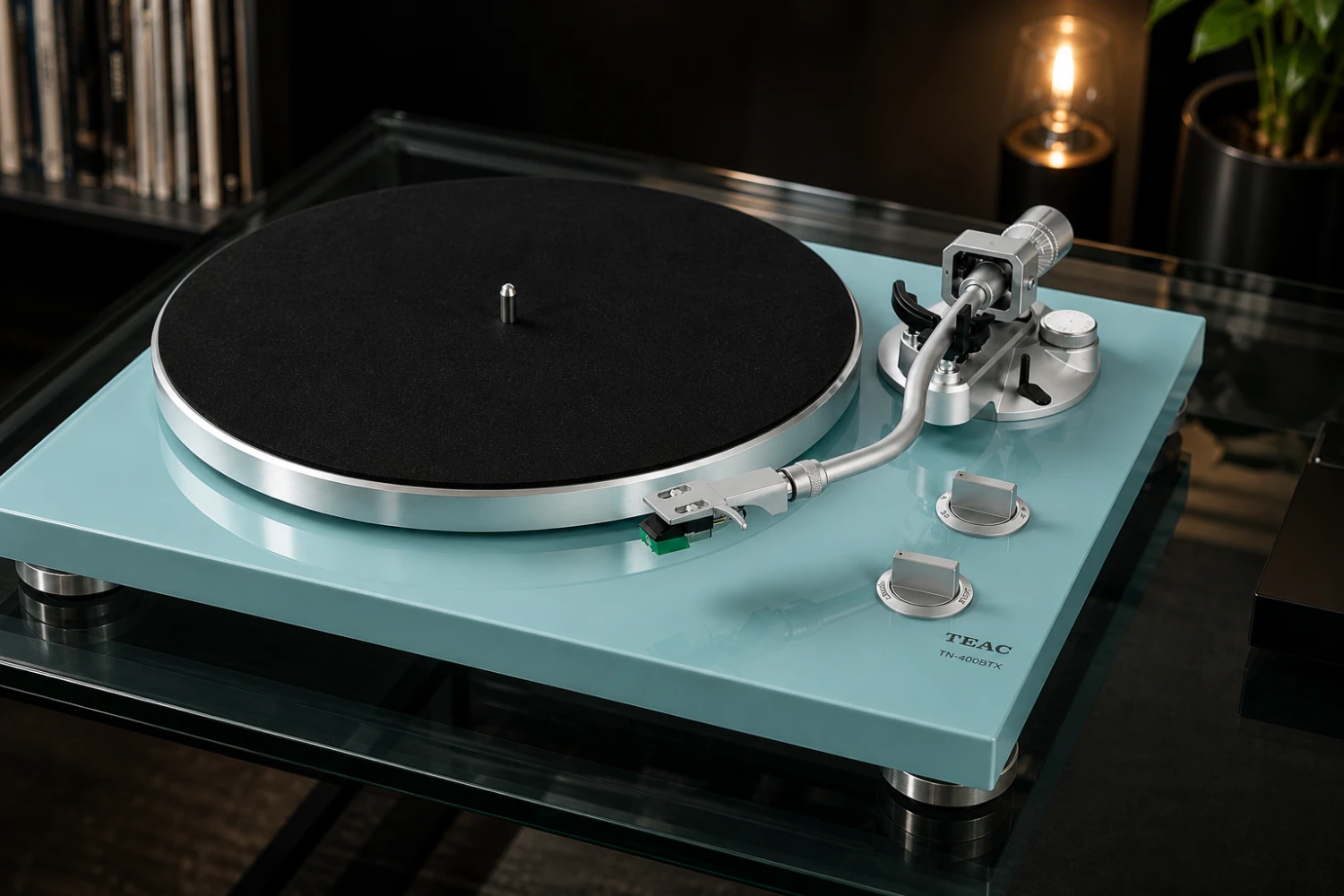
TEAC has introduced a limited-edition version of its TN-400BTX turntable, the TN-400BTX/TB, finished in high-gloss Turquoise Blue. Beneath that far less conventional exterior is a sensibly familiar turntable formula: belt drive, a cast-aluminium platter, an S-shaped statically balanced tonearm and a factory-fitted Audio-Technica AT95E cartridge.
The more significant point, however, is that the TN-400BTX/TB is not aimed solely at the traditional separate-box vinyl system. Its built-in, switchable phono stage permits direct use with suitable active speakers or a conventional amplifier, while Bluetooth transmission with aptX Adaptive support is intended to send records to compatible wireless speakers or headphones. For listeners who want a proper record-playing mechanism without making every listening session dependent on a full rack of hi-fi separates, that combination is the appeal.
A conventional vinyl platform, for good reason
The TN-400BTX/TB uses a belt-drive arrangement. In this layout, the motor drives the platter indirectly via a belt rather than being coupled directly to it. The practical objective is mechanical separation: motor vibration and cogging effects have less direct route into the platter, tonearm and ultimately the cartridge. That does not automatically make every belt-drive deck superior to every direct-drive design—implementation matters greatly—but it remains a well-established approach for a turntable intended to prioritise low mechanical noise and straightforward operation.
TEAC pairs the drive system with a high-mass cast-aluminium platter. Platter mass is useful because rotational inertia helps resist small speed disturbances once the platter is spinning. In vinyl replay, steady rotation matters because changes in speed are heard as pitch instability: sustained piano notes, vocals and synthesiser tones are particularly revealing. The draft does not provide a wow-and-flutter figure, so no conclusion can be drawn about the TN-400BTX/TB’s measured speed performance, but the platter’s mass is clearly part of TEAC’s strategy to promote stable rotation.

Cast aluminium is also a logical material choice in a product at this level. It allows a rigid, repeatable platter structure without the cost and weight of more exotic materials. The ultimate result depends on the bearing, motor control, belt and overall chassis design as much as platter material alone, and TEAC has not supplied further details on those areas here. Still, the specified drive architecture is recognisably focused on the fundamentals that affect record replay before any wireless feature enters the picture.
S-shaped arm and fitted AT95E cartridge: what the package means
The turntable is fitted with an S-shaped, statically balanced tonearm and arrives with an Audio-Technica AT95E cartridge installed. That is important in practical terms: a new vinyl listener is not faced with choosing a cartridge, mounting it in a headshell, aligning it and setting the arm before hearing a first record. Cartridge installation and alignment are valuable skills, but they can also be a substantial barrier for someone buying their first more serious deck.
An S-shaped arm is a familiar form in turntable design, particularly on decks using a detachable headshell-style approach, although TEAC has not detailed the headshell arrangement or arm geometry in the supplied information. The arm’s job is to let the stylus follow the record groove while maintaining the correct relationship between cartridge and groove. Its bearings, effective mass, geometry and adjustment provision all influence the final outcome; those specifications have not been published in this announcement.
“Statically balanced” refers to the way tracking force is established with the arm and counterweight rather than a spring-based force mechanism. In a properly set-up turntable, tracking force is not simply a convenience adjustment. It determines how securely the stylus sits in the groove: too little can lead to mistracking and distortion, while too much can increase record and stylus wear. Owners should therefore follow TEAC’s setup guidance for the fitted cartridge rather than assuming that an out-of-box installation requires no checks at all.

The supplied AT95E makes the TN-400BTX/TB a complete playback package rather than merely a turntable chassis. It should also be understood as the starting point of the analogue chain, not an immutable part of it. Cartridge upgrades can be a meaningful route to changing or improving a turntable system, but compatibility with the arm, available adjustment and TEAC’s own guidance would need to be confirmed before making any change. No upgrade path or arm compatibility specification has been announced for this limited-edition model.
Switchable phono stage broadens system options
A turntable cartridge does not produce the same type of signal as a CD player, streamer or DAC. Its output is very low, and records are cut with equalisation that must be reversed during playback. A phono stage provides the necessary gain and RIAA equalisation, turning the cartridge signal into one that an amplifier or active speakers can use.
TEAC includes that stage within the TN-400BTX/TB and makes it switchable. For a compact system, this is an especially useful inclusion. It enables connection to active loudspeakers or to an amplifier with a standard line-level input, avoiding the need for a separate phono preamplifier. That can make a record player, a pair of powered speakers and a few cables into a coherent vinyl system with relatively little complication.

The switchable arrangement also matters to owners of more conventional hi-fi systems. If an integrated amplifier already has a phono input, or if the owner prefers to use a separate phono stage, TEAC’s internal stage can be bypassed. This avoids putting two phono preamplification stages in series, which would be the wrong connection method and could overload the input. It also gives the deck a more plausible long-term place in a system that may develop over time.
TEAC has not specified the phono stage’s gain, loading options, noise performance or cartridge compatibility beyond the supplied moving-magnet AT95E package. Those details would be relevant for enthusiasts considering a cartridge change or comparing external phono stages. For the intended ready-to-play role, though, the key benefit is clear: users can begin simply, then move to external amplification if their system and priorities change.
Bluetooth vinyl is about convenience, not abandoning the record player
The TN-400BTX/TB can transmit its playback signal over Bluetooth to compatible speakers or headphones. This is a practical response to how many people now listen at home. A turntable need not be installed next to an amplifier, nor does the listening system have to be built around passive loudspeakers and a dedicated hi-fi rack. It may be possible to place the deck where records are stored and send sound to an existing compatible wireless speaker or headphone setup.
TEAC specifies aptX Adaptive support. In general, aptX Adaptive is a Bluetooth codec designed to vary its data rate according to connection conditions and content requirements, with the aim of balancing sound quality, robustness and latency. Both the transmitting turntable and receiving product need relevant compatibility for that codec to be used; otherwise Bluetooth devices normally fall back to a mutually supported connection method. As with all Bluetooth audio, the wireless transmission stage entails digital encoding after the analogue record signal has been amplified, so it is not the same signal path as using a wired analogue output.
That is not necessarily a contradiction. The direct wired route remains available for those building a conventional analogue system, while Bluetooth can be the more sensible option for convenience-led listening, secondary rooms, active speaker systems or headphones. What matters is choosing the connection method that suits the wider system rather than treating wireless and wired operation as competing ideologies.
The turntable can store up to eight paired devices. That is a genuinely useful ownership feature in a household where a pair of headphones, a main wireless speaker and another compatible device may all be used at different times. It should reduce the need to repeat the initial pairing process when changing setups, though prospective buyers should check TEAC’s operating instructions for the precise switching process and any limitations on simultaneous connections.
Turquoise Blue turns a familiar deck into a statement piece
Until now, the TN-400BTX has been offered in a classic walnut veneer. The TN-400BTX/TB replaces that restrained visual cue with a high-gloss Turquoise Blue lacquer finish. It is an unapologetically conspicuous alternative in a category dominated by black, silver and wood-effect finishes, and it makes sense for buyers who see a turntable as part of the room rather than equipment to hide in a cabinet.

Finish does not determine playback quality, but it can determine whether a turntable gets used. A record player is often left visible because operating it involves handling sleeves, cleaning records and cueing a side. A design that works with the furniture and the owner’s taste can be more inviting than an anonymous black box, especially in a living-room system rather than a dedicated listening room.
There is a practical trade-off to a high-gloss finish: it is likely to make dust, fingerprints and careless cleaning more conspicuous than a more matte or textured surface. Owners should use an appropriate soft cloth and avoid treating the plinth as a casual shelf for record sleeves or accessories. More broadly, the usual turntable installation rules still apply regardless of finish: put the deck on a firm, level support and keep it away from loudspeaker-borne vibration where possible. A stylus tracing a record groove is trying to recover extremely small movements, so unwanted vibration can become audible as low-frequency muddiness, feedback or unstable tracking.

Who the TN-400BTX/TB is for
The limited-edition TN-400BTX/TB is most compelling as a flexible, design-conscious vinyl source rather than a purist deck stripped of convenience features. Its essential appeal is the ability to begin with a modest system—perhaps compatible active speakers or Bluetooth headphones—without closing off a later move to a wired amplifier and external phono stage.
Its strengths, based on TEAC’s announced specification, are the complete fitted cartridge package, belt-driven platter system, built-in switchable phono stage, Bluetooth transmission and memory for eight paired devices. The Turquoise Blue finish gives the limited edition a distinct identity beyond a routine colour change. The unanswered questions are those that more technically minded buyers will want clarified before purchase: detailed tonearm adjustment, the phono stage’s electrical specifications, outputs, isolation provision and measured speed performance are not included in the supplied announcement.
That does not undermine the product’s purpose. Rather, it defines it. The TN-400BTX/TB is a turntable for someone who values traditional record replay hardware but wants it to fit into a current, possibly wireless, domestic audio setup. TEAC’s limited-edition finish simply ensures that this bridge between analogue playback and modern convenience will be difficult to overlook.