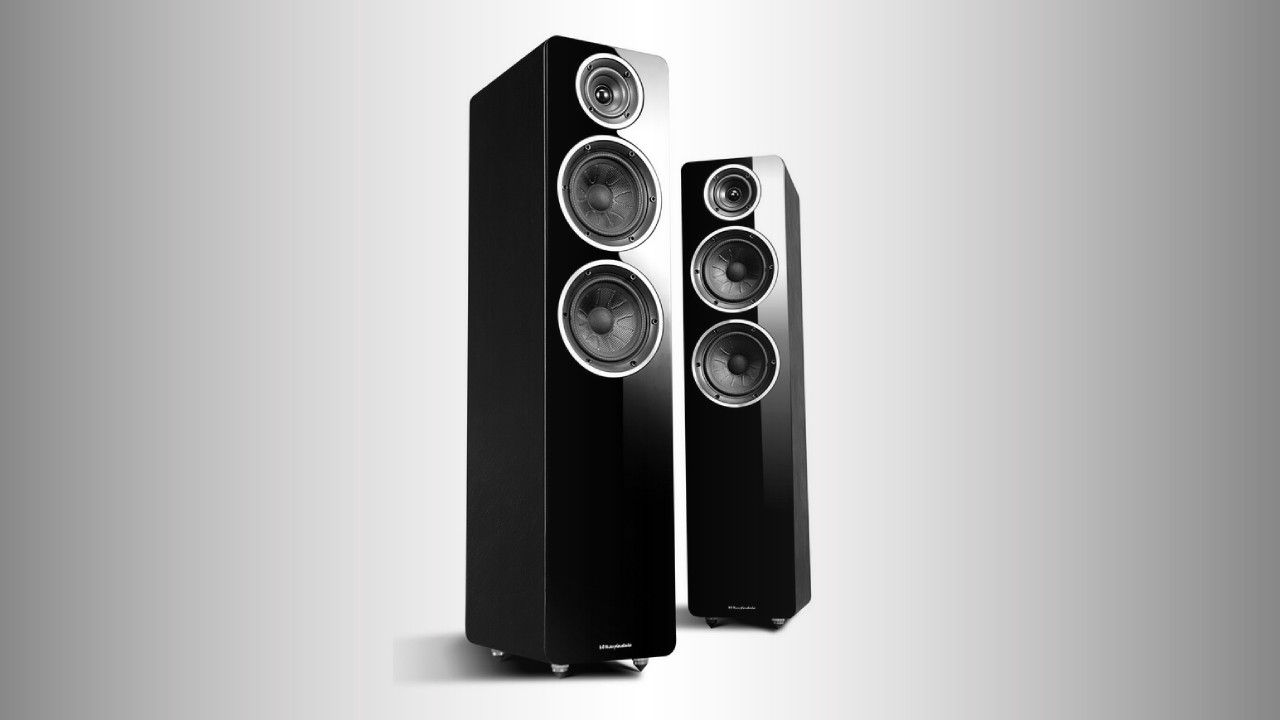
Wharfedale’s Diamond Active A2 takes a different route to the familiar compact stereo system. Rather than placing amplification in a central receiver and running conventional speaker cable to two passive loudspeakers, it builds amplification into the speakers themselves and uses the small Wharfedale H1 control unit as the source hub.
The result is a deliberately cable-light system: the H1 receives Bluetooth and wired sources, then sends audio to the speakers over a dedicated wireless link. Each of the three main components still requires mains power, so this is not a truly wire-free installation, but it avoids having to route speaker cable around a room. For listeners who want a proper left/right stereo layout without an amplifier rack or long visible cable runs, that is the central proposition.
An active-speaker system, not a conventional receiver package
The important distinction here is between active and passive loudspeakers. In a conventional stereo system, a single external integrated amplifier supplies a high-level amplified signal to passive speakers through speaker cable. The Diamond Active A2 instead places an amplifier section in each speaker. Wharfedale specifies 50W per speaker, or 100W across the stereo pair.
This architecture can have practical advantages beyond tidier installation. The amplifier is dedicated to the speaker it drives, with no long high-level cable between amplifier and cabinet. It also permits a more integrated amplifier/speaker design than an entirely mix-and-match passive system, although Wharfedale has not published detailed information on the A2’s amplifier topology, crossover implementation or load behaviour. Those are details worth confirming for anyone trying to compare it directly with separate active monitors or an integrated amplifier and passive speaker pair.
“Dual mono” is sometimes used broadly in marketing around systems with separated left- and right-channel amplification. In its strictest sense, it can imply highly independent channel circuitry and power supplies; here, the useful real-world point is simpler. Each loudspeaker has its own 50W amplifier and its own external power supply, rather than both channels sharing one conventional amplifier chassis.

The H1 hub handles sources, control and wireless transmission
The compact H1 unit is the operational centre of the system. It contains the Bluetooth receiver, provides the physical source connections, and transmits the selected audio signal to the speakers. This is a more flexible arrangement than putting Bluetooth and inputs on one speaker cabinet, particularly if the speakers are positioned well apart or are not easy to reach.
Its front-panel controls include volume adjustment and source selection, allowing the hub to handle everyday operation without immediately reaching for the supplied remote control. The draft compares its compact form to an Apple TV or Mac mini; that is a useful indication of its intended domestic role, although it should not be read as evidence of Apple-specific streaming integration. No Wi-Fi streaming, AirPlay, Chromecast, Roon or network-service support is specified in the supplied information.
Bluetooth is available, but it is not the speaker-to-speaker link
The H1 supports Bluetooth with aptX. aptX is a Bluetooth codec intended to offer higher-quality transmission than basic SBC when the sending device also supports it. Compatibility therefore matters: a phone, tablet or computer that does not support aptX will use another mutually supported Bluetooth codec instead. Bluetooth remains an easy way to play from a mobile device, but it is not a substitute for a full network-streaming platform with app-based access to services and local music libraries.
Crucially, Bluetooth is used between the source device and the H1 controller, not directly from the source to each loudspeaker. The H1 then relays audio to the speakers using Wharfedale’s dedicated radio connection. Separating those jobs lets the wireless speaker link be optimised for the system rather than relying on ordinary Bluetooth’s limited range and device-to-device pairing model.
Wired digital and analogue inputs preserve source flexibility
For physical sources, the H1 provides optical and coaxial S/PDIF digital inputs plus a stereo RCA analogue input. That covers the most obvious uses: a television or games console with an optical output, a CD transport or other digital source through coaxial S/PDIF, and an analogue line-level component via RCA.
The stated digital processing limit is 24-bit/96kHz. In practical terms, that is sufficient for CD-quality material and a large proportion of high-resolution PCM content, but it is not a specification aimed at owners who require playback of 176.4kHz, 192kHz or DSD files through the H1’s digital inputs. The supplied information does not identify the DAC chip, digital filters or the exact signal path taken by the RCA input, so it would be premature to draw more detailed conclusions about conversion or analogue handling.
There is also an important analogue-system caveat. The RCA sockets are described as a standard analogue input; no phono stage is specified. A turntable will therefore need its own phono preamplifier, either built into the deck or used as a separate component, before it can be connected safely to the H1.

Wireless placement: useful freedom, but not freedom from setup
Wharfedale states that the H1 can communicate with the speakers over a 5.8GHz radio channel at distances of up to 20 metres. That is potentially useful in rooms where running speaker cable beneath floors, around doorways or along skirting boards would be inconvenient. It also means the hub can sit close to the television or source equipment while the speakers occupy more conventional stereo positions.
The supplied draft also describes the operating range as “5.2–5.8 MHz”, which conflicts with the earlier 5.8GHz description and is almost certainly a unit discrepancy in the source material. Because radio-band details affect interference expectations and regional compliance, prospective buyers should seek confirmation of the exact operating band from Wharfedale or a dealer rather than treating that MHz figure as definitive.
A dedicated 5GHz-class connection is generally preferable to sharing the crowded 2.4GHz band used by many domestic wireless devices, but no wireless system is entirely exempt from its room environment. Walls, dense construction, nearby wireless equipment and placement of the hub can all affect radio performance. The claimed 20-metre figure is best regarded as a maximum operating distance rather than a reason to place the H1 at the far end of a challenging property. A straightforward line through an ordinary living room should be the easier installation case.
The system is also said to offer a two-room option in which each speaker can be switched to mono and used to cover a separate area. That could be handy for casual background listening, though it is fundamentally different from stereo playback: stereo depends on both speakers reproducing their respective channels in the same listening space, at comparable distances from the listener.
Cabinet, drivers and placement considerations
The Diamond Active A2 uses a two-way arrangement with a Kevlar-fibre-cone bass/midrange driver and a fabric-dome tweeter. Kevlar has long been associated with light, stiff diaphragm construction; in general, the aim is to maintain controlled piston-like motion over the driver’s working range. A fabric dome is a common tweeter choice for smooth, controlled high-frequency dispersion. Neither material alone determines how a speaker will sound, however: the motor system, crossover, cabinet and final voicing are at least as consequential.
Wharfedale places the tweeter in a recess, described in the draft as creating a horn effect. More cautiously, a shaped recess or waveguide can influence dispersion and the way a tweeter integrates with the bass/midrange driver around the crossover region. The supplied material does not give crossover frequency or dispersion measurements, so those specific outcomes cannot be verified here.
The enclosure is bass reflex loaded, with ports at the rear. Rear porting makes placement more important than it would be with a sealed cabinet: placing the speakers extremely close to a rear wall can reinforce upper bass and make the result heavier or less even in some rooms. Start with a little space behind each cabinet where possible, keep the two speakers similarly placed relative to nearby boundaries, and adjust gradually. As with any stereo pair, equal-ish distances to the main listening position and sensible toe-in are likely to matter more than the novelty of the wireless link.
The supplied description refers to the speakers as compact or bookshelf-style cabinets, despite the original headline’s floorstanding wording. It also later mentions an “A2 model” with full-size floorstanding speakers, which is internally inconsistent. On the available information, the safer description is a compact active speaker system; buyers should confirm the exact cabinet format and model designation with the retailer before ordering.

Who the Diamond Active A2 system makes sense for
The Diamond Active A2 appears best suited to someone who values a simplified, self-contained stereo system but does not want to rely solely on Bluetooth. Its optical, coaxial and RCA inputs make it more adaptable than a basic wireless speaker, while the separate H1 hub avoids the usual compromise of locating all source equipment beside one loudspeaker.
It may be especially appealing in a living room where speaker-cable routing is the principal barrier to installing proper stereo separation. The individual powered speakers can be positioned for imaging rather than dictated by where an amplifier happens to sit, while the H1 remains close to a television, disc player or other source.
There are trade-offs. The design is a system rather than an open-ended separates platform: the amplification is integral to the speakers, and no subwoofer output, pre-out, HDMI/eARC input or network-streaming capability is specified in the available material. Those wanting to add a subwoofer, integrate modern TV control via HDMI, or stream directly from Qobuz, Tidal or a Roon library should establish whether an external solution is needed before buying.
Equally, 50W per speaker is a power rating, not a complete prediction of maximum loudness or bass authority. Speaker sensitivity, impedance behaviour, room size and listening distance all influence the result, and none of those further figures is supplied here. The rear-ported two-way configuration points to a compact, domestically practical stereo solution rather than a substitute for large floorstanders in a big room.
The key appeal is integration, not the absence of cables
The most persuasive idea behind Wharfedale’s Diamond Active A2 is not that it eliminates every cable—it does not, since each speaker and the H1 need power—but that it relocates the complexity of a conventional system. Source switching, Bluetooth reception and digital inputs live in a small hub; amplification lives close to each loudspeaker; and the long speaker-cable run disappears.
That makes the A2 an interesting middle ground between traditional hi-fi separates and one-box wireless speakers. Its published connectivity is broad enough for televisions, digital transports and analogue line-level sources, while its 24-bit/96kHz processing and aptX Bluetooth set clear limits on the digital feature set. The remaining questions—particularly the inconsistent cabinet/model description and the precise wireless-band specification—are worth resolving with Wharfedale before purchase, but the underlying system concept is clear: proper two-speaker stereo with less visible infrastructure.