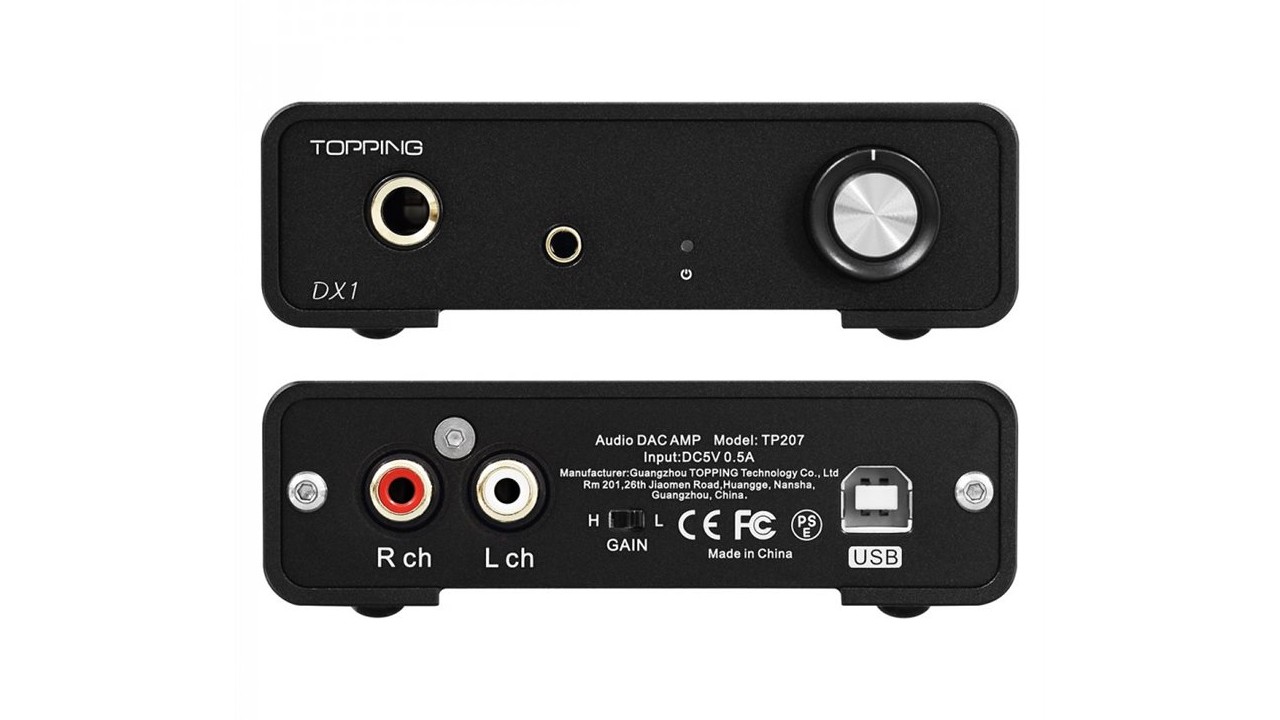
Topping has introduced the DX1, a compact USB DAC and headphone amplifier aimed at listeners who want to improve on a computer’s built-in audio without assembling a stack of separate components. Priced at $99, the DX1 combines an AKM AK4493S digital-to-analogue converter, XMOS XU208 USB interface, two front-panel headphone socket formats and a fixed-level RCA output for use with an external amplifier or powered speakers.
That combination matters because a small desktop DAC/headphone amplifier can solve two distinct problems in a music system. First, it takes digital audio processing and conversion away from the electrically noisy environment and often modest analogue circuitry of a laptop or desktop PC. Second, it provides a dedicated analogue output stage intended to drive headphones with more control and lower noise than a typical computer socket. The DX1 is a deliberately straightforward, USB-centred design rather than an all-in-one streamer or a traditional integrated amplifier, but its connectivity gives it a credible place at the front of a compact two-channel setup.

USB power treatment is central to the DX1’s design
The DX1 uses Topping’s discrete LNRD, or Low Noise Reference Driver, circuit. According to Topping, this is used to filter noise and interference associated with the USB power supply before it reaches the audio circuitry. USB is convenient because a single cable can carry both music data and power, but the same connection can also expose a compact DAC to switching noise from a computer or other host device. Managing that supply cleanly is therefore an important engineering consideration in bus-powered digital audio equipment.
The point is not that USB itself is unsuitable for hi-fi use; it is a mature interface capable of carrying high-resolution audio reliably. Rather, a DAC’s power regulation, grounding and analogue-stage implementation influence how well it rejects unwanted electrical noise from its surroundings. Topping says the LNRD circuit gives the DX1’s audio section a cleaner, more stable electrical supply. As with any such claim, the practical result will depend on the whole system, including the computer, USB connection and headphones in use, but the inclusion of a dedicated noise-management stage is more meaningful than treating USB power as an afterthought.
The unit measures 100 x 98 x 32mm, so it should occupy little more desk space than a small external drive. It is offered in black or silver. This is the sort of footprint that makes sense beside a laptop, under a monitor or alongside a pair of active desktop speakers, where a full-width hi-fi component would be impractical.

AKM AK4493S conversion and XMOS USB input
At the digital heart of the DX1 is AKM’s AK4493S DAC chip. The AKM device converts incoming digital PCM or DSD data into the analogue signal subsequently sent to the headphone amplifier and RCA line output. Topping partners it with an XMOS XU208 USB interface, a widely used USB-audio controller platform that handles communication between a computer and the DAC.
Via its sole USB-B input, the DX1 supports PCM up to 32-bit/384kHz and native DSD up to DSD256. It also accepts DSD over PCM (DoP) up to DSD128. These figures confirm compatibility with high-resolution music files and suitably configured playback software. They should not, however, be read as a guarantee of better sound simply because a file has a higher sample rate: the recording and mastering quality, playback chain and headphone or loudspeaker performance remain more consequential. The practical advantage is broad format headroom for owners of high-resolution download libraries and software players capable of native DSD output.
For conventional CD-quality music, which is 16-bit/44.1kHz PCM, the DX1’s stated DAC performance at a 44.1kHz USB input provides useful context. Topping specifies THD+N of 0.0002% at 1kHz, A-weighted, alongside a 120dB signal-to-noise ratio and 120dB dynamic range, both A-weighted at 1kHz. In simple terms, these are very low distortion and noise figures on paper. Signal-to-noise ratio describes the separation between the wanted signal and the background noise floor; dynamic range similarly indicates the span between the quietest reproducible information and maximum signal. A 120dB figure suggests that the converter electronics should not be the obvious limiting factor in a modest desktop system.
Topping also quotes DAC frequency response of 20Hz–20kHz within ±0.3dB, extending to 40kHz within ±0.7dB. The first figure covers the broadly accepted audible frequency range and indicates close level consistency across it. The specified 2.0Vrms output level at 0dBFS is the conventional line-level voltage expected by many integrated amplifiers, preamplifiers and active speakers with analogue inputs.

Headphone stage: power, gain and load matching
The DX1 provides both 3.5mm and 6.35mm headphone outputs, avoiding the immediate need for an adapter whether your headphones use a portable-style mini-jack plug or the larger connector common on many home hi-fi models. The manufacturer specifies output power of 2 x 280mW into 32 ohms at 0.1% THD+N, 2 x 190mW into 64 ohms, and 2 x 51mW into 300 ohms, again at 0.1% THD+N. The stated minimum load impedance is greater than 8 ohms.
Those power figures need to be read alongside headphone sensitivity, which is not supplied here. Impedance alone does not establish how loudly a headphone will play: two headphones with the same nominal impedance can require substantially different voltage or current depending on their sensitivity. Still, the figures give useful guidance. The DX1 offers its greatest rated power into 32-ohm headphones, a common nominal impedance among portable and closed-back designs, while the 300-ohm rating shows that it can provide usable voltage for many higher-impedance dynamic headphones as well.
Its 0.5-ohm specified headphone output impedance is particularly relevant for matching. A low output impedance helps the amplifier maintain a more consistent frequency response with headphones whose impedance varies across the audible band, and it avoids giving the headphone’s electrical load too much influence over the amplifier. This is generally desirable, especially with low-impedance headphones and many in-ear monitors. Topping specifies 1.0µVrms A-weighted noise, which is a promisingly low figure on paper for sensitive headphones, although the ultimate suitability for a particular IEM will also depend on its sensitivity and how much residual noise is audible in real use.
Two gain settings are provided: -2dB (Vrms/FS) in low gain and 12dB (Vrms/FS) in high gain. Gain does not create extra recording detail, but it determines how much the amplifier increases the voltage from the DAC stage. Low gain gives more usable travel on the volume control with sensitive headphones; high gain is intended for headphones requiring more voltage. Choosing the lowest gain that reaches a comfortable maximum listening level is usually the sensible approach, as it offers finer volume adjustment and can minimise audible background noise with highly sensitive designs.
For the headphone output, Topping quotes THD+N at 1kHz of 0.0003% at 200mW into 32 ohms and 0.0002% at 45mW into 300 ohms, both A-weighted. Its stated headphone-stage signal-to-noise ratio and dynamic range are each 118dB at 1kHz, A-weighted, with crosstalk of -86dB at 1kHz. Crosstalk describes unwanted leakage of one stereo channel into the other; lower, more negative values indicate better channel separation. These specifications indicate an emphasis on measured cleanliness, though they do not substitute for matching the unit to the headphones and listening preferences of an individual buyer.
Fixed RCA output for a simple desktop system
In addition to headphone listening, the DX1 has a stereo RCA line output specified as fixed volume. This allows it to function as a USB DAC feeding an integrated amplifier, an analogue-input-equipped active speaker pair, or a preamplifier with spare line inputs. Fixed output means the RCA level is not intended to be controlled by the DX1’s volume control, so downstream volume control is essential. It is not, on the supplied information, a variable-output DAC intended to connect directly to a power amplifier.
This distinction is important when planning a system. With active speakers that have their own volume adjustment, the DX1 can be a neat USB source. With an integrated amplifier, connect it to an ordinary line-level input rather than a phono input; phono inputs apply substantial gain and equalisation intended solely for turntables. Owners wanting a one-box desktop preamp with remote-controlled volume, multiple digital inputs, Bluetooth or network streaming will need to look beyond the DX1’s more focused specification.
The published DAC output level is 2.0Vrms at 0dBFS, while the specification list states a 22-ohm output impedance. Because the supplied information does not explicitly identify that figure as applying to the RCA line stage, it is best treated as Topping’s published output-impedance specification rather than assuming further implementation details. In any event, RCA interconnects should be kept sensibly short in a desktop system and connected to a conventional high-impedance line input.
Key specifications
- Product type: USB DAC and headphone amplifier
- DAC chip: AKM AK4493S
- USB interface: XMOS XU208
- Input: 1 x USB-B
- Outputs: fixed stereo RCA line out; 3.5mm headphone output; 6.35mm headphone output
- Supported formats: PCM up to 32-bit/384kHz; native DSD up to DSD256; DoP up to DSD128
- DAC THD+N: 0.0002% at 1kHz, A-weighted (USB input at 44.1kHz)
- DAC SNR/dynamic range: 120dB, A-weighted at 1kHz
- DAC frequency response: 20Hz–20kHz, ±0.3dB; 20Hz–40kHz, ±0.7dB
- Headphone power: 2 x 280mW at 32 ohms; 2 x 190mW at 64 ohms; 2 x 51mW at 300 ohms, all at 0.1% THD+N
- Headphone gain: -2dB low gain; 12dB high gain
- Headphone output impedance: 0.5 ohm
- Dimensions: 100 x 98 x 32mm
- Finish: black or silver
- Price: $99
Who is the Topping DX1 for?
The DX1’s appeal is its focus. It is a compact computer-audio front end with a conventional line output and a headphone stage offering both common plug sizes, low stated output impedance and switchable gain. It looks most naturally suited to a listener moving from a laptop or desktop headphone socket to dedicated conversion and amplification, or to someone building a clean desktop arrangement around analogue-input active speakers.
Its trade-offs are equally clear. There is only one digital input, USB-B, and no stated wireless, network, optical, coaxial or balanced connectivity. The RCA output is fixed rather than variable. These are not flaws if the intended source is a computer and the rest of the system already has volume control, but they define the DX1 as a specialist desktop component rather than a universal digital hub. For $99, the combination of AKM conversion, XMOS USB support and stated headphone power makes the Topping DX1 a technically well-specified entry point into dedicated headphone and desktop hi-fi.