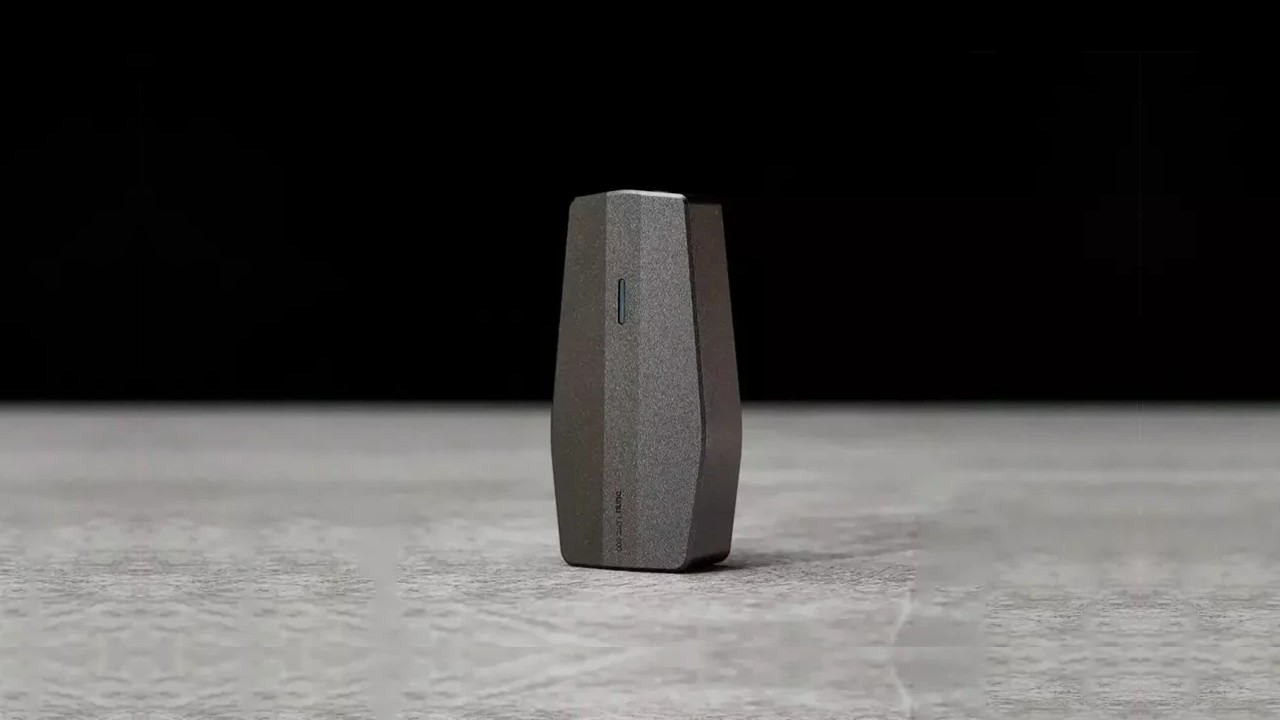
DUNU has introduced the DTC-800, a portable USB DAC and headphone amplifier positioned as the company’s third device in this category. At $98.99, it brings a notably ambitious component list to the compact dongle-DAC format: a dual-mono-style DAC arrangement using two Cirrus Logic CS43198 chips, two SGM8262 operational amplifiers in its headphone amplification section, 3.5mm single-ended and 4.4mm balanced headphone outputs, and support for PCM up to 32-bit/384kHz plus native DSD256.
That combination matters because portable DAC/amps are often asked to do two jobs at once. They must replace the basic audio hardware in a phone, tablet or computer with a higher-quality conversion and amplification stage, while remaining small enough to live in a pocket or travel bag. The DTC-800’s specification suggests DUNU is aiming beyond the most basic USB audio adapter, particularly for owners of higher-resolution music libraries and headphones or earphones terminated in 4.4mm balanced plugs.
A dual-DAC architecture in a 20g portable device
At the centre of the DTC-800 are two Cirrus Logic CS43198 DAC chips, with one chip assigned to each audio channel. A DAC, or digital-to-analogue converter, is the stage that turns the numerical data in a music file or stream into the analogue signal an amplifier can send to headphones. In a dual-chip implementation such as this, each channel has its own conversion hardware rather than sharing a single stereo DAC chip.
The potential attraction of this arrangement is channel independence: the left and right channels can be processed separately before reaching the analogue amplification stage. However, the presence of two DAC chips alone does not reveal every aspect of the finished design. The quality of a portable DAC/amp also depends on its power supply, analogue-stage layout, output implementation and firmware, none of which DUNU has detailed here. It is nevertheless a more elaborate approach than the single-DAC architecture commonly found in entry-level dongles.
DUNU specifies PCM decoding to 32-bit/384kHz. PCM is the standard digital-audio format used for the overwhelming majority of music, encompassing CD-quality 16-bit/44.1kHz material as well as higher-resolution downloads. The 384kHz ceiling is far beyond the resolution required for ordinary CD and most streaming use, but it gives the DTC-800 compatibility headroom for a wide range of high-resolution PCM files.
The unit also supports native DSD256. DSD is a different encoding method from PCM and is most often encountered in specialist download libraries rather than mainstream music services. “Native” support ordinarily means that a compatible source can pass the DSD data to the DAC without first converting it to PCM. Whether a particular phone, computer, player app or operating system can make use of that path is dependent on the source device, its USB-audio support and playback software, so prospective buyers using DSD should verify their complete playback chain rather than treating the DAC specification in isolation.

Amplification: what the 450mW figure does—and does not—tell us
Conversion is only one half of the DTC-800’s role. DUNU has paired the dual DAC section with two SGM8262 operational amplifiers, described as independent op-amps. In portable audio hardware, op-amps are commonly used in the analogue gain and output stages, where they provide the voltage and current needed to drive the headphone load after conversion.
The headline output figure is up to 450mW into 32 ohms. Thirty-two ohms is a common nominal impedance for portable headphones and many in-ear monitors, making it a useful reference point for the kind of load a dongle DAC is likely to encounter. In practical terms, a higher available power rating can provide more volume headroom for less-sensitive headphones and can reduce the likelihood of operating near the device’s limits during dynamic musical peaks.
Power is not, however, a complete guide to headphone compatibility. Headphone sensitivity is at least as important as impedance: two 32-ohm models can need very different amounts of drive for the same listening level. High-impedance headphones often demand more voltage swing, while low-impedance designs can place greater current demands on an amplifier. DUNU has not published separate output-power figures for the 3.5mm and 4.4mm sockets, nor maximum voltage, gain settings, output impedance or supported headphone impedance range. Those details would be needed to make a precise assessment of how the DTC-800 will behave with a particular full-size headphone.
For sensitive in-ear monitors, the relevant ownership questions are somewhat different. Ample power is useful, but low noise at the listening position, controlled volume adjustment and sensible gain are equally important. The DTC-800 includes physical volume buttons, which should be more convenient than relying solely on a phone’s touchscreen volume control when the device is connected on the move. DUNU has not stated whether its volume control is implemented in the digital or analogue domain, or how many adjustment steps it provides.
3.5mm and 4.4mm outputs: connection choice before buying
The DTC-800 provides two headphone connections: a conventional 3.5mm unbalanced output and a 4.4mm balanced output. The 3.5mm socket is the straightforward choice for the vast number of headphones and IEMs supplied with a standard stereo mini-jack plug.
The 4.4mm Pentaconn-style connection is increasingly common among higher-end portable headphones and detachable-cable IEMs. In a balanced headphone connection, the left and right channels are carried on separate positive and negative conductors rather than sharing a common return. This can allow an amplifier designed for balanced operation to offer a different output configuration and, in some designs, greater available power. It is not inherently a guarantee of better sound; the quality of the individual amplifier circuits, the headphone itself and the source material remain decisive.
It is also important not to use a simple passive adapter to connect a conventional 3.5mm headphone plug to a balanced output unless the manufacturer explicitly approves it. The wiring schemes are different, and an inappropriate adapter may connect conductors in a way the balanced output was not designed to accommodate. Buyers should use a properly terminated 4.4mm balanced cable where they wish to use that socket, and otherwise select the 3.5mm connection.

Portable construction and everyday indicators
DUNU says the DTC-800 is CNC-machined from aluminium alloy and weighs 20g. CNC machining is a process in which the enclosure is cut from metal under computer control, allowing tighter shaping and a more substantial chassis than a simple moulded plastic housing. For a portable DAC/amp, an aluminium body can offer useful physical protection and help dissipate the small amount of heat generated by the electronics, although DUNU has not provided operating-temperature information.
The low 20g weight is significant because a dongle DAC remains attached to the source device in use. A heavy unit can put strain on a phone connection or swing against the handset while walking; a lighter one is easier to accommodate in a short cable-and-phone arrangement. The trade-off, as with most compact USB-powered devices, is that installation details matter. The draft does not specify the DTC-800’s USB connector, supplied cable, power consumption or compatibility with particular mobile operating systems, so those points should be checked by anyone planning to use it with a specific handset.
A multi-colour LED indicates the bit rate of the material being played. This is useful as a quick confirmation that the DAC is receiving a signal and that a source has switched to the expected format family or resolution. It should not be mistaken for a verdict on sound quality: a high-resolution indicator confirms the incoming data rate, not the quality of the recording, mastering or playback setup. Still, it is a practical feature for listeners who switch between local high-resolution files, CD-quality services and different playback applications.

Where the DTC-800 fits in a portable system
The DTC-800 makes most sense for listeners whose phone, tablet or computer either lacks a headphone output or has an output that is not powerful enough for their preferred headphones. It is also a plausible upgrade for owners of balanced-cable IEMs who want a compact source with a 4.4mm socket rather than carrying a larger battery-powered portable amplifier.
Its feature set is particularly relevant to a two-headphone household or collection: the 3.5mm output preserves compatibility with everyday wired headphones, while the 4.4mm output accommodates the growing number of balanced portable cables. The physical volume controls are a welcome practical addition for mobile use, and the LED provides immediate format feedback without requiring an app interface.
There are limits to what can be concluded from the published information. DUNU has not stated the precise USB interface, whether the device has a line output mode, the output power of each socket individually, or the format behaviour of its digital input beyond PCM and DSD limits. Nor are there figures for noise, distortion or channel separation. Those omissions do not invalidate the DTC-800’s component specification, but they mean buyers with unusually demanding headphones, extremely sensitive IEMs or a specific desktop integration requirement should seek those details before purchase.
For $98.99, the DUNU DTC-800 presents a well-targeted portable DAC/amp proposition: dual CS43198 conversion, a dedicated op-amp output stage, high-resolution PCM and DSD256 compatibility, and both major portable headphone connection types in a 20g aluminium chassis. It is now available at its recommended retail price of $98.99.