Bluesound has announced the Pulse Sub Plus, a compact wireless subwoofer designed to bring more convincing low-frequency extension to compatible Bluesound systems. Priced at €849 and due at the end of October, it replaces the company’s 6-inch Pulse Sub with a larger 8-inch long-throw woofer and a 150W Smart Amplifier.
Those changes matter because a subwoofer’s usefulness is not simply about making bass louder. In a well-integrated system, it takes responsibility for the lowest octave and the upper-bass region where appropriate, allowing a soundbar or compact wireless speaker to work within a more comfortable range. The potential gains are greater scale with films, more physical impact from effects and, with music, a more complete foundation for bass guitar, kick drum, double bass and electronic low-end.
Bluesound places particular emphasis on use with its Sound Bar, so the Pulse Sub Plus is clearly aimed at users building a neat, cable-light TV and music system rather than a conventional separates-based AV installation. However, the company says it can in principle be connected to a range of Bluesound products, making it a possible upgrade for compatible multi-room and powered-speaker setups as well.

An 8-inch long-throw driver is a meaningful step up
The Pulse Sub Plus uses an 8-inch long-throw woofer, up from the 6-inch driver used in the earlier Pulse Sub. Driver diameter is only one part of subwoofer performance, but the increase is significant in practical terms. A larger cone has more surface area with which to move air, while a long-throw design is intended to permit substantial forward-and-back excursion. Together, those qualities can help a compact subwoofer generate useful low-bass output without asking a small driver to operate at the edge of its mechanical limits.
Bluesound specifies bass response down to 22Hz. That figure reaches into the lowest audible bass region: the area that gives cinema soundtracks their sense of room pressurisation and lends large-scale recordings a greater impression of depth. It is worth treating any single low-frequency extension number with the usual care, as in-room bass response depends heavily on placement, room dimensions and the measurement conditions used. Nevertheless, 22Hz indicates that Bluesound is targeting genuinely deep bass rather than merely reinforcing the upper bass.
The 150W Smart Amplifier and DSP are central to that objective. In active subwoofers, DSP can be used to shape the driver’s response, manage output at very low frequencies and protect the woofer and amplifier when demanding material is played. This is particularly valuable in a discreet enclosure: deep bass requires moving considerable volumes of air, and electronic control can help a small cabinet and driver operate more predictably than an entirely passive design would allow.
Bluesound has not detailed the enclosure alignment, driver material, maximum output, crossover range or distortion performance in the supplied information. Those are all specifications that would help establish how the Pulse Sub Plus compares with conventional wired subwoofers at this price. Equally, no listening assessment should be inferred from the specification alone. What is clear is that its engineering brief is more ambitious than that of the outgoing 6-inch model, with deeper claimed extension and a larger driver intended to provide greater low-frequency authority.
Wireless integration, with placement freedom and room-acoustic caveats
The Pulse Sub Plus is described as wireless apart from its mains connection. That is a major convenience benefit in a living-room system, where running a signal cable across the floor can make adding a subwoofer impractical. It should allow owners to position the unit independently of the main speakers or soundbar, provided a power outlet is available.
That freedom is useful because the visually obvious position is not always the acoustically best one. Low frequencies interact strongly with room boundaries. Placing a subwoofer close to a wall or in a corner usually increases bass output, but can also exaggerate certain frequencies; a position away from boundaries can sound cleaner but may sacrifice some level. Seating location is equally important, as room modes can cause one chair to receive excessive bass while another is left with a noticeable dip.
For a soundbar installation, the first sensible position is often near the front wall, but not necessarily directly beneath the screen. If a room sounds boomy, moving the subwoofer even a modest distance can have a bigger effect than making broad EQ adjustments. Conversely, a carefully placed sub can make the entire system sound more even and less strained, rather than simply more bass-heavy.
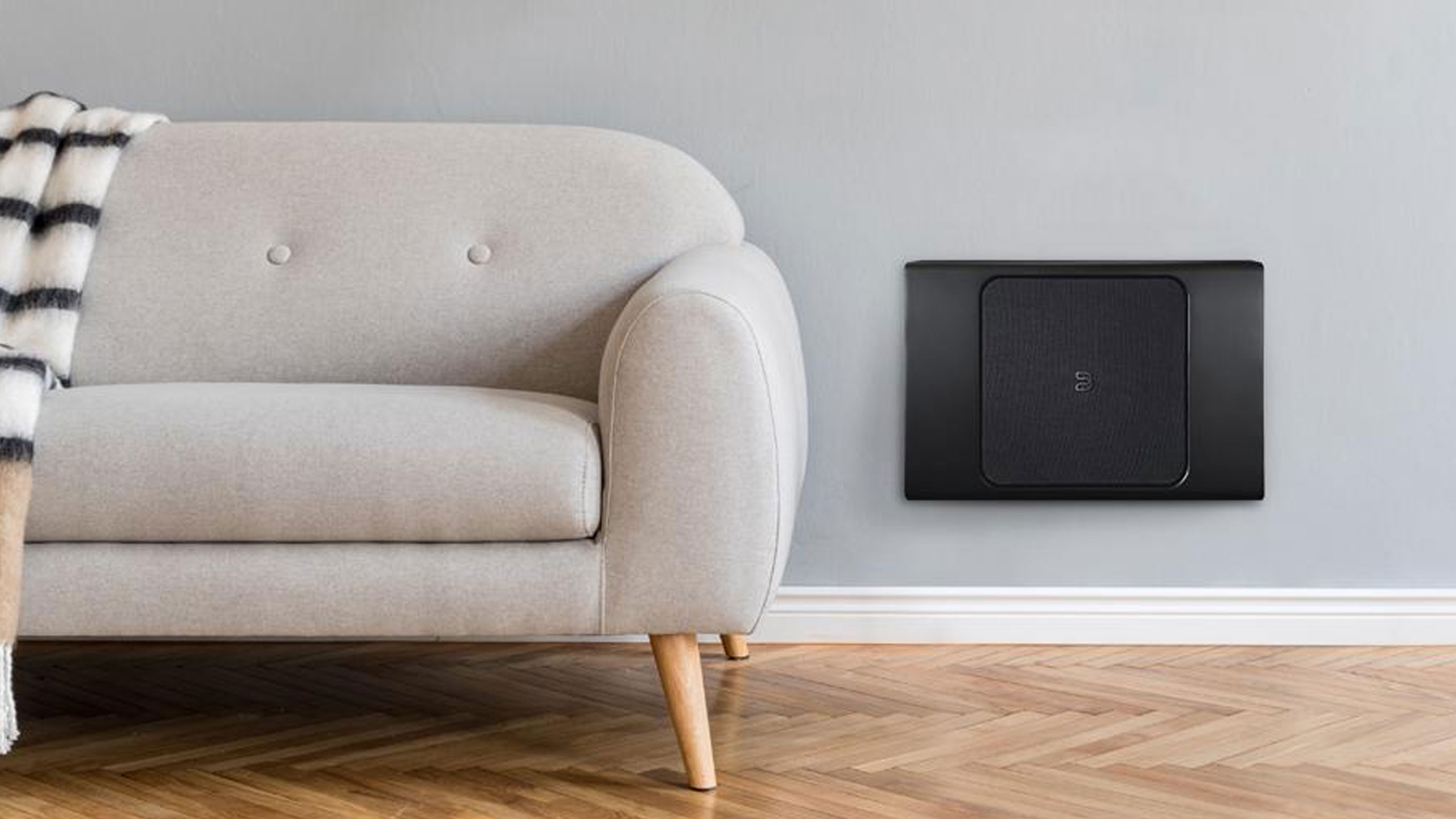
Bluesound says the Pulse Sub Plus can be placed beneath a sofa or cabinet, which is useful where a conventional subwoofer would dominate the room. It can also be wall-mounted for installations where floor space is limited. Either approach needs a degree of practical judgement. A subwoofer should not be enclosed in a way that blocks any cabinet openings or causes furniture to rattle, and a wall installation should use an appropriately secure mounting solution. Deep bass transfers energy into nearby surfaces, so furniture, ornaments and loose panels may need attention even in an otherwise tidy system.
BlueOS setup and the case for two subs
Initial setup and sound optimisation are handled through Bluesound’s BlueOS app. This is an important part of the product’s proposition: in an integrated wireless system, configuration should be less intimidating than manually setting crossover and level controls on the rear panel of a traditional subwoofer.
The supplied details do not specify which parameters BlueOS exposes for the Pulse Sub Plus, nor do they describe any automatic room-correction process. Prospective buyers should therefore confirm the exact controls available with their particular Bluesound component. In broad terms, proper integration requires the subwoofer level, crossover behaviour and timing relationship with the main speaker system to be managed carefully. A sub set too high can draw attention to itself and make voices sound thick; too low, and it will fail to deliver the intended scale. Good subwoofer integration is generally noticed as a more convincing whole rather than as a separate source of bass.
The BlueOS app also supports the addition and optimisation of two Pulse Sub Plus units. A dual-sub arrangement is not only for listeners who want greater maximum bass output. Two subs placed in different positions can help smooth room-related peaks and dips across a wider listening area, often making bass more consistent from seat to seat. This can be especially valuable in an open-plan room or a shared home-cinema space where more than one person is watching.
There are practical trade-offs, of course. A second subwoofer doubles the expenditure and requires another mains socket, while successful dual-sub deployment still benefits from considered placement. But the option makes sense within Bluesound’s ecosystem: an owner could start with one Pulse Sub Plus for a Sound Bar-based system, then add a second later if the room or listening habits justify it.
Where the Pulse Sub Plus fits in a Bluesound system
The Pulse Sub Plus is primarily a system product rather than a universal analogue subwoofer in the traditional hi-fi sense. Its appeal lies in its promised wireless connection and app-led setup with compatible Bluesound equipment. That makes it particularly relevant to buyers who already have a Bluesound Sound Bar or are assembling a discreet multi-room system and want deeper bass without introducing a separate AV receiver, long signal leads or a rack of electronics.
For film and television, the expected benefit is more convincing weight from action sequences, orchestral scores and effects that a slim soundbar cannot physically reproduce on its own. For music, the advantage can be subtler but no less worthwhile: small speakers commonly lose output as notes descend, so a correctly blended subwoofer can restore the sense of scale and rhythmic underpinning that is missing from compact cabinets.
Its compact format, availability in black or white and ability to be hidden or wall-mounted all reinforce that lifestyle-friendly positioning. At €849, however, it will also need to be judged on the depth and control of its integration within the Bluesound platform, not simply its neat appearance. Buyers with a conventional stereo amplifier, passive loudspeakers and a wired subwoofer output should check compatibility before assuming the Pulse Sub Plus will suit their system; the supplied information focuses on Bluesound product integration rather than detailing conventional wired inputs or outputs.
Price and availability
The Bluesound Pulse Sub Plus will be available from the end of October through dealers carrying Bluesound products. It costs €849 and will be offered in black and white.
For existing Bluesound owners seeking more substantial bass than the previous 6-inch Pulse Sub can provide, the combination of an 8-inch long-throw woofer, 150W amplification, DSP and a claimed 22Hz low-frequency reach makes this a potentially meaningful upgrade. The key questions for buyers will be compatibility with their existing component, the configuration options offered in BlueOS and, as ever with subwoofers, whether their room can accommodate thoughtful placement.