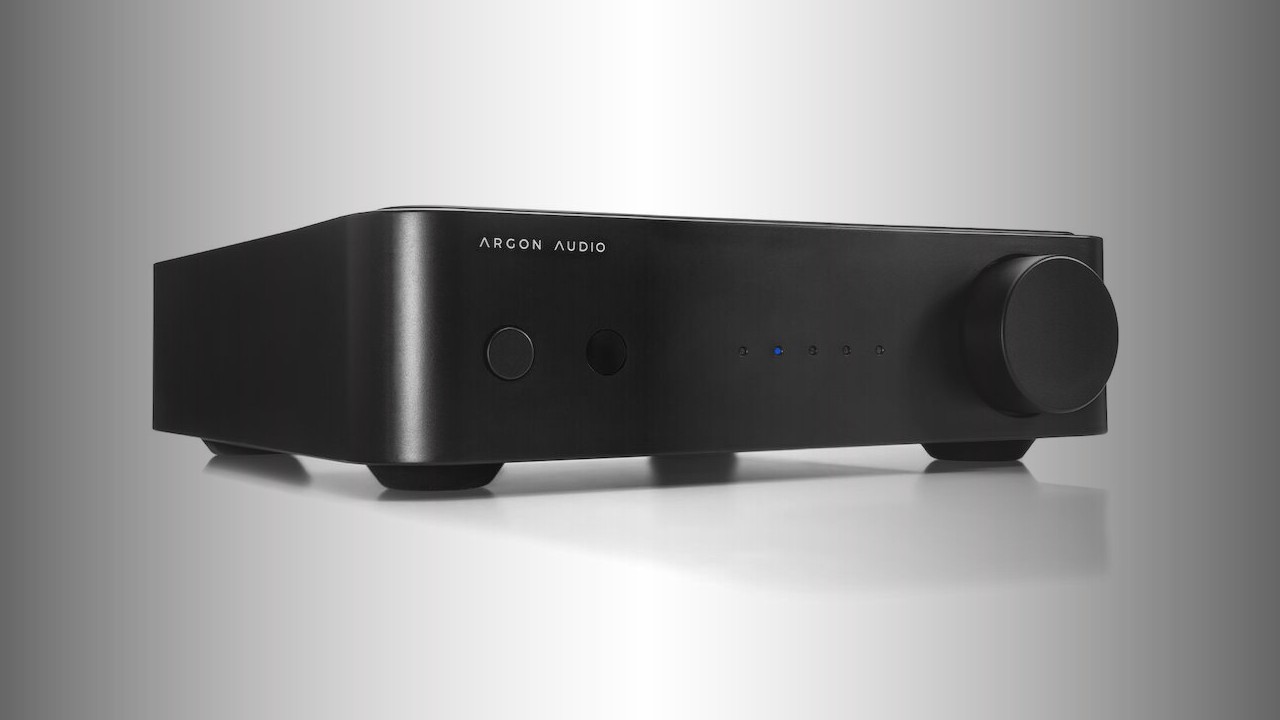
Compact integrated amplifiers are often treated as compromises: convenient boxes for a desk or secondary room, but not necessarily the heart of a serious two-channel system. The Argon Audio SA1 takes a more ambitious route. It combines a quoted 2 x 40 watts of Class D amplification with digital and analogue inputs, an MM phono stage, aptX HD Bluetooth, a pre-out and a 24-bit/192kHz-capable digital section, all in a small chassis offered in black or white.
That combination matters because it addresses several real-world system requirements at once. The SA1 can accommodate a television via optical, a turntable without an external phono preamp, conventional analogue sources and Bluetooth playback from a phone or tablet. It is not a network streamer, and it does not have a headphone output or a display, but its connectivity is considerably broader than that of many minimalist desktop amplifiers.
The important question is therefore not whether the SA1 is a substitute for a large full-width integrated amplifier in every system. It is whether its size, connection set and power rating make sense for a compact stereo system built around a sensible pair of loudspeakers. On paper, this is an unusually well-targeted amplifier for that job.
A small integrated amplifier, not simply a Bluetooth box
The SA1 is a stereo integrated amplifier: it combines source switching, volume control and power amplification in one enclosure. This is distinct from a powered speaker, which has amplification built into each cabinet, and from a streaming amplifier, which incorporates network playback. Argon Audio includes Bluetooth, but Wi-Fi and multi-room streaming are not built in. That distinction is worth making before buying, because Bluetooth is convenient for immediate playback, whereas network streaming is generally the better route for a permanent music-library or subscription-service setup.
The compact format is central to the SA1’s appeal. It can be placed on a shelf, sideboard or desktop where a conventional hi-fi amplifier would be intrusive. Its black and white finish options also make it easier to integrate into a living room rather than a dedicated equipment rack. Compactness should not be confused with immunity from installation considerations, however: even an efficient Class D amplifier needs unobstructed space around it, sensible cable routing and a firm, level supporting surface.
Argon Audio rates the SA1 at 2 x 40 watts. That figure is a useful indication that this is intended for proper passive loudspeakers rather than nearfield micro-speakers, but a power number alone never tells the whole matching story. The source information does not state the load impedance at which that rating is measured, nor does it provide sensitivity, distortion or continuous-versus-peak measurement conditions. Buyers should therefore regard the rating as a guide rather than a guarantee of suitability for every speaker.
In practical terms, 40 watts per channel can be entirely appropriate with reasonably sensitive standmounts and many conventional floorstanders in a small or medium-sized room. Very large rooms, unusually inefficient speakers, or speakers with especially demanding low-impedance behaviour may call for an amplifier with more clearly documented current and load capability. The SA1 offers one pair of speaker outputs, so it is aimed at a single focused stereo system rather than switching between multiple listening zones.

Class D amplification and a claimed balanced internal signal path
The SA1 uses an analogue switching amplifier architecture, commonly called Class D, alongside digital volume control. Class D does not mean that the musical signal is simply “digital”; it describes a power-amplifier approach in which output devices switch at high frequency and a filter reconstructs the audio signal for the loudspeaker. Its principal practical benefit is efficiency. Compared with a conventional linear amplifier topology, it can deliver useful output from a much smaller enclosure while generating less waste heat.
That efficiency is particularly relevant in a compact amplifier. It helps make a low-profile chassis viable and can reduce idle and operating power consumption. It does not, by itself, predict sound quality: execution of the power supply, output filter, input stage and layout remains crucial. Argon Audio’s stated approach combines the switching output stage with digital volume control, a familiar solution in compact digital amplifiers because it can keep channel tracking accurate at low listening levels.
The company also describes a fully balanced signal path from the DAC to the speaker terminals. In engineering terms, balanced signal handling uses complementary versions of a signal to reject certain forms of noise and interference. Here, the claim concerns the amplifier’s internal architecture; it should not be read as confirmation of balanced XLR inputs, which are not listed in the supplied information. Internal balanced operation can be useful in keeping a compact digital-and-analogue design quiet, but the exact implementation and its measurable consequences have not been specified.
Separate power supplies are stated for the digital and analogue circuits. This is a sensible design priority in a component containing both digital processing and analogue amplification, as digital circuitry can introduce high-frequency electrical noise if power distribution and grounding are poorly controlled. The SA1 also uses Japanese long-life capacitors and includes overload protection. The latter is a practical ownership feature: if a speaker cable is shorted, the amplifier is overdriven, or the connected load becomes problematic, a protection circuit is intended to prevent damage. It should not be treated as permission to use unsuitable speakers or careless wiring, but it is welcome in a small all-in-one unit.
Digital playback, Bluetooth and television integration
The SA1 supports high-resolution stereo audio up to 24-bit/192kHz. This tells us that its digital input and conversion section can accept PCM material at up to that resolution, assuming the connected source outputs a compatible signal. It does not mean every streaming service, app or television will automatically deliver 24-bit/192kHz audio; the effective result depends on the source device, service settings and connection method.
Optical digital input is a particularly sensible inclusion for television sound. Optical carries a digital audio signal without an electrical connection between TV and amplifier, which can help avoid ground-loop hum. Most televisions should be set to PCM stereo output when feeding a two-channel amplifier; multichannel Dolby or DTS bitstreams are not the same thing as two-channel PCM and may not be decoded by a stereo integrated amplifier. This simple menu setting is often the difference between reliable TV sound and silence.
Argon Audio says the optical input is designed to reduce jitter-related effects from connected devices, particularly televisions, and that a second digital input also incorporates jitter reduction. Jitter refers to timing variation in a digital signal. A well-designed receiving stage and DAC clock-recovery system are intended to minimise its influence before conversion to analogue. The useful takeaway is not that every optical connection is inherently poor, but that the digital input stage has been designed with ordinary consumer sources in mind.
For day-to-day television use, the SA1’s infrared remote compatibility is potentially more significant than a long specification list. It can be controlled with certain Samsung, Sony and LG TV remotes, including Samsung IR Remote models such as TM1240A and Sony’s XF8 series. This reduces the need to reach for a separate amplifier remote just to adjust volume. Compatibility should be confirmed with the specific television and remote before purchase, especially as TVs can be supplied with Bluetooth rather than infrared handsets.
The amplifier can also wake from standby when it detects a signal from supported sources; the turntable input is the stated exception. This makes practical sense. A digital source such as a TV or streamer can provide a detectable signal, whereas a phono cartridge produces a very low-level analogue signal and is not an appropriate trigger. Automatic wake-up can make the SA1 feel more appliance-like in a living-room system while avoiding the need to leave an amplifier fully powered at all times.

Bluetooth is convenient; the USB output enables a better permanent streamer
Bluetooth is built in, with aptX HD support. When both the transmitting device and the amplifier support aptX HD, the codec can offer a higher-quality Bluetooth link than basic SBC. It remains a lossy wireless codec rather than a direct lossless network-streaming connection, but it is a valuable feature for guests, casual listening and quick playback from a phone without joining a Wi-Fi network.
As always with Bluetooth, codec support is negotiated between both ends. A phone that does not support aptX HD will use another mutually supported codec, so purchasers should not assume that the logo alone guarantees aptX HD operation. Bluetooth also remains tied to the transmitting device: incoming calls, alerts and system sounds can interrupt playback depending on phone settings.
For a more permanent streaming solution, the rear-panel 5V USB output can power a compact external streamer, including a Chromecast Audio or similar device. Connected digitally to the SA1’s optical input, such a streamer can add Wi-Fi-based playback from compatible apps without needing its own separate power supply. This is a pragmatic modular approach: users can choose a streaming platform that suits their preferred services and replace that front end later without replacing the amplifier.
The trade-off is equally clear. There is no integrated Chromecast Audio, multi-room platform or native streaming app in the SA1 itself. Anyone who wants a single-box system with built-in network control should choose accordingly. For listeners happy to add a small streamer—or who mostly use Bluetooth, TV sound and physical sources—the USB provision is a thoughtful piece of system integration.

Analogue sources, turntables and expansion through pre-out
Alongside its digital inputs, the SA1 accepts analogue sources and includes an MM phono input for a turntable. MM stands for moving magnet, the most common cartridge type fitted to entry-level and mid-priced record players. A phono input does more than provide another pair of sockets: it applies the gain and RIAA equalisation needed to turn the tiny cartridge output into a line-level signal suitable for the amplifier.
This makes the SA1 a straightforward partner for a turntable fitted with a moving-magnet cartridge. It does not establish compatibility with moving-coil cartridges, which normally require substantially more gain and different loading. Nor should a turntable’s own built-in phono stage be connected to the SA1’s phono input: if the turntable has a switchable preamp, use its line output into an appropriate line-level input, or bypass the turntable preamp and use the SA1’s MM input. Applying phono equalisation twice will produce severely incorrect sound.
There is also a pre-out, which broadens the SA1’s upgrade path. A pre-out carries a variable-level signal controlled by the SA1’s volume setting. It can be used to feed an active subwoofer, a separate headphone amplifier or an external power amplifier. For compact speakers in a room where deep bass is limited, an active subwoofer can be especially useful: it takes responsibility for the lowest frequencies and allows more flexible bass placement. The exact bass-management options are not specified, so buyers should not assume a configurable high-pass filter for the main speakers.
There is no built-in headphone output. That is an important limitation for anyone who expects to listen privately from the amplifier itself, though the pre-out offers a route to a dedicated external headphone amp. Similarly, there is no stated tone control. Purists may prefer an unadorned signal path, but tone adjustment can be useful where room placement or recordings make a modest bass or treble correction desirable. The SA1’s approach is clearly one of compact simplicity rather than comprehensive system tailoring.

Power supply claims and sensible speaker matching
Argon Audio describes the SA1’s compact active power supply as quieter and more stable across voltage variations than traditional copper-transformer designs, while also emphasising efficiency. A switch-mode power supply is a natural partner for Class D because both are compact and efficient, although quality of implementation is much more important than the label alone.
The manufacturer further states that the amplifier can deliver up to 400 watts despite its 40-watt rating and that it remains stable with impedance variation. The supplied information does not define the conditions, duration or type of power represented by the 400-watt figure, so it should not be interpreted as a continuous 400W-per-channel rating. It is more useful to view the claim as an indication that the power supply and protection system have been engineered to handle short-term demand and changing speaker loads. Prospective owners with difficult loudspeakers should still seek full load-specific specifications before drawing conclusions.
For most intended systems, speaker selection should be based on sensible matching rather than chasing the largest cabinet the SA1 can conceivably drive. A pair of moderate-sensitivity standmounts or easy-going compact floorstanders, positioned correctly and used in an appropriately sized room, is likely to make better use of this amplifier than a demanding speaker designed for a high-current heavyweight. Keep speaker cables short enough for a tidy installation, ensure that bare conductors cannot touch, and begin with modest volume after any connection changes.
Who the Argon Audio SA1 is for
The Argon Audio SA1 is most compelling as the control centre of a space-conscious stereo system. It offers the core connections many modern listeners actually need: TV audio, Bluetooth, a turntable input, conventional analogue and digital sources, plus pre-out expansion for a subwoofer or external amplification. The 5V USB output is a small but useful detail for adding a compact network streamer cleanly.
Its compromises are purposeful rather than hidden. There is no built-in streaming platform, no front display, no headphone socket, no tone controls and no second speaker zone. Those wanting an app-driven all-in-one streamer or extensive connection readouts will need a different kind of component. But for someone assembling a neat two-channel system around passive speakers and a mix of TV, vinyl and phone playback, the SA1’s feature balance is unusually coherent.
Most importantly, its compact dimensions do not force the owner into a closed system. Add a streamer via optical, a subwoofer via pre-out, or a dedicated headphone amplifier when required. That modularity, together with an MM phono stage and TV-remote integration, is what makes the SA1 more than a small amplifier with Bluetooth.