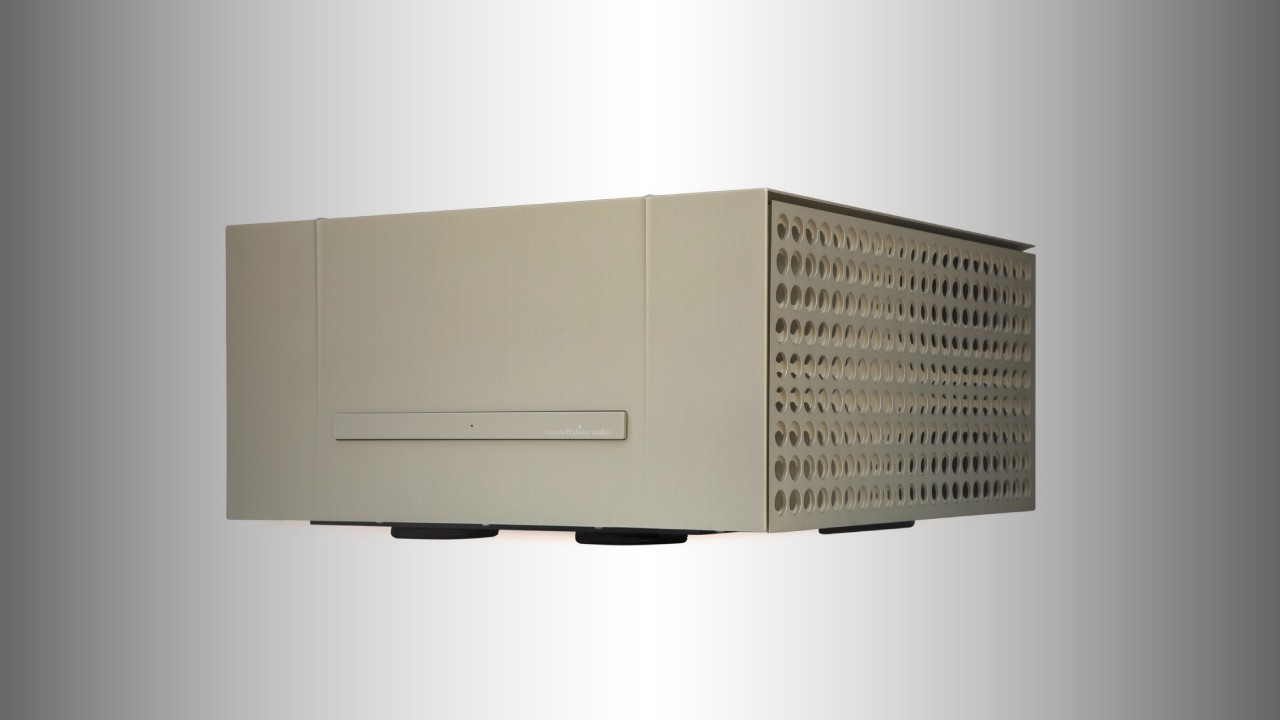
Constellation Audio has offered an early look at its forthcoming Inspiration 2 power amplifiers, confirming that the range will be offered in both stereo and monaural versions. The company is positioning the new models as more compact expressions of the engineering found in its Reference and Performance amplifier lines, while placing particular emphasis on a new power-supply implementation it calls C-SMPS.
There is an important caveat to this announcement: Constellation has not yet released the figures that will determine how the Inspiration 2 amplifiers fit into a real-world system. Output power, supported speaker loads, input and output connections, dimensions, weight, pricing, territories and delivery timing have all yet to be confirmed. For now, this is a preview rather than a complete technical launch.
Inspiration 2: stereo convenience or dedicated monoblocks
The two versions address different approaches to building a high-end separates system. A stereo power amplifier puts both channels in a single chassis, reducing rack space, mains connections and cable runs. It is usually the more straightforward option for a conventional two-channel installation, particularly where equipment furniture or amplifier placement is constrained.
A mono power amplifier, or monoblock, dedicates one chassis to each channel. In principle, this can allow greater separation between the left and right amplification channels, while making it possible to place each amplifier close to its respective loudspeaker. That can be useful where a system uses long balanced interconnects from the preamplifier and shorter speaker cables. Whether those benefits are practical with the Inspiration 2 Mono will depend on its eventual connection provision, power specification, physical dimensions and recommended installation guidance.
Neither format is inherently superior in every system. A stereo chassis can make for a tidier, lower-cost route to a two-channel power-amplifier system, while a pair of monoblocks requires more space, more mains outlets and a carefully considered equipment layout. The choice should ultimately be guided by the loudspeakers being used, room arrangement and the amplifier’s confirmed electrical specifications rather than channel count alone.

A new C-SMPS power supply is the headline feature
Constellation’s initial statement focuses on what it calls C-SMPS. The company says: “Our Inspiration Stereo and Mono amplifiers distill the performance, power and passion of our Reference and Performance amplifiers into a more compact package. And now we’ve equipped them with C-SMPS. It’s by far the best power supply ever created for an audio amplifier.”
That is a bold claim, but the announcement does not define the C-SMPS acronym or set out its circuit architecture, energy-storage capacity, regulation method or thermal strategy. It would therefore be premature to treat it as confirmation of any particular supply topology. A switch-mode power supply is often abbreviated SMPS in audio engineering, but Constellation has not provided enough detail here to establish precisely what the “C-” designation means or how this implementation operates.
The focus on the supply is nevertheless significant. In a power amplifier, the power supply is responsible for providing stable energy to the output stage as music demands change. Its design can affect the amplifier’s ability to maintain voltage and deliver current into the varying impedance presented by a loudspeaker. Demanding bass passages and speakers whose impedance falls at particular frequencies can place especially heavy demands on this part of the amplifier.
There is no universal rule that one supply type guarantees better sound or better speaker control. The outcome depends on the complete amplifier design: regulation, filtering, layout, noise management, output-stage design and protection arrangements all matter. The useful details to look for when Constellation publishes a full specification will be continuous and peak power ratings into stated loads, current capability where quoted, idle consumption, heat dissipation and any guidance concerning ventilation or AC power requirements.

What “more compact” may mean in a high-end power amplifier
Constellation says the Inspiration models bring the performance, power and passion of its Reference and Performance amplifiers into a more compact package. At present, that is a statement of product positioning rather than a claim that can be quantified: the company has not supplied dimensions, weight or comparative measurements for the Inspiration 2 models.
Still, compactness is a meaningful consideration in this category. Large power amplifiers can be difficult to accommodate safely on conventional hi-fi furniture, and their placement needs to account for ventilation, access to rear-panel connections and the routing of heavy speaker cables. A smaller chassis can simplify installation, but enthusiasts will want to see the final measurements before assuming that the stereo amplifier or a pair of mono amplifiers will fit a particular rack or shelf.
For prospective owners, the eventual rear-panel layout will be as important as the front-panel presentation. Balanced XLR inputs are common in high-end pre/power systems because balanced connections can be helpful on longer cable runs; unbalanced RCA inputs remain useful for compatibility with a wide variety of preamplifiers and sources. The supplied material does not confirm either option for Inspiration 2, nor does it state whether there will be trigger connections, grounding provisions or other control facilities.

The specifications that matter for speaker matching
Until Constellation publishes ratings, it is not possible to say which loudspeakers are an appropriate match for either Inspiration 2 model. A wattage figure on its own would not tell the whole story in any case. Loudspeaker sensitivity, nominal impedance and the way impedance changes across the frequency range all influence the practical load an amplifier sees.
When the full data arrive, buyers should look beyond a single headline output figure. Useful information includes power into 8-ohm and 4-ohm loads where supplied, whether the manufacturer approves operation into lower impedances, and any stated requirements for placement or ventilation. Those details help establish whether an amplifier is intended primarily for benign, relatively sensitive loudspeakers or is engineered to accommodate more challenging designs.
The preamplifier partnership also deserves attention. Gain structure, input sensitivity and the availability of balanced or single-ended connections influence how easily a system can achieve an appropriate volume range and preserve a low-noise signal path. Constellation has not yet published those figures, so existing Constellation owners and prospective new customers should avoid making compatibility assumptions based solely on the Inspiration 2 name.

What remains to be confirmed
The current preview establishes the essentials: Inspiration 2 is a forthcoming Constellation Audio power-amplifier family with Stereo and Mono variants, a claimed more compact positioning beneath the company’s Reference and Performance offerings, and a new C-SMPS supply highlighted as its key development. It does not yet establish the amplifiers’ output-stage topology, rated power, DAC or streaming functionality, connections, finish options, physical specifications or price.
That absence of detail is particularly relevant because these are power amplifiers rather than integrated amplifiers. They require a suitable preamplifier or source component with variable output, plus loudspeakers and appropriate cabling. The final specification will reveal whether the Inspiration 2 range is aimed at existing Constellation systems, broad preamplifier compatibility, or both.

For now, the announcement is best read as an indication of where Constellation is directing its next amplifier development: a two-chassis-format range in which the company considers the power supply a defining part of the proposition. We will update this story when Constellation Audio releases full technical specifications, prices and availability for the Inspiration 2 Stereo and Inspiration 2 Mono.