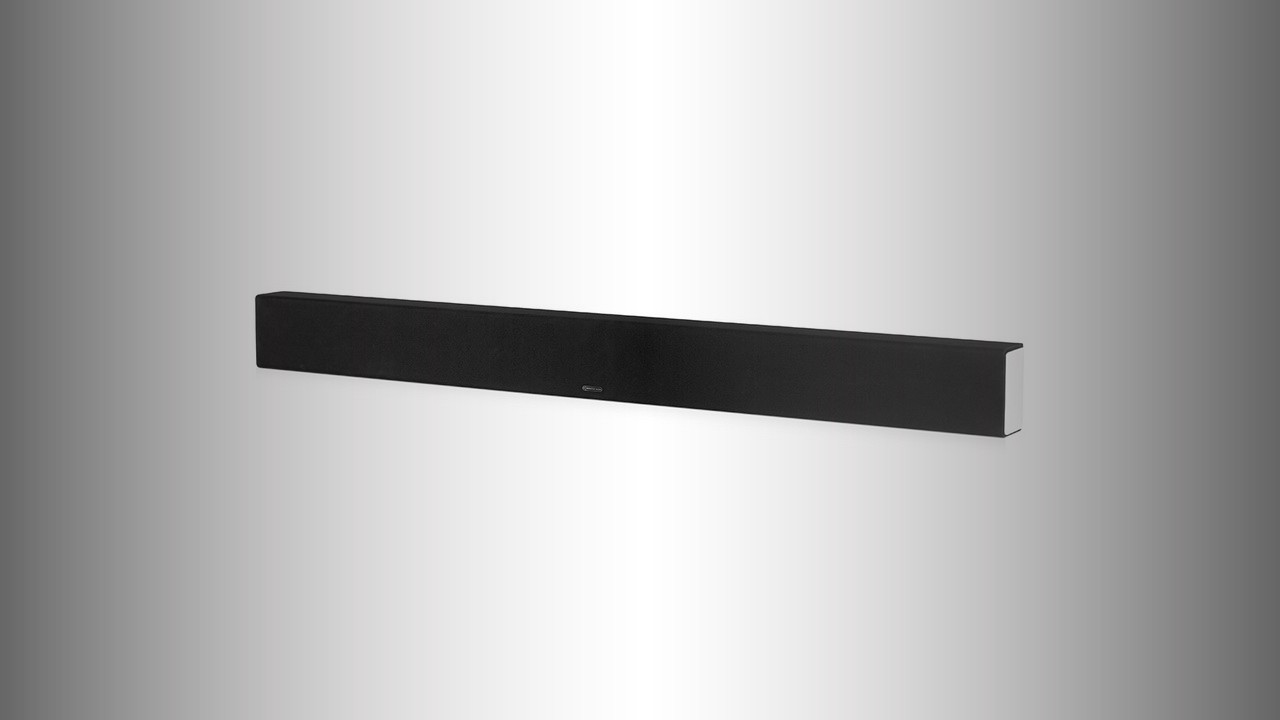
Monitor Audio’s SB-4 takes a notably different route from the usual soundbar formula. It is not a self-contained, HDMI-equipped soundbar with onboard amplification, decoding and streaming facilities. Instead, it is a fully passive three-channel speaker, intended to be connected to the left, centre and right outputs of an external AV amplifier or suitable multichannel amplification system.
That distinction matters. The SB-4 is designed for installations where a large television needs a visually discreet front soundstage, but where the owner does not want to surrender the channel separation, amplifier choice or upgrade flexibility of a conventional home-cinema speaker system. At 1562mm wide, it is the largest model in Monitor Audio’s Soundbar range and is intended to sit alongside a 70-inch TV.
Its appeal is therefore less about adding convenience features and more about solving a practical system-design problem: how to place three proper front channels around a screen without fitting three separate cabinets across a wall or cabinet. The SB-4 packages those channels into one low-profile enclosure, while retaining separate driver arrays and crossover sections for left, centre and right.
A passive alternative to the all-in-one soundbar
Most mainstream soundbars combine amplification, digital processing and several channels in one enclosure. That can be convenient, particularly when connected to a television via HDMI ARC or eARC, but it also ties the listener to the amplification and processing selected by the manufacturer. The Monitor Audio SB-4 has no such electronics specified: it needs external amplification and speaker cabling, but in return can become part of a more conventional separates-based cinema system.
In practice, an AV receiver or processor-plus-power-amplifier combination needs to provide three amplified channels for the SB-4: front left, centre and front right. The external electronics carry out the decoding, input switching, volume control and bass management; the SB-4’s job is to reproduce those three front channels. This makes it fundamentally different from a single-input passive speaker, because its left, centre and right sections remain discrete rather than mixing everything into one broad mono presentation.
That separation is especially relevant to film sound. The centre channel carries much of the dialogue and on-screen action, while the left and right channels establish width, music and directional effects. Housing all three within one cabinet inevitably means the speakers are closer together than a conventional left/centre/right layout, but three discrete sections should still provide a more coherent channel-based installation than a single speaker attempting to simulate a front soundstage.

Three discrete channels, C-CAM drivers and ABRs
The SB-4 is divided internally into separate left, centre and right sections, each with its own driver array and crossover operation. Each channel uses a 25mm (1-inch) gold-plated C-CAM tweeter and two 4-inch C-CAM bass/midrange drivers, making six 4-inch low-frequency drivers and three tweeters in total.
C-CAM is Monitor Audio’s ceramic-coated aluminium/magnesium cone material. In broad engineering terms, metal-cone diaphragms are valued for rigidity relative to their mass: a stiff cone is less inclined to flex within its intended operating band, which can help maintain controlled piston-like motion. The material itself does not guarantee a particular sonic result, of course; driver geometry, crossover design, enclosure behaviour and implementation are equally important. However, it places the SB-4’s driver technology in line with the company’s established loudspeaker approach rather than treating the soundbar as a separate lifestyle product.
The 4-inch drivers use concave C-CAM diaphragms and are connected to the front baffle through a dedicated assembly intended to improve mechanical decoupling and reduce distortion. Small bass/midrange drivers are a sensible choice in a shallow cabinet: they allow the SB-4 to remain only 88mm deep while giving each channel two radiating drivers for greater surface area and output capability than a single small unit would offer.
Monitor Audio specifies oval auxiliary bass radiators (ABRs) to support bass output and power handling. There are four in total: one in each of the left and right sections, and two in the centre section. An ABR is a passive diaphragm rather than an electrically driven speaker. It is tuned to work with the air spring inside the enclosure, performing a role similar to a port but without requiring an open tube. In a soundbar cabinet, this approach can be useful because it avoids the potential for port turbulence at higher playback levels while allowing bass extension from a relatively compact sealed volume.
The stated frequency range is 70Hz to 30kHz (-3dB). That lower figure explains Monitor Audio’s recommendation that the SB-4 be used with a subwoofer for the most complete system. A 70Hz extension is respectable for such a slim speaker, but the deepest effects in movie soundtracks, and the bottom octave of much music, sit below that point. Passing low bass to a properly positioned active subwoofer also reduces the amount of cone excursion demanded from the SB-4’s 4-inch drivers, potentially giving the soundbar more headroom through the midbass and midrange.
The suggested crossover range is 80Hz to 120Hz. An 80Hz setting is a familiar starting point in a well-integrated home-cinema system, whereas 100Hz or 120Hz may make more sense where room placement, subwoofer position or playback level demands a higher handover. The right choice depends on the receiver’s bass-management options, the subwoofer’s placement and how smoothly the combined system behaves in the room; it should not be selected purely by specification.

Cabinet engineering for a wall-hugging installation
Low-profile loudspeakers face mechanical as well as acoustic constraints. The SB-4 uses a high-density MDF enclosure with internal bracing and baffles intended to increase rigidity. A rigid cabinet is important because enclosure panels can store and release energy, adding coloration or reducing clarity if they resonate significantly. Bracing divides larger panels into smaller, less resonant areas, while internal partitions are also necessary here to keep the three channels acoustically separate.
Monitor Audio also uses through-bolt driver fixings: the drivers are secured to the rear wall of the cabinet while their baskets are fixed at the front. The principle is to tie the driver and cabinet structure together more firmly than a conventional front-only mounting arrangement. This can increase mechanical rigidity and reduce unwanted movement around the driver mounting area. It is a construction detail more often associated with conventional loudspeakers than with the thin, largely cosmetic enclosures common in all-in-one soundbars.
Externally, the cabinet is covered in acoustically transparent fabric, apart from brushed-aluminium side trims. Fabric wrapping avoids the visual interruption of exposed drive units and helps the SB-4 read as one clean horizontal element beneath or beside a large television. More importantly in use, the soundbar’s recessed speaker terminals are designed to keep cable connections out of the way, allowing the cabinet to sit close to a wall rather than being pushed forward by protruding plugs and cable bends.
The supplied information describes several mounting options. The SB-4 can sit on a cabinet, mount on a wall with Monitor Audio’s dedicated bracket and template, or be used with compatible third-party mounting hardware. It is also compatible with SANUS TV mounts, allowing the speaker to be mounted with the television. For a screen-mounted installation, this can be preferable to fixing the soundbar separately to the wall: when the display position is adjusted, the speaker remains aligned with it.
Amplifier matching and system planning
The SB-4 is specified at 87dB sensitivity, with a recommended amplifier power range of 30–100W and an 80W RMS input-power figure. Sensitivity indicates how much acoustic output a loudspeaker produces for a given electrical input under the manufacturer’s measurement conditions; it is useful as a broad guide to amplifier matching, but it does not tell the complete story without an impedance curve and room context. No impedance specification is provided here, so prospective owners should consult the full installation documentation and ensure their chosen AV receiver is suitable for the load presented by three SB-4 channels.
The 30–100W recommendation makes the soundbar a plausible partner for many sensibly specified AV receivers, but amplifier power alone should not be treated as the whole requirement. Large rooms, very high playback levels and demanding soundtrack peaks place more stress on amplification than casual television viewing. Conversely, using bass management and a subwoofer means the AV receiver is not being asked to deliver the deepest bass to the SB-4, which is generally beneficial in a compact LCR speaker design.
Monitor Audio quotes a maximum sound-pressure figure of 104dB. This is an indication of the product’s intended output capability, although real achievable levels will vary with listening distance, room size, amplifier capacity and the programme material being played. For installation planning, it is best read as evidence that the SB-4 is intended to do more than simply improve television speech at modest levels; it is built for a proper cinema front end, provided the partnering system is appropriate.
For connection, the installer will need to run separate speaker cables from the amplifier’s front-left, centre and front-right terminals to the SB-4’s corresponding inputs. Careful channel identification is essential: swapping left and right will reverse screen action, while a misconnected centre channel compromises dialogue anchoring. The recessed terminals are useful aesthetically, but cables should still be planned before final wall mounting, particularly where the bracket leaves limited access after installation.

Placement, subwoofer integration and the limits of the format
At 145mm high and 88mm deep, the SB-4 is designed to minimise the visual impact of a three-channel front speaker system. Its 1562mm width is proportioned for a 70-inch display, but buyers should measure the television, furniture and mounting position rather than relying on screen size alone. The important practical questions are whether the cabinet will obstruct the lower edge of the screen or its infrared receiver, whether it can be centred correctly, and whether there is sufficient clearance for brackets and cabling.
When it is placed beneath a television, the centre-channel tweeter should remain as close as possible to screen height. This helps dialogue appear to originate from the image rather than from noticeably below it. A wall-mounted arrangement can also be useful where a low media cabinet would otherwise place the speaker too close to the floor.
A subwoofer is not merely an optional way to add spectacle. With the SB-4’s specified -3dB low-frequency limit of 70Hz, a subwoofer is the component that supplies the lower bass absent from the soundbar itself. It also allows the AV receiver to redirect low-frequency effects and bass-heavy content away from the SB-4. Correct setup should include selecting an appropriate crossover, setting level conservatively at first and experimenting with subwoofer placement, since room modes have a major effect on bass consistency.
The SB-4’s principal trade-off is intrinsic to its purpose. It offers a far neater installation than three separate speakers, but the physical spacing between its left and right channels is constrained by the width of one enclosure. Listeners with the room and visual freedom to use widely separated standalone speakers may obtain a broader stereo spread. The SB-4 instead prioritises integrated appearance, simple alignment with a large display and genuine discrete LCR operation within a slim form.
Monitor Audio SB-4: who is it for?
The Monitor Audio SB-4 is aimed at a particular kind of home-cinema installation: one centred on a large 70-inch television, where visual order matters but an external AV receiver, proper speaker wiring and a subwoofer are all acceptable parts of the system. It is not a shortcut to HDMI simplicity, nor a replacement for a complete receiver-based setup. It is the front three-speaker element of that setup.
Its strongest technical points are the discrete LCR architecture, twin 4-inch C-CAM drivers and dedicated tweeter per channel, ABR-assisted bass design, braced MDF construction and genuinely wall-conscious terminal and mounting arrangements. Add an appropriately matched amplifier and active subwoofer, configure bass management in the 80–120Hz range as required by the room, and the SB-4 offers a compact route to a more serious front soundstage than television speakers can provide.
Monitor Audio SB-4 specifications
- Configuration: Passive three-channel soundbar; discrete left, centre and right sections
- Low-frequency drivers: 6 x 4-inch C-CAM (two per channel)
- High-frequency drivers: 3 x 1-inch gold-plated C-CAM (one per channel)
- Passive radiators: 4 x oval ABRs; one in the left and right channels, two in the centre channel
- Frequency range: 70Hz–30kHz (-3dB)
- Sensitivity: 87dB
- Input power: 80W RMS
- Recommended amplifier power: 30–100W
- Maximum sound pressure: 104dB
- Recommended crossover setting: 80–120Hz
- Dimensions (W x H x D): 1562 x 145 x 88mm
- Weight: 12kg