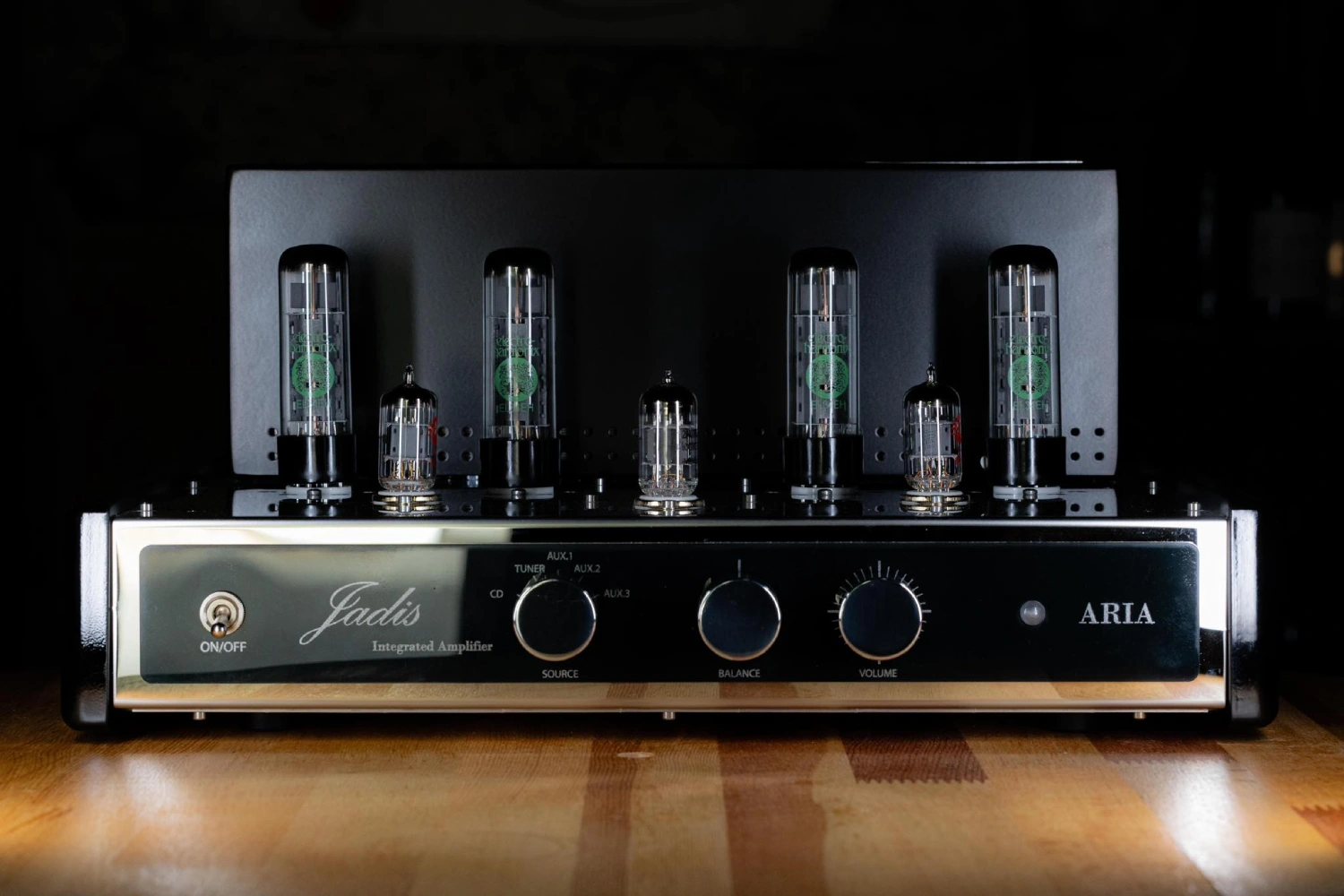
Jadis Electronics has introduced the Aria, a Class AB integrated valve amplifier that succeeds the Orchestra as the French manufacturer’s entry-level model. “Entry level” needs some qualification here: at $4,800, and with a 20kg chassis, the Aria is not a budget amplifier. Rather, it is Jadis’ most accessible route into the company’s long-established approach to valve amplification: substantial transformers, point-to-point internal wiring and a deliberately uncomplicated all-analogue control layout.
The headline specification is 30W per channel, but the more consequential change over the outgoing Orchestra is flexibility. The Aria can be supplied with EL34, KT88, KT120 or 6CA7 output valves, allowing owners and dealers to choose among several established tube families rather than being tied to one output stage configuration. It also adds a remote control as standard, updates the external finish and moves the transformer set beneath a metal cover.
For prospective buyers, the Aria’s appeal will rest less on a long features list than on whether its power rating, valve arrangement and five-input analogue connectivity suit the rest of the system. Here is what Jadis has disclosed, and what those choices mean in practice.
A new entry point for Jadis, not a stripped-down amplifier
The Aria takes over from the Orchestra, a model that Jadis says was introduced nearly 20 years ago. That makes this more than a cosmetic refresh: it is a replacement for the company’s entry integrated amplifier, with revised tube compatibility, a new physical layout and a standard remote handset.
Jadis continues to use point-to-point wiring, a construction method it also employs in its larger amplifiers. In broad terms, point-to-point construction connects components directly with wire and terminal points rather than placing every connection on a conventional printed circuit board. It is valued in valve-amplifier design because it can make servicing, component selection and heat-conscious physical layout more straightforward. It does not automatically determine sound quality; execution remains crucial. But it signals that the Aria is built around the same traditional engineering language as Jadis’ higher-priced products rather than a wholly different, cost-led internal platform.
The amplifier uses a non-magnetic stainless-steel chassis with wooden side panels. Stainless steel can provide a rigid, durable enclosure, while the non-magnetic specification is relevant in a product containing sensitive small-signal valve circuitry and large magnetic components. It should not be read as a complete solution to electrical or mechanical noise—the internal grounding, transformer design and circuit layout matter greatly too—but it is a sensible material choice in this context.

30W per channel: enough power, with sensible speaker matching
The Aria is rated at 30W per channel and operates in Class AB. In a push-pull valve output stage, two or more output valves share the work of amplifying the signal waveform. Class AB is widely used where an amplifier needs to deliver more output power and efficiency than a pure Class A design, without adopting the switching operation associated with Class D amplification.
Thirty watts is modest beside the outputs claimed by many modern transistor integrated amplifiers, but wattage alone is an incomplete guide to suitability. The speaker’s sensitivity, impedance behaviour, room size, listening distance and desired peak level all matter. A 30W valve amplifier can be a very credible partner for speakers of reasonably high sensitivity with an impedance load that does not become especially difficult. Conversely, low-sensitivity loudspeakers or designs with demanding impedance dips may require more power and current capability than this kind of amplifier is intended to provide.
That is why an Aria audition should be conducted with the actual loudspeakers wherever possible. Buyers should not assume that the amplifier’s 30W rating rules it out, nor should they treat it as a guarantee of compatibility with every floorstander. The important question is how comfortably the amplifier and loudspeaker work together at real listening levels, including on music with substantial dynamic peaks.
Jadis specifies a frequency response of 5Hz to 60kHz, measured at -3dB. The lower figure indicates that the amplifier’s response extends well below the conventional audible bass range, while the 60kHz upper figure shows bandwidth beyond the top of human hearing. In valve amplification, bandwidth figures are closely related to the quality and design of the output transformers, which couple the valve output stage to the loudspeaker. The published range is useful context, but it is not by itself a complete account of amplifier performance: distortion, noise, load behaviour and channel balance are not specified in the supplied information.
Four output-valve options, but manual bias adjustment
The most notable technical development is support for four output-valve types: EL34, KT88, KT120 and 6CA7. These valves are familiar names to experienced tube users, but they are not simply interchangeable flavour choices in the casual sense. Each family has different electrical characteristics, and an amplifier must be designed and set up correctly to operate them safely and effectively.
EL34 and 6CA7 are closely related output-valve types, although individual examples and modern production variants can differ. KT88 and KT120 are larger beam-tetrode families generally associated with higher dissipation capability. Jadis has not published separate power ratings or operating conditions for each valve type in the supplied information, so it would be wrong to assume a particular output-power increase with KT88 or KT120 valves. What can be said is that the choice gives the Aria an unusual degree of ownership flexibility at this level of the Jadis range.
The output valves work in a push-pull configuration and are driven by two ECC83 valves and one ECC82. The ECC83, also known as the 12AX7, is commonly used where a circuit requires high voltage gain; the ECC82/12AU7 is commonly used in driver or buffer duties. Their exact roles within the Aria’s circuit have not been detailed, but this valve complement indicates a conventional small-signal gain-and-driver arrangement feeding the output stage.
Valve bias is manual, unlike on Jadis’ i35, where bias adjustment can be made while the amplifier is playing. Bias sets the operating point of the output valves. Correct adjustment is important for preserving valve life, maintaining channel consistency and ensuring the output stage works as intended. Manual bias is not inherently a drawback—many established valve amplifiers use it—but it means retubing is a more involved ownership task. Owners should follow Jadis’ instructions and, if they are not confident working around high-voltage valve equipment, ask a dealer or qualified technician to carry out the adjustment.

Transformer cover, conventional width and practical finish choices
At 430mm wide, the Aria has standard hi-fi component width. This is a practical change for owners using conventional equipment racks or furniture, where unusually narrow or wide valve amplifiers can complicate placement. Its full dimensions are 430 x 210 x 360mm, and it weighs 20kg.
That weight and depth deserve consideration before purchase. The Aria will need a stable shelf capable of supporting it securely, as well as generous ventilation. Valve amplifiers produce heat in normal operation, and enclosing one tightly in a cabinet is rarely sensible. The 210mm height also does not tell the whole story, because valves project above the chassis and need clear space around them. Any prospective installation should allow room for heat to escape and for safe access when changing valves or checking bias.
Where the Orchestra left its three transformers visible, the Aria places them beneath a metal cover. Transformers are central to a valve amplifier: the mains transformer supplies the voltages required by the circuit, while output transformers match the high-voltage, relatively low-current valve output stage to loudspeaker loads. A cover changes the visual presentation and offers physical protection, while retaining the substantial transformer-based architecture expected of a conventional valve integrated amplifier.
The Aria is available in stainless steel with black or in stainless steel with white. The valves are fitted in ceramic sockets with gold-plated connectors. Ceramic is widely used for valve bases because it tolerates heat well, while gold plating is intended to resist corrosion at the contact surfaces. As with the chassis material, these are worthwhile construction details, though they should be seen as part of the whole engineering package rather than as isolated predictors of performance.

Five RCA inputs make this an analogue system hub
Jadis fits five RCA line-level inputs. This makes the Aria a straightforward analogue control centre for a multi-source system: a standalone DAC or network streamer, CD player, phono stage, tape machine or another line-level component can all be accommodated, subject to the connection requirements of the specific sources.
There is no phono stage mentioned in the supplied specification. Turntable owners should therefore plan on a separate phono preamplifier unless their turntable or cartridge system already provides the necessary RIAA equalisation and gain elsewhere. Equally, no digital inputs, streaming platform, Bluetooth provision, HDMI connection, balanced XLR inputs or subwoofer output are listed. The Aria is best understood as a traditional line-level integrated amplifier, not an all-in-one digital hub.
That simplicity may be precisely the point for listeners who already own, or prefer to choose separately, a streamer and DAC. It also creates a clear upgrade path: digital front-end changes can be made without replacing the amplifier, and analogue sources can be selected to suit the owner’s priorities. The trade-off is that users seeking one-box streaming, TV integration or a built-in moving-magnet/moving-coil phono stage will need additional components or should consider a differently specified amplifier.
The inclusion of a remote control as standard is a meaningful day-to-day improvement over the previous model’s specification. For an amplifier likely to be used in a living-room system rather than a dedicated equipment rack, remote volume operation is a practical convenience rather than a luxury.

Who the Jadis Aria is for
The Jadis Aria is aimed at listeners who want a serious, traditionally engineered valve integrated amplifier without moving into the brand’s larger and more expensive models. Its particular strengths on paper are its point-to-point construction, covered three-transformer arrangement, standard-width casework, five analogue inputs and support for EL34, KT88, KT120 and 6CA7 output valves.
Its compromises are equally clear and should be treated as deliberate system choices. There are no stated digital or streaming facilities, its 30W-per-channel output calls for considered loudspeaker matching, and manual bias adjustment places a little more responsibility on the owner or dealer when output valves are changed. In return, the Aria offers a more focused proposition than a feature-heavy modern integrated: a conventional valve amplifier designed to sit at the centre of a carefully chosen analogue or separately sourced digital system.
Jadis describes the Aria as the result of extensive research intended to create a high-end product at a manageable price, and characterises its presentation as expressive, sparkling and powerful. Those are the manufacturer’s claims rather than independent listening findings, so an audition remains essential—particularly with the loudspeakers the amplifier will ultimately drive. But the technical changes are tangible: the Aria is a modernised successor to the Orchestra, and its tube compatibility makes it a notably more adaptable entry point into the Jadis range.
Jadis Aria specifications
- Type: Class AB integrated tube amplifier
- Power output: 30W per channel
- Output valves: EL34, KT88, KT120 or 6CA7
- Small-signal valves: two ECC83 and one ECC82
- Output-stage configuration: push-pull
- Bias adjustment: manual
- Frequency range: 5Hz–60kHz (-3dB)
- Inputs: five RCA line inputs
- Dimensions (W x H x D): 430 x 210 x 360mm
- Weight: 20kg
- Price: $4,800