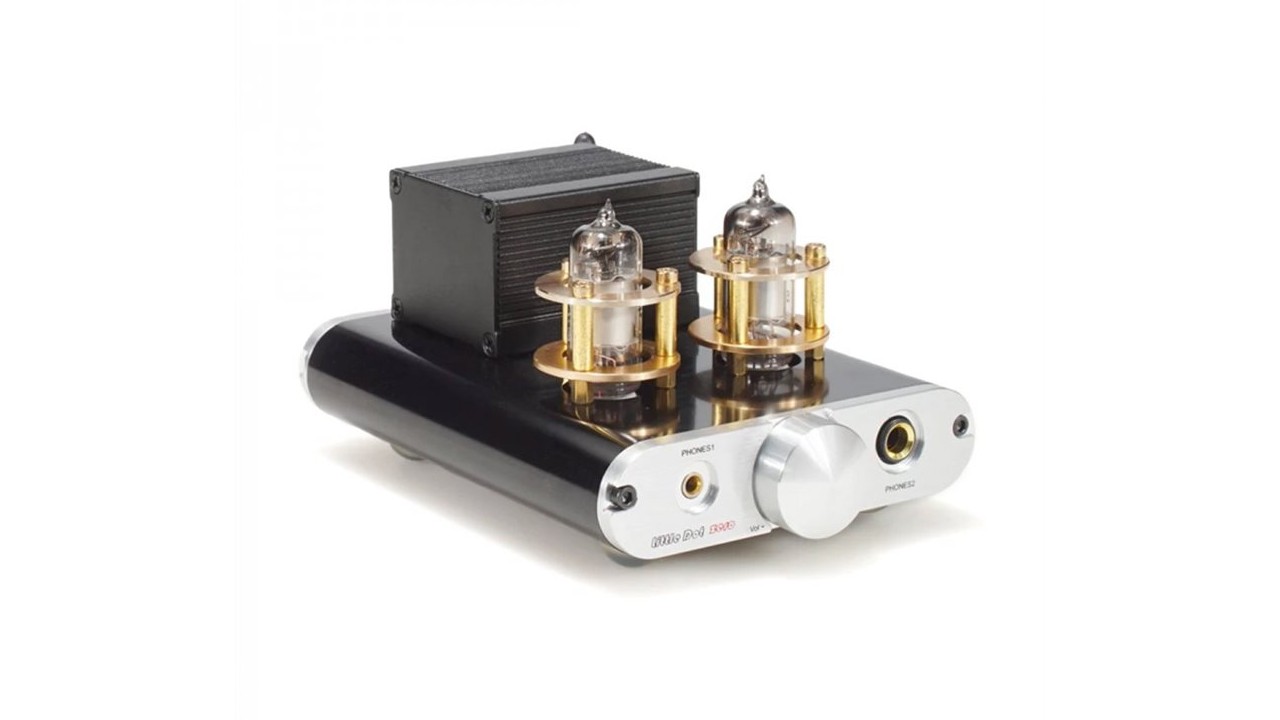
The Little Dot Zero is a compact desktop DAC and headphone amplifier that takes a distinctly hybrid approach to personal audio. It combines a tube-based amplifier stage, using two 1K2 valves, with a built-in digital conversion section and Bluetooth 5.0 receiver. That gives it three ways to enter a headphone system: a computer via USB-B, a conventional analogue source through its 3.5mm line input, or a phone, tablet or streamer over Bluetooth.
It is an unusually broad feature set for a unit measuring just 140 x 108 x 75mm. Rather than being only a tube headphone amp that requires an external DAC, the Zero can serve as the central desktop component between digital sources and a pair of wired headphones. Its two headphone sockets—3.5mm and 6.35mm—also accommodate both portable-oriented headphones and full-size models without an adaptor.

A tube stage in a modern desktop headphone system
Little Dot specifies two 1K2 tubes in the Zero’s amplifier section. In practical terms, valves are active devices used to provide voltage gain and amplification, but their behaviour differs from the solid-state transistors found in most compact DAC/headphone amplifiers. Tube circuits can introduce harmonic characteristics that some listeners seek for their sense of tonal texture and ease, although the exact result depends on the entire circuit design, the headphones connected and the recording being played.
The claim that the Zero produces a warm and subtle presentation should therefore be treated as a description of Little Dot’s intended voicing, not as a substitute for a listening assessment. Tube equipment is not automatically warm, nor is warmth necessarily preferable in every system. With headphones that are already rich or relaxed in the upper frequencies, a listener may prefer a more neutral solid-state amplifier; with leaner or more forward-sounding headphones, the appeal of a valve-based stage may be easier to understand. The important point is that the Zero is positioned as an alternative to the increasingly common measurement-led, all-solid-state desktop DAC/amp.
There are also ownership considerations with any tube component. Valves are consumable parts and generate heat in operation, even in a small chassis. The supplied information does not state the tube life, whether replacement valves are available from Little Dot, or whether the 1K2 tubes are intended for user rolling. Prospective buyers who are drawn specifically to the tube section should confirm those details with the retailer before purchase, particularly if long-term serviceability is a priority.
USB, line input and Bluetooth 5.0: three useful source options
The Zero’s USB-B input allows it to operate as an external DAC with a computer. This is the most direct route for desktop listening, bypassing a laptop or desktop machine’s usually basic analogue headphone socket and placing digital-to-analogue conversion in the dedicated audio component instead. Over USB, the Zero accepts PCM signals up to 24-bit/192kHz.
That specification covers the vast majority of lossless music files and high-resolution PCM releases likely to be used in a computer-based library. It does not, however, establish support for DSD, MQA, optical or coaxial digital inputs, as none of these is listed. The USB connection is consequently the key wired digital input, and buyers with a CD transport, television or games console should check whether their source can feed USB audio or whether another DAC would be required.
Bluetooth 5.0 gives the Little Dot Zero a more casual second role. A phone or tablet can send music to the amplifier without a cable, which is useful at a desk or bedside where convenience matters as much as absolute fidelity. Codec support is extensive: SBC, AAC, aptX Low Latency, aptX HD and LDAC are all listed.
Codec compatibility matters because Bluetooth audio is encoded before transmission. SBC is the baseline codec supported by virtually every Bluetooth device, while AAC is commonly relevant to Apple devices. aptX HD is intended to carry higher-quality audio where the transmitting device supports it, and aptX Low Latency is designed to reduce delay—a potentially useful feature for video, though real-world latency depends on the source device and the full Bluetooth chain.
LDAC is the headline format here. The Zero supports Bluetooth PCM up to 24-bit/96kHz with LDAC, whereas its USB input reaches 24-bit/192kHz. A 24-bit/96kHz LDAC connection is not the same as an uncompressed wired 24-bit/96kHz link: Bluetooth remains a wireless codec system and actual operation depends on the transmitting device, connection quality and codec settings. Nevertheless, LDAC support means the Zero is better equipped than an SBC-only receiver when used with compatible Android devices and other LDAC-capable sources.
The 3.5mm line input keeps the Zero relevant for analogue sources. It could be used with the line output of a standalone DAC, portable player or a phono stage. A turntable cannot normally connect directly unless it has an integrated phono preamp, because a cartridge’s signal is much lower in level and requires RIAA equalisation before it can feed a line-level input.

Headphone outputs and what the power figures tell us
Little Dot provides both a 3.5mm headphone output and a 6.35mm output. The two connectors primarily improve physical compatibility: many portable headphones use a 3.5mm plug, while full-size hi-fi headphones often terminate in 6.35mm. The supplied specification does not say whether the outputs are independently buffered, whether they may be used simultaneously, or whether either connection is balanced. They should therefore be considered conventional single-ended headphone connections unless further information confirms otherwise.
The stated output power is 1.8W into 32 ohms, 0.8W into 120 ohms and 0.3W into 300 ohms. These figures indicate that the Zero is designed to provide meaningful drive into conventional wired headphones rather than merely acting as a low-power USB dongle. Into a 32-ohm load—the nominal impedance region used by many modern dynamic headphones—the quoted 1.8W is substantial on paper. At 300 ohms, a common nominal impedance for certain full-size dynamic designs, the specified 0.3W suggests the amplifier retains useful output capability as impedance rises.
Power alone is not a complete guide to headphone matching. Sensitivity determines how loudly a headphone plays for a given voltage or power, and it varies greatly between models. A high-sensitivity 32-ohm headphone may need very little power, while a low-sensitivity planar magnetic model can demand considerably more current despite a modest nominal impedance. The source material does not provide the Zero’s maximum voltage, maximum current, output impedance or gain, so it is not possible to make a definitive claim about its suitability for every difficult headphone load.
For normal dynamic headphones across the broadly 32- to 300-ohm range represented in the specifications, the available figures are encouraging. Owners of unusually inefficient planar magnetic headphones, or those seeking very high playback levels, should compare their headphone manufacturer’s sensitivity recommendation with the Zero’s published output data and, ideally, audition before committing.
Published performance specifications in context
The Zero is specified with total distortion of 0.1% at 1kHz and a signal-to-noise ratio of 98dB. These figures are useful context for the product’s tube-based design. Many contemporary solid-state DAC/headphone amplifiers pursue extremely low distortion figures, but tube circuits are often designed around different electrical and subjective priorities. A 0.1% distortion specification is not automatically a problem, particularly as the nature and distribution of distortion products can matter as much as a single total figure; equally, it should not be interpreted as proof of a particular sound character without independent measurement and listening.
The quoted frequency response is 20Hz–20kHz within -0.2dB, extending to 10Hz–50kHz within -1.2dB. The first range indicates close level consistency across the conventional audible band. The wider measurement describes bandwidth beyond that range, but should not be confused with a claim that listeners hear to 50kHz. For headphone use, the more immediately relevant aspect is the specified consistency from 20Hz to 20kHz, while final tonal balance will still be dominated by the headphone’s own response and fit.
Where the Little Dot Zero fits
The Little Dot Zero makes the most sense for a listener who wants one compact component for computer audio, wireless playback and an existing analogue line-level source, but does not want an entirely solid-state signal path. It is particularly suited to a desktop system where USB-B can be permanently connected to a computer and Bluetooth offers a quick route from a mobile device.
Its dimensions should make placement straightforward, although it is sensible to leave clear space around a tube amplifier rather than enclosing it tightly or stacking heat-sensitive equipment on top. Since the draft does not list a preamplifier output, fixed line output, remote control, display, volume control arrangement or app, buyers intending to integrate it into a loudspeaker system should verify those practical details. On the published information, the Zero is first and foremost a headphone-focused DAC/amp rather than an all-purpose digital preamplifier.
The trade-off for its versatility is that there are clear boundaries to the feature set. There is no stated balanced headphone connection, no listed optical or coaxial digital input, and USB PCM support tops out at 24-bit/192kHz. Those omissions will not matter to every desktop listener, but they are worth noting for anyone whose system relies on legacy digital sources, balanced cabling or specialist high-resolution formats.
Little Dot Zero specifications
- Product type: DAC and headphone amplifier
- Amplifier tubes: 2 x 1K2
- Inputs: Bluetooth 5.0, USB-B, 3.5mm jack line input
- Headphone outputs: 3.5mm jack and 6.35mm jack
- Bluetooth codecs: SBC, AAC, aptX LL, aptX HD and LDAC
- Supported sampling rates: Bluetooth PCM up to 24-bit/96kHz via LDAC; USB PCM up to 24-bit/192kHz
- Output power: 1.8W at 32 ohms; 0.8W at 120 ohms; 0.3W at 300 ohms
- Distortion: 0.1% at 1kHz
- Signal-to-noise ratio: 98dB
- Frequency response: 20Hz–20kHz (-0.2dB); 10Hz–50kHz (-1.2dB)
- Dimensions: 140 x 108 x 75mm
For buyers looking to add a valve element to a compact headphone setup without giving up USB DAC functionality or modern Bluetooth codec support, the Little Dot Zero’s combination is compelling on specification. The key questions before buying are less about its connectivity—which is clearly laid out—and more about the specific headphones to be used, tube replacement arrangements and the operational details not covered by the published information.