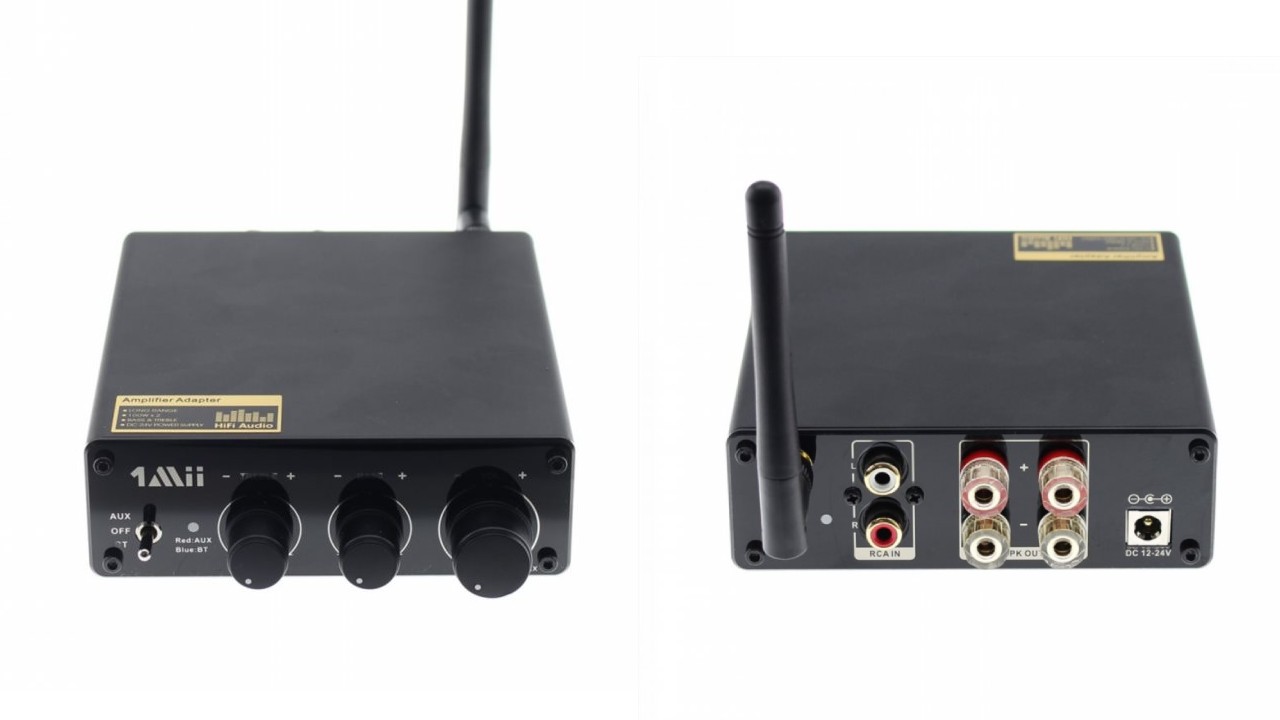
The 1Mii B08+ is a small Class D Bluetooth amplifier intended to make a pair of passive loudspeakers considerably easier to live with. Rather than requiring a separate amplifier and wireless receiver, it combines both functions in one compact unit, adding a conventional stereo RCA input for a wired source. The result is a potentially useful hub for a desktop system, secondary room or compact music setup where space, simplicity and wireless playback matter more than an extensive connection count.
At the heart of the B08+ is a TPA3116D amplifier chip, with 1Mii specifying output power of 2 x 50W into 4 ohms. Bluetooth reception is handled by an ATS2853 chip, with Bluetooth 5.0, AAC and SBC codec support. There are physical bass, treble and volume controls on the front panel, while speaker terminals provide the connection to a passive stereo pair.

A compact integrated amplifier, not simply a Bluetooth adaptor
The important distinction here is that the B08+ is designed to drive passive speakers directly. Bluetooth receivers and DACs normally provide a line-level signal, which must then be fed into an amplifier or pair of active speakers. The 1Mii combines the wireless receiver, basic preamplifier functions and power amplification in a single chassis, eliminating those extra boxes for a simple two-speaker installation.
Its 136 x 101 x 45mm dimensions and 418g weight underline that this is a compact component. Such a footprint can be particularly useful on a desk, shelf or TV cabinet, though sensible installation still matters. Class D amplifiers are generally efficient compared with conventional linear designs, but the B08+ should not be enclosed in a tight, unventilated space, especially if it is being asked to play loudly for extended periods. The specified operating-temperature range is -10°C to +45°C.
The unit uses an external DC supply rated from 12V to 24V at 4A. That broad input-voltage range is a practical specification rather than a direct statement of how much power it will deliver with every supply: amplifier output is dependent on the available supply voltage and current, as well as the loudspeaker load and programme material. Prospective owners should therefore use an appropriate power supply within 1Mii's stated limits and should not assume that any arbitrary DC adaptor will offer equivalent headroom.
TPA3116D Class D output: what the 2 x 50W rating means
The B08+'s TPA3116D-based output stage is specified at 2 x 50W into 4 ohms. In a small amplifier, Class D operation makes this sort of quoted power feasible without the substantial heatsinking and transformer size associated with many traditional Class A/B amplifiers. A Class D amplifier rapidly switches its output devices and uses filtering to recover the audio signal for the loudspeaker; its efficiency is one reason it is widely used in compact, affordable amplification.
That 4-ohm qualification deserves attention when choosing speakers. Power figures are meaningful only when accompanied by a load condition, and the B08+'s published 2 x 50W figure applies to 4-ohm speakers. 1Mii does not provide a separate output figure for 8-ohm loudspeakers in the supplied specifications, so it would be inappropriate to assume the same number with every speaker. In practical terms, the amplifier is best approached as a compact solution for modest passive bookshelf speakers rather than as an all-purpose power plant for difficult, low-sensitivity floorstanders or unusually demanding impedance loads.
The published total harmonic distortion figure is 0.5% or lower, while the signal-to-noise ratio is stated as 98dB or better. These figures offer a broad indication of the product's intended price and performance category, but they are not accompanied by test conditions such as output level, bandwidth or weighting. They should therefore be read as manufacturer specifications, not as a complete measurement profile. The stated frequency response is 20Hz to 20kHz, covering the conventional audible bandwidth.
For system matching, speaker sensitivity, listening distance and room size will matter at least as much as the headline output figure. A reasonably sensitive pair of compact speakers used nearfield on a desk needs far less acoustic output than a pair positioned several metres away in a larger living room. Likewise, bass-heavy music played at high levels places more demand on an amplifier than quieter background listening. Keeping expectations aligned with the B08+'s compact format and intended role is likely to produce the most satisfying result.

Bluetooth 5.0, AAC and SBC: wireless playback in context
The ATS2853 Bluetooth section supports Bluetooth 5.0 and the AAC and SBC codecs. SBC is the baseline Bluetooth audio codec and is supported by virtually all Bluetooth audio devices. AAC is especially relevant to users of many Apple devices, where it is commonly used for Bluetooth audio. The published specification does not list higher-bandwidth codecs such as aptX, aptX HD or LDAC, so buyers wanting one of those specific codec paths should not assume it is available.
Codec support is only one part of the wireless picture. Bluetooth remains a convenience-led, point-to-point connection between source and amplifier, rather than a network-streaming platform with app-based multi-room operation or direct service integration. The B08+ is consequently suited to playing audio from a phone, tablet or computer that is nearby, without needing to run an analogue cable from that device to the system.
1Mii quotes a maximum Bluetooth transmission distance of up to 30m without obstacles. The “without obstacles” condition is significant: walls, furniture, people, Wi-Fi congestion and the construction of a building can all reduce effective range. The supplied antennas are intended to support reception over longer distances, but the most reliable installation will still place the amplifier reasonably openly rather than hidden behind metal equipment or deep within a closed cabinet.
The listed Bluetooth profiles are A2DP, AVRCP and HFP. A2DP is the profile associated with stereo music playback, while AVRCP relates to playback control functions where the connected source supports them. HFP is also listed, although the supplied information does not detail the B08+'s call-handling implementation, microphone arrangement or control behaviour; it should not be treated as a substitute for a dedicated hands-free device without clarification from the manufacturer.
One RCA input and useful analogue tone adjustment
Alongside Bluetooth, the B08+ provides a single stereo RCA input. This is a valuable inclusion in a minimalist amplifier because it allows a permanently connected wired source: a television with a suitable analogue output, a DAC, a CD player with line output, or a standalone network streamer are all examples of components that may feed such an input. It is a line-level connection, not a turntable input. A turntable without its own built-in phono stage will require a separate phono preamplifier before it can be connected.
There is no published digital wired input, USB input, HDMI connection, subwoofer output or pre-out in the supplied specification. That keeps the product simple, but it also defines its upgrade path. Owners can improve or change their source by connecting a DAC or streamer to the RCA input, but there is no stated facility for using the B08+ purely as a preamplifier with an external power amp, or for adding a subwoofer through a dedicated output. Anyone building a system that must accommodate several sources should budget for an input switcher or consider an amplifier with a wider connection array.
Three front-panel buttons provide adjustment of volume, bass and treble. Basic tone controls can be more useful than their simplicity suggests. Speaker placement near a rear wall can produce excessive bass in a small room, while a modest treble adjustment can help accommodate a particularly dull-sounding recording or room furnishing. They are not a replacement for correct speaker positioning, however: moving speakers away from corners and ensuring each speaker has a reasonably similar acoustic environment will usually yield more fundamental improvements.

Who the 1Mii B08+ is for
The B08+ makes the clearest sense as an affordable, space-conscious amplifier for a straightforward stereo system. It can give older passive bookshelf speakers a modern wireless input, provide a tidy desktop solution, or form the centre of a compact secondary setup where one analogue source and Bluetooth are sufficient. The front-panel controls also make it approachable for users who prefer direct adjustment over menu navigation or an app.
Its compromises are equally clear from the specification. Connectivity is deliberately limited to Bluetooth and one RCA input, the quoted power is specified only into 4 ohms, and AAC/SBC are the only listed Bluetooth codecs. It is not presented as a fully featured network streamer, a multi-input digital hub or a high-power amplifier for speakers known to be demanding loads.
Within those limits, the 1Mii B08+ offers the essential elements required to get passive speakers playing with minimal hardware: wireless reception, a wired line input, speaker terminals and accessible level and tone adjustment. For a small system built around compatible bookshelf speakers, that focused approach is arguably its main attraction.
1Mii B08+ specifications
- Product type: Bluetooth amplifier
- Amplifier chip: TPA3116D
- Inputs: Bluetooth 5.0; 1 x stereo RCA
- Output: 1 x speaker terminal
- Bluetooth profiles: A2DP, AVRCP, HFP
- Supported Bluetooth codecs: AAC, SBC
- Maximum Bluetooth distance: up to 30m without obstacles
- Specified output power: 2 x 50W into 4 ohms
- THD: 0.5% or lower
- Signal-to-noise ratio: 98dB or better
- Frequency response: 20Hz–20kHz
- Power supply requirement: DC 12–24V, 4A
- Operating temperature: -10°C to +45°C
- Dimensions: 136 x 101 x 45mm
- Weight: 418g
- Finish: Black