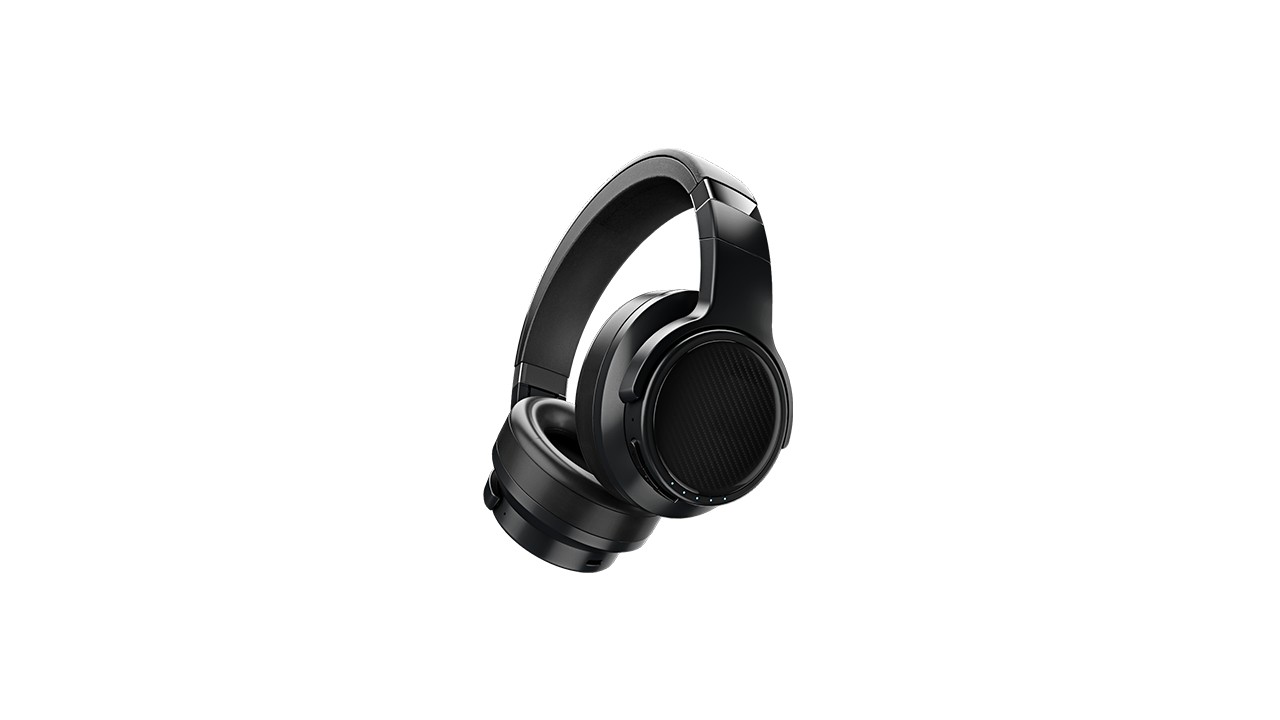
FiiO’s EH3 NC represents an important change of direction for the Chinese portable-audio specialist. Announced in pre-production form at an international exhibition in Chengdu, China, the EH3 NC was not simply another headphone model: it was presented as FiiO’s first full-size headphone, its first Bluetooth headphone and its first design to incorporate active noise cancellation.
That combination matters because it places the EH3 NC in a very different use case from the company’s established portable players, DACs and headphone amplifiers. Rather than requiring a dedicated wired source and amp, this is a closed-back, battery-powered headphone intended to work directly with a phone or other Bluetooth source, while also reducing the environmental noise that can obscure music during commuting, travel and office use.
The first public mention of the EH3 appeared on 26 March 2018, when FiiO CEO James Chang shared details in a Facebook post. The product subsequently changed considerably before FiiO showed the EH3 NC prototype in Chengdu and invited enthusiasts to try it and offer feedback. As such, the information available relates to a pre-production model; final-market specifications, controls and tuning would need confirmation from the finished product.

A hybrid approach to active noise cancellation
The “NC” suffix identifies the EH3 NC’s active noise-cancellation system. FiiO says it combines FeedForward (FF) and FeedBack (FB) methods with a high-performance noise-reduction chip from ADI. This is generally described as hybrid ANC, and it is a more involved arrangement than using microphones on only one side of the earcup.
In a FeedForward system, microphones positioned outside the earcup listen to the noise approaching the listener. Processing electronics create an inverse signal intended to reduce that noise before it reaches the ear. This can be particularly useful with relatively predictable low-frequency sounds, such as the steady rumble of an aircraft cabin, train or bus.
FeedBack ANC uses microphones inside the earcup, closer to the listener’s ear. Because those microphones monitor what remains after the external sound has passed the pads and entered the cup, the system can compensate for changes in fit and leakage to a degree. The real-world effectiveness of any ANC headphone still depends heavily on the seal formed by its earpads: glasses, hair and jaw movement can all alter that seal. Combining the two microphone positions gives the electronics more information to work with, although the resulting cancellation quality depends on microphone placement, processing and final tuning rather than the hybrid label alone.
For hi-fi listeners, ANC is best understood as a practical solution to a listening problem, not merely an extra feature. In a noisy environment, low-level musical information is masked by external sound and listeners often raise volume to compensate. Effective cancellation can make quieter listening more viable. It also introduces additional electronics and processing into the headphone, so implementation is crucial; the supplied information does not establish how the EH3 NC performs sonically or how much noise it removes in particular frequency ranges.

45mm closed drivers and a genuinely wide codec list
FiiO specifies titanium-plated 45mm closed drivers for the EH3 NC. In headphone terms, 45mm is a substantial driver diameter, giving the designer a comparatively large radiating area. That can be useful when seeking convincing bass output and dynamic headroom without demanding excessive excursion from a smaller diaphragm. It does not, by itself, predict bass depth, speed or tonal balance: diaphragm control, motor design, earcup acoustics, pads and DSP all play major roles.
The closed construction is equally relevant to the EH3 NC’s intended role. Closed earcups provide passive isolation before the active circuitry is engaged, and that mechanical barrier is the foundation on which ANC works. A good seal can reduce some outside sound naturally, while the cancellation system is typically most helpful against lower-frequency noise. The trade-off against open-back headphones is that the enclosure and pad interface become central to the final voicing, and heat build-up over long sessions can be a consideration with any sealed over-ear design.
Wireless operation is handled by Qualcomm’s CSR8675 Bluetooth chip. FiiO lists support for SBC and AAC, plus aptX, aptX HD, LDAC and LHDC (HWA). The inclusion of these options gives the EH3 NC unusual flexibility across different source devices and ecosystems:
- SBC is the baseline Bluetooth codec, intended to ensure broad compatibility.
- AAC is particularly relevant to Apple devices, which commonly use AAC for Bluetooth audio.
- aptX and aptX HD are Qualcomm codecs found across many Android devices and Bluetooth transmitters; aptX HD is designed to carry higher-resolution audio than standard aptX where both ends support it.
- LDAC is widely associated with compatible Android devices and can operate at different data rates depending on the source settings and connection conditions.
- LHDC (HWA) is another higher-bandwidth codec, but it requires support from the transmitting device as well as the headphones.
Codec support should be read as compatibility rather than an automatic guarantee of superior sound. Bluetooth always uses the best codec mutually supported by the source and headphone, subject to software settings and connection stability. A listener using an iPhone will normally be concerned with AAC, for example, while an Android user may be able to select LDAC, aptX HD or LHDC if their handset supports the relevant format. The source file format is only one part of the chain; wireless codec selection, signal level, headphone tuning and the acoustic seal all remain significant.
The EH3 NC also includes NFC. Near-field communication is principally a convenience feature, allowing compatible devices to initiate Bluetooth pairing by bringing them close together. It does not determine audio quality after the Bluetooth connection has been established, but it can make first-time setup less laborious for users of NFC-equipped phones.

Battery capacity and day-to-day implications
FiiO quotes a 1,000mAh battery and a claimed operating time of 40 hours from one charge. For a Bluetooth ANC headphone, that is a useful headline figure because both wireless reception and noise-cancellation processing draw power. Long quoted endurance reduces the frequency of charging and is especially relevant for travel, where a headphone may be used for several consecutive days away from mains power.
As with all battery-life claims, actual duration will vary with volume, chosen Bluetooth codec, signal quality, ANC use, temperature and battery condition over time. Higher wireless data rates and a poor radio connection can require more activity from the Bluetooth system, while louder playback makes greater demands on the amplifier stage. FiiO’s quoted charging time is around two hours, with standby time specified at approximately 1,000 hours.
Those figures suggest that the EH3 NC was conceived as a portable daily-use headphone rather than a product that must be charged before every session. However, the supplied details do not state the charging connector type, whether wired analogue listening is available, what controls are fitted, or whether ANC can operate in a wired mode. Those are important ownership questions for prospective buyers, particularly anyone intending to use the headphone with an in-flight entertainment system, desktop source or dedicated headphone amplifier.
Where the EH3 NC fits in a system
At its stated price of $220, the EH3 NC is aimed at listeners who want the convenience of a self-contained wireless headphone but do not want to be restricted to a single Bluetooth codec family. Its broad format support is potentially valuable for owners who move between Apple hardware, Android phones, computers and dedicated Bluetooth transmitters.
The strongest case for ANC is an environment with a consistent noise floor: public transport, flights, shared workspaces and domestic spaces with persistent appliance or traffic noise. In a quiet room, the value proposition shifts more towards the EH3 NC’s fit, closed-back isolation, driver tuning and wireless convenience. These are areas where no conclusions should be drawn from the announced specification alone.
Buyers should also distinguish between a Bluetooth headphone and a conventional passive wired headphone. With Bluetooth, the source device transmits a digital radio signal and the headphone itself handles reception, decoding, digital processing and amplification. This simplifies portable use and avoids the need to drive the headphone directly from a phone’s often-limited analogue output. Conversely, it means the internal electronics and battery are integral to the product’s operation. The draft does not provide wired connection details, amplifier specifications, weight, impedance, microphone call quality or supplied accessories, so these remain points to verify against the final retail specification.
What makes this launch significant
The EH3 NC is significant less because it claims a single unusual feature than because it brings several contemporary portable-headphone technologies together in FiiO’s first full-size design. The 45mm titanium-plated closed drivers provide the acoustic platform; the CSR8675 chip enables a broad range of Bluetooth codecs; NFC addresses pairing convenience; and the ADI-based FeedForward/FeedBack ANC arrangement targets the real limitations of listening in noisy places.
FiiO’s decision to present a pre-production unit for public feedback is also notable. Headphone performance is strongly affected by pad material, clamping force, ANC calibration and DSP tuning, so the final execution matters at least as much as the component list. On the information available, the EH3 NC is an ambitious $220 move into wireless noise-cancelling headphones. The remaining question for the finished version is how effectively those stated ingredients are integrated in everyday use.
Price: $220