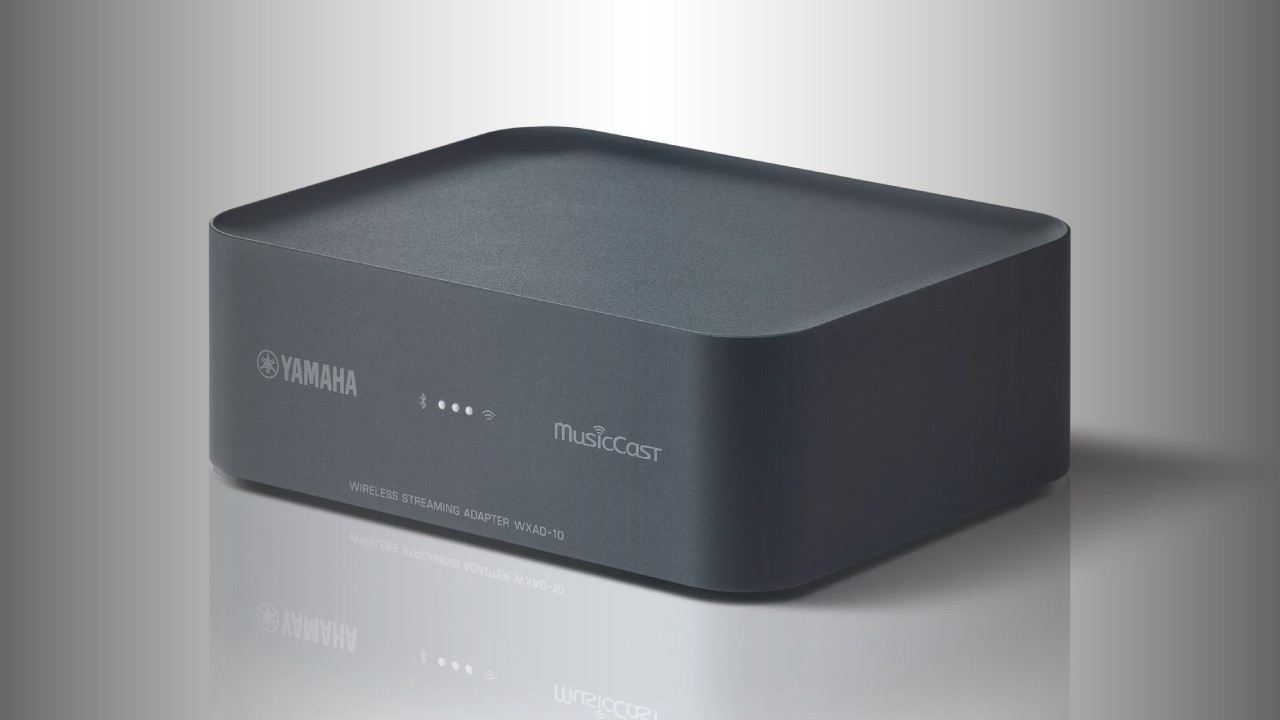
The Yamaha WXAD-10 is a compact network audio adapter designed for a very specific, still highly relevant job: adding streaming and multi-room capability to an existing hi-fi system without replacing its amplifier, receiver or active speakers. Rather than being a complete player with its own amplification, it is a source component that connects to an available analogue input and brings Yamaha’s MusicCast platform, network playback, Bluetooth and AirPlay into the system.
That makes it particularly interesting for owners of otherwise capable two-channel equipment from before the streaming era. A traditional integrated amplifier, for example, can gain access to network music libraries, internet radio and supported streaming services simply by accepting the WXAD-10’s line-level output. The same basic principle applies to an AV receiver, powered loudspeakers or another audio product with an unused stereo input.

A network source rather than a replacement hi-fi system
At 130 x 45 x 106mm and weighing 226g, the WXAD-10 is genuinely small enough to be placed beside an amplifier, behind a rack or close to a pair of active speakers. Its low-profile approach is important: this is not a component intended to dominate a system physically, but one that extends what an existing system can do.
The unit has both Wi-Fi and Ethernet connectivity. In practical terms, Wi-Fi offers the simplest installation where a router and hi-fi system are in different parts of a room, while wired Ethernet is usually the more dependable option if a cable can be run to the equipment rack. Network-streaming reliability is often determined as much by the home network as the audio component itself. Ethernet avoids potential wireless congestion and dropouts, particularly when playing large lossless files from a NAS drive; Wi-Fi, however, can be entirely effective where signal strength is good and the network is not heavily burdened.
Once connected to the home network, the WXAD-10 can play music through DLNA 1.5-compatible servers. This matters to listeners with locally stored libraries on a NAS drive or computer: the adapter can act as the network endpoint in the playback chain, accessing compatible shared music rather than relying solely on a subscription service. The listed format support includes WAV, MP3, WMA, MPEG-4 AAC, FLAC, ALAC and AIFF, covering the most common compressed, lossless and uncompressed file types likely to be found in a long-standing digital collection.
For PCM material, Yamaha specifies a maximum signal capability of 24-bit/192kHz. That ceiling is relevant for high-resolution WAV, FLAC and AIFF files, which are supported up to 192kHz/24-bit, while ALAC is specified up to 96kHz/24-bit. In use, the more important consideration is format compatibility across the library: lossless FLAC and ALAC preserve the original audio data, whereas MP3, WMA and AAC are compressed formats with varying degrees of data reduction. A streamer that accepts both lets a household combine older download libraries, ripped CDs and newer high-resolution purchases in one system.
MusicCast is the central attraction
The defining feature of the WXAD-10 is its integration with Yamaha MusicCast. MusicCast is Yamaha’s networked audio ecosystem, designed to link compatible products in different rooms. The WXAD-10 can therefore serve two purposes at once: it is a streamer for the system to which it is physically connected, and it can make that system part of a wider Yamaha multi-room installation.
According to Yamaha, a MusicCast-equipped hi-fi player, AV receiver, soundbar, active speaker or Clavinova digital piano can be combined in a multi-room arrangement. This is potentially useful in a mixed Yamaha household. One room might have a conventional stereo amplifier fed by the WXAD-10, while another uses a compatible soundbar or wireless speaker. MusicCast provides the common control layer for selecting and distributing music between them.
The key advantage over simply fitting a Bluetooth receiver is that the WXAD-10 is a network-aware source. A Bluetooth connection is convenient for quick playback from a phone at close range, but it ordinarily makes the phone the active source and ties playback to it. With network streaming, the adapter is connected directly to the network, allowing it to access a DLNA server, internet radio or supported service within the MusicCast environment. That is a more natural arrangement for regular, whole-system listening.
The supplied information lists Spotify, Deezer, Tidal and Qobuz among supported services, as well as internet radio. Service availability and account requirements can change over a product’s life, so prospective buyers should confirm current regional support and app compatibility before purchase—especially if a particular service is central to their listening. It is also worth distinguishing between a service appearing in an ecosystem and every service tier or format being available in every territory; those details are best checked at the point of setup.
AirPlay and Bluetooth add useful everyday flexibility
Beyond MusicCast control, the WXAD-10 can receive audio via Apple AirPlay and Bluetooth. AirPlay makes it straightforward for users of Apple devices to send audio from compatible apps to the hi-fi system, while Bluetooth provides a broadly familiar fallback for guests and quick casual use. Neither facility eliminates the value of a proper network connection, but both reduce friction in real households where several people may want to play music from different devices.
No Bluetooth codec support is specified in the supplied information, so it would be unwise to assume the presence of a particular high-quality codec. Likewise, the draft identifies AirPlay but does not specify a generation. The sensible expectation is convenience and ecosystem compatibility rather than an assumption about the exact transmission format.

DAC and signal-path considerations
Digital audio has to be converted to analogue before it can enter a conventional amplifier. The WXAD-10 handles that conversion internally using a Burr-Brown PCM5121 digital-to-analogue converter. The significance of this is straightforward: the unit provides an analogue source output, so it can be connected directly to the line-level input of an integrated amplifier, receiver or active loudspeaker without requiring a separate external DAC.
Yamaha also cites a shortened digital signal path, PML capacitors used in its AV receivers, an Original Network Module intended to maintain transmission accuracy and reduce jitter, and a precision clock generator said to improve signal-to-noise ratio. These are design descriptions rather than independently published measurements, but they point to the areas that matter in a compact network player. Clocking governs the timing reference used during digital conversion, while careful layout and power-supply component selection can help keep unwanted electrical noise away from low-level audio circuitry.
It is important not to turn those claims into a promised sonic character without listening or measurements. What can be said is that Yamaha has not treated the WXAD-10 merely as a network receiver: it includes its own DAC stage and identifies clocking, digital routing and power-supply components as parts of the audio design. For many systems, that is precisely what is needed—an integrated, uncomplicated streamer/DAC feeding an analogue input.
The available outputs are stereo RCA and a 3.5mm mini-jack. RCA is the natural connection for a conventional amplifier or receiver and should normally be the first choice in a fixed hi-fi installation. The 3.5mm output broadens the WXAD-10’s usefulness with compact active speakers, desktop systems and products that use a mini-jack analogue input. Neither output should be mistaken for a headphone socket; the information provided identifies outputs but does not claim a dedicated headphone amplifier.
There is no digital output listed in the supplied specifications. Consequently, buyers planning to use a separate external DAC should confirm the required connection path before choosing this model. The WXAD-10’s stated configuration is best understood as a self-contained streaming source with its own DAC, built to feed analogue equipment directly.
Control, integration and day-to-day ownership
Yamaha’s MusicCast Controller app for smartphones and tablets is the intended control centre. It is used to select albums and tracks, create playlists, adjust volume and configure the system, and it can also control MusicCast-compatible devices in other rooms. App-based control is now normal for compact streamers without a front-panel display, and it allows the WXAD-10 to retain its small dimensions while placing browsing and setup on the screen already in the listener’s hand.
That design has a trade-off. Listeners who prefer a large front display, physical playback buttons or an included traditional remote will not find those features described here. The WXAD-10 instead favours unobtrusive placement and phone/tablet control. For a secondary system, an equipment rack where the source is out of reach, or an installation shared with other MusicCast products, this can be a sensible compromise. For a main system where tactile operation is a priority, it is worth considering before purchase.
The adapter can also be integrated with a centralised IP smart-home control system such as Control4. This will matter most in professionally installed systems, where source selection and multi-room control may be consolidated into one automation interface. It is a useful indication that the product is intended to work not only as a stand-alone consumer streamer but also as a component in a broader connected-home installation.

System matching and setup advice
The WXAD-10 makes most sense when the downstream system already has amplification and loudspeakers. Connect its RCA output to a spare line-level input labelled AUX, CD, Tuner or Line on an amplifier or receiver; avoid a phono input, which is designed for the much lower signal level and equalisation characteristics of a turntable cartridge. With active speakers, use whichever compatible analogue input is provided, ideally a proper line input rather than a microphone or instrument socket.
Because it is a source component rather than an amplifier, it does not impose speaker matching requirements. Its suitability is determined by the input options of the component receiving its analogue output, not by loudspeaker impedance or sensitivity. The quality and character of the final system will still depend heavily on the amplifier, speakers, room and placement, but the WXAD-10 offers a simple way to modernise the source side.
For local playback, a NAS drive or computer should be configured as a compatible DLNA server and connected reliably to the same home network. Those with substantial 24-bit/192kHz libraries may prefer Ethernet where possible. For streaming-service users, stable Wi-Fi may be entirely adequate, particularly where physical cabling is impractical. In either case, positioning the adapter away from sources of radio-frequency interference and ensuring the router has a strong signal at the hi-fi rack are sensible starting points.
Who should consider the Yamaha WXAD-10?
The Yamaha WXAD-10 is aimed at the owner of an existing analogue hi-fi system who wants modern access without adding a full-size network player. Its strongest proposition is not extravagant hardware or a display-led user experience; it is the combination of compact dimensions, a built-in Burr-Brown DAC, analogue RCA and 3.5mm outputs, wired and wireless networking, AirPlay, Bluetooth, local DLNA playback and the MusicCast multi-room platform.
It is especially logical for homes already using MusicCast-compatible Yamaha products, where it can bring a conventional stereo system into the same multi-room environment. It is also a neat option for adding network playback to active speakers or a modest second system. Buyers who require a digital output for an external DAC, detailed published performance measurements, or explicit confirmation of particular Bluetooth codecs should seek those details before committing. Within its stated role, though, the WXAD-10 is a focused example of how a small adapter can give established hi-fi equipment a much broader set of music sources.
Yamaha WXAD-10 specifications
- Type: Network audio player
- Network connections: Ethernet, Wi-Fi
- Additional wireless connectivity: Bluetooth, AirPlay
- Outputs: Stereo RCA, 3.5mm mini-jack
- Service and protocol support: DLNA 1.5, Tidal, Qobuz, Spotify, Deezer
- Playback formats: WAV, MP3, WMA, MPEG-4 AAC, FLAC, ALAC, AIFF
- Maximum PCM signal parameters: 24-bit/192kHz
- Dimensions (W x H x D): 130 x 45 x 106mm
- Weight: 226g