CES has long been a useful barometer for the direction of home-cinema hardware, and the all-digital CES 2021 was no exception. Soundbars announced at the show ranged from expansive Dolby Atmos systems designed to replace much of a conventional surround package to compact, lifestyle-led alternatives for smaller rooms.
The category was already moving well beyond the familiar long, slim enclosure beneath a television. At one end were multi-speaker packages with wireless rear channels and subwoofers; at the other were deliberately small designs intended to make better TV sound possible without dominating a room. Streaming and multi-room features also remained a major part of the proposition for several models.
Below is a closer look at five soundbars that stood out at CES 2021, including what their respective designs and feature sets were intended to deliver.
Samsung HW-Q950A

Samsung positioned the HW-Q950A as its 2021 flagship soundbar system and as the successor to the HW-Q950T, which had launched in late 2020 with a 9.1.4-channel configuration. The newer model increased that headline channel count to 11.1.4.
The key change was in the wireless rear speakers, which gained a pair of side-firing emitters. Combined with the front and rear upward-firing speaker modules, this arrangement was designed to create a broader, more enveloping presentation for Dolby Atmos and DTS:X soundtracks. Rather than relying on a single bar to simulate every element of surround sound, the HW-Q950A was conceived as a full system, with discrete rear speakers and a wireless subwoofer.
That subwoofer incorporates a built-in microphone to help the system adjust its output to the surrounding room. Room interaction can have a significant effect on bass weight and overall balance, so automated adjustment is a practical addition to a system with this many channels.
Samsung had said the HW-Q950A would arrive later in 2021, although an exact release date had not been confirmed at CES. Pricing was also unconfirmed. For context, the preceding HW-Q950T launched at $1,399, making it reasonable to expect the new flagship to sit at the premium end of the market.
LG QP5 Éclair

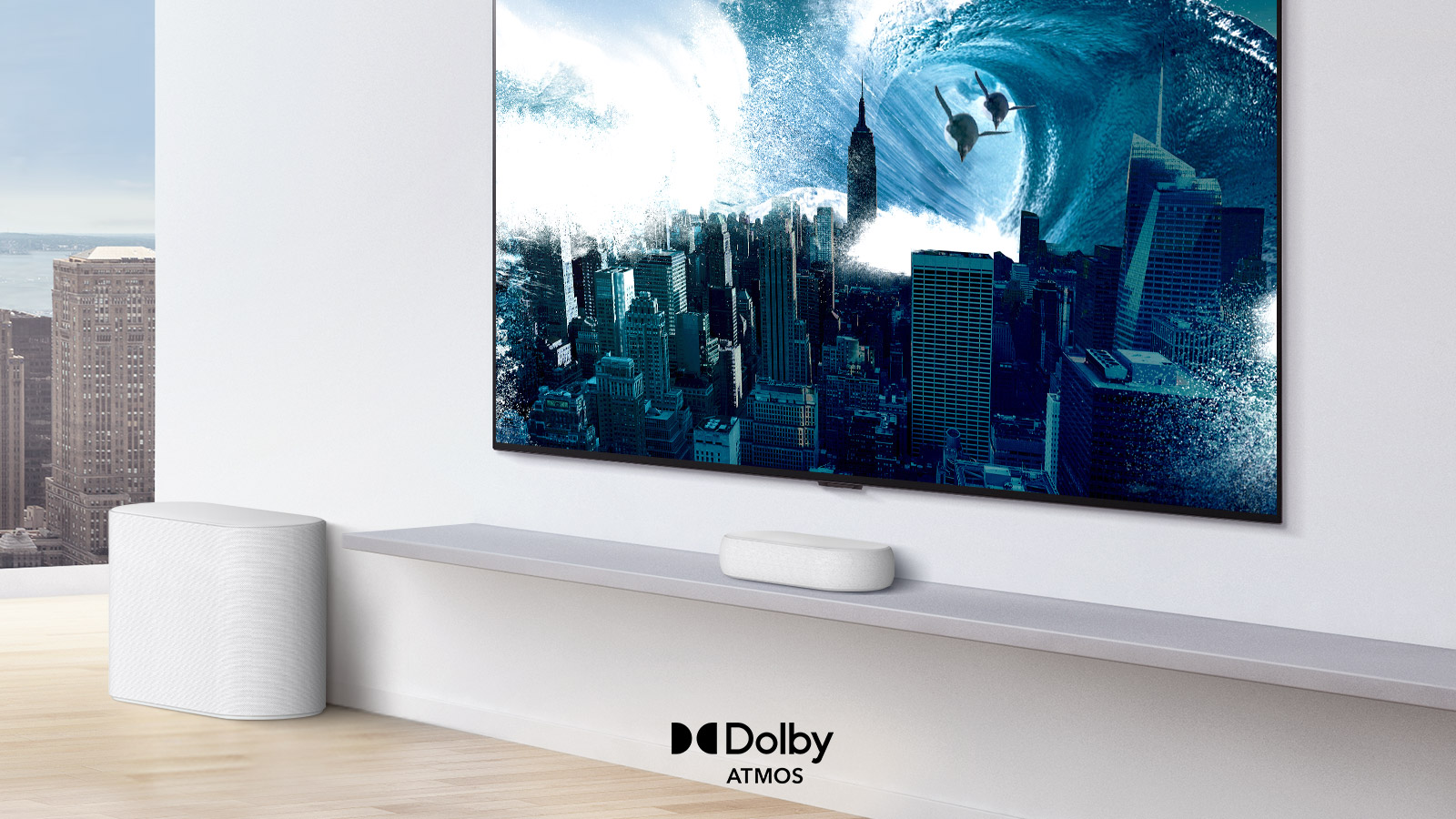
LG took a very different approach with the QP5 Éclair. At just 30cm wide and 6cm high, this unusually compact soundbar was designed for smaller living spaces and televisions where a conventional full-width bar would look excessive. Its distinctive, rounded form also offered an alternative to the standard anonymous black soundbar cabinet.
Despite its size, the QP5 Éclair contains five drivers: a centre driver, left and right drivers positioned at 45 degrees, and upward-firing drivers for Dolby Atmos and DTS:X material. The angled side drivers were intended to help widen the soundstage, while the upward-firing units address the height information carried by immersive sound formats.
LG paired the small bar with a wireless subwoofer using bi-directional drivers, a design intended to reduce vibration. The inclusion of a separate subwoofer matters particularly in a compact system: it allows the soundbar itself to concentrate on dialogue and effects while providing more substantial low-frequency support than such a small enclosure could ordinarily manage alone.
Pricing had not been announced at the time of CES 2021. Its appeal rested on the prospect of bringing Atmos- and DTS:X-capable home-cinema sound to rooms where space is as important as features.
Cowin Soundbar

The Cowin Soundbar was the most affordable and unconventional entry in this group. Rated at 25W and priced at $80, it could be used as a conventional soundbar beneath a television or mounted on a wall, but its defining feature was a cabinet that could split into two separate speaker sections.
That flexibility gives the owner a choice between the usual single-bar layout and a wider physical spread, with one speaker placed on each side of the TV. The two sections could also be wall-mounted separately. A wider speaker placement can be useful where a television’s own speakers sound narrow or detached from the picture, though it was unclear whether the split configuration provided true stereo operation.
Connectivity included Bluetooth 4.2, AUX, optical and HDMI, allowing it to serve both as a TV-sound upgrade and as a simple wireless speaker. It did not offer features such as Dolby Atmos, but the combination of a low price and a convertible form factor made it a distinct proposition among CES 2021’s soundbar announcements.
JBL Bar 5.0 MultiBeam

The JBL Bar 5.0 MultiBeam was aimed at buyers who wanted Dolby Atmos support without accommodating a separate subwoofer or rear speakers. It uses digital signal processing to create a three-dimensional effect, alongside JBL’s proprietary MultiBeam beamforming technology, which directs sound around the room.
This is a virtual-surround approach rather than a system based on multiple discrete speakers placed around the listening position. That distinction matters: it is a space-saving compromise, but one that can be attractive for rooms where running cables or positioning rear speakers is impractical.
JBL also equipped the Bar 5.0 MultiBeam with extensive music-streaming support. Alexa Multi-Room Music, Apple AirPlay 2, Chromecast built-in and Bluetooth provide several routes for playing music from iOS and Android devices, as well as integrating the bar into a broader wireless-audio setup.
JBL said the Bar 5.0 MultiBeam would be released between March and May 2021 for $480, with international pricing still to be confirmed. That placed it $600 below the Sonos Arc at the time, while retaining Atmos compatibility.
Denon Home Sound Bar 550

Denon’s Home Sound Bar 550 combined Dolby Atmos support with the company’s HEOS multi-room ecosystem. It could be used on its own, but its larger role was as part of a scalable wireless home-cinema system.
Adding Denon Home 150, Home 250 or Home 350 wireless speakers allowed the Sound Bar 550 to be used with rear channels. The Denon DSW-1H wireless subwoofer could also be added, creating a wireless 5.1 system with more substantial bass support. This modularity is important for listeners who may want to begin with a simple bar and expand later without introducing speaker cable around the room.
HEOS compatibility also meant the soundbar could join a multi-room system spanning Denon Home products and other Denon and Marantz devices. Additional features included Hi-Res Audio support, Alexa voice assistance and a control panel that illuminates when a hand approaches it.
The Denon Home Sound Bar 550 was already available at the time for $600. Its combination of Atmos, wireless surround expansion and multi-room integration made it one of the more fully fledged connected-audio options announced around CES 2021.
A broad picture of soundbar design in 2021
These five models illustrated how wide the soundbar market had become. Samsung pursued maximum channel count and a complete wireless surround package; LG focused on making immersive audio fit a much smaller physical footprint; Cowin prioritised affordability and placement flexibility; JBL used processing and beamforming to avoid extra speakers; and Denon built its bar around an expandable multi-room platform.
For prospective buyers, the most relevant choice was not simply between price points, but between approaches. A soundbar with rear speakers and a subwoofer may offer a more comprehensive cinema-system layout, while a single-bar solution can suit a cleaner, simpler installation. CES 2021 showed that manufacturers were continuing to address both needs.