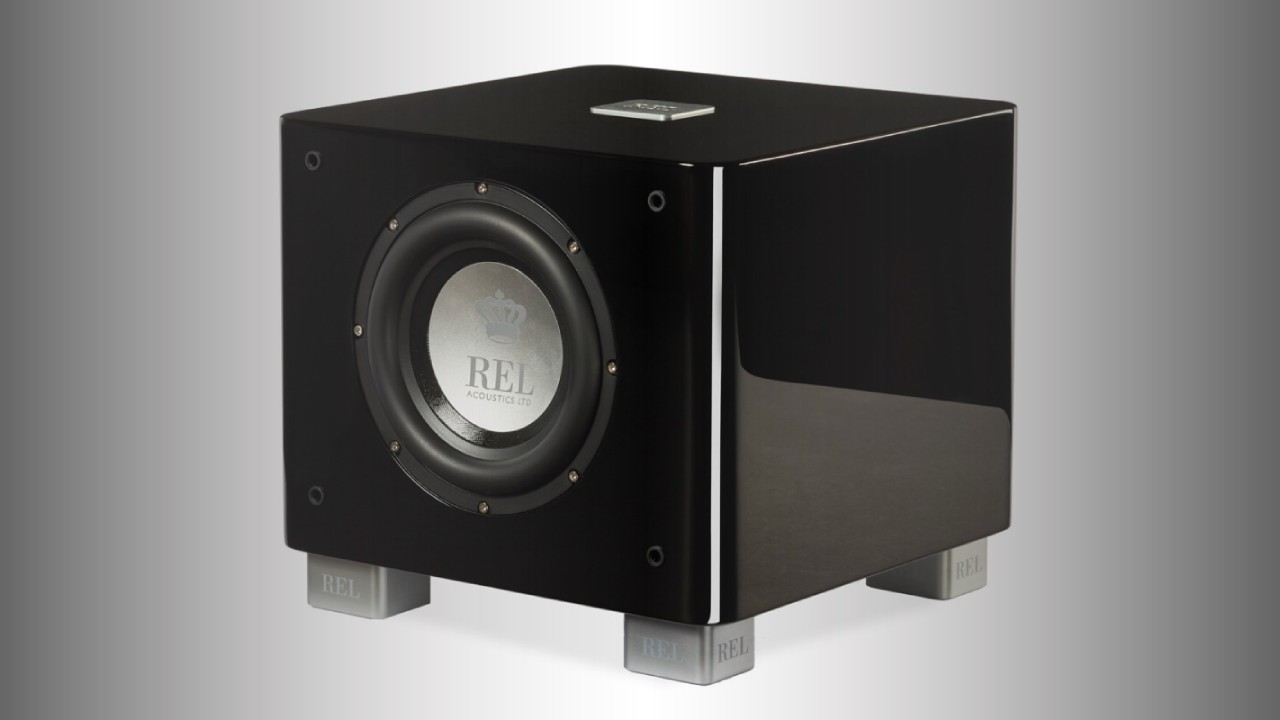
REL has refreshed its long-running entry-level T/i subwoofer family with the T/x series, a three-model range intended to bring some of the company’s higher-series thinking to more compact systems. The line comprises the T/5x, T/7x and flagship T/9x, with the middle T/7x likely to be the most versatile proposition for stereo listeners: it pairs an 8-inch front-firing active driver with a 10-inch downward-firing passive radiator, powered by a 200W RMS Class A/B amplifier.
This is not simply a cosmetic update. REL says the new cabinets have greater internal volume and that the drive units use revised suspensions to allow increased cone travel. The aim is greater control and dynamic capability while retaining the company’s familiar approach to integrating a subwoofer with a two-channel system. Crucially, the T/x models retain REL’s high-level Speakon connection alongside conventional RCA line-level and dedicated LFE inputs, making them suitable for both hi-fi and home-cinema installations.
A lower, more substantial cabinet with more air behind the driver
The most obvious change to the T/x series is its altered silhouette. The cabinets are lower and more substantial-looking than their T/i predecessors, with rounded side edges and a five-layer lacquer finish in black or white. That finish is an aesthetic detail, but the revised proportions have an engineering purpose: REL says the enclosure volume has increased noticeably, as has the volume of air the system can move.
For a subwoofer, cabinet volume is more than a matter of appearance. The air trapped within an enclosure acts as part of the driver’s mechanical load. A larger enclosure can give a designer different options when balancing low-frequency extension, driver control and maximum output. It does not automatically guarantee deeper bass in every room, but it can help a compact subwoofer produce useful low-frequency energy with less reliance on excessive equalisation or cone movement.
REL has also retained the same number and nominal size of drive units across the respective models, so the claimed increase in productivity comes from the cabinet changes and revised driver behaviour rather than simply fitting a larger woofer. The updated suspension is intended to permit increased diaphragm excursion. Greater excursion means the cone can displace more air, which is fundamental to bass output: at low frequencies, a driver must move a substantial volume of air to create meaningful sound pressure.

Where the REL T/7x sits in the new range
The T/7x occupies the middle position in the T/x range. Its 200mm (8-inch) active woofer faces forwards, while a 254mm (10-inch) passive low-frequency radiator is fitted to the bottom panel. This arrangement differs from the smaller T/5x, which uses one downward-firing 8-inch active driver in a sealed cabinet. Above it, the T/9x uses a 10-inch front-facing active driver and a downward-facing passive radiator.
A passive radiator resembles a conventional bass driver but has no voice coil or amplifier connection. Instead, it is moved by pressure changes inside the cabinet caused by the active woofer. In broad terms, it performs a related role to a bass-reflex port while avoiding the turbulence and pipe resonances that can arise in a ported design. A larger passive radiator can be especially useful in a relatively compact cabinet because it allows low-frequency tuning without needing a very long physical port.
Its downward-facing placement also has practical implications. Bass below the upper bass region is far less directional than treble, so the radiator is not intended to create a conventional stereo image in the way a pair of main speakers does. However, it still needs clearance from the floor and should not be obstructed by a thick, soft surface. The floor itself becomes part of the acoustic boundary around the radiator, which is one reason positioning and final setup matter so much with any subwoofer.
The active driver uses REL’s FibreAlloy diaphragm material, an inverted dust cap and a steel chassis. The company describes the aluminium cap as protective. In engineering terms, a stiff driver chassis is valuable because it gives the motor assembly and suspension a firm reference point; unwanted flex in the basket can compromise the precision with which the cone starts and stops. The published information does not specify the driver’s motor structure or the exact composition of FibreAlloy, so those details should not be assumed, but the combination of a revised suspension and steel chassis indicates that mechanical control is a central part of the update.
200W Class A/B amplification and filtering derived from the S series
The T/7x retains a 200W RMS Class A/B amplifier, while the larger T/9x is rated at 300W RMS and the T/5x at 125W RMS. RMS power is the more useful continuous-power figure than a peak-power headline, but it is not a complete guide to real-world bass capability. The driver’s excursion, the enclosure alignment, amplifier current delivery and the room all influence how loudly and how cleanly a subwoofer can play.
Class A/B remains a sensible choice in an active subwoofer when the designer prioritises a proven linear amplifier topology. It is generally less electrically efficient than modern Class D amplification, so it can generate more heat, but REL has kept the established amplifier modules for the T/x range and states that they meet newer, more stringent requirements. The source material does not specify power consumption, standby behaviour or thermal output, so owners should leave reasonable ventilation around the amplifier panel rather than placing the subwoofer in a tightly enclosed cabinet.
REL says the T/x range borrows ultra-fast low-pass filters and specially selected settings from its S series. The low-pass filter is one of the most consequential parts of a subwoofer’s integration. It determines where the subwoofer begins to hand over to the main speakers, and how gradually it rolls away above that point. If the crossover is set too high or the slope is poorly matched to the speakers and room, bass can become easy to localise, thick in the upper bass, or uneven through the crossover region.
The T/7x provides an adjustable input filter from 30Hz to 120Hz, plus an absolute-phase switch at 0 or 180 degrees. It is important to understand what that phase control can and cannot do. It reverses the polarity of the subwoofer output, allowing the owner to choose the setting that gives the strongest and smoothest blend at the listening position. It is not a continuously variable phase control, but it is still a useful adjustment when the subwoofer and main speakers partially cancel one another around the crossover frequency.

High-level Speakon, RCA and LFE connections explained
REL continues to offer three principal connection routes: a high-level input via Neutrik Speakon, RCA line-level input and RCA LFE input. The T/7x includes a 10-metre cable terminated with the Neutrik Speakon connector, which is significant for stereo users because it allows the subwoofer to be connected to the amplifier’s speaker outputs without using a separate preamp output.
High-level connection does not mean that the T/7x draws speaker-level power from the amplifier to drive its woofer. The subwoofer uses its own internal amplifier. Instead, the high-level input takes a high-impedance signal from the speaker terminals, allowing the subwoofer to receive the same amplifier character and volume changes as the main loudspeakers. REL specifies a 150kOhm input impedance for this connection, a deliberately light load that should not materially burden the host amplifier.
This arrangement can be useful with integrated amplifiers that lack a variable pre-out or dedicated subwoofer output. It also preserves a straightforward system architecture: the main speakers remain directly connected to the amplifier, while the subwoofer follows their signal. The T/7x has separate level controls for the high-level/line input and for LFE, which is particularly valuable in mixed music and cinema systems. It allows a stereo setting to be established independently of the low-frequency-effects level used by an AV processor.
The 10kOhm input impedance quoted for the line and LFE inputs is conventional for this type of connection. The LFE input is the natural choice when an AV receiver or processor provides a dedicated subwoofer output and applies bass management itself. In that configuration, the processor normally determines the crossover frequencies for the speakers and subwoofer. For a two-channel analogue system using the line input or high-level connection, the T/7x’s own 30–120Hz low-pass adjustment becomes the principal blending tool.
An optional REL Arrow wireless module is available for uncompressed wireless signal transmission. It is not supplied as standard. Wireless operation can make room placement considerably easier where a long signal cable would be impractical, although the subwoofer will still need mains power at its chosen position. The T/x series cannot be configured in REL line arrays, a capability reserved for higher parts of the company’s range.
Setup: getting the T/7x to support, rather than announce, itself
REL quotes the T/7x’s frequency range as extending from 30Hz at -6dB in-room. The “in-room” qualifier matters. Domestic rooms add or subtract bass energy according to their dimensions and construction, with walls and corners often reinforcing the lowest frequencies. Consequently, the same subwoofer may sound lean in one location and excessive in another. A -6dB figure also describes a reduced-output point rather than a flat-response limit, so it should not be read as a guarantee of ruler-flat 30Hz performance.
For music-first use, begin conservatively. Set the low-pass filter low enough that the subwoofer fills in the main speakers’ genuine bass roll-off rather than duplicating their upper bass. With compact standmounts, that may mean a higher setting than with substantial floorstanders, but the correct number depends on the speakers, their room position and the listening room. Then raise the level only until bass lines gain weight, scale and continuity. If the subwoofer is immediately obvious as a separate source, the level or crossover frequency is often too high.
Try both 0- and 180-degree phase settings from the main listening seat, using familiar material with steady bass notes or a repeated kick drum. Select the setting that produces the more coherent and even transition through the crossover area, not necessarily the one that initially sounds louder. Placement should be treated as an adjustment just as important as the controls. A corner typically increases output and can extend perceived low bass, but may also excite room resonances; moving the cabinet away from walls can trade some output for smoother response.
At 356 x 320 x 363mm (W x H x D) and 17.5kg, the T/7x is compact enough to integrate into many living rooms while still substantial enough to require a stable floor position and sensible handling during installation. Its front active driver and underside passive radiator mean it should have open space around it, particularly beneath the cabinet, rather than being wedged into furniture.
What the T/7x is for—and what to check before buying
The REL T/7x is designed around a recognisably hi-fi-oriented subwoofer formula: a compact lacquered cabinet, an active driver assisted by a passive radiator, Class A/B power and high-level connection for conventional stereo amplifiers. Its 8-inch/10-inch driver arrangement and 200W RMS rating put it between the simpler sealed T/5x and more powerful T/9x. Listeners wanting a compact system to gain low-frequency foundation without changing their existing amplifier will find the Speakon input especially relevant.
The published specification also makes clear where careful planning is needed. There is no stated onboard room-correction system, app control or multi-sub array support in this T/x range, so room placement and manual adjustment remain the route to the best result. Nor does the supplied information state a recommended room size, maximum output figure or detailed low-frequency response beyond 30Hz at -6dB in-room. Those omissions do not determine performance, but they mean buyers should match the T/7x to their speakers, room and desired playback levels rather than relying on wattage alone.
For the right system, the update appears to be a meaningful one: more cabinet volume, longer-travel driver hardware, filtering said to derive from REL’s S series, and the connection flexibility that has long made REL subwoofers appealing to two-channel owners.
REL T/7x specifications
- Frequency range: from 30Hz (-6dB, in-room)
- Active driver: 200mm woofer with inverted dust cap and increased cone travel, front-firing
- Passive radiator: 254mm low-frequency radiator, downward-firing
- Amplifier: 200W RMS, Class A/B
- Inputs: RCA line-level, RCA LFE and Neutrik high-level
- Input impedance: 150kOhm (high-level); 10kOhm (line-level and LFE)
- Controls: separate high-level/line and LFE level controls; 30–120Hz input-filter adjustment; 0/180-degree absolute-phase switch
- Other features: protection system; optional REL Arrow wireless module; 10-metre Neutrik Speakon cable included
- Dimensions (W x H x D): 356 x 320 x 363mm
- Weight: 17.5kg